The Basics: Add the Acid, or Grow It
If you take one idea from this whole section, take this one, because it is the line that separates everything here from everything in Fermentation.
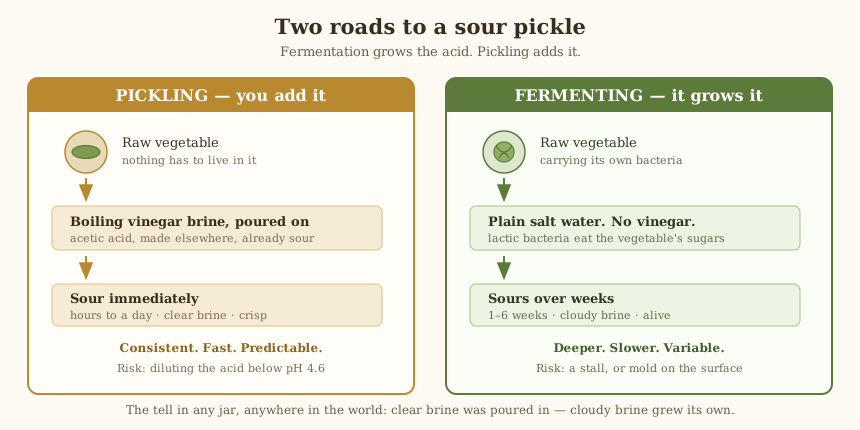
Fermentation grows the acid. Pickling adds it.
That is the entire distinction. In a ferment you put vegetables in plain salt water and wait, and the lactic-acid bacteria already living on the vegetable eat its sugars and make the acid themselves. The sourness is manufactured on site, by something alive, out of the vegetable. In a pickle you pour acid on. You boil vinegar — already sour, made somewhere else, by somebody else — with salt and spice, and you pour it over the food. Nothing has to grow. Nothing is alive. Nothing can go wrong in the way a ferment can go wrong.
The word is on my side
Here is the thing that delighted me when I went looking. The English word “pickle” originally meant the liquid, not the cucumber.
It shows up around 1400, borrowed from Middle Dutch pekel — “pickle, brine.” By the early 1500s it means the brine or vinegar solution that food is kept in. And “a cucumber preserved in pickle” is not recorded until 1707, three hundred years later, named after the liquid it was sitting in.
So the word never meant the vegetable. It meant the stuff you pour on. The thesis of this whole section is sitting inside its own title, and has been for six centuries.
(The deeper root is genuinely uncertain. The OED offers that pekel may go back to the Germanic base of Middle Dutch peken, “to prick, pierce” — which would make a pickle a thing that stings. It is a lovely idea and it is not established, so I am not going to pretend it is.)
Why the distinction matters practically
This is not pedantry. The two crafts fail in different ways and need different things from you.
| Pickling (this section) | Fermenting (that one) | |
|---|---|---|
| Where the acid comes from | The bottle | The vegetable |
| What preserves it | Acetic acid, immediately | Lactic acid, over days or weeks |
| Is anything alive? | No — the vinegar sees to that | Yes, and that is the point |
| How long | Hours to a day | One to six weeks |
| Consistency | High. It does what you tell it | Variable. It does what it likes |
| The main risk | Diluting the acid below safety | Losing the batch to mold or a stall |
| Taste | Bright, sharp, clean, direct | Sour, deep, funky, complicated |
| Texture | Crisper, usually | Softer, usually |
The thing I want to head off is the assumption that one of these is the beginner’s version of the other. They are not on a ladder. They are different foods, and I make both, constantly, and would not give up either. A vinegar dill and a fermented dill are not the same pickle at two skill levels. They taste nothing alike.
Three modes, one decision
Almost anything you can pickle can be done three ways, and picking between them is the first decision, before the vegetable and long before the spice.
Refrigerator (quick) pickles. Pour hot brine over raw vegetables, let it cool, refrigerate. Ready in hours, crisp and fresh-tasting, keeps a few weeks cold. No canner, no processing, and because the cold is helping to preserve them, the acid rules are looser. This is my default for a small batch and it is where I would tell anyone to start. My refrigerator pickles live here.
Canned, shelf-stable pickles. The same acid brine, but water-bath processed so the jars keep for a year on a shelf with no refrigeration. This is where the safety rules stop being advice and start being arithmetic — see Safety. Nothing else in this section will hurt you. This might. If you ever step off a tested recipe here, Measuring pH is how you find out what you actually made.
The ferment instead. When you want depth and complication rather than speed and brightness, ferment the same vegetable in salt water and skip the vinegar entirely. Go here.
What “pickled” turns out to mean everywhere else
I need to undercut my own clean distinction immediately, because the rest of this section is going to do it anyway.
The add-versus-grow split is real, it is useful, and it is how I think when I am standing in my own kitchen. It is also a description of English. Once you leave, the word stops holding still:
- Japan does not sort pickles by acid at all. It sorts them by what they are buried in — salt, soy, vinegar, rice bran, miso, rice malt, sake lees. Only one of those seven is vinegar. The Japanese table.
- India’s traditional achar has no vinegar in it whatsoever. Salt, spice, oil and sunlight. Turkey, India and Russia.
- Turkey’s turşu is one word covering both methods at once — the vinegar route and the salt-brine ferment.
- Umeboshi, the most famous pickle in Japan, is a salt cure. It is also not a plum.
I did not know any of that when I started eating this food in the Marine Corps in the mid-eighties. What I said at the time about the Japanese table was that there were “so many vegetables that, at the time, I had no idea what they were.” Forty years later, having gone and looked it up properly, I can report that the not-knowing was the correct response. The categories genuinely do not line up between languages. I wasn’t failing to recognise a system. I was looking at four different systems at once, through a word that flattens all of them.
That is what this section is actually about. The thesis is at the top of this page and I stand by it. Everything after it is the world declining to cooperate.
Where to go next
- The Brine — vinegar, salt, sugar, ratios, and the one number that is not negotiable.
- Safety — the short list of things that can actually hurt you.
- The Crunch Problem — why pickles go soft, and why the answer everybody gives is only part of it.
- Cucumbers — the default pickle, and the vegetable that punishes every mistake.
- Keeping Them — how long things last, and how to read a jar that looks wrong.
- A History — including why the “4,000 years old” story you have read a hundred times has nobody’s name on it.
Comments (0)