The Brine
The brine is the whole game. Get it right and everything else is seasoning — literally, because everything else is seasoning. There are four things in a pickling brine and only one of them is not negotiable.
Vinegar, and the 5% rule
Vinegar is the preservative. Everything else in the jar is flavour, texture or safety margin, but the acid is the thing actually doing the work.
For canning, the vinegar must be labelled 5% acidity. That number is not a quality mark or a suggestion, it is the entire safety calculation, and I will come back to it hard on the Safety page. Most standard distilled white and cider vinegars sold in the United States are 5%. Many wine vinegars, most “artisan” vinegars and every homemade vinegar are not, or are of unknown strength — which makes them fine for a refrigerator pickle you will eat this month and unusable for a jar you intend to put on a shelf.
| Vinegar | What it does | Use it for |
|---|---|---|
| Distilled white | Sharpest and cleanest. Adds no colour and no flavour of its own, so the vegetable and the spices show | Dills, bread-and-butter, anything where you want the vegetable’s colour to stay true |
| Cider | Mellow, faintly sweet, orchard-y. Slightly darkens the brine | Anything with fruit or sugar — peaches, cherries, watermelon rind, chow chow |
| White wine / red wine | Softer acid, more character, often not 5% | Refrigerator pickles, Mediterranean things, escabeche |
| Rice | Gentle and low-key. Frequently only 4% — read the label | Japanese-style suzuke, quick Asian pickles. Not for canning unless it states 5% |
| Malt | Strong, dark, distinctly British | Onions, walnuts, eggs |
Homemade vinegar is for the table, not the canner. I make it, I like it, and its acidity is unknown to me. See Vinegar on the other side of the house — and note that unknown to me is a choice, not a fact of nature. A meter would tell me, and what it takes to get a number worth trusting is written up in Preservation. I still would not can with it, because a strength I measured once is not a strength the next batch has.
Salt
Use pickling or canning salt — pure sodium chloride, nothing added.
The objection to table salt is not that the iodine is dangerous. It is that iodized table salt carries anti-caking agents that cloud the brine, and the iodine itself can dull or darken some vegetables. The jar still works. It just looks murky, and after all the trouble you went to, you want to see through it.
If you are weighing rather than measuring — and for brine strength you should — remember that salts differ enormously by volume. A tablespoon of pickling salt is roughly twice the salt of a tablespoon of Diamond Crystal kosher, because the crystal shapes are completely different. The same trap is written up in more detail on Salt & Water; it bites harder over there, because in a ferment the salt concentration is doing the preserving. Here the vinegar is, so a salt error costs you flavour rather than safety.
Sugar
Sugar is flavour. It preserves nothing at these concentrations, so treat it as a free variable.
A sharp deli dill has none at all. A bread-and-butter brine is nearly a syrup. Sugar’s real job is to blunt the acid’s edge so you taste the spice instead of just the sting, and how much you want is entirely a matter of taste and vegetable.
The one thing worth knowing: in a canned recipe you may always adjust sugar and spice upward, but never adjust vinegar downward. Sugar is not part of the safety maths. Vinegar is all of it.
The ratio I start from
Equal parts 5% vinegar and water, with 1 tablespoon each of pickling salt and sugar per two cups of brine.
Boil it, pour it over packed vegetables, and then judge. That is a starting point, not a destination — I have never made two batches of anything with the same brine twice. From there:
- More vinegar, less water → sharper, firmer, keeps better.
- More sugar → rounder, and the spices come forward.
- Less salt → flabbier. Salt does real textural work even when it is not preserving.
For a canned pickle, “more vinegar” is always safe and “more water” never is.
Spices
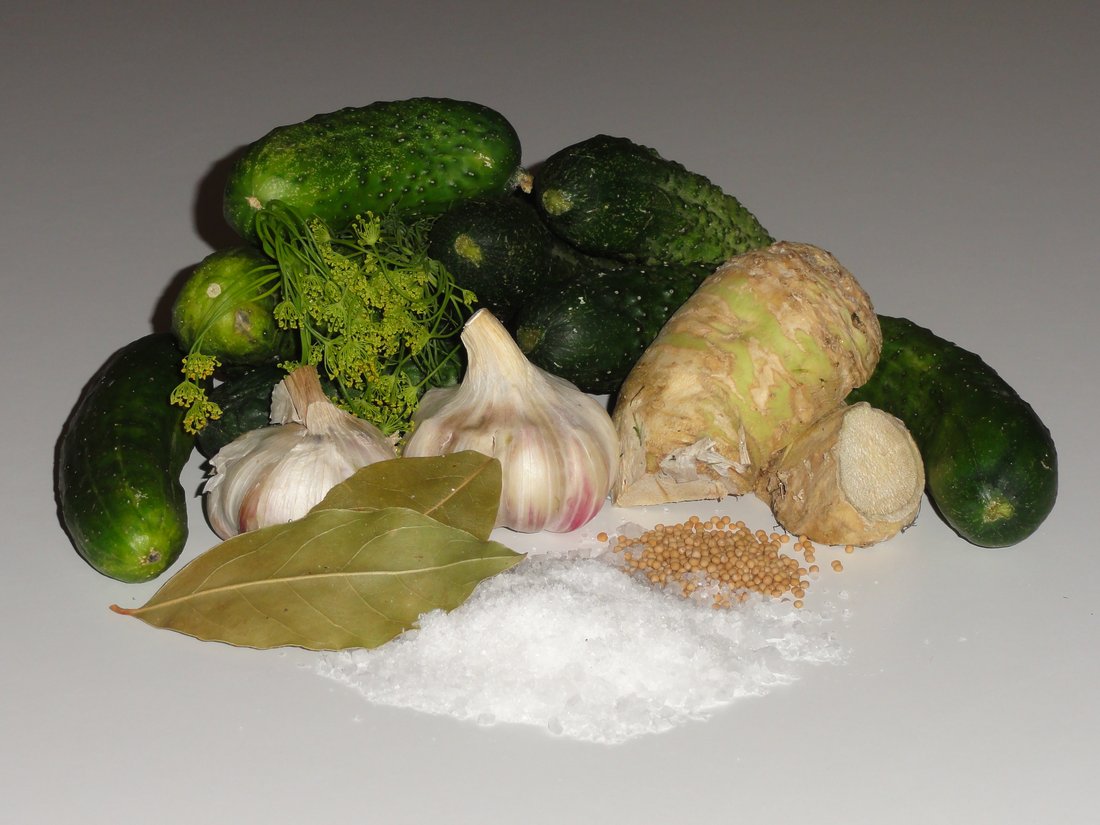
Spices are where a pickle stops being generic. Whole, not ground — ground spice clouds the brine and goes muddy and bitter over months.
The workhorses:
- Dill — heads if you can get them, seed if you cannot. The signature of a deli pickle. ⚠ And the single most likely reason your pickles went soft; see The Crunch Problem, which genuinely surprised me.
- Garlic — the other half of a proper dill. Whole cloves, lightly smashed.
- Mustard seed and coriander — warmth and body.
- Black peppercorns — heat without capsaicin.
- Bay — background. You notice it when it’s missing.
- Dried chilies or crushed red pepper — my own habit is to put a pinch in almost everything. It is what I do to my pickled cherries and it is the best thing about them.
- Turmeric — the golden colour of bread-and-butter pickles, and how commercial takuan gets yellow when it hasn’t earned it honestly.
- Allspice, clove, cinnamon — the sweet-pickle group. These are what make Grandma Hay’s peaches smell like a holiday.
Add them to the jar and let the hot brine pull them out. A pickle keeps getting stronger for the first week or so, which is why the jar you taste on day one is not the jar you will eat.
Hot pack or raw pack
Two ways to fill the jar, and the choice is texture against density.
Raw pack — vegetables go in cold and raw, boiling brine goes over them. The vegetable’s only heat is the brine. This is the crunchy option and it is what I do for anything cucumber.
Hot pack — the vegetables are heated briefly in the brine first, then packed. Better for dense things that need a head start (beets, watermelon rind, whole peaches), and it drives out trapped air so the jars pack tighter and float less.
Crunch says raw. Density says hot.
A note on floating
Vegetables float. It is the most common complaint after softness and it is almost entirely cosmetic — trapped air in the tissue plus a brine denser than the vegetable. Hot-packing helps. Packing tighter helps. Leaving the correct headspace helps. Anything sticking up out of the brine in a refrigerator jar should be pushed back under, because the part above the liquid is the part that goes off; in a properly sealed canned jar it will discolour but it is not a safety problem.
Next: Safety — the short, specific list of things in this craft that can actually hurt you, and the much longer list that cannot.
Comments (0)