Japan: Seven Kinds of Pickle, and Only One of Them Is Vinegar
I was stationed in Japan with the Marine Corps in the mid-1980s, and this is where the section’s tidy little thesis starts falling apart.
What I remember about the food, and what I said about it long before I looked any of it up, is this: there were so many vegetables that, at the time, I had no idea what they were. Small dishes of things, at every meal, in colours I could not place, made by methods I could not guess.
I have now gone and found out. And the finding is that I was not failing to recognise a system. I was looking at four different systems at once, through an English word that flattens all of them into one.
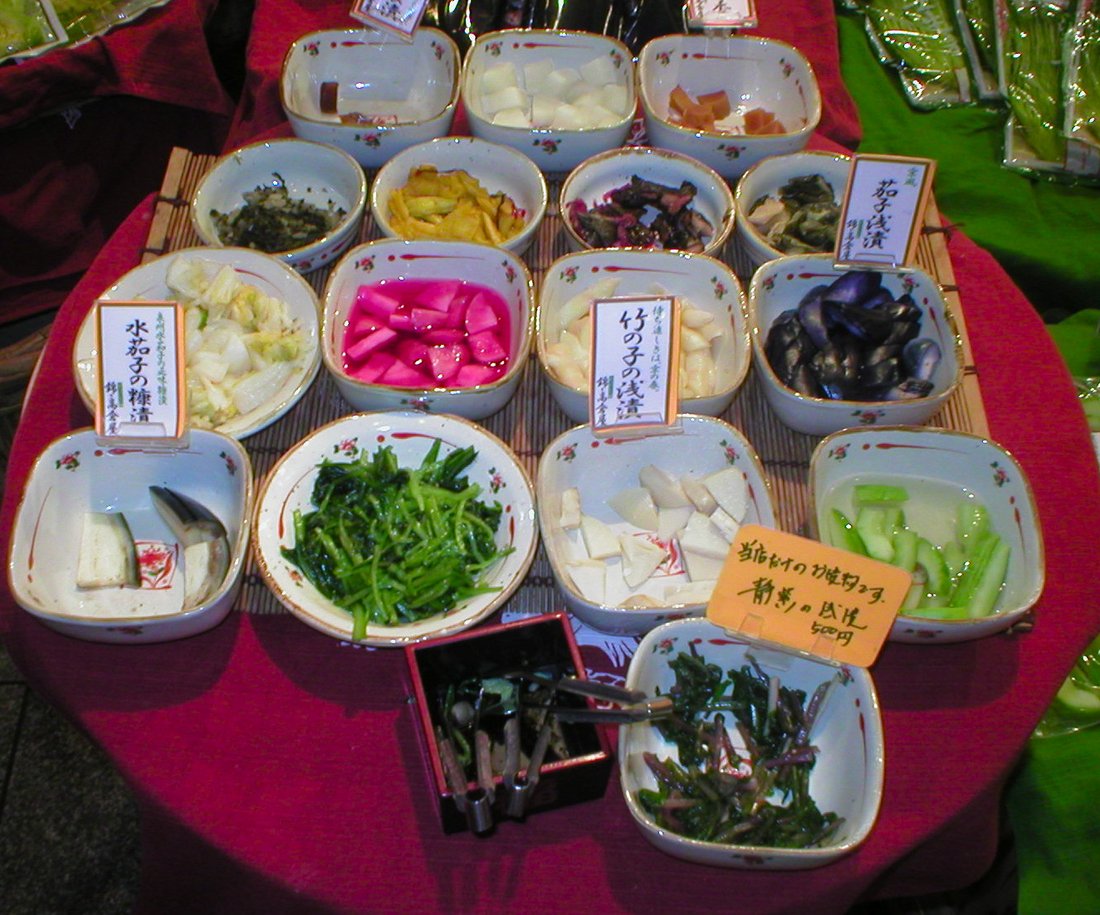
Japan sorts pickles by what they’re buried in
This is the whole thing. English asks is it sour? Japanese asks what is the bed?
Tsukemono (漬物, “pickled things”) is classified by the medium the vegetable is packed into, and Japan’s Ministry of Agriculture, Forestry and Fisheries counts over 600 regional varieties. The main beds:
| Bed | Japanese | What it is | Grows or adds acid? |
|---|---|---|---|
| Salt | shiozuke 塩漬け | Vegetables layered with salt under a weight | Grows — it’s a lacto-ferment |
| Rice bran | nukazuke ぬか漬け | A living bed of roasted rice bran, salt, kombu and water | Grows |
| Miso | misozuke 味噌漬け | Buried in miso | Grows |
| Rice malt | kojizuke 麹漬け | Packed with koji | Grows |
| Sake lees | kasuzuke 粕漬け | Packed in the lees left from brewing sake | Grows |
| Soy sauce | shoyuzuke 醤油漬け | Steeped in soy | Mostly grows |
| Vinegar | suzuke 酢漬け | Rice vinegar, often with sugar | Adds |
One row out of seven belongs in this section. The other six belong in Fermentation.
So when I say I ate a lot of pickled vegetables in Japan in 1985, the honest translation is that I ate a lot of tsukemono, most of which — by category — were not pickles in the sense this section means at all. I have filed this page under Pickled because that is where the story goes and because the English word put it here. The word is wrong and I am telling you so on the page it’s wrong on.
The daikon, and I genuinely cannot tell you which kind it was
The one I remember clearly is the pickled daikon — bright yellow, sharp, sliced thin, present at what felt like every meal. That is takuan (沢庵).
And here is where forty years becomes a real problem, honestly:
- Traditional takuan is a rice-bran ferment. Whole daikon are hung and sun-dried for one to two weeks until they go leathery and flexible, then packed into a crock with salt, rice bran and kombu and left for weeks or months. The colour comes up naturally, deepened with turmeric, gardenia fruit or safflower. That is nukazuke. It grows its own acid. It is not a vinegar pickle.
- Mass-market takuan is a vinegar pickle. Sliced daikon, salt, a lot of sugar, vinegar, a few days, and food colouring for the yellow that the traditional process earns over months.
Both were on sale in Japan in 1985 and both are on sale now. I do not know which one I was eating and I am not going to pretend I do — the odds are I ate both, repeatedly, without the faintest idea there was a distinction. That is not a hole in the page. That is the actual state of my knowledge, and the reason I find this whole subject interesting.
The recipe on this site — Pickled Daikon, Japanese Style — is the quick vinegar kind, which is the one a home cook can actually do on a Tuesday.
🔴 Umeboshi is not a plum
Every jar in every shop in the West says “pickled plum.” It is wrong twice over.
First, the fruit. Prunus mume is classified in section Armeniaca of the genus Prunus — the apricot section, named for Prunus armeniaca, the apricot. Botanically the ume sits with apricots, not plums. “Japanese apricot” is the accurate common name and it is what botanical gardens and floras use. The English “plum” is a translation habit that stuck.
Second, the method. Umeboshi is not a vinegar pickle and not a plain lacto-ferment. It is a salt cure:
- The fruit is packed in salt — traditionally around 20% — and left about a month. Within a week it is sitting in the brine it has drawn out of itself, which is called umezu.
- Red shiso leaves go in during the salting, which turn everything deep crimson and act as an antibacterial as well as a flavour.
- Then doyoboshi — the fruit is sun-dried for three or four days, traditionally in the doyo period right after the rainy season ends, late July into early August.
The result is around pH 2.5–3.2 and extremely salty, and it is one of the most intense things anyone has ever handed me.
⭐ Note the detail that gets the naming exactly backwards: umezu — “plum vinegar” — is a product of umeboshi, not an ingredient in it. The liquid people call vinegar is the brine the fruit made. Nobody poured anything on.
I ate umeboshi constantly and I have never stopped. It was always there.
The rest of the table
Things I remember, with what I now know about them:
- Cucumber, sliced thin and salted — shiozuke, the simplest of all of them, and a ferment.
- Eggplant, an astonishing purple, usually salt-pickled.
- Ginger — the pale pink kind with sushi is gari, and that one genuinely is suzuke, a vinegar pickle. So is the red beni shoga.
- Nukazuke proper — cucumber, carrot, daikon out of a live bran bed. The bed (nukadoko) has to be turned by hand every single day or it goes wrong, which means a household with a bran bed has a daily chore that never ends. That detail tells you more about Japanese home cooking than any recipe.
What I’d tell 1985 me
Nothing, probably. He was doing fine.
The thing I would want him to know is that the confusion was not ignorance to be embarrassed about — it was an accurate perception that the food in front of him was organised on principles he had no category for. The vegetables were not the mystery. The taxonomy was. He grew up with one grandmother’s vinegar and sugar and walked into a country with seven pickling beds and six hundred regional variations, and correctly concluded that he had no idea what he was looking at.
There is a great deal more from those years — the driving, the coast, the food in people’s houses — and it is not really a pickling story, so it is getting written up on its own.
Next: Korea and the Philippines — the rest of those years.
Comments (0)