The South
Tennessee is where a loop closed that I did not know was open.
I grew up on Grandma Hay’s pickled peaches, assuming they were a thing my great-grandmother did. Then the Marine Corps put me in Tennessee, and I found the Southern tradition of pickled peaches standing behind her — a whole regional practice, in everybody’s pantry, that she had been part of the entire time.
I was in heaven.
Pickled peaches are a regional food, not a family eccentricity
That is the discovery, and it is a strange feeling to have about a jar.
A Southern pickled peach is a whole or halved freestone peach in a sweet-sour syrup — vinegar, sugar, and the warm spices: cinnamon, clove, allspice, sometimes ginger. It is a condiment, not a dessert. It goes beside pork and ham, on a holiday table, next to the greens. The sweetness is there to be cut by the vinegar, and the whole point is that it is neither one thing nor the other.
It exists because the South had peaches in enormous quantity for a few weeks a year and needed them in December. Same reason as everything else in the history: the shelf is the answer to the calendar.
Finding it did not diminish my great-grandmother’s version even slightly. It relocated her. She wasn’t inventing; she was carrying something, and nobody in my family had ever said so out loud because to them it was just what you did with peaches.
Grandma Hay’s Pickled Peaches · Canned pickled peaches
Pickled pork — oh yes
Pickled pork, or “pickle meat” as it is called in New Orleans, is one of the great unglamorous foundations of Southern cooking, and it is a genuinely different thing from what most people picture when you say pickle.
It is not a cucumber. Today it is meat cured in an acidified brine — pork (shoulder, butt, or belly) sat in vinegar and salt with bay, allspice, clove, garlic, mustard seed, peppercorns, and often saltpeter. Before refrigeration and commercial curing it went into barrels and kept for close to a year, and it was a staple of the Creole kitchen for exactly that reason.
🔴 I have since had to correct that first sentence, and the correction is on the Pickled Meat page. The oldest printed Creole recipe for pickled pork — The Picayune’s Creole Cook Book, under the name Petit Salé — has no vinegar in it at all. It is salt, saltpetre, onions and three spices, dry-packed in a weighted barrel. The vinegar version is the modern one; the dish is older than the acid in it, and the book’s own red-bean recipe is printed as Haricots au Petit Salé à la Créole. The full working-out, and a step-by-step for making the modern version, live over there.
What it is actually for: it is a seasoning meat. You do not serve pickled pork as a piece of meat on a plate. You put it in the pot — into red beans, into greens, into smothered vegetables — where it delivers salt, fat, acid and pork all at once, in a way that plain salt pork does not because of the vinegar tang underneath.
Red beans and rice is the dish this exists for. And there is a link back into the Caribbean page I did not expect to find: the red-bean tradition itself came into Louisiana in the late 1700s with French-speaking refugees from the revolution in Saint-Domingue — Haiti. So the Monday-red-beans habit of New Orleans and Haitian pikliz are cousins, arriving on the same boats.
And there is a whole counter behind it — corned beef, souse, tongue, pigs’ feet — which turned out to be the place where the oldest meaning of the word “pickle” is still in daily professional use. That is its own page now: Pickled Meat.
Recipes: Alton Brown’s Pickled Pork · Slow Cooker Pickled Pork · New Orleans Style Red Beans and Rice with Pickled Pork · Pableaux’s Monday Night Red Beans — and the step-by-step for the cure itself.
Chow chow
The other Southern pickle worth its own paragraph. Chow chow is the end-of-the-garden pickle — green tomatoes, cabbage, onions, sweet and hot peppers, chopped, salted overnight, then put up in a vinegar brine with mustard seed, turmeric, celery seed.
It exists because in October you have a garden full of things that will not ripen before frost, and throwing away a green tomato was not something anybody’s grandmother was prepared to do.
⭐ And it is not one recipe — it is a family signature. Some households make it sweet, some make it hot, some lean cabbage and some lean green tomato. The only constants are the vinegar and the end-of-season vegetables. Mountain families made it by the case every autumn to last the year.
Chow Chow and Crackers — which is exactly how it should be eaten.
Green tomatoes, okra, and the rest of the shelf
The Southern pickle shelf is broader than it gets credit for:
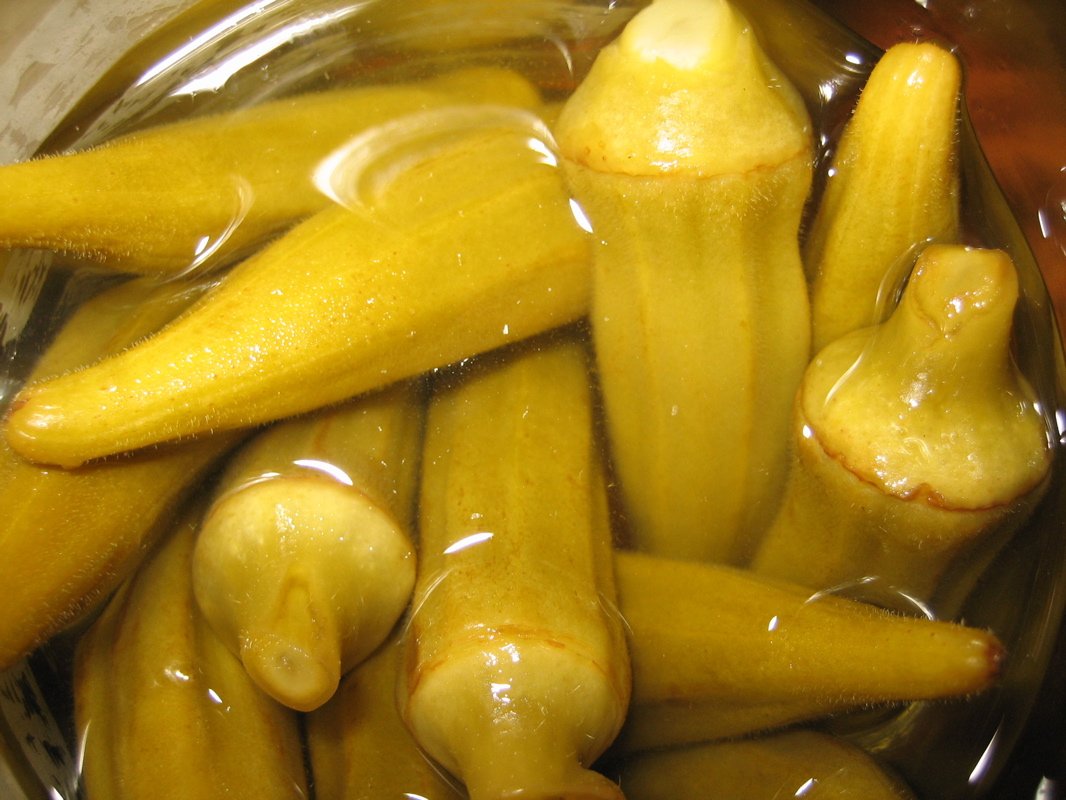
- Pickled okra — the one that converts people who think they hate okra, because the vinegar and the whole pod together defeat the sliminess entirely.
- Green tomatoes, whole or sliced, on their own as well as in chow chow.
- Pickled beets, which are everywhere and which are also the base of red beet eggs.
- Watermelon rind — see Grandma Hay.
- Dilly beans and pickled corn.
- Pickled eggs, in every bar and every gas station, and please read the safety page about them, because that is the one item on this list with a body count.
A note on boiled peanuts, and why they’re not here
I wanted boiled peanuts in this section and they do not belong, so they are not.
Green peanuts boiled in salt brine are not a pickle. There is no acid — added or grown. It is a salt-brine boil, and putting them here to satisfy my own fondness for them would break the one distinction this whole section is built on. Filing them under Pickled would mean the word “pickled” means “salty,” and then I have nothing.
(Sour or fermented boiled peanuts are a real Southern thing, and those genuinely would go under Fermentation. Which is a nice illustration that the boundary I’m defending is real and cuts right through a single food.)
They need their own home, because the actual interesting thing about them is regional: they change character all the way down the coast — North Carolina, west through Georgia, into Mississippi, Alabama, Louisiana. That is a Southern-food story, not a pickling one, and it is on the list.
Existing recipes in the meantime: Boiled Peanuts · Boiled Peanuts, several ways · Canned.
What the South taught me
That a pickle can be a background ingredient rather than a garnish. Everything in Japan was served as its own small dish, deliberately, to be looked at. In the South the pickle very often disappears into the pot — the pickled pork into the beans, the chow chow onto the plate as a matter of course, the peach beside the ham without comment.
Both are right. But the Southern version is the one where you would not necessarily know a pickle was involved, and I think that is the harder trick.
Comments (0)