The Caribbean
I sailed the Caribbean on and off for years, and the pickled food there is louder, hotter and more purposeful than almost anywhere else I have eaten it. It is also the end of a very long road for a Persian word.
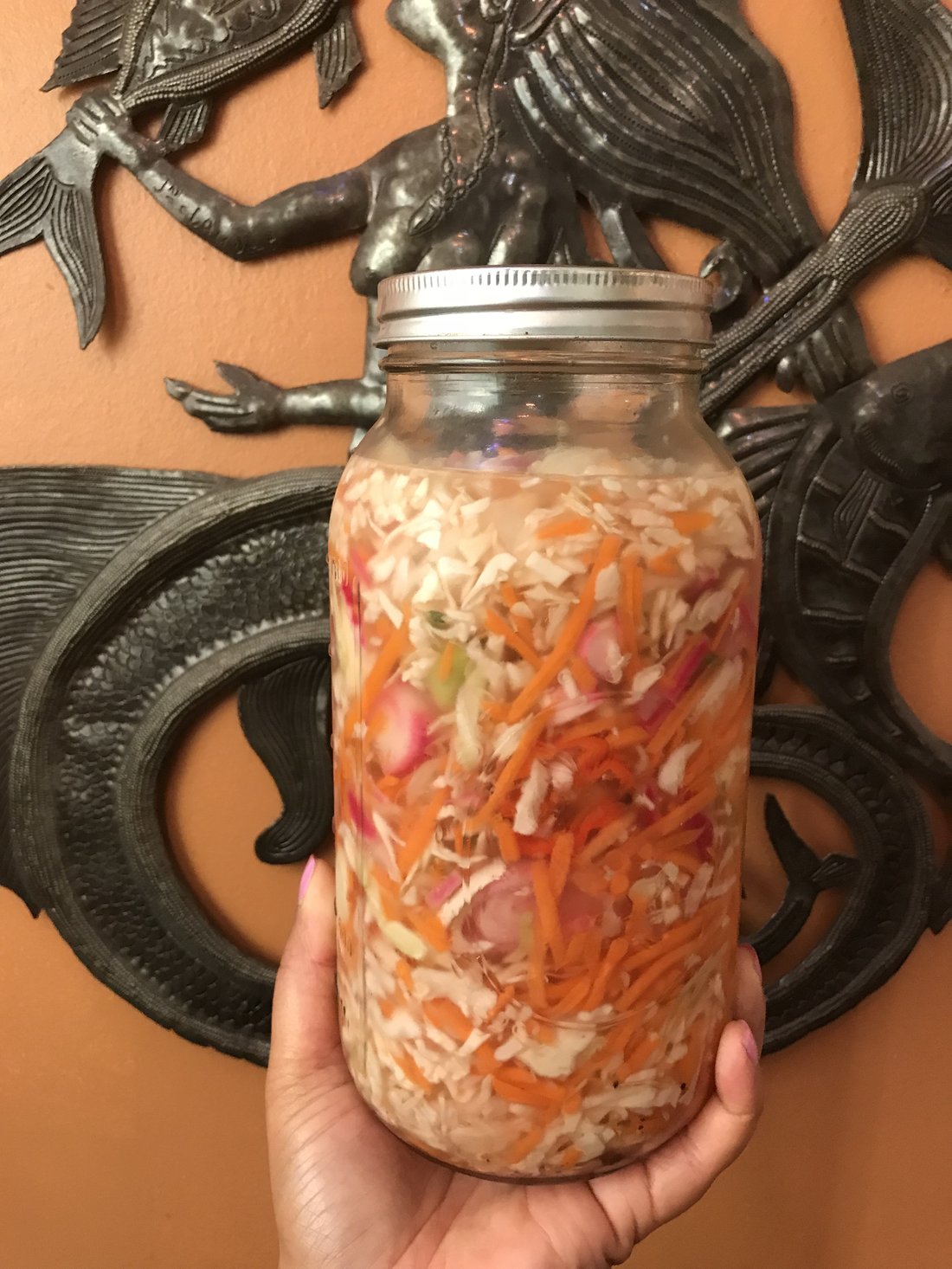
Haitian pikliz
Pikliz (say PEEK-leez) is shredded cabbage with carrot, onion or shallot, scotch bonnet, lime and vinegar, packed into a jar and left to sit. It is fiercely hot, sharp and crunchy, and it is one of the great condiments.
The name reads straight off the page: English pickle + French piquer, “to sting.” Which is about as good a two-word description of the thing as anyone could write.
⭐ What it is actually for matters more than the recipe. Pikliz is served with fatty fried food — griot (fried pork), tassot (fried beef), fried plantain. It is not a salad and it is not a side dish you eat by itself. The acid and the heat exist to cut the fat, in the same structural role as the atchara beside Filipino barbecue and the chow chow beside a Southern plate. Three unconnected traditions, all having worked out that a hot sour thing is what fried food needs.
Pikliz (Haitian Pickled Cabbage)
Jamaican escovitch
Escovitch is the other one I ate constantly, and it is a method more than a condiment — fish fried hard, then dressed with a vinegar sauce full of vegetables and heat: bell pepper, carrot, onion, garlic, scotch bonnet, sometimes cho-cho, usually with allspice (Jamaican pimento) and whole peppercorns.
⭐ And the name is the payoff of the whole section. As the fish page sets out, escovitch is the same word as Spanish escabeche, which came from Andalusian Arabic as-sukkabáj, from Arabic as-sikbāja, from Middle Persian sikbāg — sik “vinegar” + bāg “stew.”
A fried fish on a Jamaican beach is called, in a language nobody there speaks, “vinegar stew.” The dish travelled from a Sasanian Persian court to Arab Spain to the Spanish Atlantic to the Caribbean, changing from a sweet-sour meat stew into a way of keeping fried fish, and the name came all the way with it.
Escovitch and pikliz are frequently confused, including by people who make both. The honest distinction: pikliz is cabbage-forward and is a condiment in a jar; escovitch sauce has a wider mix of vegetables and is dressed over fried fish. They share the scotch bonnet, the vinegar and the job.
Escovitch Sauce (Jamaican Pickled Vegetables)
Barbados — a gap I am leaving open
There was a pickled cucumber in Barbados that I ate and liked and have thought about since, and I cannot remember what it was called.
I could guess. “Bajan” is the demonym and it attaches to plenty of things — Bajan pepper sauce, Bajan seasoning — and it would be easy to reach for one of those and file it here, and it would probably be wrong. Bajan pepper sauce is a mustard-and-scotch-bonnet condiment and it is not a pickled cucumber.
So this is a gap and it stays a gap. I am going through the photo albums, and if I find a picture of the jar or the plate, this paragraph will get replaced with something true.
The wider shelf
Things worth knowing about, beyond the two I ate most:
- Souse — pork (often trotters or ears) pickled in lime, cucumber, onion and hot pepper. Barbados and Trinidad both claim versions. A close relative of pickled pork, and a reminder that the Caribbean and the Gulf South are the same culinary world.
- Pepper sauce — in Trinidad and across the islands, hot peppers preserved in vinegar, which is a pickle whether or not anybody calls it one.
- Pickled green mango and green papaya, throughout — and note that green papaya turns up in the Philippines too, pickled almost identically, half a world away.
- Escabeche proper, in the Spanish-speaking islands, closer to the Iberian original than the Jamaican descendant.
The connection back to Louisiana
The thing I did not expect to find while writing this section is how tightly the Caribbean and the American South are tied together on this specific subject.
Red beans and rice — the dish that pickled pork exists to season — came into Louisiana in the late 1700s with French-speaking refugees from the revolution in Saint-Domingue, which is Haiti. The same movement of people that produced pikliz produced the Monday red beans of New Orleans.
So the two pages sit either side of one migration, and I had them filed as separate parts of my own travelling for years without noticing.
Comments (0)