Freezing Fish to Destroy Parasites
This is the one page in this section where I am going to give you numbers and ask you to follow them exactly, because a pickled fish is a raw fish, and the acid is not doing what you think it is doing.
Vinegar does not kill parasites. It firms the flesh, it makes it opaque, it makes it taste cooked, and it preserves against bacteria. Nematode larvae — Anisakis and its relatives — survive it comfortably. Every ceviche, gravlax, cold-cured salmon and pickled herring on this site starts from a fish that has to have been dealt with before it goes anywhere near the brine.
There are exactly two acceptable answers: buy fish that has already been treated, or freeze it correctly yourself.
🔴 The standard is FDA, not USDA
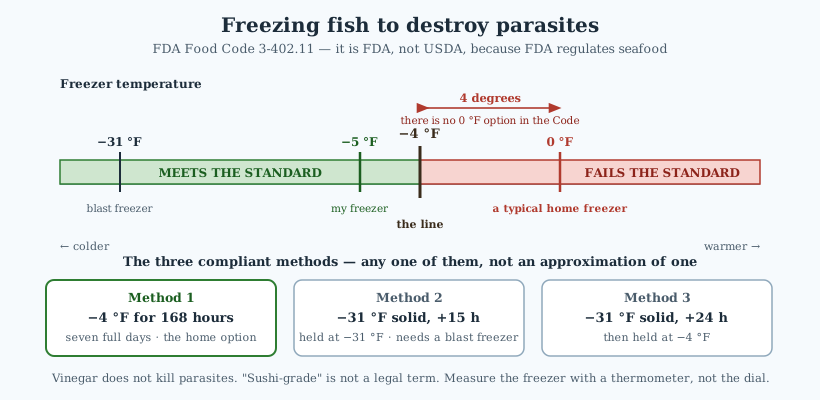
Worth stating because it is got wrong constantly, including by people selling fish. The FDA regulates seafood. USDA regulates meat and poultry. The rule you want is the FDA Food Code, section 3-402.11, “Freezing — Parasite destruction.”
The three compliant methods
Any one of these. Not approximations of them.
| Freeze at | Then hold at | For | |
|---|---|---|---|
| 1 | — | −4 °F / −20 °C or below | 168 hours (7 days) |
| 2 | −31 °F / −35 °C until solid | −31 °F / −35 °C or below | 15 hours |
| 3 | −31 °F / −35 °C until solid | −4 °F / −20 °C or below | 24 hours |
Method 1 is the one a home cook can actually meet. Methods 2 and 3 need a blast freezer.
Scope: this applies to fish sold or served ready-to-eat in raw, raw-marinated, partially cooked, or marinated-partially-cooked form. Pickled fish is squarely inside it.
Exemptions in the Code include certain tuna (Thunnus species) and aquacultured fish raised on formulated feed containing no live parasites — which is the reason farmed Atlantic salmon is treated differently from wild.
🔴 A standard home freezer FAILS this
This is the part that matters most and it is the part nobody says.
A typical home freezer runs at 0 °F (−18 °C). That is the design target, it is what the appliance is sold as, and it is not −4 °F. There is no 0 °F option anywhere in 3-402.11. Four degrees does not sound like much and the standard does not care what it sounds like.
Worse, a home freezer’s actual temperature swings — every door opening, every defrost cycle. A freezer whose average is 0 °F spends real time well above it.
So:
- Get a freezer thermometer. Not the dial on the front. An actual thermometer, in the freezer, read after a day.
- If it will not hold −4 °F or below, you cannot use it for this. Many chest freezers will, on their coldest setting. Most refrigerator-freezer compartments will not.
- Seven full days. 168 hours. Not “about a week.”
- Time it from when the fish is frozen solid, not from when you put it in.
My own freezer runs at −5 °F, which meets method 1, and that is why I am comfortable pickling salmon at home. That is not a boast, it is the specific fact that makes the recipe responsible rather than reckless. If your freezer does not do this, buy fish that has already been frozen to spec and ask the counter to confirm it.
🔴 “Sushi-grade” is not a legal term
There is no such standard. “Sushi-grade,” “sashimi-grade” and “sushi-quality” have no legal, regulated or certified meaning in the United States. No federal agency defines them, confers them or inspects against them.
What the label actually means is: the seller has decided this fish is fine to eat raw. The standard behind that decision varies from company to company, shop to shop, and fishmonger to fishmonger. It might mean the fish was frozen to 3-402.11. It might mean it is fresh and handled well. It might mean nothing but marketing.
So do not buy the label. Ask the question:
“Has this been frozen for parasite destruction?”
A good fish counter will answer immediately and specifically, and many will produce the supplier’s letter — some jurisdictions require retailers serving raw fish to hold exactly that documentation. A counter that cannot answer is a counter to buy cooked fish from.
I buy sushi-grade fish or I freeze it myself at −5 °F. Both are fine. What is not fine is assuming the sticker did the work.
What freezing does and doesn’t do
It does: kill parasitic nematode larvae, reliably, at the times and temperatures above.
It does not: kill bacteria, and it does not kill Clostridium botulinum spores. Freezing pauses bacteria; it does not remove them. Which means correct freezing does not excuse you from the rest of the safety page — the acid still has to be right, and the fish still has to have been fresh and cold when it went in.
It also costs you a little texture. Ice crystals rupture cells, and a fish that has been frozen and thawed is slightly softer and gives up slightly more liquid than one that never was. For pickled fish this genuinely does not matter, because the acid is going to firm it right back up — and then keep going.
The short version
- Vinegar does not kill parasites. Freezing does.
- −4 °F or below, 168 hours. Or buy fish already treated.
- Your kitchen freezer is probably 0 °F, which fails. Measure it.
- “Sushi-grade” means nothing legally. Ask whether it was frozen for parasite destruction.
- It is FDA, not USDA.
There is a printable version of this in the recipe collection as Fish, Freezing to Destroy Parasites (Reference), so it sits beside the recipes that depend on it.
Comments (0)