Korea and the Philippines
Two more stops in the same stretch of years, and between them they gave me the sentence I still think is the truest thing I can say about this food: I never knew how much I liked pickled food until those early years in the Marine Corps.
Korea: the first kimchi
Korea is where I met kimchi for the first time.
And it doesn’t belong in this section. I know that, and I want to say it up front rather than have somebody catch it — kimchi is a ferment. Nobody pours vinegar on kimchi. The sourness is grown by lactic-acid bacteria out of the cabbage’s own sugars, exactly as described on the fermentation side of the house, which is where the real treatment of it lives.
I am mentioning it here anyway, because this page is about an arc and not a taxonomy. In the sequence of things that changed how I ate, kimchi in Korea sits right in the middle of the run, and leaving it out to keep a category tidy would be a lie about the order events happened in.
What I would say about it, from that first encounter: nobody who has only had jarred supermarket kimchi has had kimchi. And the thing that surprises Americans — that it is a category of hundreds of preparations rather than one recipe, and that it was not red for most of its history — is on the other page, and worth reading.
Go there: Kimchi & the Asian Table.
The Philippines
Three things I ate pickled: green papaya, fish, and something made of banana blossom.
Green papaya — atchara
This one is squarely a vinegar pickle and squarely in this section.
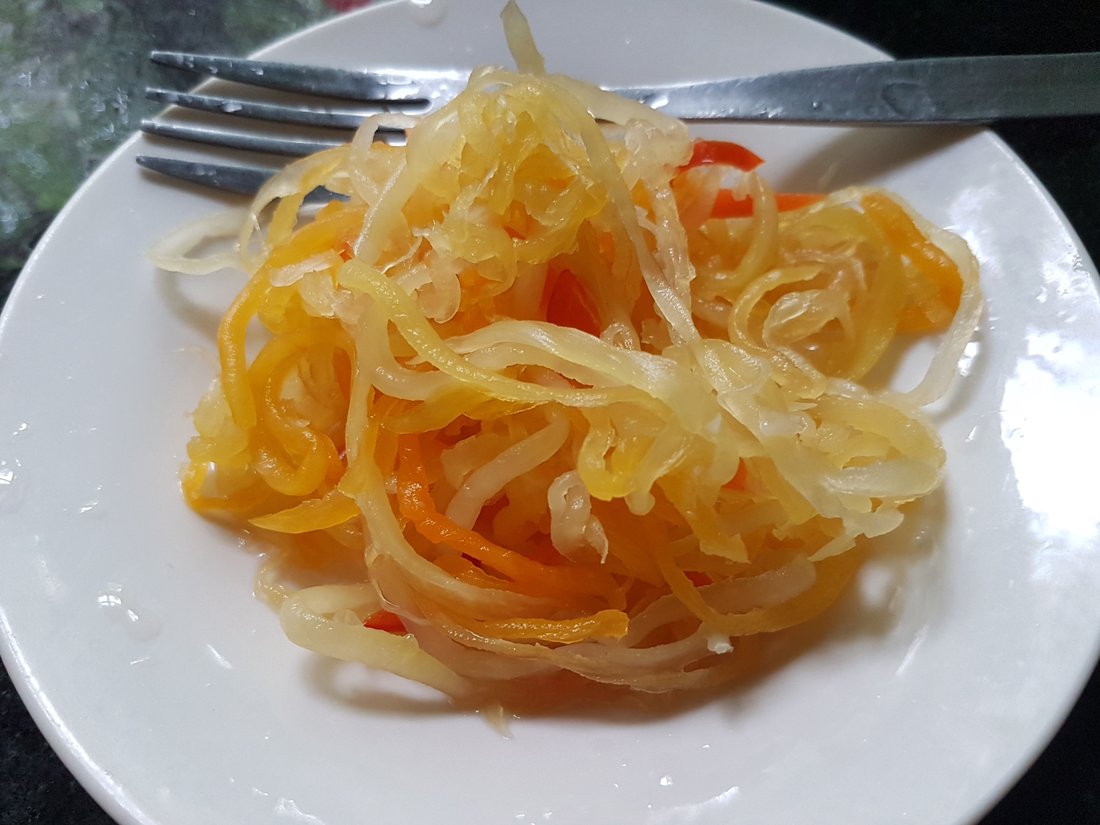
Atchara (also achara, atsara) is grated unripe green papaya in a sweet vinegar brine, usually with carrot, onion, garlic, bell pepper, ginger, and often pineapple and raisins. It is bright orange-gold, sweet and sour at once, and it turns up beside fried and grilled food — pork barbecue, fried fish, anything rich — doing exactly the job a pickle is supposed to do, which is cut through fat and reset your mouth.
⭐ And look at the name. Atchara is the same word as India’s achar, which arrived in the Philippines through trade and colonial routes. Two pickles at opposite ends of Asia carrying one name — and, as the India page gets into, made by completely different methods. The Filipino one is vinegar and sugar. The Indian one is oil, salt and sunlight. Same word, different craft. This section keeps running into that.
Atchara (Filipino Pickled Green Papaya)
Fish
Pickled fish, in a lot of forms, and I could not tell you the names of most of them. The Philippines has a deep tradition of soured and preserved fish, and vinegar is genuinely central to Filipino cooking in a way it is not anywhere else in Southeast Asia — paksiw and kinilaw and adobo are all built on it.
That thread picks up properly on Pickled Fish.
🔴 The banana blossom — a correction to my own memory
I remembered banana blossom as one of the pickled things I ate there. When I went looking for the dish to write it up, I could not find a documented Filipino vinegar pickle of banana blossom at all.
What I found instead was kulawo — minced banana blossom (puso ng saging) dressed in coconut milk, often with grilled coconut, sometimes called minanok, “done like chicken,” because the shredded blossom has that texture. It is a salad. It is not a pickle. It has no vinegar doing the preserving.
So on the evidence, what I ate was most likely kulawo, and I have been filing it under “pickled” in my head for forty years because it was sour-ish, shredded, served in a small dish beside other small dishes, and I had no idea what any of it was.
I am leaving this on the page rather than quietly deleting the banana blossom, for two reasons. One: it is a good example of how memory works on food you ate once, in a country you did not speak the language of, four decades ago. Two: if I will not correct myself in public then none of the other corrections in this section are worth anything.
If you know of a genuine Filipino pickled banana blossom, I would be glad to be corrected back.
The verdict on those years
I went into the Marine Corps knowing Grandma Hay’s pickles and came out the other side of Japan, Korea and the Philippines knowing that pickled food was an entire way of eating and that most of the planet was better at it than I was.
Everything after this — Tennessee, Turkey, India, Denmark, Russia, the Caribbean — is a man who has figured out what he likes and started going looking for it on purpose.
Comments (0)