Pickled Meat
Everywhere else in this section I have been arguing that the word “pickle” is doing too much work. Here is the place where the oldest meaning of the word is still in daily professional use, and almost nobody outside a butcher’s shop notices.
On the first page I made a fuss about the etymology: “pickle” named the liquid, not the cucumber. Middle Dutch pekel, brine, arriving in English around 1400 — and “a cucumber preserved in pickle” not recorded until 1707. The cucumber eventually stole the word outright in ordinary speech.
It never stole it from the meat trade. A butcher puts beef in pickle. The tub is the pickle. The verb is to pickle, and it does not mean vinegar — it means the brine. Six hundred years on, that is still how the trade talks, and it is the only living survival of the original sense I know of.
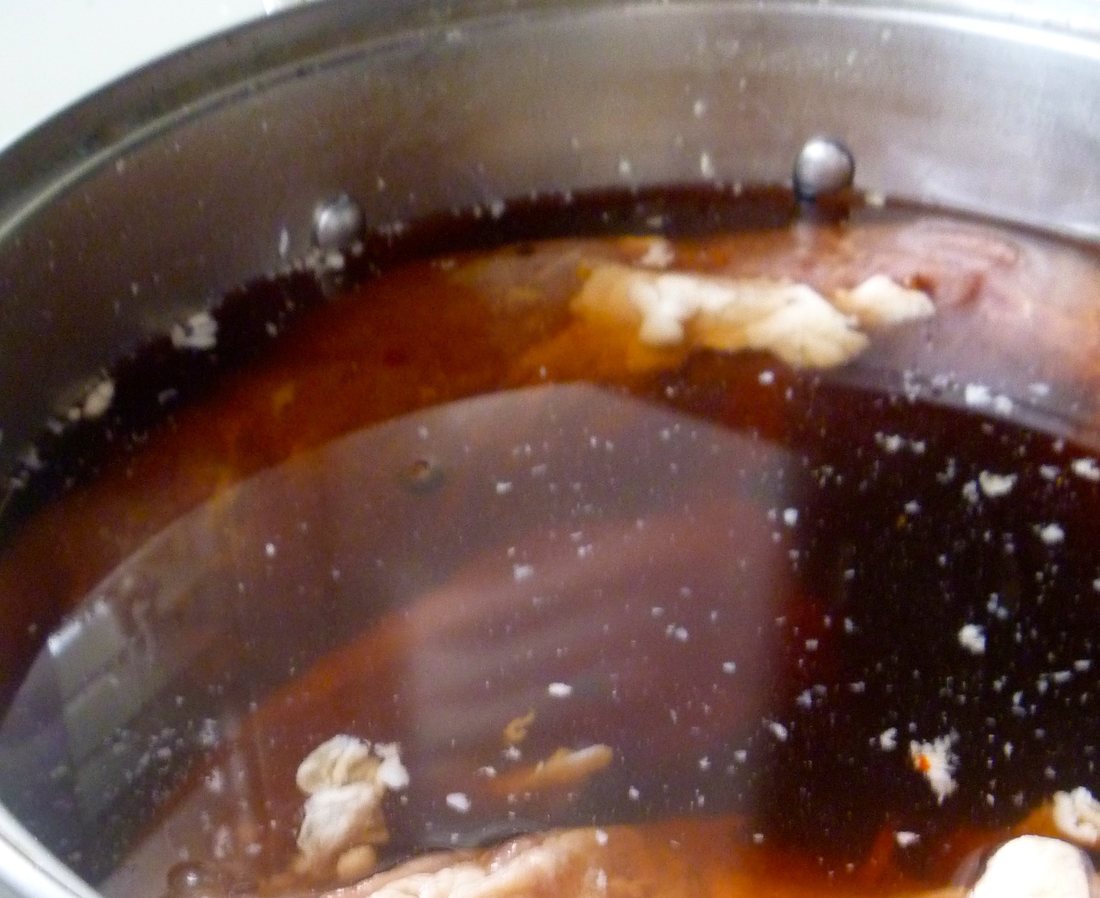
🔴 Which puts corned beef in an awkward spot, and I am keeping it anyway
By this section’s own rule — fermentation grows the acid, pickling adds it — corned beef is not a pickle. There is no acid in it, added or grown. It is salt, nitrite, water, sugar and spice, and what preserves it is the salt.
So by my own test it fails, and I am putting it here regardless, with the reason stated: the trade calls that brine a pickle, and the trade is using the word correctly and I am the one using it narrowly. If I threw corned beef out of a section called Pickled on the grounds that it contains no vinegar, I would be enforcing a definition that is younger than the food.
I would rather show you the seam than pretend the fabric is continuous. It is the same call I made about boiled peanuts and I came down the other way there — because boiled peanuts have no claim on the word at all, and a beef brine has the oldest claim there is.
⭐ And “corned” is its own small correction. It has nothing to do with corn the grain. Etymonline dates the verb to the 1560s: “to preserve and season with grains (‘corns’) of salt.” A corn is a grain of anything — a corn of salt, a corn of gunpowder. So corned beef is grain-of-salt beef, and the name is a description of the crystals, not the crop.
That 1560s date is the same decade “in a pickle” first shows up in English, which I noticed while writing the history page and which means nothing at all. Two words about preserved food happened to be written down in the same ten years. I mention it only because it looked like a pattern for about an hour and it isn’t one.
Recipes: Home Cured Corned Beef · Beef, Corned · Pastrami
The nitrite numbers, and the one people quote wrong
Curing brine for meat contains sodium nitrite, sold to home cooks as Cure #1 — pink so you cannot mistake it for salt, and 6.25% sodium nitrite by weight, the rest being ordinary salt.
It is doing three jobs: the colour (cured pink instead of grey), a large part of the flavour people identify as “cured”, and — the one that matters — it is the specific control for C. botulinum in a low-acid, oxygen-poor, salty environment, which is an exact description of a brine tub.
🔴 And here is the number that gets misquoted. Home curing guides routinely give 156 ppm as the ingoing limit. It is not; it is one row of a table. The Meat Institute’s July 2025 processing guide, citing 9 CFR 424.22, lists them:
| Product | Maximum ingoing sodium nitrite |
|---|---|
| Bacon | 120 ppm (plus 550 ppm ascorbate or erythorbate) |
| Dry-cured bacon | 200 ppm |
| Frankfurters or cured sausages | 156 ppm |
| Brine-cured or injected products — ham, pastrami | 200 ppm |
| Dry-cured meat items | 625 ppm |
156 ppm is the sausage number. A brisket in a tub is a brine cure, which is the 200 ppm row. ⚠ To be clear about the direction of the error: curing a brisket at 156 ppm is under the limit and perfectly fine — the mistake is calling it the limit, and then carrying that number to a product where it was never the number. This is the second time the same trap has turned up in my writing; the Irish rashers needed the opposite correction, where a general “dry-cured = 625 ppm” line would have over-cured bacon by three times if read in isolation.
Read the row, not the table.
Souse — where the acid finally shows up
Souse is the first thing on this page with vinegar in it, and it is the difference between souse and head cheese.
Head cheese is a terrine of meat from the head — tongue, cheek, sometimes the feet and heart — set in its own gelatin. Souse is the same thing with vinegar in it, and usually more jelly. That is the whole distinction: sulz, brawn, head cheese, souse are one family, and vinegar is what makes the last one souse. Pimentos, peppers or pickles often go in with it, which they can, because the vinegar is already there.
It is Southern and it is West Indian, which is not a coincidence — the same two coasts that gave this section pikliz and escovitch and the pickled pork in the next section down.
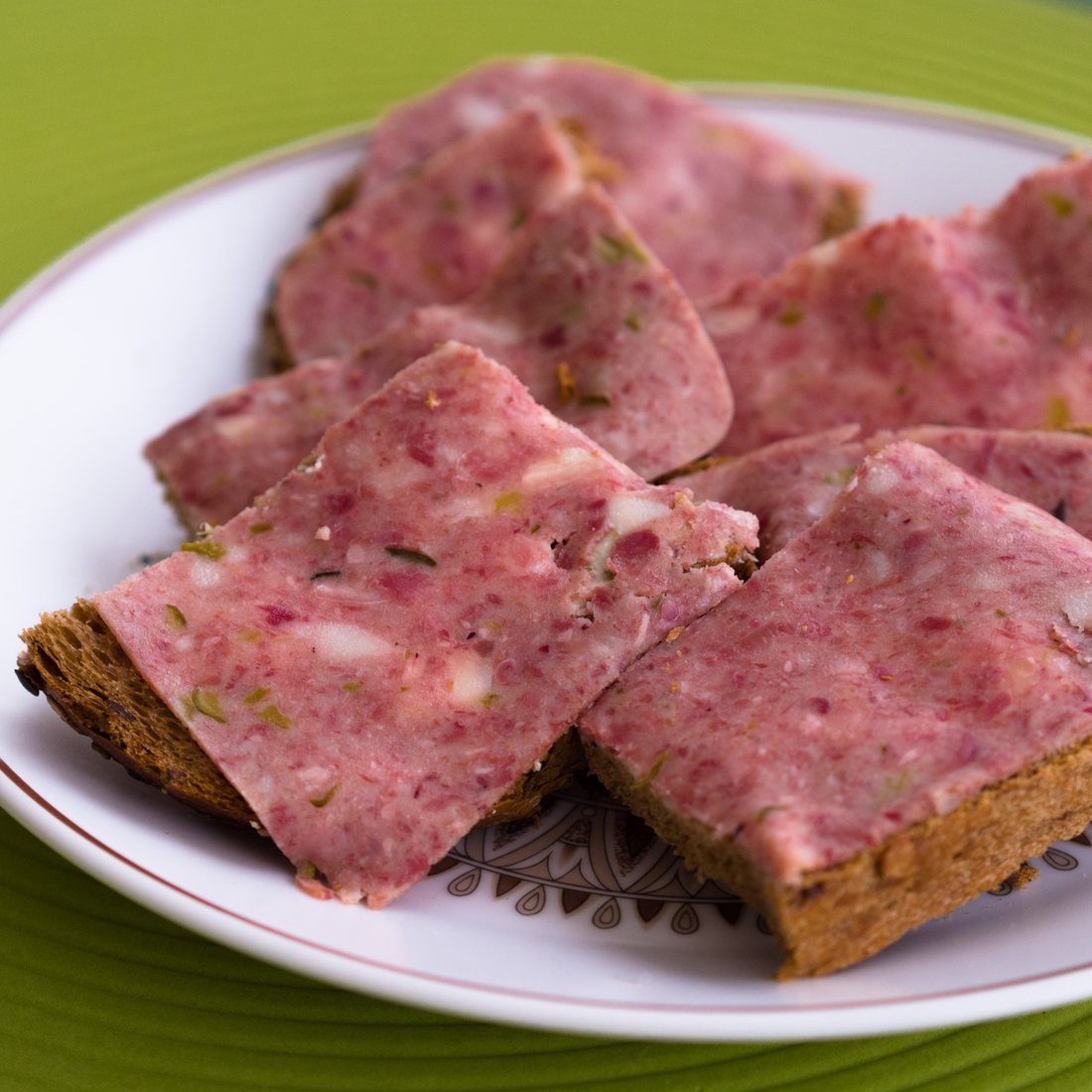
Dutch zure zult on rye. “Zult” is brawn; “zure” means sour, and the sourness is the vinegar — the language is doing the same job here that this page is: marking, in the name of the dish, which member of the family you are looking at. You can see the set holding the pieces together, which is gelatin out of the head and not an added thickener.
Hog Head Cheese (Souse) Sandwich · Souse (Pickled Pork) and Onion Sandwich
Pickled pork — and the oldest Creole recipe for it has no vinegar in it
This is the one people in Louisiana actually mean when they say the word. Pickle meat, in New Orleans. It is the seasoning meat that goes into a pot of red beans, and it is the reason this whole page exists as far as most of the South is concerned.
On the South page I described it as “meat cured in an acidified brine” — vinegar and salt, spices, often saltpetre. Every modern recipe agrees with me. Camellia, the Louisiana bean company whose red beans are the ones people mean, builds theirs on distilled white vinegar with mustard seed, celery seed, hot sauce, bay, garlic, salt and peppercorns, and says to “cover and refrigerate for at least three days before using as a seasoning meat.”
🔴 Then I read the oldest printed Creole recipe for it, and there is no vinegar in it at all.
The Picayune’s Creole Cook Book — I read the 1916 printing of the 1901 book, page 70 — gives it under two names, and the second one is the tell:
Pickled Pork. — Petit Salé. Coarse Salt Sufficient to Make a Brine. 12 Bay Leaves. 2 Dozen Onions. 25 Pounds of Pork. 1 Ounce of Saltpetre. 12 Cloves. 6 Allspice.
That is the whole ingredient list. Salt, saltpetre, onions, and three spices. No acid of any kind. And the method is a dry pack, not a soak: cut the pork into two-pound pieces, “slash each piece through the skin, and then rub thoroughly with the salt and saltpetre mixture till the meat is thoroughly penetrated through and through,” then layer it in a small barrel between salt, chopped onion and minced spices, “cover the preparation with a board on which a heavy weight must be placed.” Nothing is poured in. The salt and the weight pull the brine out of the meat. “It will be ready for use in about ten or twelve days,” and “if proper care is taken, it will keep one year after pickling.”
⭐ And petit salé is the same phrase that book uses for bacon. Its own index reads
BACON (Petit Sale) 71, with Petit Salé Bouilli for boiled and Petit Salé Frit for fried.
Literally “little salted.” The French name for Creole pickled pork is a word about salt, and the
book spends it on bacon without blinking.
⭐⭐ And here is the one that made me sit up. Turn to the vegetable chapter and the red-bean dish is printed as “Bacon and Beans à la Créole — Haricots au Petit Salé à la Créole.” Beans with pickled pork, Creole style. One quart of dried red beans, one pound of the cured pork left in a single square piece, boiled about two hours, then baked in the bean liquor until it is nearly all absorbed. Red beans and pickle meat is in the book, under that name, and the meat in it is a salt cure with no acid anywhere.
So the honest correction to my own South page is this: the dish is older than the vinegar. I do not know when the vinegar arrived — I looked, I could not find a date, and I am not going to invent one. What I can say is that the oldest printed Creole version I can read is a salt cure, which puts pickled pork in exactly the same awkward spot as corned beef at the top of this page: by this section’s own rule it is not a pickle, and the trade called it one for a century anyway.
⚠ Do not read that as “the old way is the right way.” The 1901 barrel worked because it was salted to a level nobody would eat today, nitrated with saltpetre, weighted, and kept in a cellar. You cannot reproduce it in a kitchen and you should not try. What follows is the modern refrigerated version, which is a vinegar cure, and which is what every recipe below actually makes.
Why every modern recipe tells you to cube it
Because the brine has to travel, and it travels slowly. This is the same fact that runs the whole marinated eggs section — a soak works from the outside in, a few millimetres a day, and a cure is a race between diffusion and the calendar.
⭐ Watch the two recipes solve it the same way, a century apart. The Picayune cuts to two-pound pieces and then slashes each one through the skin and rubs the cure “through and through” — because rubbing the outside of a closed piece of pork does not reach the middle. Every modern recipe instead cuts the shoulder into 1½–2 inch cubes. Different technique, identical problem: get the distance from any surface to the centre down to about an inch, or the cure never arrives.
⚠ Which also means the acid is not doing what you think. Vinegar penetrates a piece of muscle about as far as salt does, and meat’s own buffering fights it the whole way — I could not find a measured penetration depth for pork in a vinegar cure that I could actually read (the one paper I found is paywalled), so I am not printing a number. But the practice tells you the answer: if the acid reached the centre of a roast, nobody would be cutting it into cubes.
Making it — the step by step
Makes about 4 lb, which is roughly four pots of red beans. Published cures run from three days (Camellia) to seven (most Louisiana blogs); Alton Brown’s says “at least 3 days.” I go seven — three days seasons the outside, seven gets the tang into the middle of a two-inch cube.
You need: about 4 lb boneless pork shoulder (Boston butt — you want the fat and the connective tissue; this meat is going to be simmered for hours) · a non-reactive container or a couple of good zip-top bags — glass, food-grade plastic or stainless, never aluminium, never bare cast iron, because you are about to fill it with vinegar · fridge space.
The brine: 3 cups cider or distilled white vinegar (5% acidity, the ordinary supermarket strength) · 2 cups water · ½ cup kosher or pickling salt · 2 tbsp brown sugar · 2 tbsp yellow mustard seed · 1 tbsp celery seed · 1 tbsp black peppercorns · 1 head of garlic, cloves peeled and crushed · 1 large onion, sliced · 2–3 bay leaves · 1 tsp cayenne, or a good shot of Louisiana hot sauce.
⚠ That vinegar-to-water ratio is a choice, not a rule, and I am telling you it is mine. The published versions are all over the place — Alton Brown runs 1 part vinegar to 2 parts water, the seven-day blog versions run 3 to 5, Camellia makes vinegar the main liquid. None of those ratios is the safety, so pick by taste: more vinegar, more tang in the finished beans. 3:2 is where I land.
- Trim and cube. Take the excess hard fat off the shoulder, but leave it well marbled. Cut into 1½–2 inch pieces. This is the step that makes the cure work — see above.
- Build the brine and boil it. Everything except the pork into a non-reactive pot. Bring to a boil, simmer 5 minutes, then take it off the heat. The boil dissolves the salt properly and opens up the mustard and celery seed; five minutes is plenty.
- 🔴 Chill the brine completely before it ever touches the pork. All the way cold — fridge or an ice bath, not “cool to the touch.” Warm brine on raw pork puts the meat into the danger zone at the exact moment you are sealing it into a bag for a week.
- ⚠ Skip the two hours on the counter. Several popular versions have you rub the cubes in a salt-and-sugar rub and “let stand about two hours for the pork to get to room temperature.” FSIS’s rule is a 2-hour maximum for perishable food between 40 °F and 140 °F, so that step spends your entire allowance before the cure has even started — and it buys nothing, because the salt will dissolve into a cold brine just as well. Rub if you like the rub; do it in the fridge.
- Submerge and weight. Pork into the container, cold brine over it, and make sure every piece is under the liquid — a small plate or a zip-top bag of water on top works. In bags, press the air out and seal, then stand the bags in a bowl in case one leaks.
- Refrigerate 3–7 days, and turn it once a day. Flip the bags or stir the container so the cubes swap places; the ones at the bottom sit in the saltiest brine.
- Rinse before you use it. Drain, rinse under cold water, drain again. Camellia says to rinse off “all traces of seasoning aromatics” and they are right — nobody wants to bite a whole mustard seed in a bowl of beans.
- Cook it. This is raw pork. Pickled pork is a cured meat, not a cooked one, and no amount of vinegar changes that. It goes into the pot early, with the beans, and simmers for hours until it falls apart. Alton Brown says it plainly: “Although the pork is pickled, and thus preserved, the pork does still need to be cooked over some kind of heat.”
Keeping it: leave it in the brine in the fridge and use it within two weeks. Beyond that, portion it into 1-lb bags — one pot of beans each — and freeze it.
⚠ Four things the popular recipes get wrong about this, and one they get right
I built the method above off the widely-shared seven-day blog version, and I would change four things:
- 🔴 The two hours at room temperature. Covered above. It is the one step that is actually against the guidance, and it is doing no work.
- 🔴 “Drain the brine, then it lasts two weeks in the fridge.” The two weeks is real; the draining is not part of it. Alton Brown’s own wording is “use within 2 weeks or remove the pork from the brine and freeze” — in the brine for two weeks, or out of the brine and into the freezer. Draining it and leaving it on a fridge shelf for a fortnight throws away the salt and the acid and leaves you holding raw pork. In the brine, or in the freezer.
- ⚠ “Pickled, and thus preserved.” Only in the sense that a fortnight is longer than three days. This is a refrigerator food and the refrigerator is the control, exactly like everything else on this page. There is no shelf-stable version of this that does not involve the salt levels and the saltpetre of the 1901 barrel.
- ⚠ The vinegar is not the safety. I know that is an odd thing to say in a section built on pickling adds the acid — but see the bottom of this page. A vinegar cure on a low-acid food in 1½-inch cubes acidifies the outside properly and the middle barely at all, and none of the published home versions measure anything.
⭐ And the one they get right, which is worth saying out loud: no pink salt. Every modern pickled-pork recipe leaves out the nitrite, and that is correct, not an omission. Nitrite earns its place in a cure that is low-acid, oxygen-poor, salty and long or warm — a brisket in pickle for a fortnight, a fermented salami, a barrel in a cellar for a year. A three-to-seven-day refrigerated cure that then gets boiled for three hours in a bean pot is none of those things. The Picayune needed the saltpetre because its version sat in a barrel until next winter. Yours does not. Do not “improve” this with Cure #1 — you will get cured colour and cured flavour, and red beans are not supposed to taste of ham.
The recipes
Pickled pork itself: Pickled Pork, Alton Brown — the three-day version, and the one whose notes tell you honestly that it still has to be cooked · Pickled Pork, Slow Cooker — what to do with it if you want to eat it as meat rather than as seasoning · Pickled Pork Hocks — the hock version, and note that it still carries saltpetre, which is the old road · Pork, Pickled — ⚠ a different animal entirely, a saltpetre brine cure for slicing cold, not a Creole seasoning meat; I am linking it so you can see how far apart the two uses of one name are.
The dish it exists for: New Orleans Style Red Beans and Rice with Pickled Pork — the one that builds the seven-day cure into the same recipe · Pableaux’s Monday Night Red Beans · Justin Wilson’s Red Beans and Rice · Pressure Cooker Red Beans and Rice.
⭐ Why Monday? Because wash day was Monday, a pot of beans looks after itself for four hours while you do something else, and Sunday’s ham bone was still in the house. The pickle meat is the part you keep on hand so that Monday works even when there was no ham on Sunday — which is the whole point of a seasoning meat, and the reason it got cured in the first place.
The rest of the counter
- Pickled pigs’ feet — the gas-station jar. Feet simmered until tender, then held in a strong vinegar brine. Mostly collagen and skin, which is why the texture is the entire argument for or against them. I do not have a recipe for these and I should.
- Salt pork is the acid-free cousin of modern pickled pork, and the difference is exactly the vinegar — which, as the section above works out, means salt pork is the closer relative of the 1901 Creole original than today’s pickle meat is. Salt Pork Sandwiches
- Tongue is traditionally brine-cured the same way as corned beef and is one of the best cheap things in a butcher’s case. Simmered Tongue
⚠ Where this page stops resembling the rest of the section
Everywhere else here, the vinegar is the safety and I have been repeating that for seventeen pages. On this page it mostly isn’t.
A meat cure is held safe by salt concentration, nitrite, temperature and time — and cold is load-bearing in a way it never is for a shelf of dill pickles. A brisket in pickle lives in the refrigerator for its whole cure. It is not a shelf-stable food and it never was; the barrel-and-a- year version worked on salt levels that would be inedible today, in a cellar.
So do not carry the habits across. Nothing on this page is made safe by acid, souse included — the vinegar in souse is flavour and keeping quality, not a botulism control, and souse is a refrigerator food. If you want to put cured meat on a shelf you are in canning territory and you need a tested process, which means a pressure canner, because meat is as low-acid as food gets.
⚠ Which is why a pH meter does not rescue this page. Everywhere else in this section, measuring is how you find out whether you are safe — and it is worth knowing how, because a fermented salami genuinely does live or die on that number. But a corned brisket is not acidified at all: there is no reading that would make it shelf-stable, and the numbers doing the work here are nitrite in parts per million and the temperature of your fridge.
What this page is actually about
I did not expect a page on meat to be the one that best defends the section’s title.
Everything else here breaks the thesis from the outside — Japan sorting by the bed, India with no vinegar at all, Turkey using one word for both methods. This one breaks it from the inside, in English, in a trade that has been using the word continuously since before the cucumber got hold of it.
A butcher’s pickle is a brine. That was the word’s job first. Everything I have written about adding acid is true, and it is also a fairly recent way of thinking about a very old word.
Next: Peppers, and the Hot-Sauce Shelf — where one supermarket aisle contains both halves of this argument, sitting next to each other, and a bottle that does both in sequence.
Comments (0)