The Crunch Problem
The most common complaint about home pickles is that they went soft, and the advice everybody gives is to trim the blossom end of the cucumber.
That advice is correct. It is also about a third of the story, and when I went to check it properly I found a 2022 paper that made me reconsider what I put in my own jars. The most likely cause of a soft pickle is not the blossom end. It is the fresh dill.
What actually softens a pickle
The mechanism is an enzyme. Specifically pectinase, and in particular polygalacturonase (PG), which breaks down pectin — the substance gluing plant cell walls to each other. Break the pectin and the walls collapse, and a firm cucumber becomes a limp one. It is the same chemistry that ripens fruit; a soft pickle is a cucumber that has been made to rot structurally without rotting microbially.
So the whole crunch question is: where is the enzyme coming from, and how do I keep it out or shut it down?
Traditional advice knows about one source. There are at least three.
Source 1 — the blossom end (real, and worth doing)
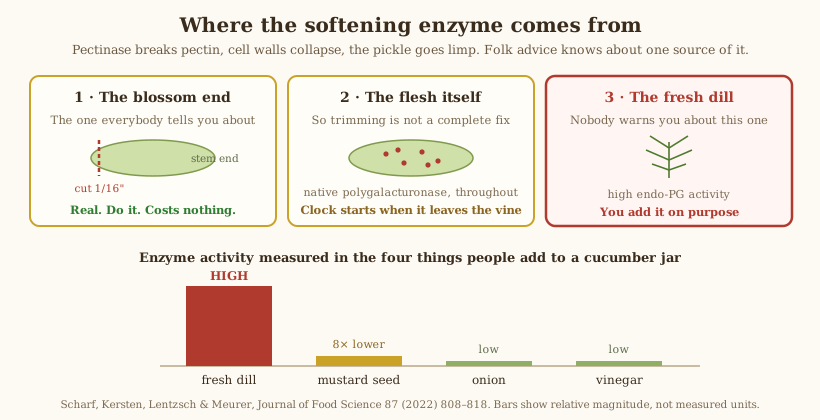
The cucumber’s blossom end carries pectinase, and the flower itself harbours microbes that produce more. Slice about 1/16 of an inch off the blossom end and discard it. Extension services from Utah State to Penn State are consistent on this and it costs you nothing.
Which end is the blossom end? The one opposite the stem scar — the stem end has the little attachment nub, the blossom end is usually slightly paler and rounder. If you cannot tell, cut both. You lose an eighth of an inch of cucumber and you remove all doubt.
Source 2 — the cucumber itself
Less famous, and it means trimming is not a complete fix. Research on fresh-pack pickles found that native polygalacturonase in the cucumber flesh can soften the product on its own — extracts concentrated from pickling cucumbers rapidly softened pasteurised pickle tissue. The enzyme starts being released as soon as the cucumber comes off the vine.
Which is the science behind the oldest rule of all: pickle the same day you pick or buy. A cucumber picked this morning makes a crisp pickle. One that has been in a bag on a shelf for a week cannot be rescued by anything on this page.
Source 3 — ⭐ the dill, which nobody tells you
Here is the finding that genuinely changed my mind.
Scharf, Kersten, Lentzsch and Meurer, in the Journal of Food Science (87, 2022, 808–818), measured pectolytic enzyme activity in the four things people routinely add to a cucumber jar — fresh dill, mustard seed, onion and vinegar — to find out which of them was bringing enzymes along for the ride.
- Fresh dill showed high endo-PG activity, and the paper names it as a possible spoilage factor.
- Mustard seed measured about eight times lower.
- Onion and vinegar carried only low levels of enzyme or of Alternaria molds.
So the herb that defines a dill pickle is, by measurement, the largest enzyme source you add on purpose. You trim the blossom end to remove pectinase and then drop a fresh dill head into the jar.
(A caveat I owe you: the full paper is paywalled, and I am working from its abstract and from papers citing it. I have not read the methods. Take it as a strong indication rather than a settled number.)
What I do with that. Not stop using dill — a dill pickle without dill is a cucumber in vinegar. But it reframes the problem:
- Dill seed and dried dill instead of fresh heads, when crunch matters more than the fresh green note. Enzymes are proteins; drying and age degrade them.
- Pour the brine over boiling hot. Heat denatures enzymes. This is a strong argument for a truly boiling raw-pack brine rather than a merely warm one.
- Lean harder on the other defences below, because you have just added the problem yourself.
- Suspect the dill first when a batch goes soft and you did everything else right. Previously I would have blamed the cucumbers.
The defences that work
Cold soak. One to two hours in ice water before packing. Firms the tissue and it is free.
Tannins. A grape leaf, oak leaf, horseradish leaf, or a pinch of black tea in each jar. This is the old-timers’ trick and it is real — the tannins inhibit the pectinase directly. It is the same mechanism the fermenting crowd relies on, where the enzyme problem is worse because the jar sits for weeks.
Calcium chloride (“Pickle Crisp”). Firms pectin directly by cross-linking it, rather than by inhibiting an enzyme. 1/8 teaspoon per pint jar. This is the one modern additive I keep in the cupboard, and it is the correct answer for canned pickles.
Boiling brine, raw pack. Denatures enzymes on contact and keeps the vegetable from cooking.
Do not overcook. For a raw-pack pickle the brine should be the only heat the cucumber ever meets. Boiling the cucumbers makes relish.
Enough salt. Salt firms tissue by drawing water out osmotically. Cutting salt “for health” in a pickle costs you texture.
🔴 Alum is obsolete, and the reason is not what people think
Old recipes — including plenty still circulating — call for alum. Do not use it.
USDA no longer recommends alum except in fermented pickles, and NCHFP advises against it generally. The reasons are specific:
- It has little effect on quick-process pickles, which is what most people are making.
- Too much alum actually decreases firmness. It works against you past a threshold that is easy to cross in a home kitchen.
- Excess causes digestive upset and leaves a bitter, metallic taste.
It is not that alum was a poison and we found out. It is that it was only ever marginally effective, easy to overdose, and has been superseded by calcium chloride, which is better at the job in every respect. If a recipe you inherited calls for alum, substitute 1/8 tsp calcium chloride per pint and it will be a better pickle.
Hollow pickles are a different problem
Worth separating, because the fix is different. A hollow pickle — one with a cavity in the middle rather than soft flesh — is usually not an enzyme issue at all. It is either:
- A cucumber that grew that way, from irregular watering or heat stress in the field. Nothing you do in the kitchen touches it.
- Cucumbers that sat too long between picking and pickling, drying out from the inside.
- A fast, gassy ferment — but that belongs to the other section.
Hollow cucumbers float, which is a useful sorting trick: drop them in water before you pack, and set the floaters aside for relish.
The short version
- Buy or pick them today, and use them today.
- Trim 1/16” off the blossom end. Cut both ends if unsure.
- Ice water, one to two hours.
- A tannin leaf in each jar.
- Calcium chloride, 1/8 tsp per pint, for anything canned.
- Truly boiling brine, raw pack.
- Consider dill seed over fresh dill heads when crunch is the priority — and know that the fresh head is a real trade you are making, not a free ingredient.
Comments (0)