Turkey, India and Russia
Three traditions that have nothing to do with each other, grouped because each one breaks the section’s thesis in a different direction — and because they are the stretch of my own travelling where I stopped being surprised that everybody pickles and started being surprised by how.
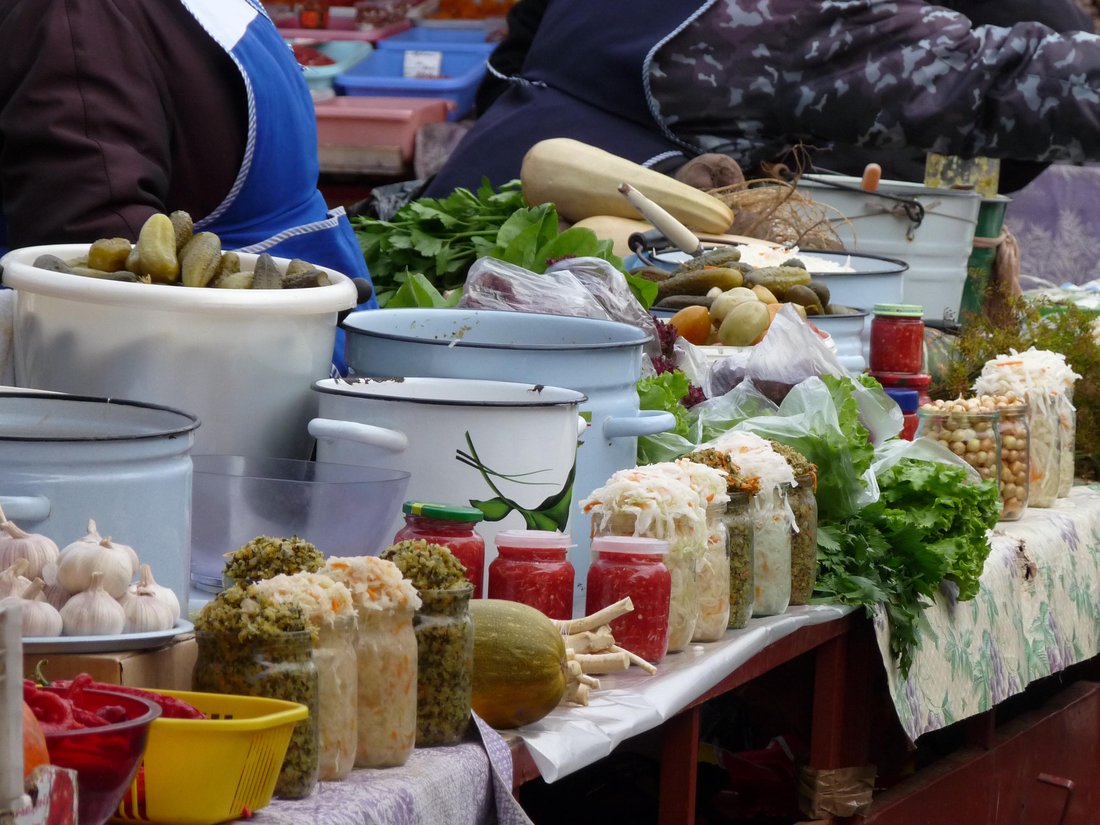
Turkey — turşu
Turşu is the Turkish word for pickles and it is a serious business. Whole shops sell nothing else — walls of jars, mixed vegetables, cabbage, peppers, green tomatoes, unripe plums, garlic — and you can buy a glass of the brine to drink, which is turşu suyu and which the country treats as a cure for a hangover.
The thing that matters for this section: turşu covers both methods under one word.
- Salamura — the older way. Vegetables in rock-salt water, no vinegar or barely a splash, and wild lactic bacteria do the work over two to four weeks. Cloudy brine, live culture, funkier. That is a ferment.
- The vinegar route — grape or spirit vinegar plus salt, preserving on contact. Clear, bright, harder crunch, shelf-stable before opening. That is a pickle.
Both are turşu. Nobody in Turkey needs to distinguish them to order lunch, and the language does not force the issue the way my section headings do. A jar of Turkish pickles might be either, and the tell is the brine: cloudy means it grew its own acid; clear means somebody poured it in.
That is a genuinely useful thing to be able to read, and it works nearly everywhere.
Turşu (Turkish Mixed Pickles) — the vinegar route, which is the one you can make on a weeknight.
🔴 India — achar, which has no vinegar in it at all
This is the one that most thoroughly demolishes the premise of the section, and it is my favourite for that reason.
Traditional Indian achar is not a vinegar pickle. It is not a lacto-ferment either, exactly. It is salt, spice, oil and sunlight.
The method, in outline:
- The fruit or vegetable — green mango, lime, lemon, chili, garlic, carrot — is cut and salted, typically 2–5%, and left a day or two. The salt pulls out moisture and makes a brine that partially cures it.
- It is layered with ground spices — mustard seed, fenugreek, chili, asafoetida, turmeric — and mustard or sesame oil.
- Then it goes into the sun, in jars, for days or weeks. Sun-curing is not a garnish step; it is the process.
The oil is a seal, not an acid. It excludes air from the surface, which is a completely different preservation strategy from anything else in this section — and one that would be a botulism hazard if the salt were not so high and the whole thing were not so acidic from the fruit and the fermentation that does occur.
What acid there is comes from the fruit itself — a lime pickle is preserved substantially by the lime — and from wild fermentation happening under the oil.
⭐ So India solved the same problem with a completely different toolkit: instead of adding acetic acid, it uses salt, the fruit’s own citric acid, spice with real antimicrobial activity, an oil barrier, and the sun. No vinegar anywhere. And the results keep for a year in a climate where nothing keeps.
And the naming: Filipino atchara — the green papaya pickle — is the same word, carried east by trade. But atchara is vinegar and sugar. Same name, completely different craft. Two ends of Asia, one word, and it is not describing a method. It is describing a role at the table.
Achar, Green Mango (Indian Oil Pickle) — and note the warning in it: everything must be bone dry, because there is no vinegar here to protect you.
Russia, and a restaurant in Dubai
The Russian pickled table is where pickled fish stops being a side dish.
Selyodka in St Petersburg
I ate selyodka — Russian salt-cured, pickled herring — in St Petersburg. OMG.
It is not a garnish there. It is a course, and it is a national institution, and the version most people meet outside Russia is selyodka pod shuboy, “herring under a fur coat” — the fish layered under beetroot, potato, carrot, egg and mayonnaise into something magenta and startling.
”Little Russia” in Dubai
And then, of all places, Dubai, in the Russian quarter, at a restaurant I still think about.
Entire platters of pickled fish. Not a plate — a platter, several kinds at once, laid out to be worked through. Borscht, which I love. Russian pickled mushrooms, which are their own category of good and which I would put up against any pickle in this section.
It is a genuinely strange thing to eat some of the best Russian food of your life in the Persian Gulf, and it is the clearest example I have of why I keep travelling toward this food. The tradition goes where the people go.
The mushrooms, and a warning
Russian pickled mushrooms — marinovannye griby — are typically small firm mushrooms in a vinegar brine with dill, garlic, bay, peppercorn and often a little sugar. They are extraordinary with cold vodka and dark bread and they are one of the things I would most like to get properly good at making.
⚠ And they are the one item on this page with a real safety file. Mushrooms are low-acid, and there is genuine outbreak history with home-canned ones. A vinegar mushroom pickle kept in the refrigerator is fine. A home-canned, shelf-stable low-acid mushroom is a botulism risk — a boiling-water bath does not reach spore-killing temperature, so plain mushrooms need a pressure canner.
🔴 Correction, added later. This paragraph used to end “unless you are following a tested pressure-canning process,” which made it sound as though pressure was the only tested route. It is not. NCHFP publishes a tested boiling-water process for Marinated Whole Mushrooms, and it works because the recipe carries a large acid load — 2½ cups of 5% vinegar and ½ cup of bottled lemon juice per 7 lbs. The mushrooms stop being a low-acid food, so they stop needing a pressure canner. The full correction, and how I found it, is on Under Oil. Italy’s health institute names “le conserve di funghi sott’olio” — mushroom preserves in oil — as one of the country’s leading home-made botulism vehicles, so this is not a theoretical hazard.
Make them. Keep them cold. Tangy Pickled Mushrooms
What these three have in common
Nothing, technically. Turkey uses both methods, India uses neither, Russia is squarely vinegar-and- salt.
What they share is that all three treat pickles as a course rather than a condiment. A Turkish pickle shop, an Indian thali with three achars on it, a Russian zakuski table — in none of these is the pickle a thing on the side of something else. It is one of the things you are eating.
That is the opposite of the American South, where the best pickled food disappears into the pot. Both work. But I ate for thirty years in a country where the pickle is a spear next to a sandwich, and it took going elsewhere to find out that was a local custom rather than the nature of the food.
Comments (0)