Measuring pH: Meters, Strips, and What the Number Has To Be
Half the safety writing on this site turns on one number. pH 4.6. Below it, Clostridium botulinum cannot grow; above it, in a sealed oxygen-free container at room temperature, it can. Canning, pickling, fermenting, curing, hot sauce, olives, garlic in oil — the same line, over and over.
Which raises a question I dodged for a long time: how do you actually know where your jar sits?
This page is the answer, and it is linked from every page on this site that leans on that number.
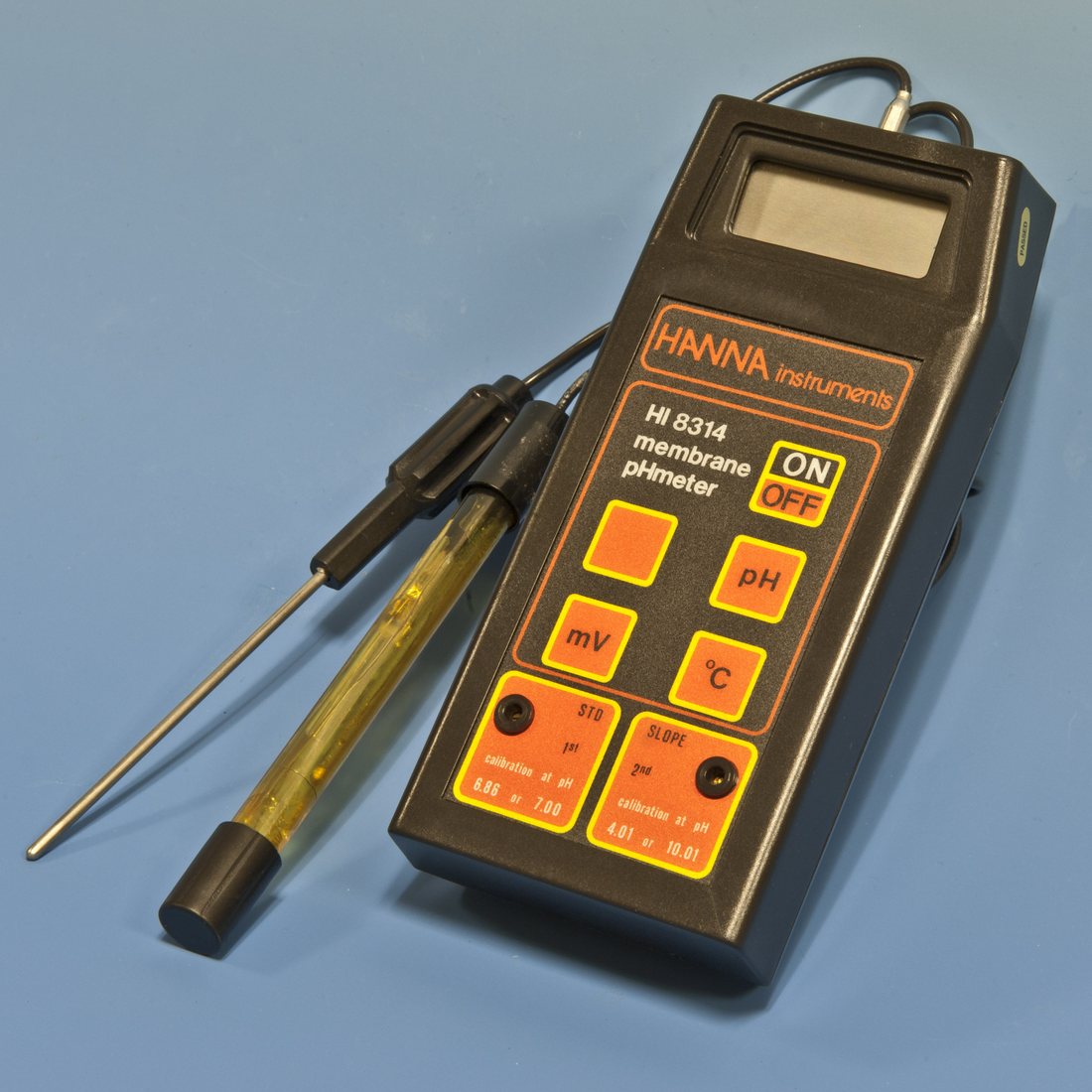
Note what is not in this photograph: the buffer solutions. They are the part nobody photographs and the part that decides whether any of the numbers mean anything.
Start here: you may not need one at all
I want to say this before the shopping list, because the shopping list is more fun and it is not the honest headline.
If you follow a tested recipe exactly — NCHFP, a current Ball book, a university extension publication — you do not need to measure anything. The measuring was already done, by people with laboratory meters, on that exact formulation, and the tested processing time is built on it. Buying a meter to check a tested recipe is like buying a scale to check a bag of flour.
The meter is for when you leave the tested recipe. Which is what most of us actually do:
- A ferment, where the acid is grown rather than added and nobody can predict where it lands.
- Cured olives, where the brine strength is yours and the ISS’s guidance is a salt figure, not an acid one.
- Hot sauce, chow chow, giardiniera, a marinade you invented on a Tuesday.
- Anything you want to put on a shelf that is not a published process.
- Scaling, substituting, or “just a splash of water” — the change that makes the failure invisible.
If that is you, read on. If it is not, you can stop here with a clear conscience.
The two numbers, not one
Everyone knows 4.6. Fewer people know that there is a second line at 4.0, and it is the one that decides what equipment you need.
| Reading | What it means | What you may measure it with |
|---|---|---|
| 4.0 or below | Comfortably acid, with margin | Paper or strips are acceptable |
| 4.0 to 4.6 | Legally acid, but close to the line | A meter. Nothing else. |
| Above 4.6 | Low-acid. Not shelf-stable by acid | A meter — and then a pressure canner or the fridge |
That first row is not my opinion, it is the regulation. 21 CFR 114.90, the methods section of the federal acidified-foods rule, permits colorimetric methods — indicator dyes, papers, strips — “if the pH is 4.0 or lower.” Above that, the rule expects a potentiometric measurement, which means a meter with a glass electrode.
⭐ This is the cleanest rule in the whole subject and almost nobody states it. Strips are not useless and they are not adequate; they are adequate in one specific band. A vinegar pickle at 3.2 does not need a $150 instrument. A ferment you hope is at 4.3 does.
🔴 The mistake that makes a good reading meaningless
Before any equipment: you have to measure the right thing, at the right time.
A jar of pickles is not one pH. Straight after packing, the brine might read 3.2 and the centre of a cucumber 5.4, because the acid has not got there yet. Measure the brine and you will congratulate yourself on a jar that is not safe.
Two consequences:
- Wait for equilibrium. The acid has to diffuse all the way in. For a canned product that is typically 24 hours or more after processing, and the whole basis of the acidified-foods rule is finished equilibrium pH, not the pH of the liquid you poured in.
- Measure the solids, or measure a representative blend. Which brings us to the part everybody improvises.
How to prepare a sample, from the regulation itself
21 CFR 114.90 is unglamorous and specific, and it is the best home guidance available because it is what the pros are held to:
- Semi-solid products: blend to a uniform paste. If it is too thick to read, “10 to 20 milliliters of distilled water may be added to 100 grams of product.”
- Marinated or oily products: pour off the oil first, blend the solids to a paste, and “no more than 20 milliliters of distilled water should be added to each 100 grams of product.”
- Mixed solid-and-liquid jars: purée solid and liquid in the same proportion as they sit in the jar. Not the brine alone. Not the solids alone.
⚠ Use distilled or deionised water, and no more than the ratio says. Tap water has its own buffering and its own pH, and it will drag your reading toward 7. Too much of any water dilutes the acid you are trying to measure.
And: take the reading at 20–30 °C, ideally 25 °C. Hot samples read wrong. Let it come to room temperature.
Meters: what the specification has to say
Accuracy is the only number that matters, and the extension services genuinely disagree with each other. I am giving you both because pretending there is consensus would be a lie:
- University of Wisconsin (Barb Ingham): “Purchase a pH meter with an accuracy of ±0.02 units or better.”
- Oklahoma State (William McGlynn): ±0.10 or better is workable — but explicitly warns that a ±0.2 meter “might present a problem if the pH of your product approaches the legal limit of 4.6.”
Both are right, and the disagreement resolves on distance from the line. A ±0.1 meter reading 3.3 tells you everything you need. The same meter reading 4.5 tells you almost nothing — your true value could be 4.6. The closer you sit to 4.6, the more accuracy you are buying.
My rule: ±0.02 if you are going to trust it, ±0.1 if you are only ever confirming that something is obviously acid.
Other things worth having:
- A replaceable probe. Glass electrodes die — a year or two of regular use, faster if abused. A sealed meter with a dead probe is landfill.
- ATC (automatic temperature compensation). Convenient, not essential if you calibrate immediately before use and let samples reach room temperature. Nice to have.
- A spear or flat tip if you work with solids — cheese, sausage, cured olives, thick relish. A standard round bulb designed for liquids will clog its reference junction in a purée and drift.
- Two-point calibration at minimum.
Calibration, which is the whole thing
An uncalibrated meter is not a less accurate meter. It is a random number generator with a decimal point, and it is genuinely more dangerous than no meter, because it produces false confidence.
- Buffers: pH 4.0 and pH 7.0. That is all you need for food. Skip the pH 10.
- Calibrate every day you use it. Not every reading — once per session is the standard advice.
- Pour buffer out into a clean cup and discard it after. Never dip the probe into the bottle, never pour used buffer back. You will contaminate a whole bottle in one careless move.
- Buffers expire. Roughly a year sealed; treat an opened bottle as good for months, not years. They are cheap. Replace them.
- Rinse with distilled water between buffer and sample, and blot — do not wipe. Rubbing the bulb builds a static charge and the reading wanders.
🔴 Storage kills more probes than use does
Never store a glass electrode in distilled water. This is the single most common way people destroy a meter, and it is usually done carefully and with good intentions.
The reference junction depends on a concentrated potassium chloride solution inside. Park the probe in distilled water and osmosis pulls that electrolyte out. The probe goes slow, then noisy, then useless.
Store it in the manufacturer’s storage solution (or, at a pinch, pH 4.0 buffer — never plain water, never dry). Keep the little sponge in the cap wet.
What to buy, and where
Three honest tiers. Prices are the ballpark I have seen and will drift.
Tier 1 — strips, ~$10–20
Buy narrow-range strips, not the 1–14 rainbow ones from a pool-supply aisle. For this work you want a 2.0–5.0 or 2.5–4.5 range so the colour blocks are close together and readable. Hydrion and MColorpHast are the names that turn up.
Good for: confirming a vinegar pickle, a hot sauce, or a mature ferment is where you expect. Not good for: anything between 4.0 and 4.6, per the regulation above.
Where: Amazon, homebrew shops, lab suppliers (Cole-Parmer, Grainger), cheesemaking suppliers.
Tier 2 — a pocket meter with a replaceable probe, ~$50–100
The sweet spot for a home kitchen. Look for ±0.01–0.02, ATC, two-point calibration, replaceable electrode. Apera’s PH60 series is the one most often recommended in this band, and the PH60S / PH60F spear-tip versions exist specifically for solid and semi-solid food — cheese, meat, canning.
Where: Amazon, the manufacturer direct, homebrew and winemaking retailers (which is genuinely the best-value channel — brewers have been buying good pH meters for years).
Tier 3 — a food-specific portable, ~$150–250
Milwaukee MW102 (±0.02, with the food/conical probe options) and Hanna’s Foodcare line (HI99161 and relatives) are the recognisable names. These are what a small producer or a cottage-food operation buys, and if you are ever asked to document a pH for a regulator or a farmers’-market licence, this is the tier that will be accepted.
Where: Test Equipment Depot, eSeasonGear, Hanna and Milwaukee direct, Amazon.
And the running costs nobody mentions
Budget for buffer sachets or bottles (4.0 and 7.0), storage solution, and a replacement probe every year or two. The probe is often a third to a half the price of the meter. A cheap meter with an unavailable probe is a false economy.
⚠ What not to buy
- The $12–15 no-brand aquarium/hydroponics pen. No ATC, no replaceable probe, accuracy usually unstated or ±0.1 at best, and frequently sold with no storage solution at all — so it arrives half-dead and gets finished off in a cup of tap water.
- Universal 1–14 strips. The colour blocks are a full pH unit apart. You cannot resolve 4.4 from 4.8 with them, and 4.4 and 4.8 are opposite sides of the only line that matters.
- A meter with no buffers in the box — unless you are buying buffers in the same order.
The short version
- Following a tested recipe? You do not need this page.
- Under 4.0 — strips are fine and the regulation agrees.
- Anywhere near 4.6 — meter, ±0.02, calibrated that day.
- Measure the finished, equilibrated product, blended, at room temperature — not the brine you poured in.
- Calibrate with fresh 4.0 and 7.0 buffer, and store the probe wet in storage solution.
- A reading you cannot trust is worse than no reading, because you will act on it.
Where this number comes from and what it protects against: Food Safety · Canning · Is This Safe? The Honest Answer · Fermentation Safety
Comments (0)