Keeping Them
How long things last, what to do when something looks wrong, and the small number of habits that have saved me more batches than any technique on the other pages.
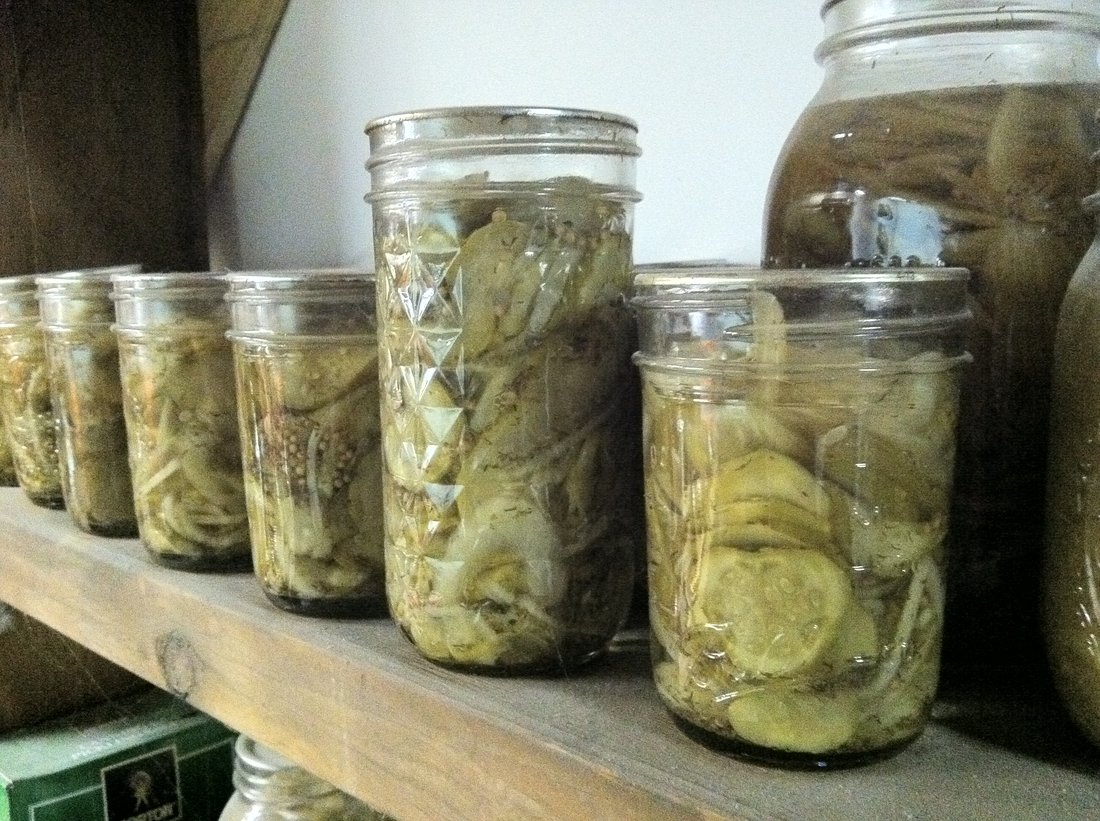
How long
These are working numbers for quality, not safety limits. A correctly canned jar is safe far longer than it is good.
| Where | How long | What ends it | |
|---|---|---|---|
| Refrigerator pickles | Fridge | 3–6 weeks | Texture goes soft |
| Canned pickles, sealed | Cool dark shelf | 1 year for best quality | Colour and crunch fade |
| Canned pickles, opened | Fridge | 1–2 months | Texture, then mold |
| Pickled eggs | Fridge only | 3–4 months | See the safety page |
| Pickled fish, vinegar | Fridge | 2–3 weeks | Gets firmer, then dry |
| Pickled fish, cream sauce | Fridge | 1 week | The dairy |
| Pickled pork | Fridge | 2–4 weeks | It’s a cure; it keeps |
| Home-cured olives in brine | Fridge | 6–12 months | Softening |
| Chow chow, relishes, canned | Shelf | 1 year+ | Colour |
Two things worth noticing. Pickled fish gets firmer with time rather than softer, for the protein reason on the fish page — so the end of its life is dryness, not sliminess. And canned pickles peak somewhere around one to three months and decline slowly after; a two-year-old jar is safe and dull.
Label everything
Every jar. Contents and date, in pen, on the lid or the side.
This sounds like nagging and it is the single highest-value habit in preserving. The jar I cannot identify is the jar I throw away, every time, without exception, and every unlabelled jar is a small future loss that has already happened. Masking tape and a marker cost nothing.
Add the batch number or a note if you are changing a recipe — “less sugar,” “2nd try, more garlic” — because otherwise the good batch and the mediocre one are indistinguishable in February.
Where to keep them
Cool, dark, dry. Heat and light are what kill a canned pickle’s colour and texture. A basement shelf is ideal; above the stove is the worst place in the house. Direct sun is genuinely bad — and in the pickled-egg case sunlight was a named contributing factor, not just an aesthetic problem.
Remove the screw bands from sealed canned jars for storage. This is a real recommendation, not fussiness: a band left on can hold a failed seal in place so the jar looks fine, and it traps moisture and rusts. Take them off, wash them, store the jars on the seal alone. Then a failed seal announces itself.
Reading a jar that looks wrong
| What you see | What it is | Do what |
|---|---|---|
| Cloudy brine | Table-salt additives, garlic, spice sediment | Nothing. Cosmetic |
| Blue or green garlic | Sulphur compounds + trace copper in acid | Nothing. Harmless |
| White sediment | Spice and vegetable solids settling | Nothing |
| Floating vegetables | Trapped air | Nothing. Push under in a fridge jar |
| Faded colour | Light exposure, or age | Fine to eat, store darker next time |
| Soft pickles | Pectinase | Disappointing, not dangerous |
| Shrivelled | Brine too concentrated | Fine to eat |
| Slimy or ropy brine | Bacterial growth | Discard |
| Mold on a vinegar pickle | Acid failed | Discard the jar |
| Bulging lid, spurting, pressure | Gas from microbial growth | Discard unopened. Do not taste |
| Unsealed canned jar | Seal failure | Refrigerate and eat now, or discard |
The line to hold: on a vinegar pickle, mold means something is genuinely wrong. That is different from a ferment, where surface kahm yeast is normal and gets scraped off. If the acid was right, nothing should be growing.
And never taste to check. Botulinum toxin does not change flavour, smell or appearance — which is the whole problem.
Reusing brine
Everybody asks and the answer is a qualified no.
Do not re-use brine to make a new batch of pickles, particularly not for canning. The first batch diluted it — the vegetables gave up water into it — so its acidity is now unknown and lower than it started. That is exactly the failure mode the safety page is about. ⚠ And “unknown” is the operative word: you can measure what is left, but a brine that reads acid today is not a brine of known strength tomorrow, which is why the answer stays no for canning.
Do use leftover brine for other things, and it is good for a lot of them:
- Drink it. The Turks are ahead of us here — turşu suyu is sold by the glass.
- In a vinaigrette, in place of the vinegar and some of the salt.
- In potato salad, coleslaw, deviled eggs — anywhere you want acid and dill at once.
- To brine chicken before roasting.
- In a cocktail. A pickleback is a legitimate use of a resource.
- A quick single-use refrigerator pickle — throw sliced onion or cucumber in the leftover jar, eat within a week, and do not pretend it is preserved.
Restarting a soft batch
You mostly cannot. Softness is structural — the pectin is broken and there is no putting it back.
What you can do is repurpose: soft cucumber pickles chopped into relish, tartar sauce, potato salad or deviled eggs are entirely good, because in all of those the texture you lost was never going to be noticed. I do this several times a year and it does not feel like a defeat.
Then go and read The Crunch Problem again, and look hard at the dill.
The four habits
After a lot of years, this is what I would actually pass on:
- Label every jar with contents and date. Nothing else on this list is close.
- Pickle the day you buy or pick. Most texture problems are decided before you start.
- Never reduce the vinegar in a canned recipe. Add anything you like; take away nothing.
- Keep a notebook, because the batch you want to repeat is always the one you improvised.
That last one is the one I am worst at, and it is why Grandma Hay’s recipes had to be rebuilt from memory and why my own pickled salmon is currently a reconstruction of my own cooking. Forty years on, I am still telling myself I will remember.
Comments (0)