Cucumbers
The default pickle. When somebody says “pickle” with no other word attached, in English, they mean a cucumber in vinegar — and as the history page points out, that meaning is only about three hundred years old and the word originally meant the brine.
This is also the vegetable where every technical decision in the section actually bites, because a cucumber is 95% water in a thin, fragile cell structure and it will punish you for getting anything wrong.
Buy the right cucumber
More batches are lost here than anywhere else, and no technique downstream can fix it.
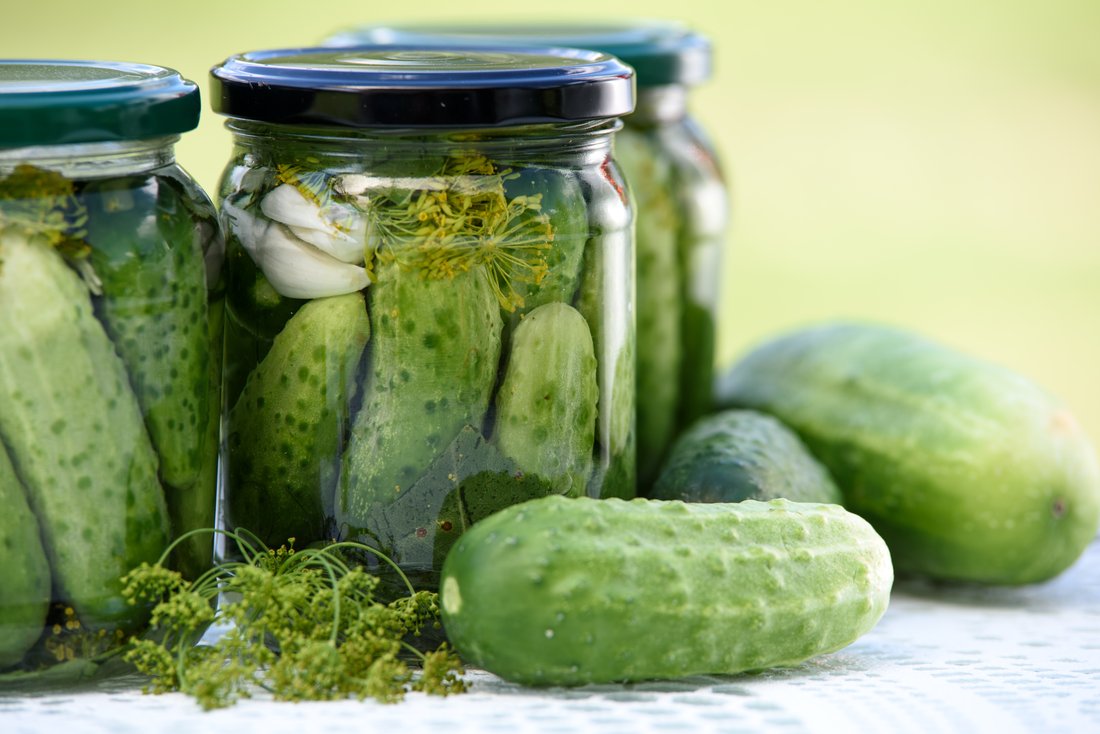
You want pickling cucumbers — Kirby, National Pickling, Boston Pickling, or whatever your market calls them. Short, squat, bumpy, thin-skinned, with small seeds and dense flesh. Not the long smooth waxed slicing cucumber, which has thick skin, big watery seeds and loose flesh, and which makes a limp, hollow pickle no matter what you do to it.
- Firm enough to be slightly awkward to bend.
- No soft spots, especially at the ends.
- Unwaxed. Wax stops brine getting in.
- Small. Under four inches for whole pickles. Big cucumbers are usually the hollow ones.
- Today. The enzyme clock starts when it leaves the vine.
The three modes, applied
Same decision as everywhere in this section, and for cucumbers it is the biggest fork.
Refrigerator pickles
Where I would tell anybody to start, and where most of my own cucumber output actually goes.
Pack raw cucumbers into a clean jar with dill, garlic and spice. Bring vinegar, water, salt and sugar to a simmer. Pour it over hot. Cool, then refrigerate. Eatable in hours, good the next day, excellent for a couple of weeks, gone before then.
No canner, no processing, no acid arithmetic — because the refrigerator is doing preservation work alongside the vinegar, the safety margin is much wider. This is the low-stakes version of the craft and it produces the crunchiest pickle of the three.
Jeff’s Refrigerator Pickles · Refrigerator garden pickles · Mom’s sliced cucumbers · Spicy refrigerator pickles · Zucchini pickles
Canned pickles
The same brine, water-bath processed, shelf-stable for a year. This is where the rules stop being advice — 5% vinegar, never diluted, tested proportions.
The trade is texture. A canned pickle has been held at boiling-water temperature and it is never going to be quite as crisp as one that went straight into the fridge. Calcium chloride and a tannin leaf close most of the gap.
Garlic dill, canned · Spicy garlic, canned
Ferment it instead
Salt brine, no vinegar, three to six weeks, and you get a completely different food — cloudy, funky, deep, alive. My favourite thing I make, and the hardest of the common vegetable ferments.
It is not in this section. It’s over here.
Styles worth knowing
Dill. The default. Fresh dill heads or dill seed, garlic, mustard seed, peppercorn, bay. Sharp, savoury, no sugar or nearly none.
Kosher dill. Not a religious designation — it refers to the generous garlic of the Jewish delicatessen tradition of New York. A kosher dill is a dill with the garlic turned up.
Bread-and-butter. Sweet-sour, sliced, with turmeric for the gold colour, onion, mustard and celery seed. Trademarked by Omar and Cora Fanning in 1923. Not for me — see the honest paragraph about sweet pickles — but properly popular.
Cornichons / gherkins. Tiny, tart, no sugar, usually with tarragon. The correct thing beside pâté and charcuterie.
Half-sour. Confusingly named, because a true half-sour is a ferment, not a vinegar pickle — a short brine cure that leaves the cucumber still bright green and crunchy in the middle. Half-sour pickles — and the cross-section reading that goes with it is on the fermentation page.
Spicy. Crushed red pepper, dried chilies, or fresh hot peppers in the jar. My habit in nearly everything. Spicy · Spicy dill garlic · Za’atar pickles
Whole, spears, or coins
Not just a shape decision — it changes the pickle.
- Whole — the slowest to take up brine, the crunchiest, the best keeper. Needs small cucumbers and patience. A whole pickle at one week is not finished.
- Spears — the compromise, and what most people want. Brine gets to the middle in a couple of days.
- Coins / chips — fastest by a long way, most surface area, softest soonest. Right for bread-and-butter, right for burgers, wrong for keeping.
- Sandwich planks — lengthwise slices. Same speed as spears, better geometry for a sandwich.
The rule: the more you cut it, the faster it pickles and the sooner it softens. Both ends of that trade are real.
The things that go wrong
| Problem | Cause | Fix |
|---|---|---|
| Soft | Pectinase — from the blossom end, the flesh, or the fresh dill | The whole page on it |
| Hollow | Grew that way, or sat too long before pickling | Float-test before packing; hollows float |
| Shrivelled | Brine too strong — too much salt, sugar or vinegar all at once | Dilute the sugar and salt, never the vinegar in a canned recipe |
| Cloudy brine | Table salt’s anti-caking agents, or garlic | Use pickling salt. Cosmetic either way |
| Bitter | Bitter cucumbers (a real varietal/stress trait), or too much alum | Taste a raw slice first; stop using alum |
| Blue-green garlic | Harmless sulphur/copper reaction in acid | Nothing. It’s fine |
| Floating | Trapped air | Hot pack, or pack tighter |
What I actually do
A pint jar, sliced cucumbers, three to five sprigs of dill, two smashed garlic cloves, half a cup each of white vinegar and water, a teaspoon and a half of pickling salt, a quarter teaspoon of sugar, peppercorns, yellow mustard seed, and a pinch of crushed red pepper. Brine simmered until the salt and sugar dissolve, poured over warm, into the fridge.
That is my refrigerator pickle and I have made it more times than anything else on this site. It takes about ten minutes and it is better than anything I can buy.
The thirty-gallon crock in the basement is a different hobby entirely, and it is through here.
Comments (0)