Herring, and My Father
Pickled herring is one of my very favourite things, and I got to it through my father.
He loved it. Two ways: in vinegar, and in cream sauce. And I want to be accurate about him, because it would be easy and dishonest to turn this into a story about a man who cured his own fish.
My father does not cook. He bought pickled herring — in large gallon containers — and ate it. That was the whole of it. Back then it was a popular buffet food, and it was everywhere on cruise ships, which is a good part of why a man in the American Midwest was eating quantities of a Northern European preserved fish in the first place.
That is not a lesser story. It is a story about somebody who knew exactly what he liked and got hold of it by the gallon, and it put pickled herring in front of me early enough that I have wanted it ever since.
🔴 The invention story is a myth, and it’s the same shape as the sauerkraut one
Every account of Dutch herring credits one man: Willem Beukelszoon of Biervliet, a humble fisherman who in the 14th century supposedly invented gibbing — gutting a herring while deliberately leaving the pancreas in, so that its enzymes cure the fish from the inside as it salts.
It is a wonderful story. It is on statues. And modern historians have taken it apart on three independent grounds:
- The legend does not appear in the historical record until the 17th century — roughly 250 years after the events it describes.
- Historians cannot confirm the man existed at all.
- Gibbing was not new. The technique had been in use for years before the date the legend assigns to its invention.
What actually changed is smaller and much more interesting: Dutch and Flemish fishermen started doing the gibbing aboard the ship instead of back on land. That is it. The innovation was where, not what — and it is enough, because a herring gutted and salted within an hour of coming out of the water is a different product from one carried to shore first. It let Dutch boats stay out longer, work further from home, and land a better fish, and a very large amount of Dutch wealth followed.
⭐ If that shape looks familiar, it should. It is exactly the Genghis Khan sauerkraut correction on the other side of this site: the technique is real and old, and the transmission story is the invented part. In both cases a nation needed an origin, and one got written.
The legend survived four centuries because the “royal herring” was load-bearing for Dutch national identity. That is not a criticism of the Dutch. It is how origin stories work everywhere, and this section keeps finding them.
What pickled herring actually is
Two stages, and it is worth understanding that it is not simply fish in vinegar.
Stage one: salt. The herring is salt-cured first — historically for weeks or months in barrels, commercially now in strong brine. This is what preserves it, firms the flesh, and starts the enzymatic curing that makes herring taste like herring rather than like raw fish. A pickled herring is a salt-cured fish that is then pickled, which puts it in interesting company with umeboshi — another thing the English word “pickled” is doing a poor job of describing.
Stage two: the pickle. The salted fillets are soaked to draw salt back out, then packed in a vinegar brine with onion, bay, allspice, peppercorn, mustard seed, and usually sugar.
The two my father ate
In vinegar. The clear kind. Vinegar, water, sugar, onion rings, whole spice. Sharp, clean, and the version I would put in front of somebody who has never had it.
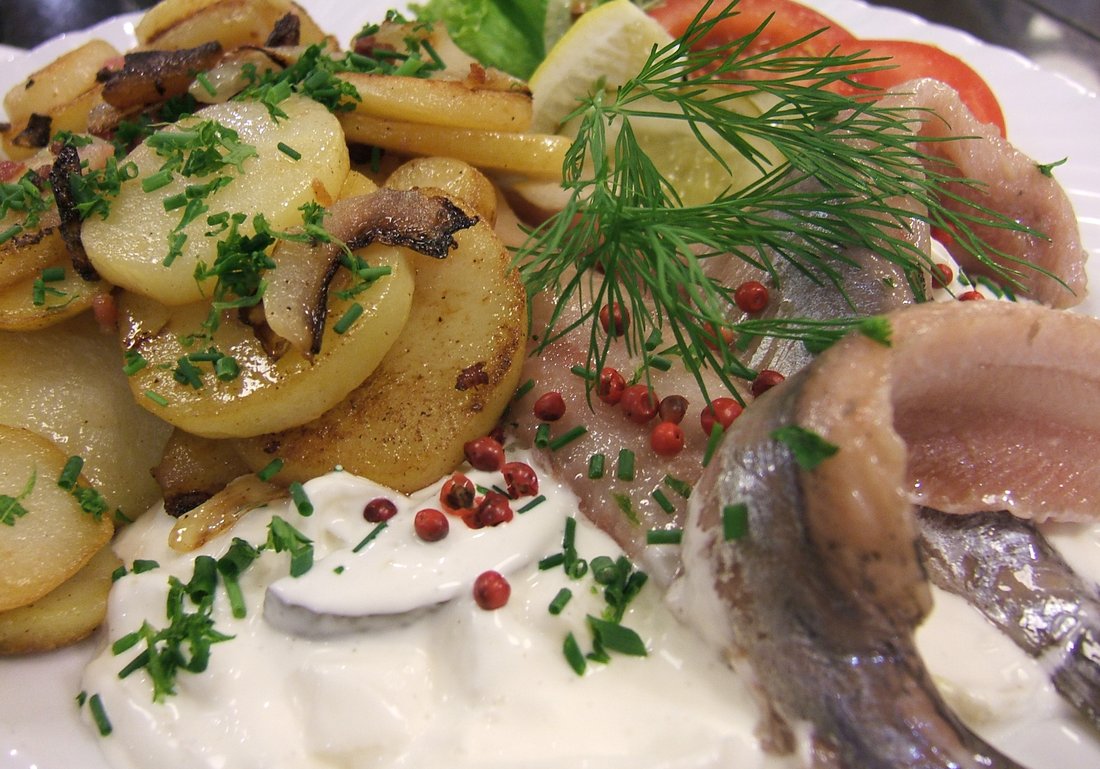
In cream sauce. The same cured fish, dressed in sour cream with onion and often dill, and sometimes apple. Softer, rounder, and to many people — my father included — the better of the two. Note that the cream sauce goes on after the fish is already cured and pickled; the dairy is a dressing, not a preservative, and cream-sauce herring is strictly a refrigerator food.
Recipes: Herring, Pickled, in Vinegar · Herring, Pickled, in Cream Sauce
The named styles
Worth knowing, because the labels are not interchangeable:
- Matjes — young, fat herring caught before spawning, mildly cured, traditionally gibbed. The delicate one. Dutch maatjesharing, Swedish matjessill.
- Rollmops — a fillet rolled around a pickled cucumber or onion and pinned with a stick, then pickled. German, and the name is exactly what it looks like.
- Bismarckhering — vinegar-cured fillets, sharper, named after the Chancellor.
- Surströmming — Swedish, and not this section at all. That is a fermented herring, and it is famous for a reason. Fermentation.
- Soused herring — the British term, essentially the vinegar cure.
Denmark
I ate pickled herring in Denmark. WOW — what a thrill.
The Danish version comes on rye, usually as part of smørrebrød, and the thing that struck me was how completely normal it was — not a delicacy, not a novelty, just lunch. Which is exactly what you want when you have spent years liking something that your own country treats as an oddity found on buffet tables.
That opened onto the rest of it — Russia and further east, where pickled fish stops being a side dish and becomes the centre of the table.
Buying it
Most people will buy rather than make, and there is no shame in it — my father bought it by the gallon and he was right.
- The jars in the refrigerated case are far better than the shelf-stable ones.
- Read for matjes if you want mild, Bismarck if you want sharp.
- Cream-sauce herring goes off faster than vinegar herring. Check the date and eat it.
- It is not expensive, which is a pleasant thing to be able to say about a preserved fish.
If you do make it, and if you are curing from raw rather than starting with a salt-cured fillet, read Freezing Fish first. That page exists for a reason.
Comments (0)