Salt & Water
Salt is the only ingredient in a vegetable ferment besides the vegetable, and it is the one number you never guess. Get the salt right and fermentation is remarkably forgiving. Get it wrong and no amount of technique saves the batch.
This page is the arithmetic, the salt types, and which of the folklore actually holds up — because a fair amount of it doesn’t.
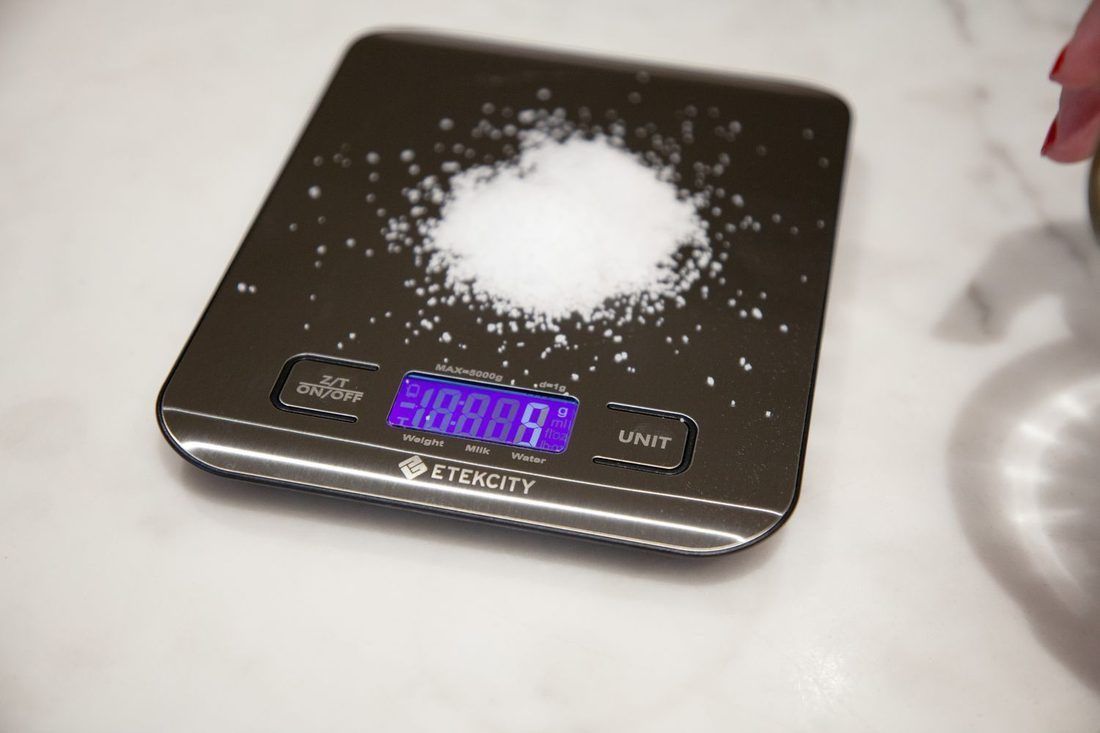
Weigh it. Always.
Volume measurements of salt are close to meaningless. Salt crystals differ enormously in bulk density, and the difference is not small:
| Salt | Approx. weight per tablespoon | Relative to fine pickling salt |
|---|---|---|
| Fine canning/pickling salt | ~17–19 g | 1.0 |
| Table salt (fine, iodized) | ~18–19 g | ~1.0 |
| Morton kosher salt (flake) | ~14–15 g | ~0.8 |
| Diamond Crystal kosher (hollow flake) | ~9–10 g | ~0.55 |
| Coarse sea salt | ~14–17 g | ~0.85 |
A recipe written in tablespoons of fine pickling salt, made with Diamond Crystal, delivers a bit over half the intended salt. That’s not a subtle seasoning difference — that’s dropping a 2.25% kraut to about 1.25%, which is below where I’d be comfortable. This one substitution accounts for a lot of mushy, off-tasting, “I followed the recipe” first batches.
A $15 scale makes the entire problem disappear. It’s the only equipment purchase in this section I’d call mandatory.
The two ways to compute salt
There are two situations and they use different math. Mixing them up is the other common beginner error.
Method 1 — self-brining (percentage of vegetable weight)
For shredded or sliced vegetables that you salt directly and that release their own liquid: sauerkraut, kimchi, shredded roots. You add no water at all.
salt = vegetable weight × target percentage
900 g of shredded cabbage at 2.25% → 900 × 0.0225 = 20 g of salt. That’s it.
The salt osmotically pulls water out through the cell walls, and that liquid is the brine. This is why you have to massage or pound it, and why you pack it hard: you’re both extracting the brine and compressing the mass under it.
Method 2 — added brine (percentage of the water)
For whole or large-cut vegetables that can’t be crushed: cucumbers, whole beans, cauliflower, carrot sticks, whole peppers, garlic. You submerge them in brine you mixed.
salt = water weight × target percentage
For 2000 g (2 litres) of water at a 5% brine → 2000 × 0.05 = 100 g of salt.
Water is convenient here: 1 litre = 1000 g, so a litre of water at 5% needs 50 g of salt and you can do it in your head.
⚠ A real subtlety worth knowing: the vegetables contain water too, and as fermentation proceeds, osmosis equalizes salt between the brine and the vegetable interiors. So a 5% brine around cucumbers ends up as a considerably lower overall salt concentration once everything equilibrates. That’s exactly why brined-cucumber percentages look alarmingly high next to kraut’s — they aren’t comparable numbers. A 5% cucumber brine and a 2.25% kraut end up in roughly similar territory.
The percentages I use
| Ferment | Salt | Method | Notes |
|---|---|---|---|
| Sauerkraut | 2.25% | Self-brine | The standard. 2.0% low end, 2.5% for warm rooms |
| Kimchi | 2–3% on the cabbage | Brine-then-rinse, then paste | Two-stage; see Kimchi |
| Cucumber pickles | 5–8% brine | Added brine | High, for crunch and safety. Details |
| Carrots, beans, cauliflower | 3–3.5% brine | Added brine | Firm vegetables, forgiving |
| Radish, turnip | 2.5–3% brine | Added brine | |
| Peppers / hot sauce mash | 3–5% brine | Added brine | Higher for long ferments |
| Whole garlic cloves | 3% brine | Added brine | Slow; expect blue-green color, harmless |
| Beets | 2.5–3% brine | Added brine | Very sugary — ferments fast |
| Salsa-style mixes | 2.5–3% | Self-brine | Tomato is low-acid-ish and sugary; don’t go lower |
The NCHFP sauerkraut recipe, for cross-reference, is 5 lb shredded cabbage + 3 Tbsp canning salt, with a top-up brine of 1½ Tbsp salt per quart of water if the cabbage’s own juice doesn’t cover it. Run the arithmetic: 3 Tbsp of fine canning salt is roughly 51–57 g, 5 lb is 2268 g, so that’s about 2¼–2½% by weight — which is where the 2.25% figure comes from, and a good demonstration of why percentage beats tablespoons.
What salt actually does
Four separate jobs, which is why you can’t just leave it out:
1. It selects. Most spoilage organisms tolerate salt poorly; lactic-acid bacteria tolerate it comparatively well. Salt handicaps the competition for the days before the acid takes over. This is the safety function.
2. It extracts. Osmosis pulls water out of the vegetable, creating the brine that submerges it. No salt, no brine, no anaerobic environment.
3. It firms. Salt helps stabilize pectin in cell walls. Under-salted ferments go soft; this is the most common texture failure and it’s usually a salt problem, not a temperature problem.
4. It slows. More salt = slower fermentation. That’s often what you want — a slow ferment is a more complex, better-tasting ferment, and it keeps longer.
What happens at the wrong percentage
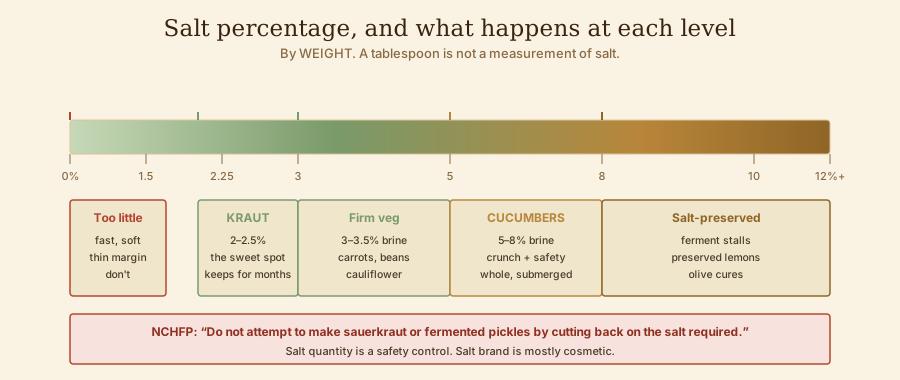
Under ~1.5%: Fast, soft, prone to off-flavors and surface growth. Margin gets thin. Don’t.
1.5–2%: Works, ferments quickly, softer texture, shorter keeping. Fine for a batch you’ll eat in two weeks. This is the “low-salt kraut” territory and it’s a real tradeoff, not a free lunch.
2–2.5%: The sweet spot for kraut. Reliable, good texture, good flavor, keeps for months.
2.5–3.5%: Slower, firmer, saltier. Good for warm rooms, long ferments, and firm vegetables.
Above ~5%: Fermentation slows dramatically. Leuconostoc is largely suppressed, and you’re into the territory of true salt-preserved vegetables — preserved lemons, some olive cures, Chinese and Korean long-keeping vegetables. Different food, and legitimate.
Above ~10%: Almost nothing ferments. This is salt curing, not fermentation.
🔴 The iodized-salt myth, examined
Every source tells you never to use iodized table salt because the iodine kills your culture. It’s stated as flat fact everywhere. It’s overstated, and the actual sourced concern is different.
Here is what NCHFP actually says, verbatim:
“Use canning or pickling salt. Noncaking material added to other salts may make the brine cloudy.”
That’s it. Cloudiness. The documented objection to table salt is the anti-caking agent — usually sodium aluminosilicate or calcium silicate — clouding the brine. Cosmetic.
Meanwhile, on the thing that genuinely matters, NCHFP is emphatic:
“Caution: Do not attempt to make sauerkraut or fermented pickles by cutting back on the salt required.”
So the priority is exactly backwards in the popular telling. Salt quantity is a safety control. Salt brand is mostly cosmetic preference. Iodine at table-salt concentrations is a plausible mild inhibitor, and I’m not going to claim it does nothing — but “it will kill your ferment” is a much stronger claim than the evidence I could find supports, and I’d rather tell you the sourced version.
Practically: use canning/pickling salt because it’s cheap, pure, dissolves cleanly, and removes the question. If all you have is iodized table salt and you want kraut tonight, weigh it correctly and make the kraut. Correct weight of the “wrong” salt beats guessed volume of the right one, every time.
Which salts to use
Good: canning/pickling salt (fine, pure, cheap — the default); non-iodized fine sea salt; kosher salt weighed, not measured; pure rock/mined salt.
Fine but note: coarse sea salt (dissolve it first or it sits on the bottom); Himalayan pink and other mineral salts (they work; the mineral content is a rounding error and the health claims are marketing); Korean cheonyeom / coarse solar salt (traditional for kimchi and genuinely different — coarser, slower-dissolving, and traditionally aged to reduce bitterness).
Avoid: anything with anti-caking agents if you care about clarity; anything with added dextrose or “free-flowing agents”; and absolutely never any salt containing nitrite. Curing salt — Prague Powder, Cure #1, “pink salt” in the curing sense — is not table salt, is dyed pink so you don’t make this mistake, and belongs in sausage, not in kraut. It is a real poisoning risk at kraut quantities.
⚠ That naming collision is genuinely dangerous: “pink salt” means Himalayan salt to a home cook and sodium nitrite to a charcutier. Two completely different things, one of which is toxic in tablespoons.
Water
Less critical than salt, but there are three real issues.
Chlorine and chloramine. Municipal water is disinfected precisely to suppress bacteria, which is the opposite of what you want. Chlorine dissipates if you leave water out overnight or boil it briefly. Chloramine does not — it’s used because it’s persistent — and boiling won’t remove it. If your utility uses chloramine (they’ll tell you; it’s public information), use filtered water, a carbon filter, or a campden tablet from a brewing shop.
In practice: I have never had a ferment fail from tap water, and plenty of people use it straight. But if a batch is inexplicably sluggish, this is the second thing I’d check after temperature.
Hard water. Generally helpful — calcium contributes to pectin firmness. Very hard water can cloud a brine. Not a problem worth solving.
Never use softened water. Ion-exchange softeners swap calcium for sodium, which means your water already carries salt you didn’t account for, and you’ve lost the calcium that firms texture. Use the untreated tap if you have one.
Additives, and whether they work
Tannins for crunch — grape leaves, oak leaves, horseradish leaves, black tea. The traditional trick, and the mechanism is real: tannins inhibit the pectinolytic enzymes that soften pickles. Modest effect, harmless, and a grape leaf in the crock is a pleasing thing to do. Worth it.
Calcium chloride (“Pickle Crisp”) — food-grade calcium salt. Genuinely effective at firming, and it’s the honest modern answer to soft pickles. Not a fermentation aid; a texture aid.
Alum — traditional, and now generally discouraged. NCHFP doesn’t recommend it. Skip it; calcium chloride does the job better.
Whey, starter culture, or brine from a previous batch — you can, and it speeds the start. Understand what you’re doing: you’re shortening the vulnerable early window, which is a real benefit for a low-salt or warm ferment. But vegetables come fully inoculated already, and adding whey is not necessary. A splash of live brine from your last good batch is the version I’d actually use.
Sugar — no, not for vegetables. There’s plenty already. Sugar belongs in the beverage ferments where it’s the whole fuel supply.
Where to go next
- The Basics — why salt is a safety control, in the context of the whole succession.
- Sauerkraut — the 2.25% method in practice.
- Fermented Pickles — where the high brines and the crunch problem live.
- Troubleshooting — soft, slimy, stalled, or too salty.
Comments (0)