Troubleshooting
This is the page to read before something goes wrong. Nearly every panicked “is this ruined?” question has one of about a dozen answers, and most of the answers are “that’s normal, carry on.”
The one distinction genuinely worth learning is kahm yeast versus mold, because getting it wrong in one direction throws out a good batch and getting it wrong in the other direction is a bad decision. So that’s first.
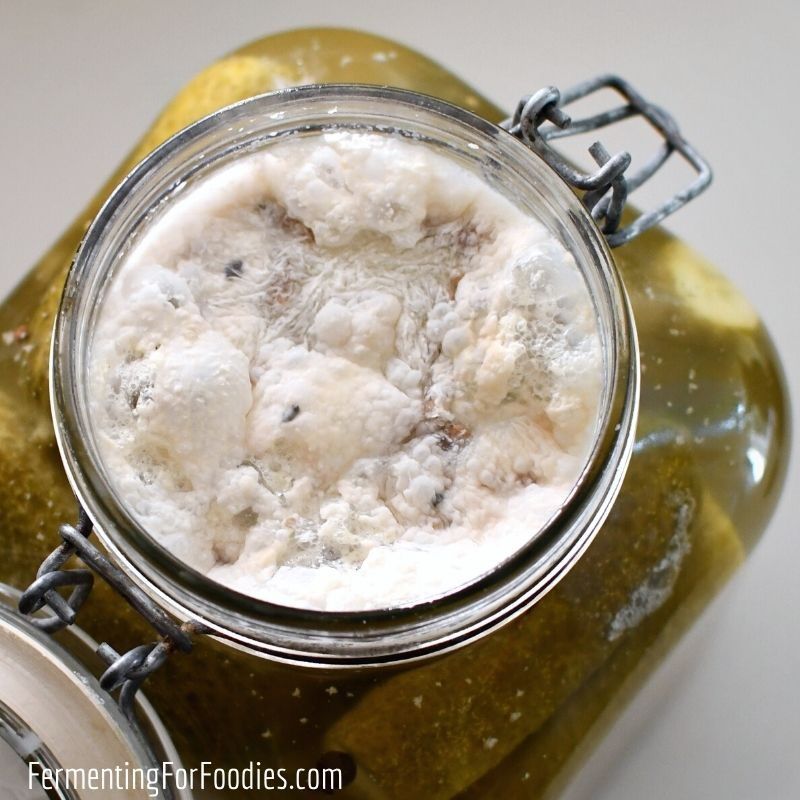
🔴 Kahm yeast versus mold
Both appear on the surface. They are completely different and the responses are opposite.
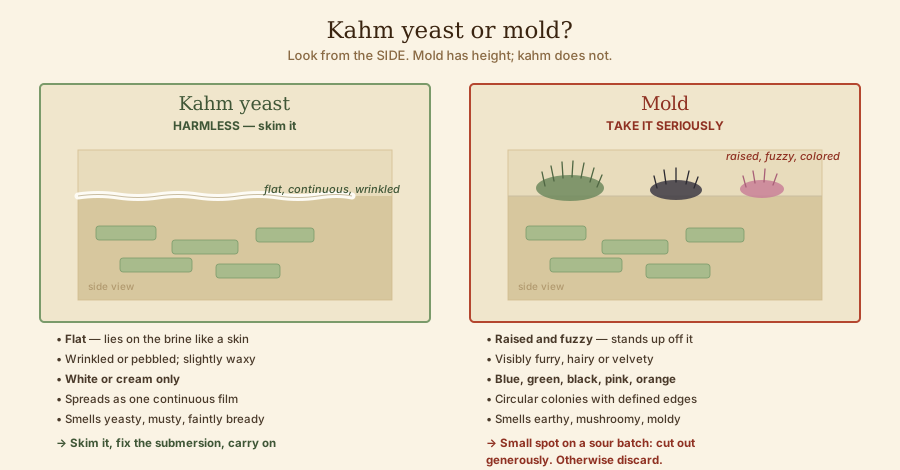
| Kahm yeast | Mold | |
|---|---|---|
| Texture | Flat. Lies on the surface like a skin | Raised and fuzzy. Stands up off the surface |
| Surface | Wrinkled, pebbled, sometimes smooth; slightly waxy or powdery | Visibly furry, hairy, or velvety |
| Color | White or cream only. Sometimes faintly grey or yellowish | Blue, green, black, pink, orange — or white and fuzzy |
| Shape | Spreads as a continuous film across the whole surface | Circular colonies with defined edges, spreading outward |
| Smell | Yeasty, musty, slightly bready | Musty, earthy, mushroomy — mold-smelling |
| Verdict | Harmless. Skim it | Take it seriously |
The single most reliable test is texture. Flat and skin-like = kahm. Raised and fuzzy = mold. If you’re looking down at it and can’t tell, look from the side — mold has height, kahm doesn’t.
If it’s kahm yeast
Skim it off and get on with your life. It’s a wild acid-tolerant, oxygen-loving yeast that colonizes the brine surface. It’s harmless. It can impart a slightly musty flavor if you let it build for weeks, so don’t ignore it — but it’s a nuisance, not a hazard.
Why you got it: something was exposed to air. Almost always one of:
- Brine level dropped below the vegetables
- The weight floated or shifted
- Fermenting warm
- Salt a bit low
- An open crock rather than a sealed vessel (kahm is much rarer in a jar with an airlock or a water-sealed Gärtopf — one of the better arguments for buying one)
If it’s mold
Be honest with yourself about scale, because the answer genuinely depends on it.
A small isolated spot on the surface of a large, well-established, sour ferment: remove it generously — the spot plus a good margin plus the top inch of vegetables — check that everything below is submerged and smells right, re-weight, and continue. Traditional practice has always done this, and a mature acidic ferment is a hostile place for mold to penetrate.
Throw the whole thing out if:
- The mold is extensive, or there are several colonies
- It’s black (be more conservative with black mold)
- It’s pink or orange — often bacterial rather than fungal, and a sign the ferment failed to acidify properly
- Anything below the surface looks or smells wrong
- The batch is young and not yet properly sour — it has no acid defense yet
- It’s on something soft or porous you can’t meaningfully remove mold from
- You’re not sure. This is the real rule.
On kombucha specifically: discard the batch and the pellicle both, and restart with fresh starter liquid. Don’t try to rescue a molded kombucha; the pellicle is porous and you can’t clean it.
Why you got it: same causes as kahm, plus insufficient starter/acid at the beginning. Mold needs air, so it’s always a submersion failure.
Texture problems
Soft or mushy — the most common complaint
Usually cucumbers, and usually a stack of causes rather than one. In order of how much they matter:
- Old cucumbers. The biggest factor by far. A cucumber starts losing firmness the moment it’s picked. Ferment them the day you get them.
- You didn’t cut off the blossom end. NCHFP: remove a 1/16-inch slice from the blossom end, which carries the pectin-digesting enzymes. Two seconds per cucumber, enormous payoff. See Fermented Pickles.
- Too warm. NCHFP again: above 80 °F and pickles become too soft during fermentation. August is cucumber season and August kitchens are hot. Ferment somewhere cool.
- Not enough salt. Salt firms pectin. Under-salting is a texture problem before it’s a safety problem.
- Fermented too long. Softening is progressive.
- Blossoms or flower parts left in. Same enzyme.
- No tannins. Grape, oak or horseradish leaves, or a black tea bag, genuinely help.
The fix for next time, in one line: fresh cucumbers, blossom end off, 5%+ brine, cool room, tannin leaves, and consider food-grade calcium chloride.
Can you fix a soft batch? No. Texture doesn’t come back. It’s still safe to eat if it’s sour and smells fine — make relish out of it.
Hollow pickles
Cucumbers that were already hollow (grown too fast, or too big), or that sat too long before fermenting, or fermented too fast/too warm. Float them before you start — hollow cucumbers float, which is a genuinely useful pre-screen.
Slimy or ropy brine
Early and mild: can be normal. Some Leuconostoc strains produce dextran and a slight viscosity that resolves as the ferment progresses. Wait a few days.
Persistent, stringy, with a bad smell: that’s not going to fix itself. Discard.
Slimy garlic or slimy individual vegetables: discard those pieces.
Everything’s too salty
You measured by volume instead of weight, or used the wrong salt. See Salt & Water — a tablespoon of Diamond Crystal is about half the salt of a tablespoon of fine pickling salt, and recipes rarely say which.
The fix: you can rinse finished ferments before eating, or serve them as a condiment in small amounts, or dilute the brine (which slows the ferment further). Or use it as a seasoning — over-salted kraut is excellent stirred into things.
Activity problems
Nothing’s happening after 3–4 days
In order of likelihood:
- Too cold. Below about 55 °F everything crawls. Move it somewhere warmer.
- Chlorinated water — if you used tap water for a brine and your utility uses chloramine (which boiling won’t remove), that’s a real suppressant. Filtered water next time.
- Too much salt. Above 5–6% things slow dramatically; above 10% almost nothing ferments.
- Over-washed, waxed, or long-stored produce, carrying a depleted surface population. See The Basics — the culture comes from the vegetable.
- It IS happening and you can’t see it. Bubbles are the Leuconostoc stage; a slow cool ferment can be quiet. Taste it. If it’s souring, it’s working. Sourness is the actual measure, not bubbles.
It bubbled hard and then stopped
Normal, and it’s the most common false alarm. The gas-producing early stage finished; the acid-producing stage continues silently. Nothing is wrong.
Bubbling over / overflowing
Normal. You didn’t leave enough headspace — 3 inches in a jar. Put it on a tray, wipe it up, and top up the brine with fresh 2% brine if the level dropped below the vegetables.
The brine level dropped
Fix it immediately — this is the failure that actually loses batches. Top up with cooled brine at the same concentration (not plain water, which dilutes your salt). Check the weight hasn’t floated.
The airlock dried out / the crock’s water moat dried out
Refill it. If it was dry for a while, you effectively had an open vessel — check the surface for kahm or mold and skim if needed. In a dry heated house a Gärtopf moat evaporates faster than you’d expect; set a reminder.
Smell and taste
How do I know if a smell is “wrong”?
The honest answer is that a bad ferment is not subtle, and the vocabulary helps:
Fine — expected: sour · sharp · tangy · vinegary · yeasty · bready · beery · sulfurous in the first few days (normal for cabbage-family) · funky · pungent · cheesy-in-a-good-way for long ferments.
Not fine — discard: putrid · rotten · fecal · like garbage · sickly sweet · rancid · like nail polish remover (acetone) · genuinely nauseating.
The distinction people struggle with is pungent versus putrid. Kimchi and long kraut are genuinely strong-smelling foods, and strength isn’t the signal. Character is. Rot smells like rot, and you already know what rot smells like — trust that.
It tastes fizzy / carbonated
Normal. Dissolved CO₂. It’ll fade in the fridge.
It tastes like alcohol or nail polish
Yeast outcompeted the bacteria — usually too warm, or too much sugar in the mix (fruit or a lot of beets). Ferment cooler next time. Mild alcohol notes are fine; a strong acetone smell means discard.
It’s not sour enough
Not done. Give it more time, or move it somewhere warmer. Also check the salt wasn’t too high.
It’s too sour
Went too long. Refrigerate to slow it. And remember with kimchi that over-sour is a feature — sour kimchi is cooking kimchi and arguably the more valuable state. Same with kraut in bigos, and with over-fermented kombucha, which is just vinegar.
Color changes
- Bright green → olive drab (pickles): normal and the correct sign of doneness. Acid acting on chlorophyll. A pickle still bright green in the center isn’t finished.
- Cabbage going translucent pale gold: normal, correct.
- Red cabbage going brilliant magenta: normal, and spectacular. Acid shifting the anthocyanins.
- Garlic turning blue or green: harmless. A reaction between sulfur compounds and trace copper. Startling the first time. Eat it.
- Pink cast throughout kraut (not on the surface): can indicate a particular yeast, often associated with uneven or too little salt. If it smells fine it’s usually edible; if there’s pink growth on the surface, discard.
- Brown or grey at the very top: oxidation of the exposed layer. Remove it; the rest is fine.
- Darkening overall: normal with time and with iodized salt or hard water. Cosmetic.
Yogurt and dairy
Covered fully on Yogurt, but the short list:
- Didn’t set: temperature wrong (above ~115 °F kills the culture), dead starter, or culture added to too-hot milk.
- Thin: skipped the 180 °F hold — that’s the usual cause.
- Too sour: too long or too warm.
- Watery whey on top: normal in small amounts; a lot means the set was disturbed while warm.
- Culture weakening over generations: real. Expect 10–20 generations of backslopping before you need a fresh starter.
The decision tree
When you genuinely don’t know:
- Is anything raised and fuzzy and colored? → Mold. Small spot on a mature sour ferment: remove generously and continue. Otherwise discard.
- Is there a flat white film? → Kahm yeast. Skim, fix the submersion, continue.
- Does it smell putrid, rotten, or sickly-sweet rather than sour? → Discard.
- Is everything under the brine and does it smell sour? → It’s fine, whatever it looks like.
- Still unsure? → Discard it. A batch costs a few dollars and three weeks. That’s the cheapest insurance in cooking, and after thirty-plus years of doing this I’ve thrown out maybe half a dozen batches — every one because I let something ride above the brine.
Where to go next
- Safety — the full risk picture, including where fermentation genuinely is dangerous.
- Salt & Water — most texture and activity problems trace back here.
- Vessels & Crocks — the hardware that prevents most of this.
- The Basics — what normal looks like, from the beginning.
Comments (0)