Sauerkraut
Sauerkraut is the ferment I love most and the one I make the most of. It’s cabbage and salt. There is no third ingredient, no culture to buy, no equipment you can’t improvise, and the result is one of the great foods. It’s also the ferment that taught me everything else in this section — my first attempt failed, and figuring out why is what made the rest of it make sense.
And it is why my house smells the way it does. Thirty gallons of cabbage going sour in the basement announces itself through a closed door, up a flight of stairs, and into every room. I consider that a feature.
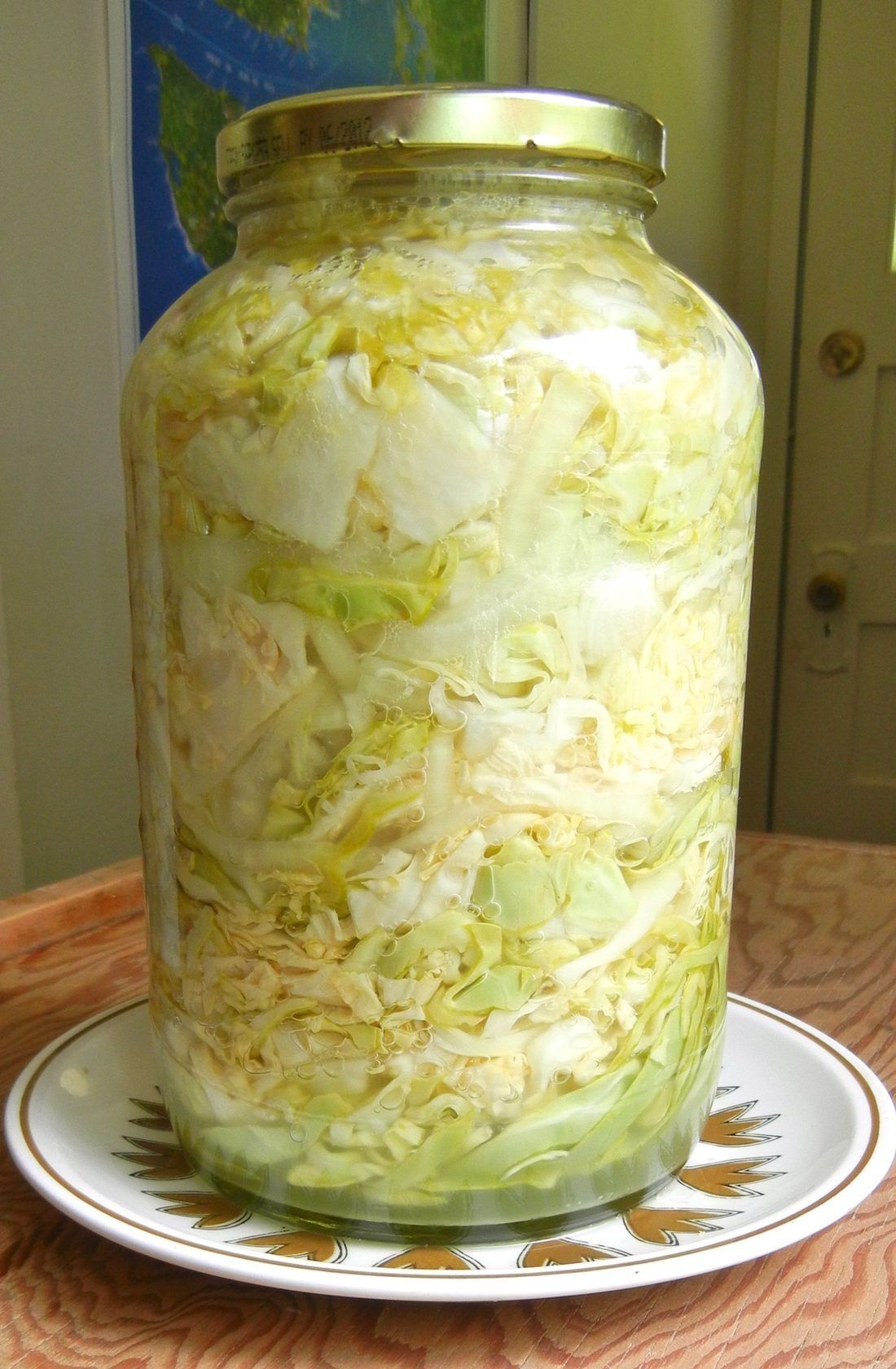
Two ingredients
Cabbage and salt at 2.25% of the cabbage’s weight. No water — the salt pulls the brine out of the cabbage. That’s the whole recipe, and everything below is refinement.
The full method start to finish is on Getting Started, and the recipe is Sauerkraut, Basic. Here I want to go deeper: the cabbage, the cut, the timing, the temperature, the scale, and the variations that are actually worth making.
The cabbage
Plain green storage cabbage is the right cabbage. Not savoy, not napa, not red as a first choice. Ordinary tight-headed green cabbage — the boring one — has the right combination of density, sugar, and low water content.
What to look for:
- Heavy for its size. Density is everything. A light head is a watery head, and watery cabbage makes limp kraut.
- Tight, squeaky, glossy. Loose leaves mean it’s been sitting.
- Late-season and locally grown if you can. Fall cabbage grown for storage has more sugar and more dry matter than spring cabbage, which means a stronger ferment and better texture. It’s also carrying a fuller population of the wild bacteria doing the work — see The Basics.
- Unwaxed. Waxed produce sometimes starts sluggishly.
Cabbages to know about:
| Cabbage | Verdict |
|---|---|
| Green storage cabbage | The standard. Use this. |
| Red cabbage | Excellent kraut, spectacular color — a deep magenta as the acid shifts the anthocyanins. Slightly tougher, slightly less sweet. Worth making for the color alone. |
| Savoy | Crinkled, loose, watery. Makes soft kraut. Not my choice. |
| Napa | Wrong cabbage for kraut — right cabbage for kimchi. Too tender and too wet; it collapses. |
| Pointed / sweetheart | Tender and sweet, ferments fast, softer texture. Pleasant, not for keeping. |
The cut
Thickness sets the texture and it sets the speed, and it’s a real decision rather than a detail.
- Fine (about ⅛ inch) — the classic. Ferments evenly, packs tightly, releases brine readily, and gives you that tangle of translucent strands. This is what I do most of the time.
- Coarse (¼ inch or more) — more crunch, slower, packs less well. Good if you like a substantial kraut.
- Quartered or wedged heads — the traditional Eastern European approach, and how you get whole fermented leaves for cabbage rolls. It needs added brine because whole wedges won’t release enough liquid, and it needs a lot longer.
- Grated or food-processed — don’t. It ruptures too many cells, releases too much water, and the result is mush.
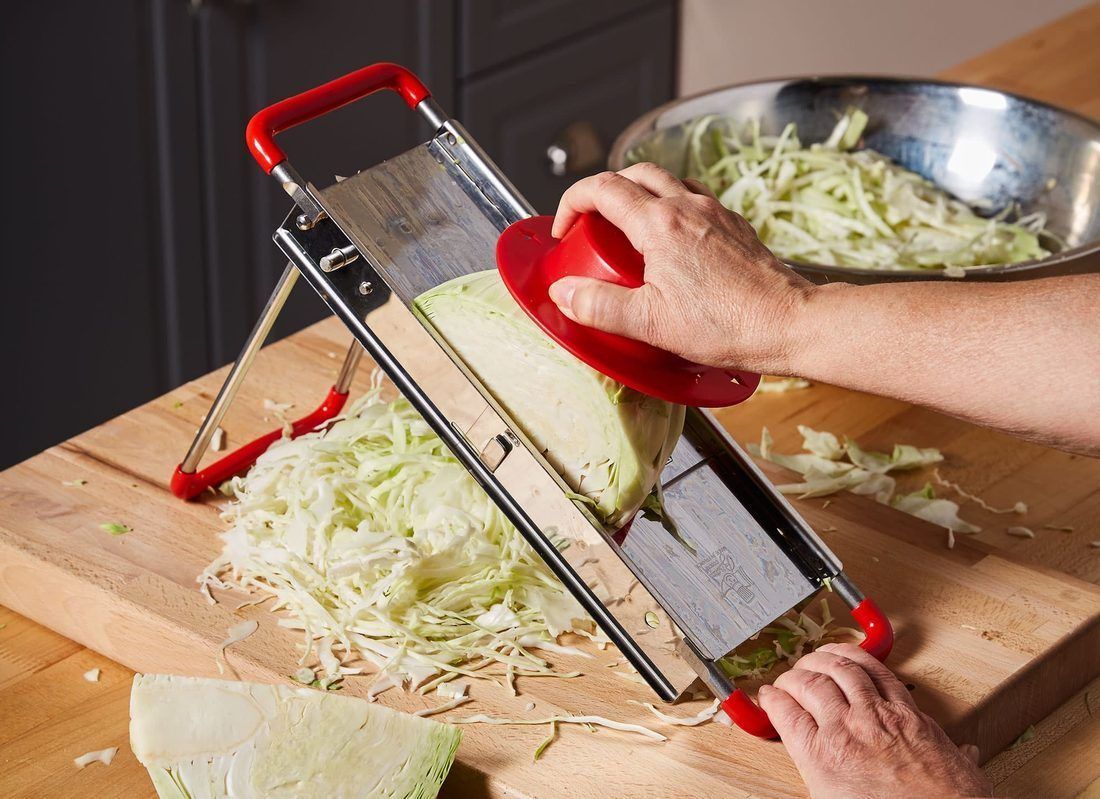
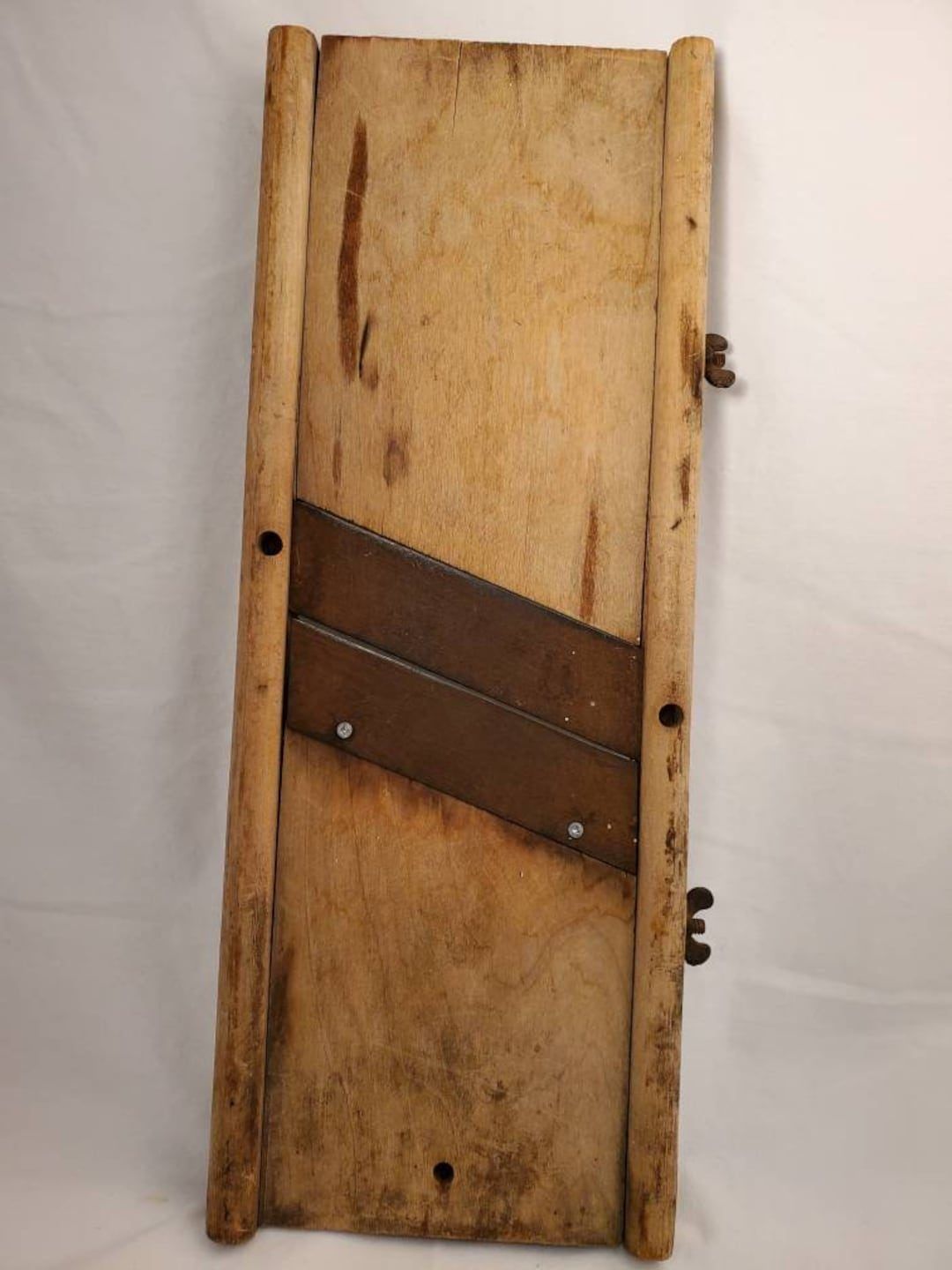
A mandoline or a traditional kraut board makes short work of it and gives you consistency, which matters more than speed: unevenly cut cabbage ferments unevenly. For 30 gallons, a kraut board stops being a nicety.
Working the salt in
Salt the shredded cabbage and then massage or pound it for five to ten minutes. It resists, and then it gives all at once — the volume collapses by roughly half and a real puddle of brine appears.
Massaging by hand is what I do for jar-sized batches. Clean hands, squeeze and crush.
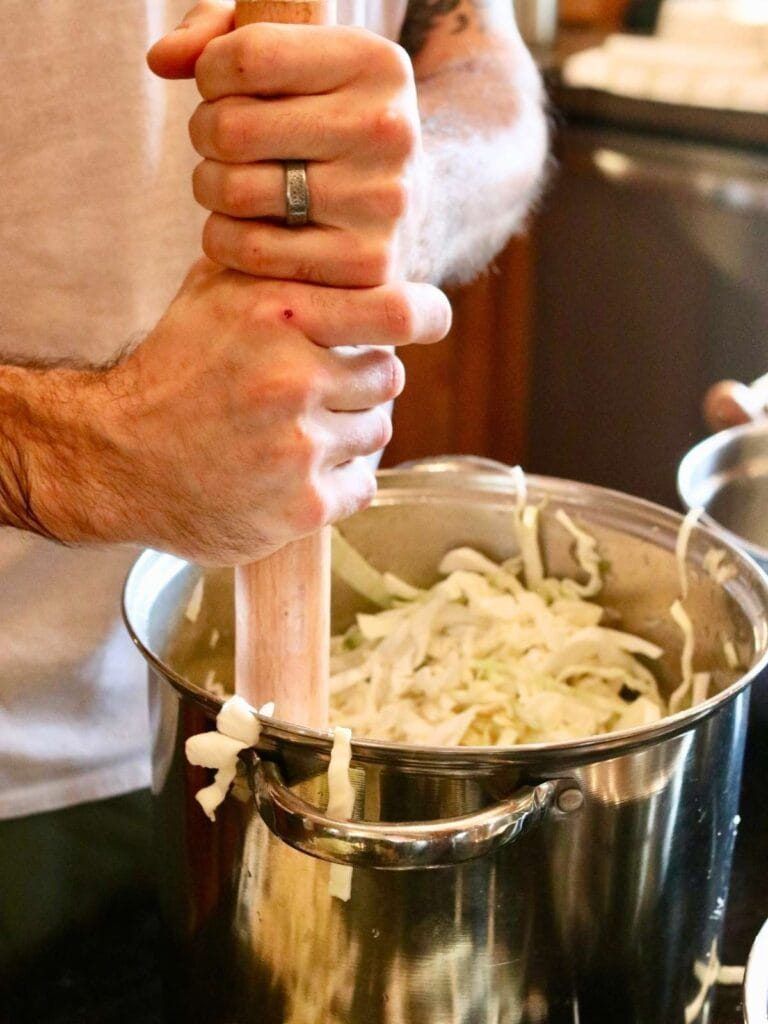
Pounding with a tamper is the traditional method and the only sane approach at crock scale. A wooden kraut pounder (a Krautstampfer) is the right tool; a clean length of 2×2 works. You’re doing two things at once: rupturing cells to release brine, and compressing the mass so the brine covers it.
The stand-mixer trick: a paddle on low for a couple of minutes does the extraction work respectably for a big batch. Not traditional, genuinely effective.
Timing note that matters: salt, then wait 15–20 minutes before you start working it. The salt does much of the extraction on its own if you let it, and you’ll get more brine with less effort.
Packing and weighting
Pack hard, in layers, pressing each one down before you add the next. Air pockets are the enemy and hard packing is how you eliminate them. The brine should rise as you compress.
Leave real headspace — about 3 inches in a jar, more in a crock. Active kraut expands and bubbles and will push brine over the rim, and you’d rather it went into the headspace than onto the floor.
Cap it with a whole cabbage leaf. Fold an outer leaf over the shredded cabbage before you weight it. It catches the small floating shreds that always escape a weight, and it’s free. Traditional and genuinely useful.
Then weight it. A glass fermentation weight, a smaller jar, a brine-filled zip bag (which conforms to the vessel and seals the surface beautifully), or at crock scale a wooden follower with a stone on it. The followers for my 5-, 10-, and 30-gallon crocks I cut myself, because old crock mouths aren’t a standard size — details on Vessels & Crocks.
If the brine doesn’t cover after an hour or two, top it up with cooled 2% brine — about 1½ tablespoons of salt per quart of water, per NCHFP. Don’t use plain water; you’d dilute the salt you carefully measured.
Temperature, which is the flavor lever
This is where good kraut and ordinary kraut separate, and it’s the variable most people ignore.
| Temperature | Time to full | Character |
|---|---|---|
| 55–60 °F | 6–8+ weeks | The best kraut. Complex, aromatic, layered, firm. Long Leuconostoc stage |
| 60–65 °F | 4–6 weeks | Excellent. My basement, most of the year |
| 65–70 °F | 3–4 weeks | Very good. Reliable middle ground |
| 70–75 °F | 2–3 weeks | Fast, clean, simpler. Fine, one-dimensional |
| 75–80 °F | 1–2 weeks | Softer, less interesting, more prone to off-flavors |
| Above 80 °F | — | Don’t. Soft and prone to spoilage organisms |
Cool and slow wins. The reason is the succession: at cool temperatures the early gas-and-aroma-producing Leuconostoc stage runs much longer before the acid-tolerant Lactobacillus species take over, and that early stage is where most of kraut’s aromatic complexity is made. Rush it warm and you get acid without the interesting part.
A cool basement is a genuine advantage and it’s most of why my kraut is good. A stable 58–62 °F through the fall and winter is close to ideal. If you don’t have one, ferment in the coolest place you have and make kraut in the cold months.
The timeline
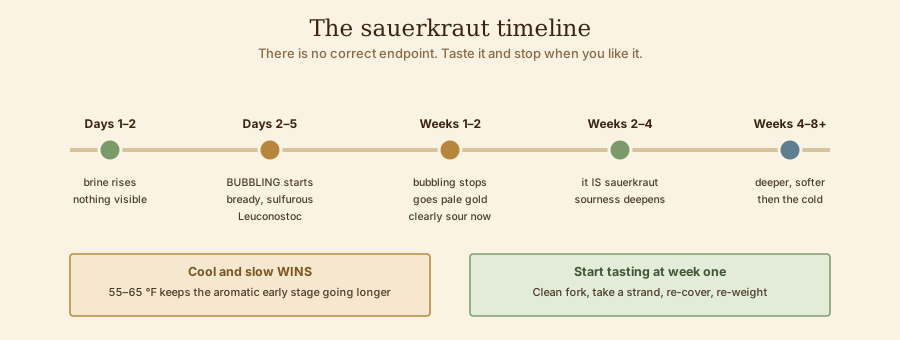
Days 1–2: brine level rises. Nothing visible. Possibly a faint cabbagey smell.
Days 2–5: bubbling begins, sometimes vigorously. The smell is bready, slightly sulfurous, a bit beery. The color starts shifting from bright to pale. This is Leuconostoc, and it’s the good part.
Week 1–2: bubbling slows and stops. Color goes translucent pale gold. The smell turns clearly sour and loses the sulfur. Start tasting now — clean fork, take a strand, re-cover, re-weight.
Weeks 2–4: it becomes sauerkraut. Sourness deepens, texture softens slightly, flavor rounds out.
Weeks 4–8+: deeper, more sour, softer. Some traditions go months. It’s a matter of preference, and you find yours by tasting.
Stop when you like it. There is no other endpoint. Then move it to the cold — a fridge, or an unheated space near freezing — where it will keep for many months and continue to change slowly.
Variations worth making
The base is cabbage and salt. These are additions I actually make, not a list for completeness:
- Caraway — the classic German pairing, and it isn’t decoration: caraway genuinely completes kraut. A tablespoon of seed per 5 lb.
- Juniper berries — the other traditional German addition. Resinous, gin-like, excellent with pork.
- Dill seed — lighter, brighter. Good with fish.
- Apple — grated, a small amount. Adds sugar (so it ferments faster) and a background sweetness. Traditional in parts of Germany and Poland.
- Carrot — grated, up to 20%. Color and sweetness. This drifts toward a mixed vegetable ferment and it’s very good.
- Onion, garlic — both work. Garlic in kraut ferments slowly and may go blue-green, which is harmless.
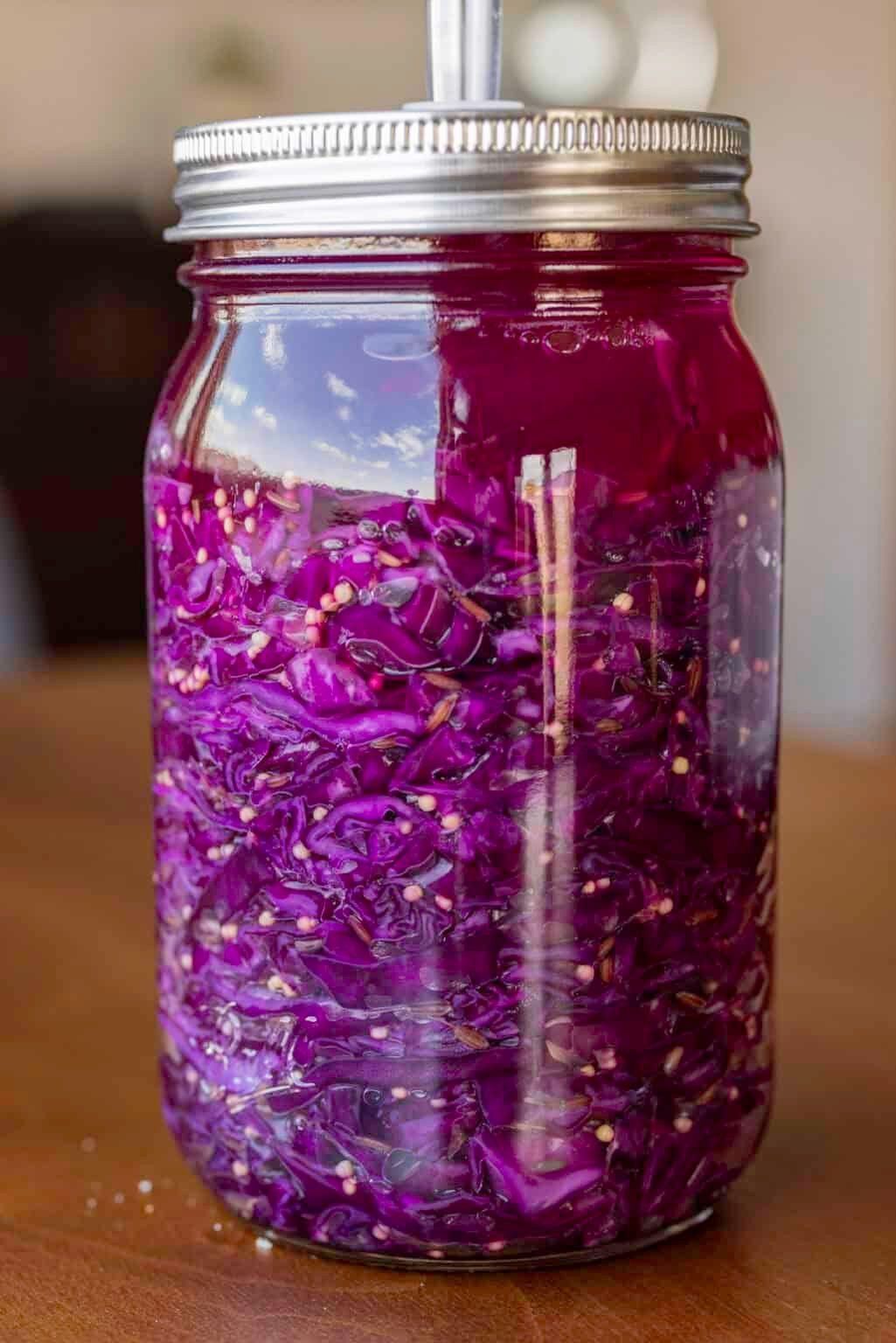
- Red cabbage + a little apple + juniper — my favorite of the variants. Startling color.
- Curtido — the Salvadoran version: cabbage, carrot, onion, oregano, sometimes jalapeño. Lightly fermented and served with pupusas. Genuinely different food from German kraut, same technique.
- Whole leaves for rolls — quarter the heads, ferment in 3% brine for several weeks, and you get sour cabbage leaves for sarma. This is what the big crocks were traditionally for in Eastern Europe, and it’s a whole cuisine.
What I’d skip: anything with much starch or much sugar as a main component (it ferments too fast and goes alcoholic), and anything oily. Oil on the surface interferes with the CO₂ blanket.
Scale, and what 30 gallons actually means
I ferment kraut at four scales, and the differences are real:
Half-gallon jar — one cabbage, a couple weeks of eating. Still what I use for testing a variation, because I can watch it.
5-litre Gärtopf — several heads, a month or two of kraut, zero babysitting thanks to the water seal. This is the sweet spot for most households and the one I’d recommend buying.
5- and 10-gallon stoneware — a real production run. 10 gallons is roughly 40–50 lb of cabbage. It’s a Saturday, and you want the kraut board and the pounder.
30-gallon stoneware — a different category of decision. That’s on the order of 120–150 lb of cabbage, it cannot be moved once loaded, it needs a cool cellar for two months, and it produces more sauerkraut than a family can reasonably eat, which means you’re giving it away — which was always the point of a crock that size. This is a community vessel by design. Farm households didn’t build 30-gallon crocks for a nuclear family.
Practical realities nobody mentions:
- You can’t lift it. Plan the location before you fill it.
- Getting kraut out from the bottom is awkward. Long tongs, clean hands, and accept it.
- Every removal disturbs the surface and re-exposes it, so you skim more often as it empties.
- It will scent your entire house for two months. Discussed above. Worth it.
Eating it
Raw is where the culture is. Heat above about 115 °F kills the live bacteria — which matters if you’re eating it for that reason and doesn’t matter at all for flavor.
- Raw, straight from the crock, as a condiment or a side. My default.
- Reuben, obviously. Drain it well.
- With pork — the fundamental pairing. Roast pork and kraut, pork chops braised in kraut, kraut under sausages. The acid cuts the fat and it’s not an accident that every kraut culture is also a pork culture. See Sausage.
- Choucroute garnie — the Alsatian assembly of kraut braised with wine, juniper, and every pork product in the house. One of the great dishes.
- Bigos — Polish hunter’s stew, kraut and fresh cabbage and meat, better every time it’s reheated.
- Kraut juice. Drink it. It’s the most concentrated part and it’s excellent, and it’s also the starter for your next batch.
- In place of pickles anywhere you’d want acid and crunch — on hot dogs, in a slaw, on top of a rich soup.
Don’t throw out the brine. Ever. It’s a seasoning, a drink, a marinade component, and a starter.
Where to go next
- Fermented Pickles — the other half of the crock shelf, and the harder ferment.
- Kimchi & the Asian Table — the same idea with seasoning and a different cabbage.
- Vessels & Crocks — the Gärtopf, the big stoneware, the followers.
- A History of Fermentation — including why the Genghis Khan story about this exact food is folklore.
Comments (0)