The Basics: What's Actually Happening
Everything in this section is one of five processes. Once you can tell them apart, fermentation stops being a list of unrelated recipes you have to memorize and becomes a small number of ideas you can reason from — which is what lets you fix a batch that’s going wrong instead of throwing it out and starting over.
So this is the page I’d read first. It’s the mechanism, the safety logic, and the two rules that actually matter.
The word covers five different things
“Fermentation” in a kitchen means five distinct processes with different organisms, different products, different smells, and — critically — different risk profiles. Most confusion I see comes from applying advice about one to another.
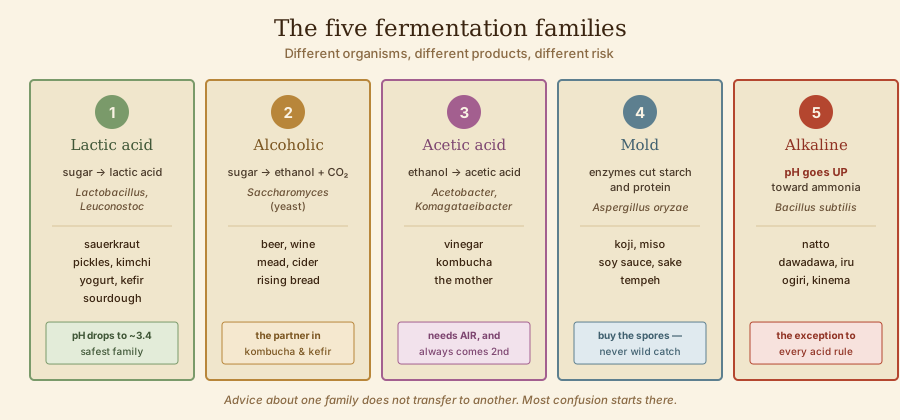
1. Lactic-acid fermentation. Bacteria eat sugar and make lactic acid, which drops the pH. This is sauerkraut, fermented pickles, kimchi, yogurt, kefir, and the sour in sourdough. It is the largest family in this section and by far the best-understood safety story.
2. Alcoholic fermentation. Yeast eats sugar and makes ethanol and CO₂. Beer, wine, mead, cider — and the reason bread rises. It’s the subject of the Alcohol site rather than this one, but it shows up here constantly as a partner: kombucha, kefir, and tepache are all mixed bacterial-and-yeast ferments.
3. Acetic-acid fermentation. Acetobacter and relatives oxidize ethanol into acetic acid — which is to say, they turn alcohol into vinegar. Note the dependency: acetic fermentation needs alcohol as its raw material, so it is always the second step. You cannot go straight from sugar to vinegar.
4. Mold fermentation. Filamentous fungi grow on grains and beans and flood them with enzymes that break starch and protein down into sugars and amino acids. This is koji (Aspergillus oryzae) and therefore miso, soy sauce, sake and mirin; it’s also tempeh (Rhizopus), and the white rind on a Camembert over on the Cheese side. Deliberately growing mold on food sounds like the one thing you’re told never to do, which is why it needs its own page.
5. Alkaline fermentation. The odd one out, and my favorite piece of trivia in the whole section: Bacillus subtilis fermenting soybeans raises the pH instead of lowering it, on its way to ammonia. That’s natto, and the several African locust-bean ferments like dawadawa. Every safety rule on this page is built on acid, so alkaline ferments are the exception that has to be handled by its own logic — a short, hot, specific process, not a long ambient one.
The rest of this page is about family 1, because that’s where the vegetables are and where most home fermenting lives.
Lacto-fermentation: the succession
“Lacto” is for lactic acid, not for dairy. No milk is involved in sauerkraut.
Here’s the thing that took me a long time to internalize: a vegetable ferment is not one organism doing one job. It’s a relay race, and each runner changes conditions in a way that hands off to the next. This is why it’s predictable, and it’s why it gets safer as it goes.
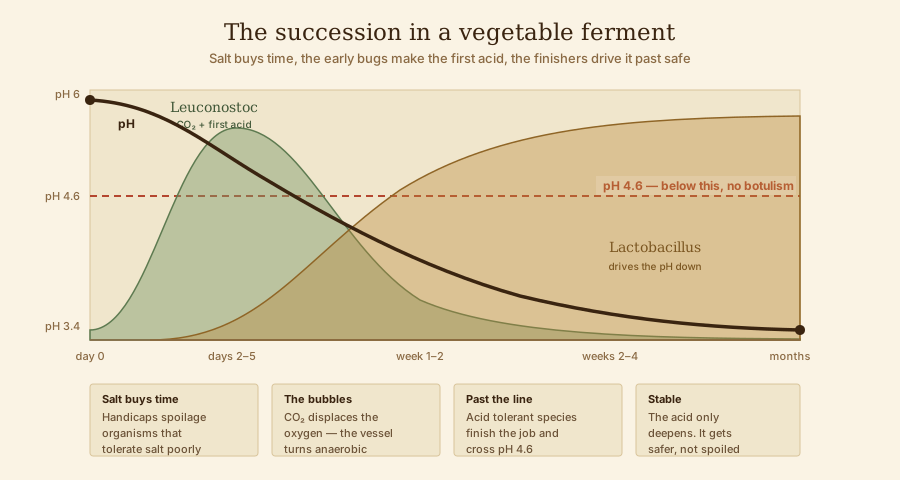
Stage 0 — salt buys time. Before any of the good bacteria have done a thing, salt is doing the work. Most spoilage organisms tolerate salt poorly. The lactic-acid bacteria you want tolerate it comparatively well. So the first thing salt does is not flavor and not texture — it’s handicap the competition long enough for your team to get started. This is exactly why the salt percentage is a safety number and not a seasoning preference.
Stage 1 — Leuconostoc opens. These are the early, gas-producing fermenters. They’re less acid-tolerant, they work at lower temperatures happily, and they produce CO₂ — those are the bubbles you see in the first few days — along with the first mild acid and a lot of the aromatic compounds that make good kraut taste like more than sour cabbage. They also do something structurally important: the CO₂ they throw off displaces oxygen, blanketing the surface and turning the vessel anaerobic on its own.
Stage 2 — Lactobacillus finishes. As the brine sours and the oxygen goes, the tougher, more acid-tolerant species take over and drive the pH the rest of the way down — from around 6 at the start to roughly 3.4 at the end.
Stage 3 — stability. At full sourness the ferment is a hostile place for almost everything. It doesn’t spoil; it slowly changes. Kept cold, it holds for months.
Why it gets safer
This is the part worth genuinely understanding, because it’s the difference between following instructions nervously and knowing what you’re doing.
pH 4.6 is the line. Below roughly pH 4.6, Clostridium botulinum cannot grow or produce toxin. That’s the same number the canning world uses to divide foods that need a pressure canner from foods that can be safely water-bath processed — not a coincidence, the same organism and the same threshold. A finished vegetable ferment lands around 3.4, which is not marginally past the line; it’s a full order of magnitude in hydrogen-ion concentration past it. How you actually read that number — meters, strips, and the band where each is honest — is its own page.
So the timeline is: salt handicaps the competition → the early bacteria make the first acid and push out the oxygen → the finishers drive the pH well past safe → and the sourness that results is the very thing protecting the food. The acid only deepens with time. A ferment does not become dangerous by sitting; that’s the opposite of how it works.
And there is a second mechanism besides acid: sheer numbers. A healthy ferment is a population explosion. The lactic-acid bacteria don’t just acidify — they occupy the niche, consume the available sugar, and crowd competitors out by mass. Acid plus competitive exclusion is why this worked for thousands of years run by people with no thermometer, no pH meter, and no germ theory.
I want to state the payoff plainly, because it’s the strongest fact in this whole section: there are no documented cases of botulism from fermented vegetables — not sauerkraut, not kimchi, not lacto-fermented pickles, not kombucha, not kefir or yogurt. The full version of that argument, and the important exception involving fermented fish, is on the Safety page. It deserves the space.
The two rules
Everything else is refinement. These two are the ones that keep you safe and keep the batch good.
Rule 1: everything stays under the brine
Fermentation is anaerobic. The bacteria you want thrive without oxygen. The molds and yeasts you don’t want need air. So the interface between brine and air is the entire battleground, and any piece of vegetable poking above the liquid is a bridgehead for the other side.
This is what all the hardware is for — weights, followers, water-filled bags, a folded cabbage leaf laid over the top, the water moat in a Gärtopf. Every one of them exists to answer the same question: how do I keep the solids down and the air out? See Vessels & Crocks.
Rule 2: get the salt right, by weight
Not by volume, not by the spoon, and not by taste. By weight, as a percentage. Salt crystals differ enormously in density — a tablespoon of coarse flake and a tablespoon of fine pickling salt are not the same amount of salt, and can differ by nearly half. A scale removes the whole problem.
The National Center for Home Food Preservation is blunt about the direction that matters:
Caution: Do not attempt to make sauerkraut or fermented pickles by cutting back on the salt required.
Salt is a control, not a garnish. Full detail, including what the different salts actually do and which of the folklore holds up, is on Salt & Water.
The three levers
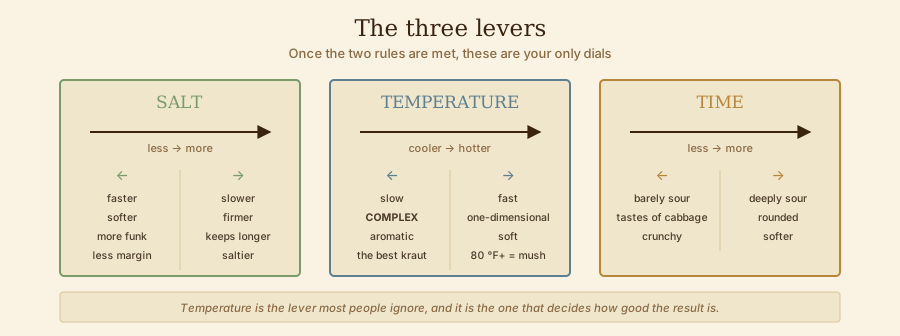
Once the two rules are met, you have exactly three dials, and they trade off against each other.
Salt percentage. More salt = slower ferment, firmer texture, more selective, keeps longer, tastes saltier. Less salt = faster, softer, more of the interesting funk, more risk. Kraut runs around 2¼–2½% because the cabbage is shredded and makes its own brine; whole cucumbers run much higher, 5–8%, because they’re submerged in added brine and need to stay crisp.
Temperature. This is the biggest flavor lever and the one most people ignore. Cool fermentation (55–65 °F) is slow, favors the early Leuconostoc stage for longer, and produces the most complex, most aromatic results. Warm fermentation (70–75 °F) is fast and clean-tasting but one-dimensional. Hot (above 80 °F) gets you soft, and for cucumbers specifically, above 80 °F is where pickles go to mush. My basement is a cool, stable 58–62 °F most of the year and that is not a small part of why the kraut is good.
Time. Which is really just “how far down the pH curve do you want to stop?” Three days is barely sour and still tastes like cabbage. Three weeks is proper kraut. Three months is a different, deeper, more sour thing. There’s no correct answer, only the point you like — which is why you taste it as it goes.
What “wild” actually means
You don’t inoculate sauerkraut. You don’t add anything but salt. So where do the bacteria come from?
They’re already on the cabbage. Lactic-acid bacteria are ordinary residents of plant surfaces. Every cabbage leaf, every cucumber skin, arrives with a full crew. The salt and the anaerobic conditions don’t introduce the fermenters, they select for them out of the mixed population that’s already present.
Two consequences that actually matter in practice:
- Don’t sterilize the vegetable. Scrub the dirt off, sure. But there’s no reason to sanitize produce for a wild ferment — you’d be removing the culture. (Vessels and hands, yes. Clean is good. Sterile is beside the point.)
- Locally grown, unwaxed, recently harvested produce genuinely ferments better, because it carries a fuller and more diverse surface population. Long-stored, waxed, heavily washed supermarket produce sometimes starts sluggishly for exactly this reason. If a batch is slow, this is one of the first things I’d suspect.
The cultured ferments are the opposite case: yogurt, kefir, kombucha, koji and vinegar all need a specific culture added, because the organisms they depend on are not reliably present in the raw material. Vegetables come with their own; milk and sweet tea do not.
The smell, and the honest part about my basement
An active ferment smells. This is normal and it is not subtle.
In the first few days you get a bready, slightly sulfurous, faintly beery smell — that’s the Leuconostoc stage and the CO₂. Cabbage-family vegetables release sulfur compounds when their cells rupture, so kraut and especially kimchi are pungent early. As the acid builds, the smell changes character: sharper, cleaner, more clearly sour, less sulfurous.
A thirty-gallon crock of sauerkraut perfumes an entire house, from the basement, through a closed door. I know this because mine does. It is one of the great smells and my family has, over several decades, arrived at various positions on it. What matters is that you learn the difference between pungent and wrong — sour, sharp, yeasty, even funky is fine; putrid, rotten, cheesy, or sickly-sweet is not. That distinction gets its own page: Troubleshooting.
Where to go next
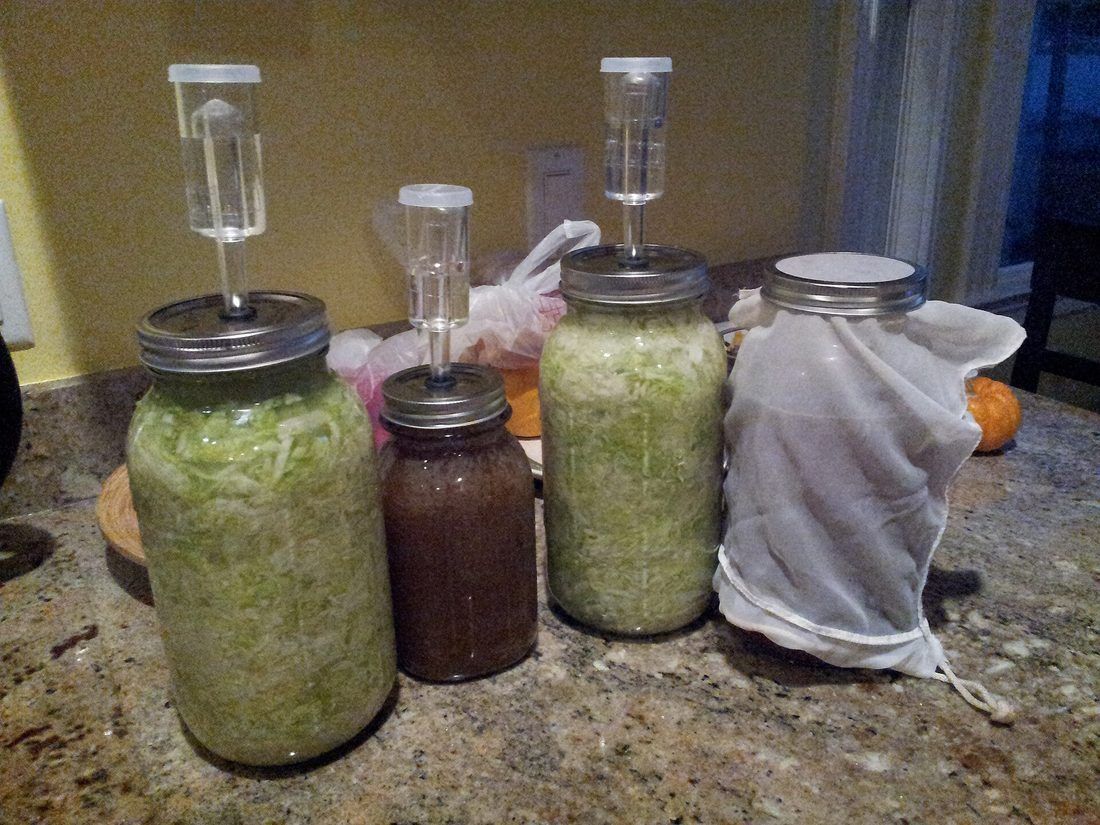
- Getting Started — the half-gallon jar and airlock, and the order I’d learn this in.
- Salt & Water — the percentages, the salt types, and which folklore survives.
- Safety — the botulism question answered properly, including the one place fermentation genuinely kills people.
- Troubleshooting — kahm yeast versus mold, soft pickles, and the batches you actually do throw out.
Comments (0)