Vessels & Crocks
Every fermentation vessel ever built is an answer to one question: how do I let the gas out without letting the air in? That’s it. That’s the whole design problem. Once you see it that way, the entire catalog — jars, airlocks, water moats, wooden followers, stones, a folded cabbage leaf — turns into a handful of different engineering answers to the same requirement, and you can judge any new gadget in about five seconds.
I’ve worked my way up the whole ladder: half-gallon jars with airlocks, a German water-sealed crock, and then 5-gallon, 10-gallon, and 30-gallon stoneware with tops I made myself. They’re all still in use. None of them replaced the others.
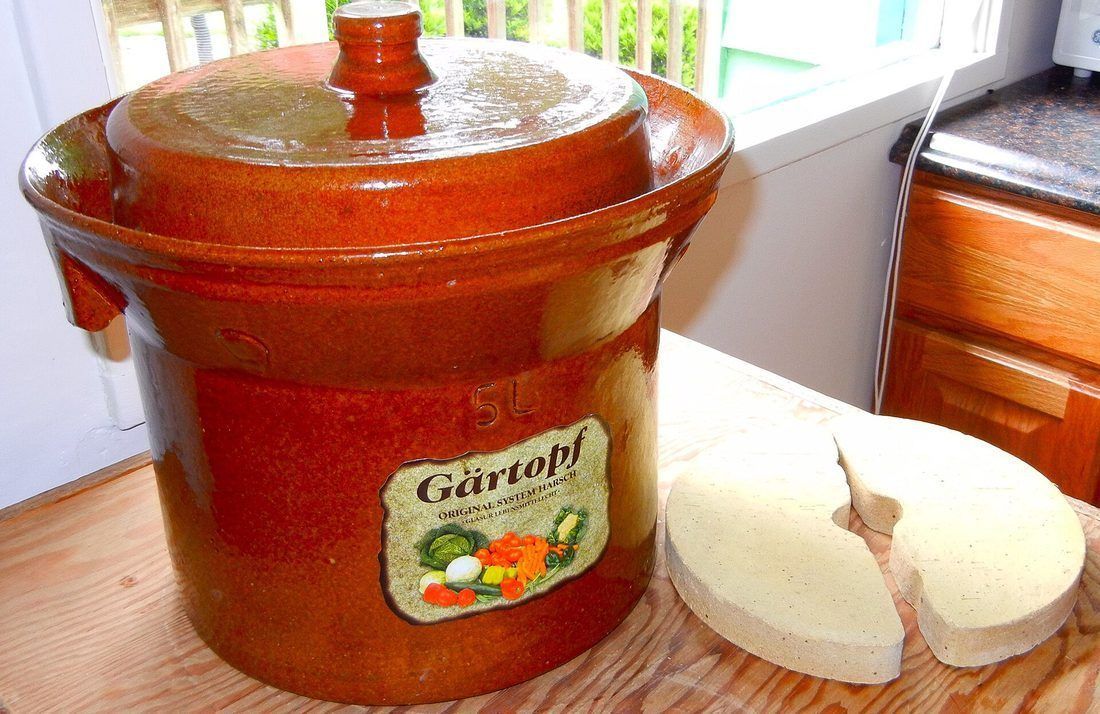
First, a correction I have to make about my own crock
I’ve called my German water-sealed crock a “Gärtopf or Schmortopf” for years. Those are two different pots, and only one of them ferments anything.
- Gärtopf — from gären, to ferment. The water-moat crock. This is the one.
- Schmortopf — from schmoren, to braise. A stewpot, a casserole, a Dutch oven. It is a braising vessel and has nothing to do with fermentation.
So it’s a Gärtopf. I had a wrong word rattling around for a long time, and this is the kind of thing a deep dive is for.
There’s a nice second-order wrinkle here that I like even better. In German, gären is used almost exclusively for yeast and alcoholic fermentation — the broad term covering bacteria and enzymes is fermentieren. Which means a Gärtopf full of sauerkraut is, strictly speaking, misnamed in its own language: kraut is a bacterial ferment, not a yeast one. The name is a fossil. It records what people believed was happening in the pot back when the only fermentation anybody could name was the kind that made beer.
The four approaches
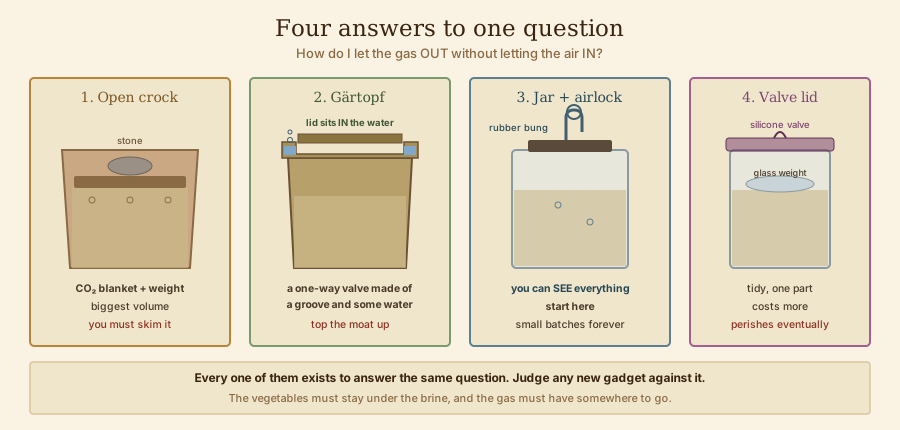
1. The open crock with a weighted follower
The oldest answer, and the one that needs the most skill. An open-mouthed crock, the vegetables packed in, a flat plate or wooden disc (the follower) laid on top, and weight on the follower to hold everything under its own brine. The CO₂ from fermentation blankets the surface and does much of the air-exclusion work by itself.
What it’s good at: volume, and nothing else touches it. A 10- or 30-gallon crock full of cabbage is a season’s food. It’s also the traditional method, which matters if you care about doing it the way it was done.
What it demands: the brine must cover, always, with no exceptions and nobody checking for you. The surface is exposed, so you will get some surface yeast, and you skim it. This is a method that rewards attention.
2. The water-sealed crock — the Gärtopf
A cast gutter — a moat — runs around the rim. You fill it with water and the lid sits down into it. Gas pressure from inside pushes down through the water and bubbles out. Air cannot get back in past the water. It is a one-way valve made entirely out of a groove and some water, and it was designed by people who had no theory of anaerobic bacteria and knew exactly what they needed anyway.
This is my favorite vessel in the whole kitchen. It gives you crock capacity with jar-grade peace of mind. No skimming, no burping, no daily judgment calls. You fill the moat, you walk away, you top the moat up every couple of weeks because it evaporates, and that’s the entire maintenance burden.
The one thing to know: if the moat runs dry, you have an open crock and don’t know it. Set a reminder. In a dry heated house in winter it goes faster than you’d think.
The German makers are Harsch (the famous one), Nik Schmitt, and K&K Keramik, in sizes from about 5 litres up to 40. If somebody who has made a few jars of kraut asks me what to buy next, this is the answer.
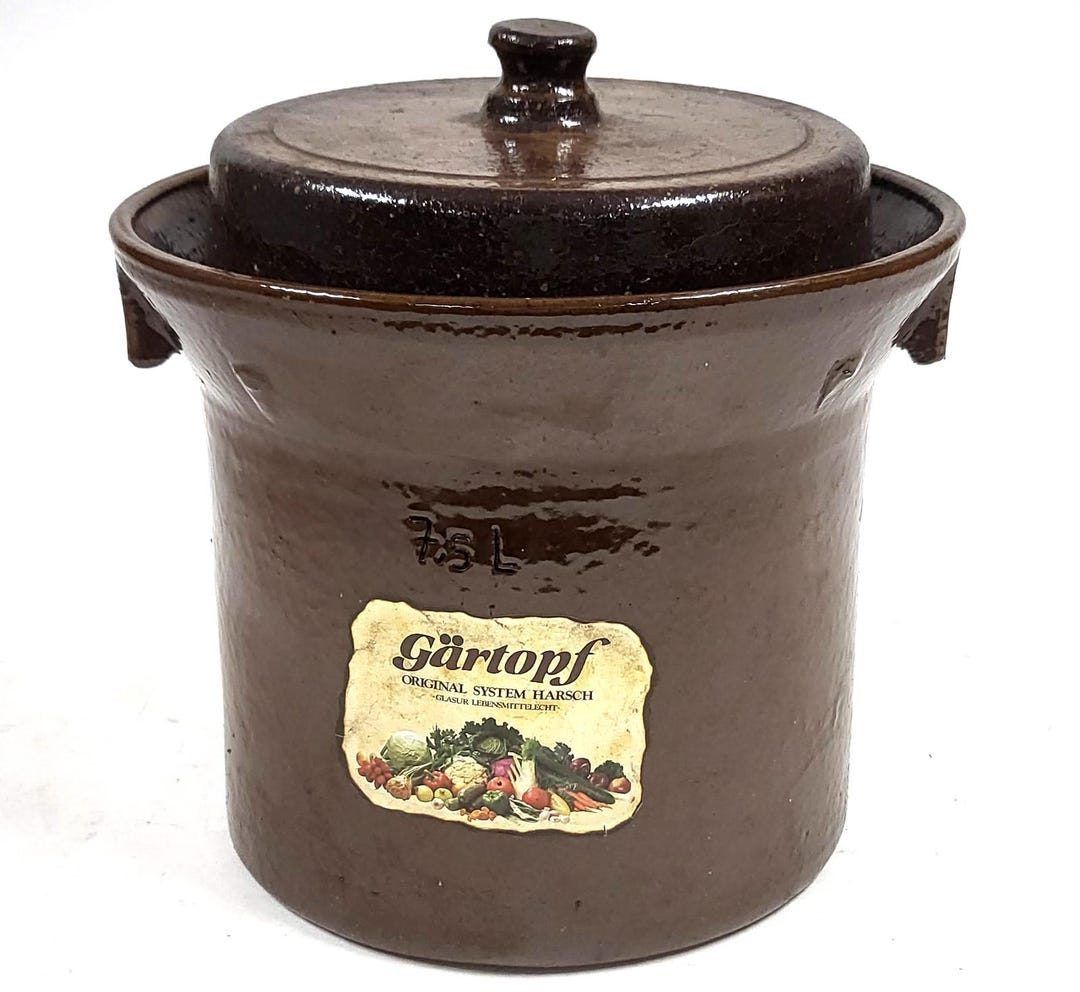
I could not find a reliable date or patent for the water-seal design, so I’m not going to invent one. It’s clearly old, and I can’t tell you how old.
3. The jar and airlock
A glass jar, a drilled rubber bung, an airlock. Same one-way-valve principle as the Gärtopf, executed in brewing parts, and it’s what I recommend to everyone starting out — see Getting Started. Visibility is the killer feature: you can watch the whole thing happen.
I never stopped using these. Small batches, experiments, one-vegetable tests, anything I want to observe. A half-gallon jar is not a lesser crock; it’s a different tool.
4. Modern lid systems
Silicone valve lids, spring-loaded glass weights, pump-down lids that pull a vacuum. They work. They’re tidy. They cost more than a bung and an airlock and they’re harder to repair when the silicone perishes.
The one category I’ll actively recommend: glass fermentation weights sized to a wide-mouth jar.
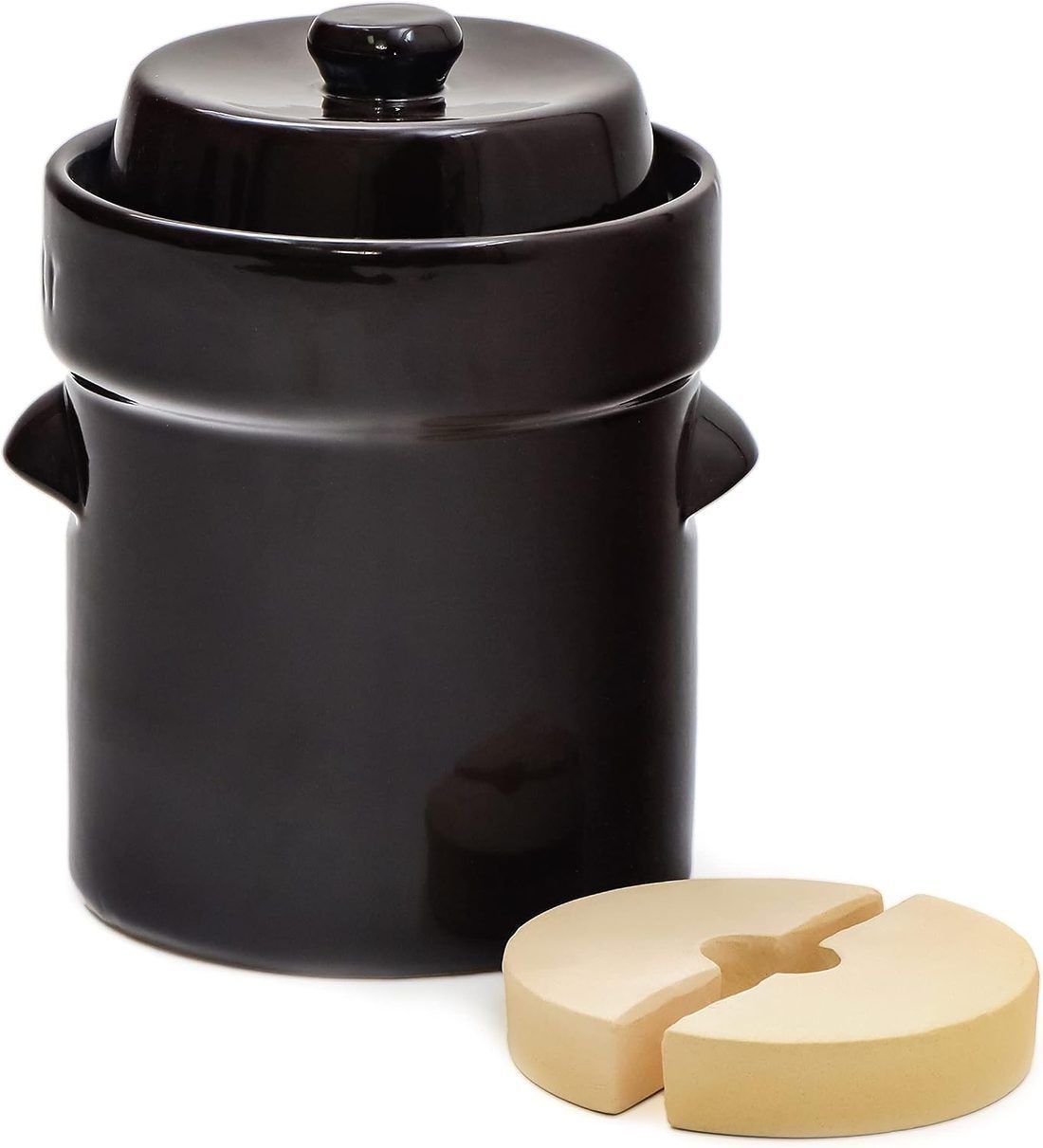 They’re better than my improvised solutions and they cost almost nothing. The rest is preference.
🔴 The question nobody asks: what’s in the glaze?
This is the finding that most changed how I think about my own equipment, and it points straight at the crocks I’m proudest of.
Documented case: Phan and colleagues reported in the Medical Journal of Australia in 1998 on a married couple who had been brewing kombucha in a ceramic pot for six months. Both developed symptomatic lead poisoning requiring chelation therapy. The proposed mechanism is straightforward and well-precedented: the tea’s acids leached lead out of the glaze pigment, the same way wine and spirits pull lead out of leaded crystal decanters.
Now let me be careful, because it would be easy to turn that into a scare, and a scare would be wrong.
What that case is: kombucha — a much more aggressive acid than kraut brine — held for months in a pot of unknown provenance. That’s the high-exposure end of everything: strong acid, long contact, unknown glaze.
What it isn’t: an indictment of stoneware fermentation. There is no comparable case series for vegetable ferments in purpose-made crocks. Kraut has been made in stoneware for centuries. The modern German crocks are sold specifically as lead-free glaze, and that claim is the reason to buy the purpose-made vessel rather than a pretty one.
But here’s the part that lands on me, and on anybody else who has accumulated crocks: the risk isn’t distributed the way you’d assume. It’s highest exactly where a serious fermenter’s affections are.
- Purpose-made modern fermentation crock, sold as food-safe and lead-free — lowest concern. This is the designed-for-the-job case.
- Modern food-service stoneware — low concern. Regulated for food contact.
- Decorative glazed ceramics, imported ornamental ware, art pottery — real concern. Decorative glazes and pigments can carry lead oxide precisely because they aren’t intended to hold food.
- 🔴 Antique stoneware crocks — the highest uncertainty, and the ones we love most. An old American salt-glazed crock is a beautiful object with an undocumented glaze from an era with no food-contact regulation. Salt-glazed stoneware is generally considered a comparatively benign glaze chemistry, but “generally considered” is doing real work in that sentence, and I can’t tell you what’s in a specific hundred-year-old crock, and neither can anyone else by looking at it.
So the honest position for my own 30-gallon: it’s the piece I’d most want tested, not the piece I’d most assume is fine. That’s the opposite of how I used to think about it.
What to actually do about it — this is cheap and settles it:
- Lead test swabs cost a few dollars at any hardware store. They’re the same rapid swabs used for paint. Swab the interior surface, especially any crazing or chips. It’s not laboratory-grade, but a positive result is a decisive answer and the test costs less than a cabbage.
- Require the claim rather than assuming it. “Lead-free, food-safe glaze” is something a manufacturer will state plainly. If nobody will state it, treat it as unknown.
- Retire crazed, chipped, or cracked interiors from food use. Crazing is a network of fine glaze cracks, and it’s both a bigger leaching surface and impossible to clean properly. A crock with a crazed interior is a planter.
- Match the vessel to the acid. Vegetable ferments finish around pH 3.4 and get poured out within months. Kombucha is more aggressive and often lives in its vessel continuously. If you’re going to be conservative anywhere, be conservative about the continuous-brew kombucha vessel — glass is free of the entire question. I say the same thing on Kombucha.
None of this is a reason to stop using stoneware. It’s a reason to know which of your crocks you actually know something about.
The big stoneware, and the wooden tops
Above the Gärtopf the vessels get simple again: a large open crock, and the problem becomes how to hold down a lot of vegetables.
I make my own wooden followers for the 5-, 10-, and 30-gallon crocks. A follower is a flat disc, cut to sit inside the crock’s mouth with a small clearance all around so brine and gas can pass, and weighted from above. Making them yourself is the sensible move because crock mouths are not standardized — an old crock is whatever diameter that potter’s wheel made it, and no manufacturer is selling a lid for it.
Things I’ve learned about followers:
- Cut for clearance, not for fit. You want maybe ⅛–¼ inch of gap around the whole circumference. A tight disc jams as the wood swells and traps gas underneath.
- Wood choice matters more than it seems. You want a close-grained hardwood with no resin and no strong flavor of its own, and it will be in contact with acid brine for weeks.
- It will stain and it will take on the smell. Permanently. Dedicate the follower to fermentation and don’t plan on using that board for anything else.
- The weight goes on the follower, not the food. A scrubbed river rock, a water-filled jug, a sealed jar of brine. The classic is a boiled stone, and the classic works.
The scale is genuinely different up here. A 30-gallon crock of kraut is not a bigger jar; it’s a food-production decision. It takes a lot of cabbage, it takes real work to pack, it’s too heavy to move once it’s loaded, and it needs a cool place to live for weeks. Mine live in the basement, which is the right answer for temperature — a stable 58–62 °F is close to ideal for a slow, complex ferment — and also the reason the whole house smells. I’ve made peace with that. Mostly.
What to use for what
| Batch | Vessel | Why |
|---|---|---|
| First ever ferment | ½-gal jar + airlock | You can see it; failure costs one cabbage |
| Single vegetable, experiment | ½-gal or 1-gal jar | Visibility; easy to label and compare |
| A few weeks of kraut for the family | 5-litre Gärtopf | Crock quality, no babysitting |
| Cucumber pickles | Jar or Gärtopf | Needs a real seal; texture is fragile |
| Kimchi | Jar | Aggressive smell — you want it containable, and it moves to the fridge |
| A season of kraut | 5–10 gal stoneware | Volume; accept the skimming |
| A winter’s worth | 30 gal stoneware | Because you can. Have a plan for lifting it |
| Kombucha | Glass | Continuous contact with strong acid — skip the glaze question entirely |
| Yogurt | ½-pint or pint jars | Portion control, and jars fit an incubator |
Things that are not fermentation vessels
- Anything metal, except stainless. Acid brine will attack aluminum, copper, cast iron, and galvanized anything. Stainless steel is fine. A galvanized bucket is a genuinely bad idea — zinc and acid — and it’s a thing people have done.
- Non-food-grade plastic. Food-grade HDPE buckets are used commercially at scale and are fine. A random bucket from the garage is not, and it’s also permanently scented.
- A crock with a crazed or chipped interior. See above.
- Anything you can’t get your hand into to clean. Narrow-necked carboys are for liquids. A gallon jug full of kraut is a jug you’re going to throw away.
Where to go next
- Getting Started — the jar-and-airlock method in full.
- Sauerkraut — the crock’s whole reason for existing.
- Safety — including the case where changing the vessel is exactly what made a traditional food dangerous.
- Kombucha — where the glaze question actually bites.
Comments (0)