Kombucha
Kombucha is sweet tea fermented by a mixed culture of bacteria and yeast into something tart, lightly fizzy, and faintly vinegary. It’s easy to make and it’s surrounded by more nonsense than anything else in this section — a fabricated origin story, a misunderstanding of what the famous rubbery disc actually is, and a set of health claims far beyond the evidence.
It also has the only two genuinely documented safety incidents in this whole dive, and neither one is the thing people worry about.
🔴 The name means something else entirely
In Japanese, kombucha (昆布茶) means KELP TEA — kombu, the brown seaweed, plus cha, tea. It’s a real, ordinary, entirely unrelated Japanese beverage: hot water poured over powdered kelp.
The drink we call kombucha in English is not that, has never been that, and is not what a Japanese speaker will hand you if you ask for kombucha. The English name for this drink is, in Japanese, the name of a different drink.
And the “Dr. Kombu” legend is a real event with a drink bolted on
The story you’ll read: a Korean physician named Kombu brought a healing fermented tea to the Japanese Emperor Ingyō in 414 CE, and the drink was named for him.
The remarkable thing is that the frame is genuine history. The Nihon Shoki records that Emperor Ingyō (r. 410–453) fell ill, and that in early 414 he sent an envoy to the Korean kingdom of Silla to find a physician — who is said to have cured him by that August. There’s even a Korean doctor of roughly that period whose name transliterates as something like “Komu-ha” or “Kon Mu.”
But: “Kombu” is not a known Korean surname, and — decisively — there is no evidence the drink existed in Korea or Japan before the late 20th century. The documented event is real. The kombucha attached to it is not.
That’s a more interesting failure than a simple fabrication. Somebody found a genuine 5th-century medical anecdote with a plausible-sounding name in it and retro-fitted a modern beverage onto it. The citation checks out; the claim doesn’t.
What can honestly be said about kombucha’s history: it appears in Russia and Eastern Europe in the late 19th and early 20th centuries, spread through Europe, and reached the US in the late 20th. Its earlier history is genuinely obscure, and I’d rather say that than pick a legend.
🔴 What the disc actually is
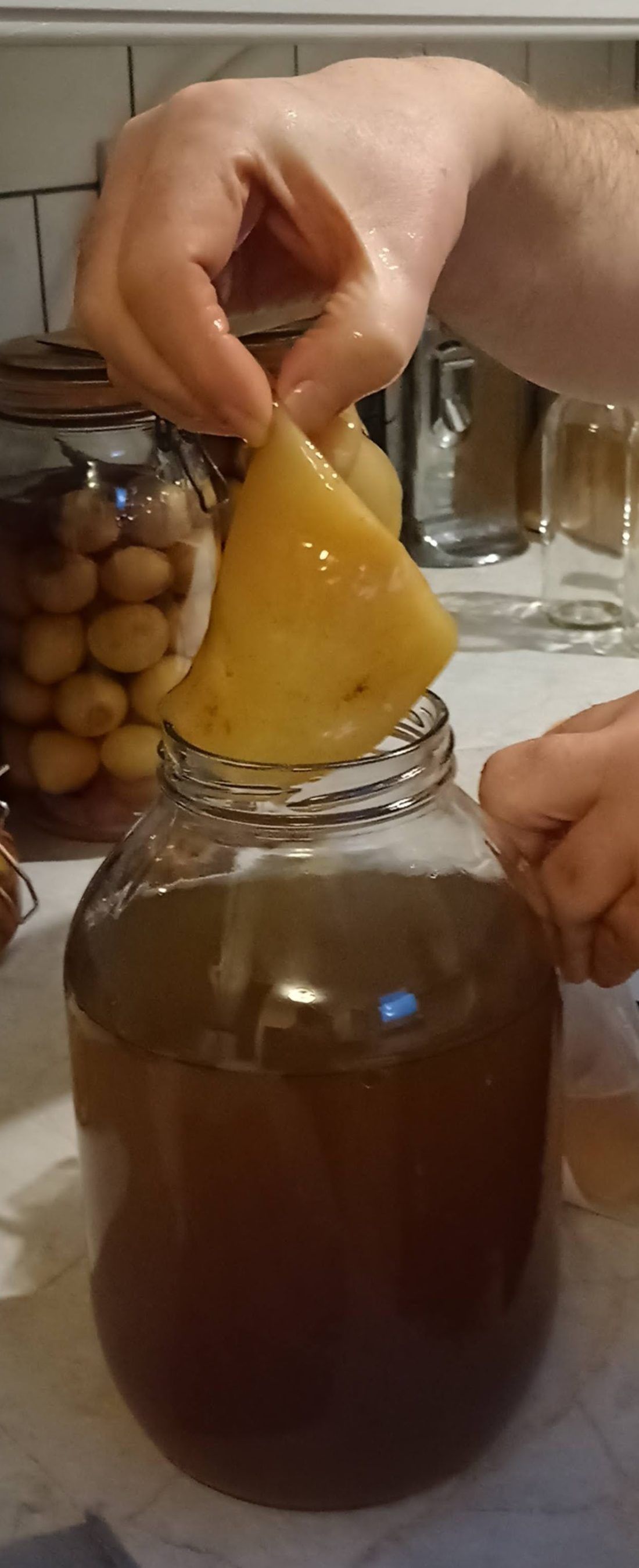
The rubbery beige pancake everyone calls “the SCOBY” is bacterial cellulose — a biofilm spun by acetic-acid bacteria of the genus Komagataeibacter (chiefly K. xylinus, formerly Gluconacetobacter / Acetobacter xylinum). It’s a structural material, chemically the same class of polymer as plant cellulose, and it can hold on the order of 200 times its dry weight in water.
The practically important consequence: you can start a new batch from mature kombucha liquid alone, with no disc at all. You cannot start one from a rinsed disc with no liquid. The liquid is what inoculates. The pellicle is a house the organisms build, not the organisms.
So the standard instruction — “you need a SCOBY” — is backwards in emphasis. What you need is strong starter liquid; a pellicle usually comes along with it and will form on its own regardless.
⚠ Where the sources actually disagree, and I’m not going to paper over it: the literature is inconsistent about which phase holds more microbial diversity. Some work reports the highest diversity in the cellulose pellicle; other work reports diversity lower in the pellicle and higher in the liquid. Both agree Komagataeibacter dominates both phases. So “the culture lives in the liquid, not the disc” is too strong a claim to make flatly — the defensible version is the one above: the liquid is what inoculates, and the pellicle is a structure the organisms live inside.
Also: “SCOBY” is an acronym — Symbiotic Culture Of Bacteria and Yeast — that properly describes the whole community, liquid included, and got colloquially narrowed to mean just the disc. That narrowing is where the confusion comes from.
Making it
Primary ferment (7–14 days):
- Brew strong tea. About 8 cups water, 4–8 tea bags or 2 Tbsp loose tea. Black tea is the reliable choice; green works; avoid oils and flavorings — Earl Grey’s bergamot oil and other flavored teas can harm the culture over time. Never herbal-only — the culture needs the nitrogen and compounds in real Camellia sinensis.
- Dissolve 1 cup of plain white sugar per gallon. Not honey (antimicrobial), not much of a substitute. The sugar is the fuel and it gets consumed — finished kombucha is not sweet.
- Cool to room temperature. Absolutely essential — hot tea kills the culture.
- Add 1–2 cups of strong starter liquid from a previous batch (or unflavored raw store-bought kombucha). This is the important inoculation, and it also drops the pH immediately, which protects the batch during its most vulnerable window.
- Add the pellicle if you have one.
- Cover with a tight-woven cloth and a band. It needs air — this is an aerobic ferment, unlike the vegetables — but not fruit flies. Fruit flies are the real pest; they’re attracted to it and they carry contaminants.
- Room temperature, out of direct sun, 7–14 days. Warmer is faster.
- Taste it through a straw from day 5. Stop when it’s tart with a little sweetness left. Go too long and you get vinegar — which is not a failure, it’s vinegar, and it’s useful.
Second ferment (1–3 days), for fizz:
Bottle the finished kombucha in pressure-capable bottles (swing-top or heavy glass), adding a little fruit, juice, ginger, or sugar. Seal and leave at room temperature 1–3 days. The remaining yeast eats the new sugar and, with nowhere to vent, carbonates the bottle.
⚠ Bottles genuinely explode.
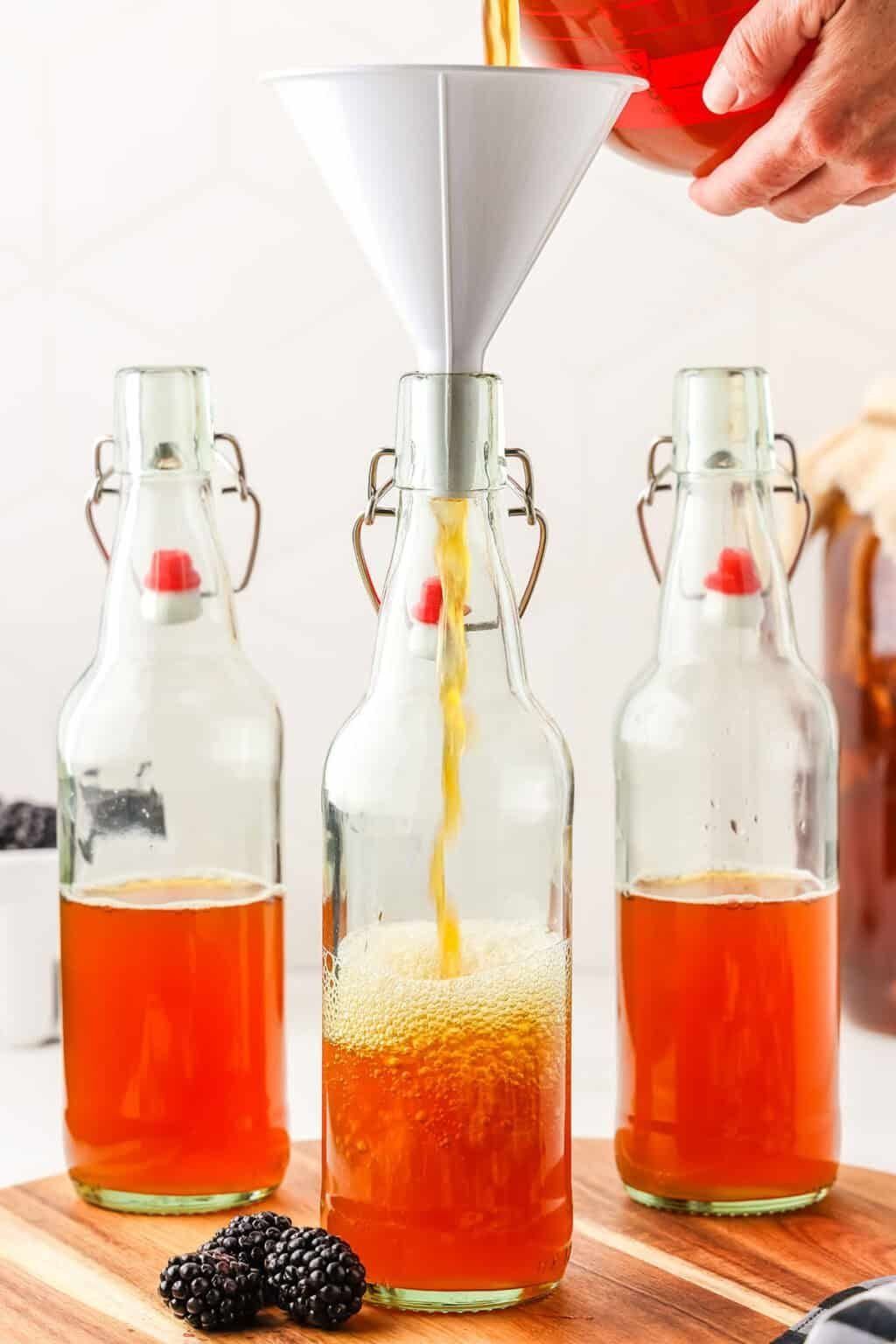 Use proper bottles, don’t over-sugar, don’t leave them warm too long,
and burp them if you’re unsure. Refrigerate to stop it. A pressurized glass bottle failing is a
real injury risk, not a mess.
Use proper bottles, don’t over-sugar, don’t leave them warm too long,
and burp them if you’re unsure. Refrigerate to stop it. A pressurized glass bottle failing is a
real injury risk, not a mess.
Continuous brew: a vessel with a spigot, from which you draw off finished kombucha and top up with fresh sweet tea. Less handling, and the pH stays permanently low, which is safer. Use glass — see below for exactly why.
🔴 The two real safety findings
Here’s where kombucha differs from everything else in this section: it has documented incidents, and they’re not botulism.
The lead case, and it’s about the vessel
Phan and colleagues, Medical Journal of Australia, 1998: a married couple who had brewed kombucha in a ceramic pot for six months developed symptomatic lead poisoning requiring chelation therapy. The mechanism: the tea’s acids leached lead from the glaze pigment, the same way wine and spirits pull lead out of leaded crystal decanters.
Kombucha is the worst case for this, and it’s worth understanding why rather than just avoiding it: it is more acidic than vegetable brine, it’s often held in the same vessel continuously for months or years, and glazed ceramic is a traditional-feeling choice. Strong acid + long contact + unknown glaze is the whole recipe for leaching.
So: brew kombucha in glass. Glass sidesteps the entire question, costs nothing, and lets you see what’s happening. Food-grade stainless is fine too. Avoid glazed ceramic unless it is certified lead-free, and avoid decorative or antique ceramics entirely — those glazes can contain lead oxide precisely because they were never meant to hold food. This applies with extra force to a continuous-brew crock with a spigot, which is the longest contact of all.
The wider version of this — including what it means for my own antique stoneware — is on Vessels & Crocks.
The Iowa case, reported honestly
CDC MMWR 44(48):892–893, 899–900, 8 December 1995 — “Unexplained severe illness possibly associated with consumption of Kombucha tea — Iowa, 1995.” In April 1995, in a rural town in north-western Iowa, two people became severely ill and one died. Both had been drinking kombucha daily for about two months. The Iowa Department of Public Health issued a news release on 10 April 1995 advising people to refrain from drinking it until the tea’s role had been fully evaluated, and IDPH, CDC and FDA investigated.
The title of the report is the finding. “Unexplained.” “Possibly associated.” Causation was never established. This is a serious signal that was properly investigated and left open — which is what an honest write-up looks like, and it is not the same thing as “kombucha killed someone.” I’ve seen it cited both ways and both are wrong: it isn’t proof of danger, and it isn’t nothing.
And the alcohol, which is more than people think
TTB’s rule: if kombucha reaches 0.5% ABV or more — at any time during production, when bottled, or at any time after bottling — it is an alcoholic beverage and falls under TTB regulation, including the Alcoholic Beverage Labeling Act health warning.
Note the trap in that wording: the rules apply even to kombucha below 0.5% at bottling if continued fermentation in the bottle later pushes it over. Which is exactly what a second ferment is designed to do.
Reported home-brew figures hover around 0.5% and often slightly above, with a range of roughly 0.25% to 1.00% ABV.
That’s a commercial-labelling rule, not a home-brewing prohibition — I’m not suggesting you need a permit for your kitchen. But it does mean “kombucha is basically non-alcoholic” is sloppy, and it genuinely matters if you’re pregnant, in recovery, avoiding alcohol for religious reasons, or serving it to children. Home kombucha, especially after a warm second ferment, is a low-alcohol beverage.
Who shouldn’t drink it
Poison Control states it plainly: young children, pregnant people, and the immunocompromised should not drink kombucha, whether home-brewed or commercial.
Health claims
Kombucha is a fermented food containing live bacteria, organic acids, polyphenols from tea, and B vitamins. It’s a reasonable thing to drink and it’s a vastly better habit than soda.
The specific claims — that it detoxifies, cures cancer, fixes your gut, boosts immunity, treats arthritis — have not been established. As one review of the literature put it, the beneficial and adverse effects of kombucha have not been determined scientifically. Most of the enthusiastic research is in cell culture or rodents.
I drink it because it’s good. That’s a sufficient reason and it doesn’t need propping up.
Troubleshooting
- A new pellicle forming on top each batch — normal. That’s what it does. They stack up; peel off and discard or share the old ones.
- Brown stringy bits hanging down — normal. Yeast strands.
- Lumpy, uneven, or holey pellicle — cosmetic. Doesn’t matter.
- No pellicle forming — often just cool temperatures or weak starter. Check the taste; if it’s souring, it’s working.
- Fuzzy, dry, raised mold — blue, green, black — this one is real. Discard the batch and the pellicle, both, and start over with fresh starter. Don’t try to rescue it. Mold on kombucha usually means insufficient starter liquid (so the pH didn’t drop fast enough), too little air, or fruit-fly contamination.
- Vinegary — over-fermented. Use it as vinegar; it’s excellent. Start the next batch shorter.
- Fruit flies — the real enemy. Tight-woven cloth, not cheesecloth.
Where to go next
- Vessels & Crocks — the lead-glaze question in full.
- Vinegar — where over-fermented kombucha belongs.
- Other Fermented Drinks — tepache, kvass, ginger bug.
- Safety — the whole risk picture, in proportion.
Comments (0)