Koji, Miso & Soy
This is the branch of fermentation where you deliberately grow a mold on food, and it is responsible for miso, soy sauce, sake, mirin, rice vinegar, and a large share of what savory tastes like across East Asia. It’s the most technically demanding family in this section and the most rewarding to understand, because once you know what koji does, a dozen apparently unrelated ingredients turn out to be the same trick.
Koji is an enzyme factory
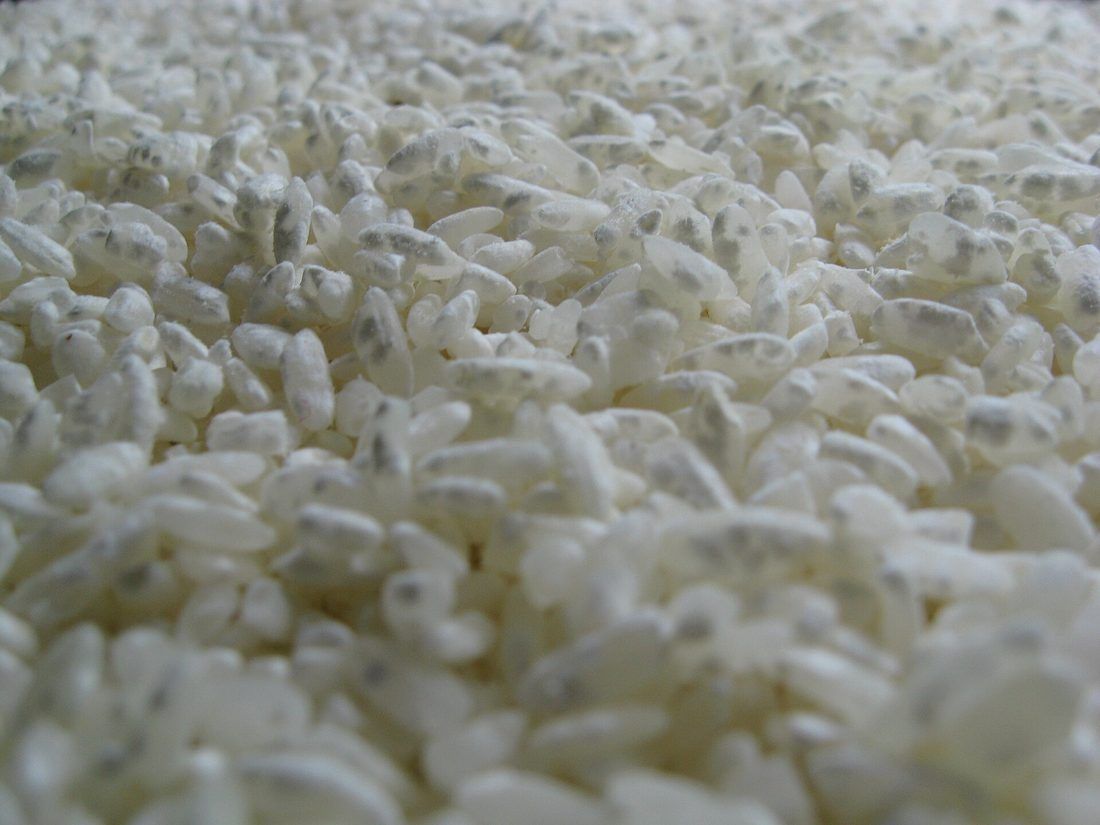
Koji (麹) is a grain — usually rice, sometimes barley or soybeans — that has been inoculated with Aspergillus oryzae and allowed to grow until it’s furred with white mycelium and smells sweet and faintly of chestnuts.
The mold itself is not the product. The product is enzymes. As A. oryzae grows it floods the substrate with:
- Amylases, which cut starch into sugars
- Proteases, which cut protein into peptides and free amino acids — chiefly glutamate
- Lipases, which work on fats
That’s the whole mechanism, and it explains everything downstream. Sugar means something for yeast to ferment (sake) or a sweetness of its own (amazake, mirin). Free glutamate means savory depth — this is where miso and soy sauce get their umami, and it is exactly the same molecule as the one in MSG, arrived at by mold instead of by industry.
Koji is a set of scissors, not a flavor. Understanding that is the key to the whole family.
Japan named A. oryzae its national fungus (kokkin) in 2006, which tells you how central this is.
The family tree
Everything below is koji plus one more decision:
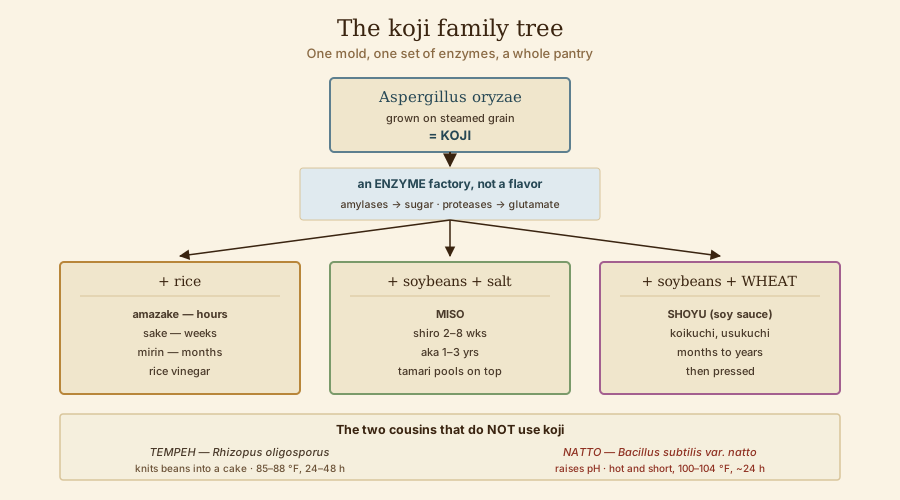
| Product | Koji + what | Time |
|---|---|---|
| Amazake | Rice koji + rice + water, held warm | Hours |
| Sake | Rice koji + rice + water + yeast | Weeks |
| Mirin | Rice koji + glutinous rice + shochu | Months |
| Rice vinegar | Sake + Acetobacter | Weeks |
| Miso | Koji + cooked soybeans + salt | Weeks to years |
| Shoyu (soy sauce) | Koji on soybeans and wheat + brine | Months to years |
| Tamari | Traditionally the liquid from miso; modern tamari is wheat-free shoyu | Months |
| Doenjang / gochujang | Korean, using meju rather than Japanese koji | Months to years |
| Shio koji | Koji + salt + water | 1 week |
Miso
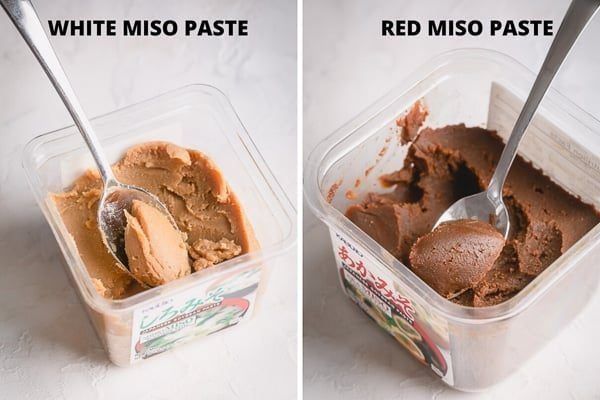
Miso is koji + cooked soybeans + salt, mashed together and left to ferment. That’s it. The variables are the ratio and the time, and they produce wildly different foods.
How the types differ:
| Miso | Koji ratio | Salt | Time | Character |
|---|---|---|---|---|
| Shiro (white) | High | Low (~5%) | 2–8 weeks | Sweet, mild, pale |
| Shinshu (yellow) | Medium | Medium | 3–12 months | The all-purpose one |
| Aka (red) | Lower | Higher (~12%) | 1–3 years | Deep, salty, powerfully savory |
| Hatchō | Soybean koji, no rice | High | 2–3 years | Very dark, intense, slightly astringent |
| Mugi | Barley koji | Medium | 6–18 months | Earthy, rustic |
The pattern is consistent: more koji and less salt = sweeter and faster. Less koji and more salt = darker, deeper, slower. Salt is the brake, and long-aged miso needs a lot of it.
Making it is genuinely simple and takes patience rather than skill:
- Cook soybeans until crushable — soaked overnight, then boiled or pressure-cooked until a bean mashes with finger pressure.
- Mash them, leaving some texture.
- Mix in koji and salt, thoroughly. Salt at 5–13% of total weight depending on how long you’re aging it.
- Add a little cooking liquid to reach a firm paste, like stiff mashed potato.
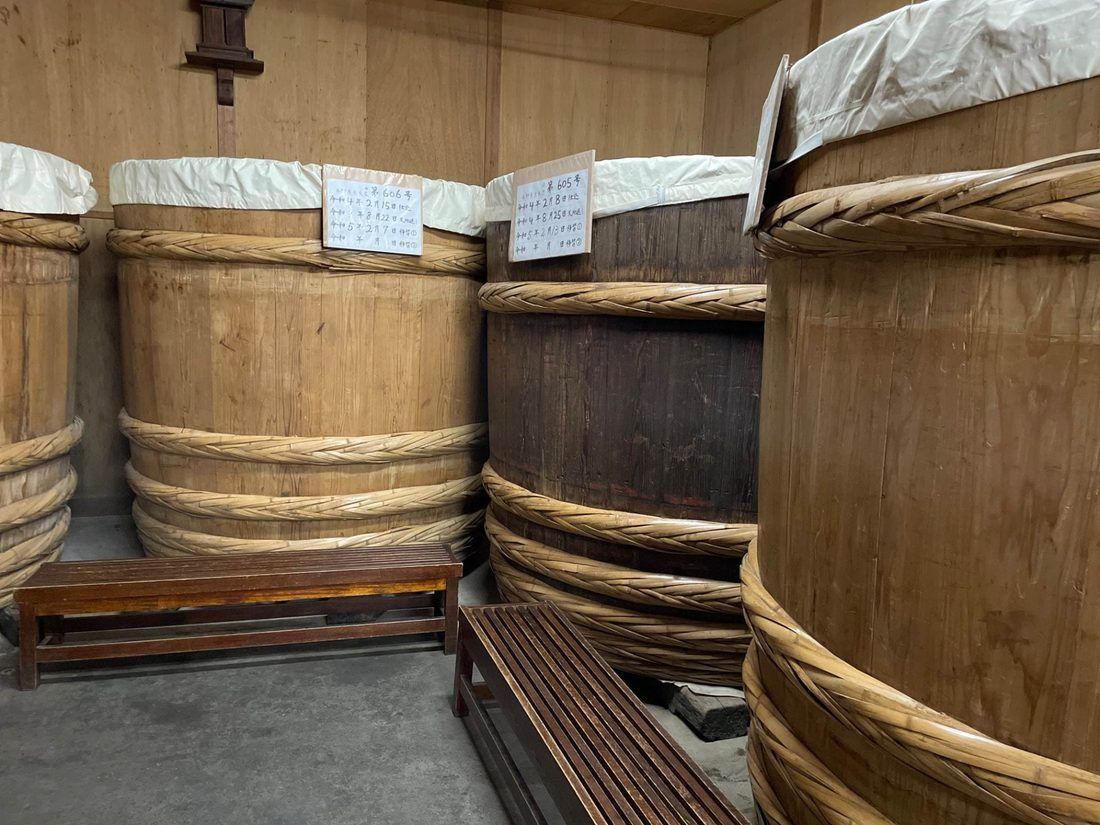
- Pack it into a crock, hard, eliminating air pockets. Smooth the top.
- Cover the surface directly — a layer of salt, plastic pressed onto the surface, or a sheet of sake lees — then weight it.
- Leave it somewhere cool for months to years. Check occasionally.
Expect tamari to pool on top — a dark, intensely savory liquid. That’s not a problem; that’s the original tamari, and it’s a prize. Stir it back in or draw it off and use it.
Surface mold happens on long ferments. White is usually fine — scrape it. Colored fuzzy mold gets scraped generously; high-salt miso is extremely stable and a surface issue rarely reaches the body of the paste. Miso is one of the safest ferments there is precisely because of the salt.
Don’t boil miso. Add it at the end, off the heat, or you lose the aromatics and kill the live culture. Whisk it into a little warm liquid first.
Soy sauce
Shoyu is koji grown on soybeans and roasted wheat, then brined and fermented for months to years, then pressed. The wheat is what distinguishes Japanese shoyu from Chinese soy sauce (which uses less or none) and it contributes sweetness and aroma.
The types worth knowing: koikuchi (the standard dark, ~80% of Japanese production) · usukuchi (lighter colored but saltier, a common confusion) · tamari (wheat-free, thicker, rounder) · saishikomi (brewed twice, using soy sauce in place of brine) · shiro (very pale, mostly wheat).
⚠ Read the label for the real distinction: genuinely brewed soy sauce lists soybeans, wheat, salt, water. Chemically hydrolyzed soy sauce — made by breaking soy protein with hydrochloric acid in hours instead of months — will often say “hydrolyzed vegetable protein,” and it’s a different and much poorer product. That single label check is the most useful thing on this page for everyday shopping.
Making soy sauce at home is a genuine long-term project
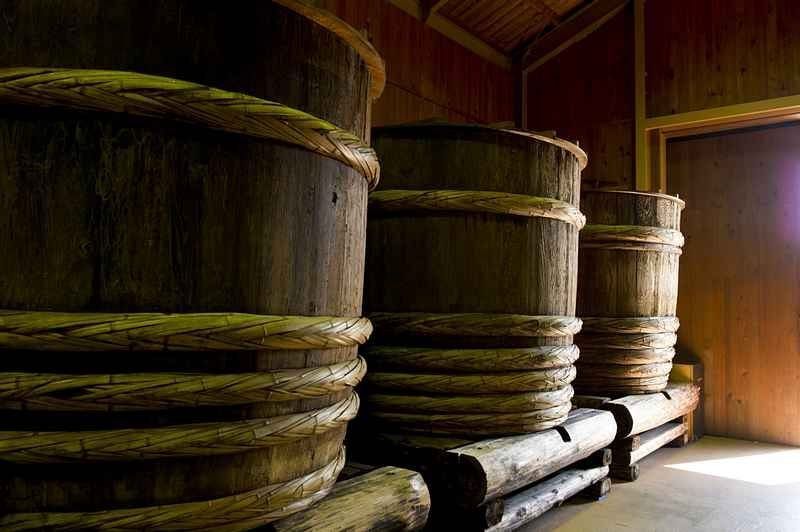 — a year-plus ferment requiring a moromi
mash, temperature management and pressing. It’s on my list rather than in my past, and it’s the
subject of a planned dive of its own.
— a year-plus ferment requiring a moromi
mash, temperature management and pressing. It’s on my list rather than in my past, and it’s the
subject of a planned dive of its own.
Shio koji — start here
If you want to try koji tomorrow with no equipment, make shio koji.
Blend 1 part koji : 0.3 parts salt : 1 part water, keep it at room temperature for about a week, stirring daily. That’s the whole thing.
The result is a loose, sweet-savory, faintly boozy paste that is an outstanding marinade and tenderizer — the proteases go to work on meat and fish, the amylases add a subtle sweetness, and the glutamate does what glutamate does. Use it as you’d use salt: on chicken, on pork, on fish, on vegetables. About 10% of the weight of the food, an hour to overnight.
It’s the single best entry point into this whole family, and it makes the case for koji faster than any amount of explanation.
The two non-koji cousins
Both are mold or bacterial ferments on soybeans, neither uses A. oryzae, and both belong here.
Tempeh — Rhizopus
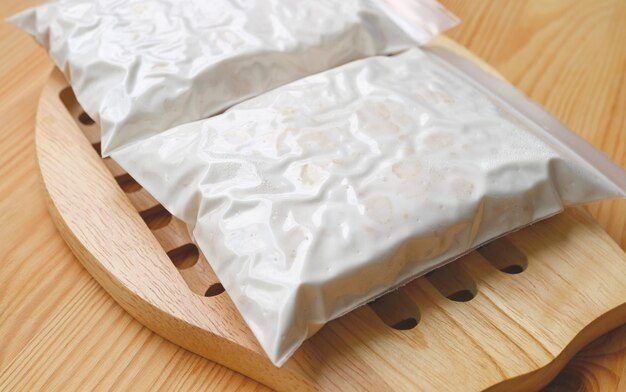
Indonesian. Cooked, dehulled, acidified soybeans inoculated with Rhizopus oligosporus and incubated warm until the mold knits the beans into a solid white cake.
The mycelium is structural — it’s what turns loose beans into something you can slice and fry. Nutty, mushroomy, firm. Nutritionally excellent and, unlike most meat substitutes, a genuinely traditional food in its own right.
Two things matter: the beans must be acidified (a splash of vinegar in the cooking water) to suppress bacteria while the mold establishes, and the incubation is warm and long — around 85–88 °F for 24–48 hours — with airflow. That warm, extended, protein-rich incubation is the one in this family I’d treat with the most respect. Grey or black patches of sporulation are normal and harmless (especially around air holes); a sour, ammoniacal smell means bacteria won and you start over.
Natto — Bacillus subtilis, and the exception to everything
Natto is the odd one out in this entire section, and I flagged it on The Basics for a reason.
Bacillus subtilis var. natto fermenting cooked soybeans raises the pH instead of lowering it, heading toward ammonia. Every safety rule in this dive is built on acidification, and natto does the opposite.
Which is why natto is not an ambient, long, casual ferment: it’s hot and short — around 100–104 °F for roughly 24 hours — with a heavy, known inoculation that overwhelms competitors by force rather than by acid. That’s the whole safety strategy, and it’s why you use purchased natto spores or a spoonful of existing natto rather than wild-catching anything.
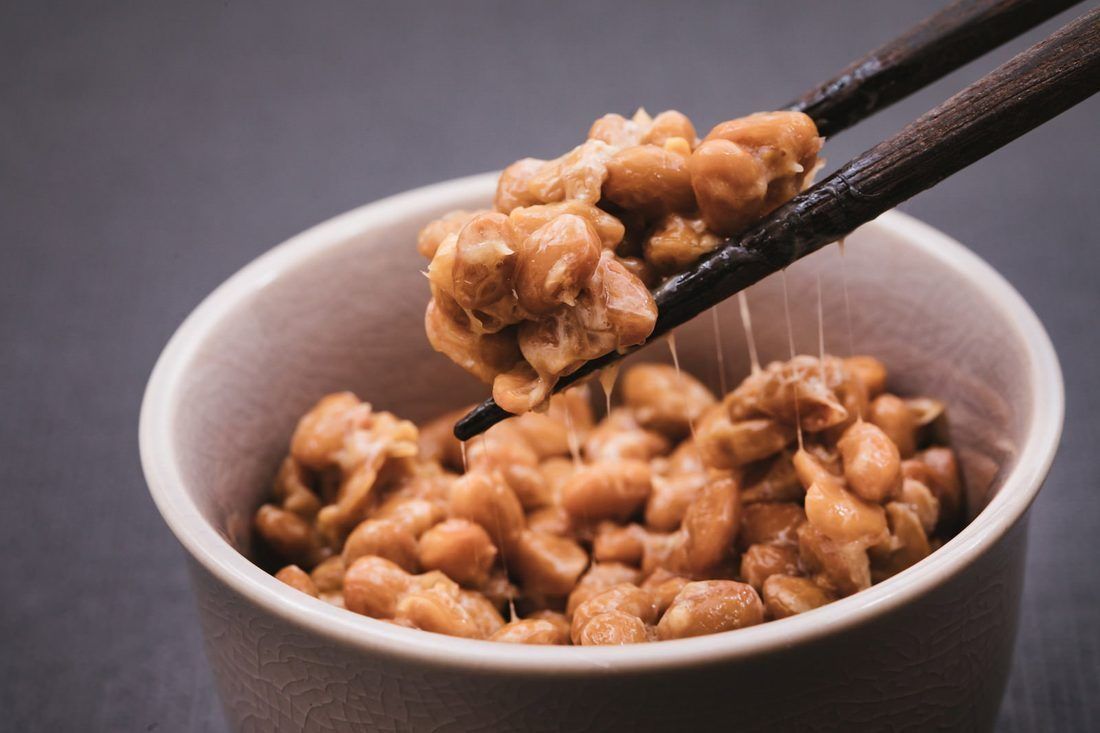
The result is sticky, stringy, pungent, ammoniacal, and an acquired taste I’ll admit I’m still acquiring. It’s also nutritionally remarkable — the richest common dietary source of vitamin K2 (MK-7) by a wide margin, plus the enzyme nattokinase.
Related alkaline ferments elsewhere: West African dawadawa / iru (fermented locust bean), Nigerian ogiri, Indian kinema. Same principle, same pungency, entirely independent traditions — another case of the same idea arriving in several places.
Practical notes on growing koji
If you want to make your own koji rather than buy it:
- Buy spores (tane-koji) from a reputable supplier. Do not wild-catch a mold, ever — you cannot tell A. oryzae from something harmful by looking, and some Aspergillus species produce aflatoxins. A. oryzae is domesticated and safe; its wild relatives are not all safe. This is the one place in this section where “use a purchased culture” is a genuine safety instruction rather than a convenience.
- The substrate is steamed, not boiled, rice — you want separate grains at roughly 30–35% moisture. Boiled rice is too wet and goes bacterial.
- Incubate at about 86–90 °F with humidity and airflow for 36–48 hours. It generates its own heat once established and needs to be stirred and furrowed to shed it — a runaway koji bed can cook itself.
- A cooler with a heat source and a controller works, which is exactly the same rig as a yogurt incubator, just at a different setpoint.
- You want white mycelium and a sweet chestnut smell. Extensive green or yellow-green sporulation means it went too long — still usable for some purposes, but past the ideal.
Where to go next
- The Basics — the five families, including where mold and alkaline fermentation sit.
- Kimchi & the Asian Table — the vegetable half of the same pantry.
- Vinegar — rice vinegar is the koji chain’s last link.
- Worcestershire Sauce — a European fermented condiment with startlingly similar logic.
Comments (0)