Kefir
Kefir is the ferment that behaves least like a recipe and most like a pet. You don’t make a batch — you keep a culture alive, and it makes batches for you as long as you feed it. Miss a week and it sulks. Feed it properly and it will outlive you, which is not a figure of speech: kefir grains are potentially immortal and every one on earth descends from another one.
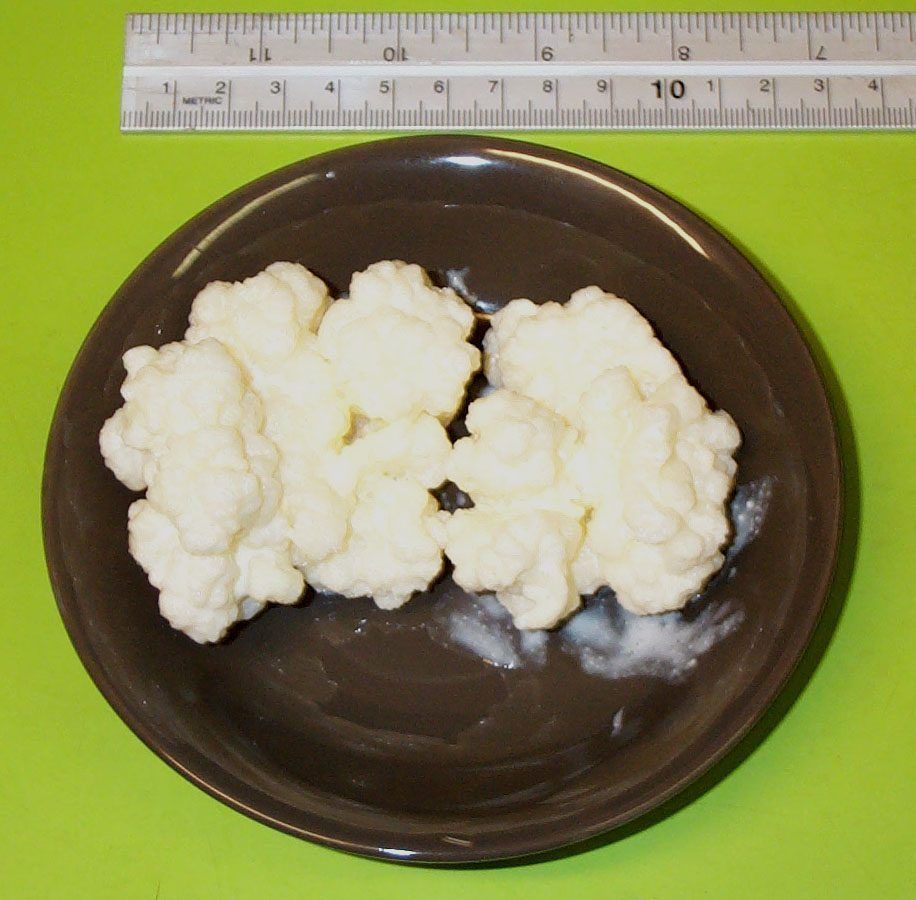
🔴 You cannot make kefir grains from scratch
This is the load-bearing fact and it’s routinely denied by articles promising to teach you otherwise.
A kefir grain is not a clump of bacteria. It’s a structured matrix of kefiran, a water-soluble polysaccharide produced by Lactobacillus kefiranofaciens subsp. kefiranofaciens — and note the precision there, because the sister subspecies kefirgranum does not produce kefiran. That matrix houses a stable consortium of roughly 30 to 60 microbial species: lactic-acid bacteria (L. kefiranofaciens, L. kefiri, Lactococcus, Leuconostoc), acetic-acid bacteria (Acetobacter), and multiple yeasts (Saccharomyces and others).
Nobody has assembled a kefir grain from a defined starter culture. The grain is the product of a very long history of co-evolution — the organisms built a physical structure to live in together, and that structure is what gets handed down. You cannot reconstruct it by combining the parts, any more than you can make a beehive by gathering bees.
So: you must be given grains, or buy live ones. There is no other route.
⚠ There are articles titled “How to Make Kefir Grains at Home From Scratch.” One of them ranked in the very search I ran to verify this. They are wrong. What they describe produces, at best, a kefir-flavored fermented milk — which is fine, but it will never grow into grains.
And note the distinction: a powdered “kefir starter” sold in sachets makes a kefir-like drink and does not grow grains. It’s a one-shot culture, or good for a handful of re-inoculations. Real grains multiply. If your grains aren’t growing, you probably don’t have grains.
Milk kefir
Keeping it going
The whole practice, and it takes two minutes a day:
- Put the grains in milk — roughly 1 tablespoon of grains per cup of milk, in a glass jar.
- Cover loosely. Kefir produces CO₂ (there’s yeast in there) so it needs to vent. A cloth and a band, or a lid resting on top. Don’t seal it tight — jars have broken.
- Leave it at room temperature 12–24 hours. It’s done when it’s thickened and smells tangy and yeasty. Warmer is faster.
- Strain the grains out with a plastic or stainless sieve. Don’t press hard; just let it pass.
- Put the grains straight into fresh milk. That’s the whole loop.
- Drink the kefir, or ripen it another 12 hours at room temperature for a second ferment.
That’s it, forever. The grains grow — visibly, over weeks — and you’ll end up with more than you need. Give them away, or eat the surplus (they’re edible), or blend them into a smoothie.
Things that matter
Never metal — mostly a myth, with a kernel. Reactive metals (aluminum, copper, unlined cast iron) genuinely shouldn’t contact acidic kefir. Stainless steel is fine and the “never let metal touch kefir grains” rule is overstated folklore. I use a stainless sieve.
Milk choice: whole dairy milk is best. Any dairy milk works. Ultra-pasteurized works but grains often grow more slowly. Raw milk works well. Kefir grains cannot live on plant milk — they need lactose. You can ferment a plant milk with kefir liquid, but the grains have to be rested in dairy regularly or they’ll starve and dwindle.
Taking a break: put the grains in fresh milk in the fridge. They’ll hold for 2–3 weeks happily, longer at a stretch. For months, some people freeze or dry them, both of which work with losses. Coming back, expect a couple of sluggish cycles before they hit stride.
Temperature is your main flavor control, as usual: cool (65 °F) is slow and mild, warm (78 °F) is fast, sour, and yeastier.
What it tastes like, honestly
Kefir is not yogurt and people expecting yogurt are often put off. It’s thinner — drinkable, not spoonable. It’s more sour. It’s slightly effervescent, because there’s yeast making CO₂. And it has a distinct yeasty, beery, almost bread-like note underneath the dairy tang that yogurt doesn’t have.
It also contains a small amount of alcohol — typically well under 1%, sometimes around 0.5–2% with a long warm ferment. Worth knowing.
If it’s too sour, ferment it for less time. That’s almost always the fix. Over-fermented kefir separates into curds and yellowish whey and tastes harsh — still safe, just past it.
Second ferment
Strain the grains out, then leave the finished kefir at room temperature for another 12–24 hours, optionally with fruit or a strip of citrus peel. It gets fizzier, more complex, and — a genuinely useful side effect — more of the lactose gets consumed, so it’s easier on the lactose-intolerant. Bottle it in something that can take pressure and burp it.
Water kefir (tibicos)
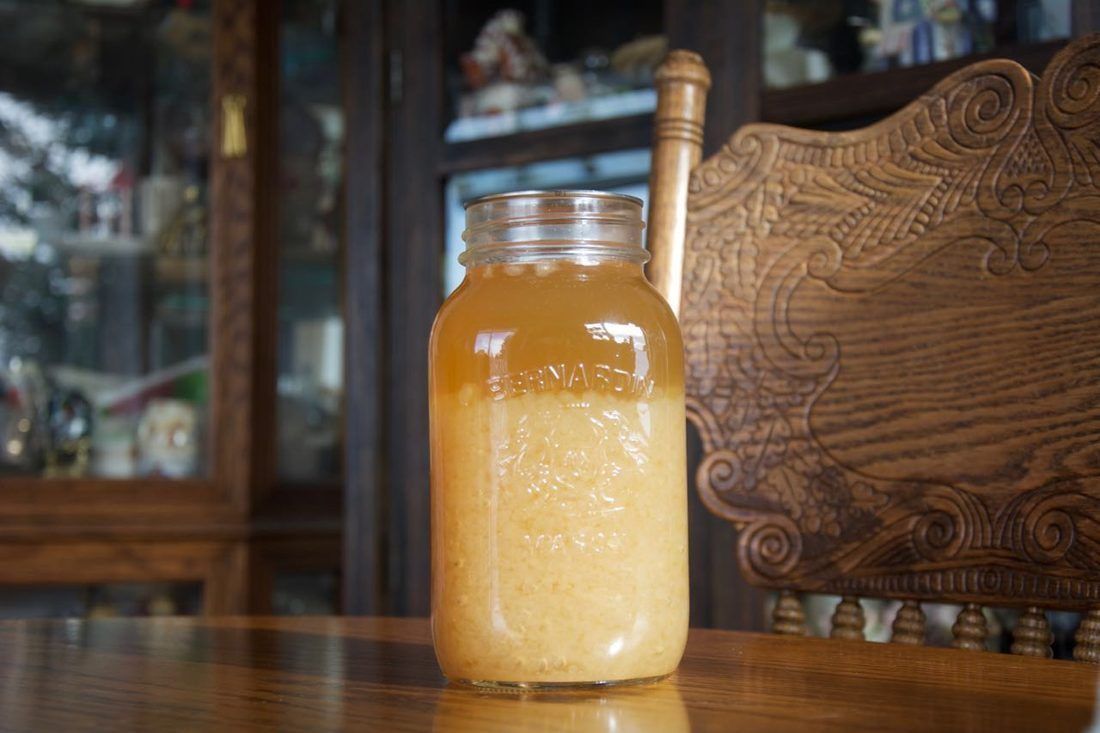
A different culture with a similar life. Water kefir grains (also tibicos, tibi, “Japanese water crystals”) are translucent, gelatinous, and crystal-like rather than the cauliflower-lumps of milk kefir. They are not the same organism set and you cannot convert one to the other. Don’t try to move milk grains into sugar water; you’ll kill them.
Feeding it:
- Dissolve sugar in water — roughly ¼ cup sugar per quart.
- Add the grains — a few tablespoons per quart.
- Add minerals. This is the part that gets skipped and it matters: water kefir grains need minerals and trace elements. A slice of dried fig, a piece of unsulphured dried fruit, a pinch of unrefined sugar or molasses, or an eggshell does it. On pure white sugar and distilled water they dwindle away.
- Cover loosely, 24–48 hours at room temperature.
- Strain, re-feed, and second-ferment the liquid with fruit juice for fizz.
Water kefir is genuinely dairy-free by nature, not by substitution — which makes it a much better answer than plant-milk kefir for anyone avoiding dairy. It’s lightly sweet, tart, and fizzy: closer to a soda than to a dairy drink, and a good way to get someone off soft drinks. Use unrefined sugar or add molasses rather than trying to make it work on refined white sugar alone.
Don’t use honey as the primary sugar — it’s antimicrobial and will weaken the culture.
Kefir versus yogurt versus kombucha
| Yogurt | Milk kefir | Kombucha | |
|---|---|---|---|
| Substrate | Milk | Milk | Sweet tea |
| Culture | 2 defined bacteria | Grains: 30–60 species, bacteria + yeast | Bacteria + yeast |
| Culture form | Added liquid or powder | A physical grain you strain out | Liquid + a cellulose pellicle |
| Alcohol | None | Small amount | Often at or over 0.5% |
| Fizzy | No | Slightly | Yes |
| Temperature | ~110 °F, needs an incubator | Room temperature | Room temperature |
| Effort | Per batch | Daily, small | Weekly-ish |
| Reusable culture | Degrades over ~10–20 generations | Effectively immortal | Effectively indefinite |
The practical takeaway: kefir is the easiest of the three to make and the hardest to maintain casually. No equipment, no temperature control, no heating step — but it wants attention every day or two, indefinitely. Yogurt is the opposite: real equipment, then a batch that asks nothing of you.
If you travel a lot or you’re inconsistent, yogurt is the better fit. If you’re home and you like a small daily ritual, kefir is remarkable.
The name and the origin
Kefir is generally traced to the North Caucasus, where the grains are traditionally held to have been a closely-guarded possession of Karachay and other mountain peoples, passed down within families and not given away. There’s a well-known story about how grains reached the Russian dairy industry in the early twentieth century involving a certain amount of intrigue.
⚠ I’m going to flag rather than retell that story. The versions circulating are colorful, mutually inconsistent, and I did not verify any of them for this pass. What’s solidly established is the Caucasus origin and the tradition of grains being inherited rather than sold — which is consistent with the microbiology, since grains genuinely can’t be manufactured, so possessing them really was the only way to have kefir.
Where to go next
- Yogurt — the defined-culture cousin.
- Kombucha — the other continuous culture, and its own myth problem.
- Other Fermented Drinks — ginger bug, tepache, kvass.
- Non-Dairy Yogurt — why plant milks are a different problem.
Comments (0)