Peppers and Hot Sauce · 5 of 14
Fermented Hot Sauce
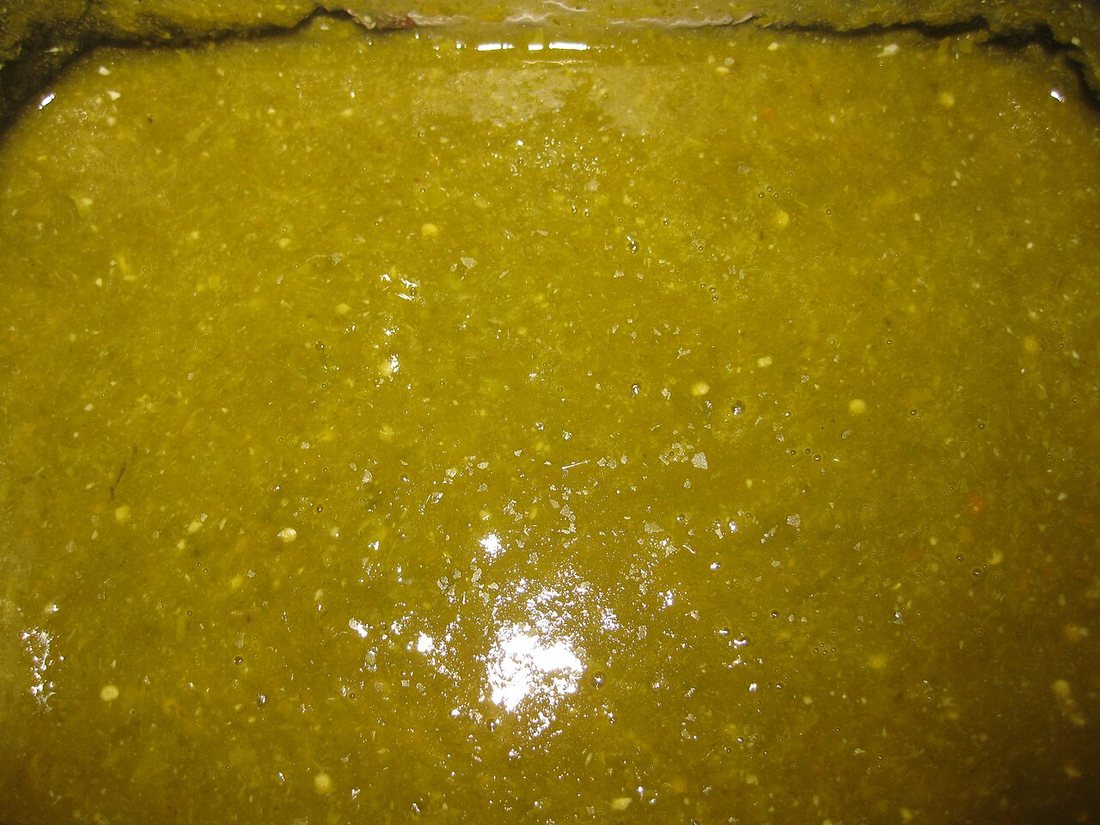
A fermented hot sauce grows its own acid. Salt holds back the organisms that rot vegetables, lactic acid bacteria on the pepper’s skin eat its sugars, and the mash turns sour. That much is the old story, and it is true. The part the story leaves out is where the acid stops. In three independent studies, pepper ferments left to their own bacteria finished at about pH 4.8 to 4.9 — sour to the tongue, and on the wrong side of the 4.6 line below which Clostridium botulinum cannot grow. The same peppers given a starter culture finished at about 3.7.
So a fermented sauce is the one kind of hot sauce whose safety cannot be read off the recipe. It has to be measured, and in nearly every case it has to be finished — with vinegar, with heat, or with a permanent place in the refrigerator. The kitchen these pages are written for has made fermented hot sauce, and works with fermentation weights, airlocks and a pH meter.
Mash or brine
There are two ways to set up a pepper ferment, and the published work uses both.
Mash is the Louisiana method: peppers ground and mixed directly with salt, packed down, and left. A 1986 LSU doctoral dissertation (Abdul Rahman Awad, Chemical and Physical Characteristics of Pepper Mash and Hot Pepper Sauce) aged hot pepper mash at 6, 8 and 10% salt in oak and plastic barrels for two years. Its conclusion: “The oak barrel hot pepper mash that was treated with 8% salt was found to contain a higher amount of pectic substances than any other of the treatments … This mash also produced a more stable hot pepper sauce after two years of aging.” The dissertation also found that the pepper’s own pectic enzymes break the mash down “very rapidly after only a few days of aging,” and that more salt or an oak barrel slowed that. The study does not name any company; the connection to Louisiana’s barrel-aged sauces is an inference from the setting, not a statement in the text.
Brine is whole or chopped peppers held under salt water. Food in Jars (Marisa McClellan) uses one quart of water and 3 tablespoons of fine sea salt over a mash of 1 lb (450 g) hot and 1 lb sweet peppers with garlic and ginger, fermented under an airlock “two to three weeks, until the color fades.” No pH target is given.
How much salt
No extension service and no regulator publishes a salt percentage for fermented pepper mash. The figures in circulation come from three different kinds of source, and they should not be confused:
| Figure | Where it comes from | What kind of number it is |
|---|---|---|
| 2–10%, “sweet spot” 2–4%, about 5% for ferments longer than four weeks | Tim Chin’s Serious Eats guide, quoting fermenters including Mara Jane King | Practitioner opinion |
| 6, 8, 10% (8% performed best in oak) | Awad, LSU dissertation, 1986 | A two-year barrel study |
| 8% for Tabasco mash | A 2023 Foods paper citing another study | Secondary; McIlhenny does not publish its salt level |
| About 2% by weight | NCHFP sauerkraut (¾ cup salt per 25 lb cabbage), converted by arithmetic | A tested cabbage ferment, not a pepper one |
| 5.0% by weight | Tim Chin’s habanero recipe (30 g salt over 600 g produce), by arithmetic | One published recipe |
There is also a ceiling. In a study of jalapeño fermentation, the salt levels that cut the growth of the main lactic acid bacteria by half were 7.2% for Leuconostoc citreum, 6.6% for Lactobacillus plantarum and 5.2% for Weissella cibaria (González-Quijano et al., J Food Sci 2014). Much above those levels, the bacteria that make the acid are being suppressed along with everything else.
The floor matters more than the ceiling. NCHFP’s caution for fermented vegetables is blunt: salt “is vital to safety and texture … Do not attempt to make sauerkraut or fermented pickles by cutting back on the salt required.”
The bacteria
In a jalapeño ferment the lactic acid bacteria were Weissella cibaria, Lactobacillus plantarum, Lactobacillus paraplantarum and Leuconostoc citreum, with two yeasts alongside. The plant-surface bacteria (Pantoea, Enterobacter) were inhibited after 12 hours, once the pH had fallen from 6.5 to 4.9. Chinese pepper ferments show the classic succession: Leuconostoc, Lactococcus and Weissella early, L. plantarum finishing (Li et al., Food Res Int 2024). L. plantarum has been Lactiplantibacillus plantarum since a 2020 reclassification; the papers use both names.
One finding is particular to peppers. When capsaicin was added to a ferment, “the total acid was significantly decreased … along with lower total bacteria, especially lactic acid bacteria” (Shi et al., Food Res Int 2023). The heat itself makes the jar a harder place for the bacteria to work. Whether that holds for home ferments of the hottest peppers has not been tested.
Time and temperature
NCHFP publishes no time or temperature schedule for pepper mash. Its sauerkraut schedule is the nearest tested analogue: 70–75 °F (21–24 °C) for about 3 to 4 weeks; 60–65 °F (16–18 °C) for 5 to 6 weeks; below 60 °F the cabbage “may not ferment”; above 75 °F it “may become soft.”
The pepper literature covers a wide range — 15 days at 21–24 °C (Espelette peppers), one month at 20–25 °C (Yunnan pickled chili), and from two weeks to three years in commercial barrels. Practice guides sit at the short end: Tim Chin gives 7 to 14 days on average, and Kirsten Shockey (Fiery Ferments, as quoted by Chin) prefers a cool 55–60 °F (13–16 °C).
Ferments stop for two reasons. The sugar runs out, which the studies measure directly, and the pH levels off at a stable value rather than falling forever. NCHFP’s practical end point for sauerkraut is “when bubbling ceases.” A ferment that has stopped bubbling has finished; it has not necessarily finished below 4.6.
The film on top
NCHFP’s description of surface scum on a cucumber ferment carries a safety point that is easy to miss: it is “wild yeasts and bacteria that feed on the acid thus reducing the concentration if allowed to accumulate.” Film yeast eats the acid. On a mash that only just reached a safe pH, an unattended film can push it back up. NCHFP’s instruction is to remove scum as often as needed. (The word “kahm” does not appear in NCHFP’s material; telling yeast film from mould is covered in Fermentation.)
Yeasts found in pepper ferments include Pichia, Candida, Kazachstania and Hanseniaspora. A Cornell study of spoiled commercial hot sauces isolated the yeast Pichia manshurica and the bacterium Lactobacillus curvatus. One widely read guide says limited mould can be scraped off and the ferment kept; that advice is not drawn from any tested process and is not repeated here.
The pH stall
This is the finding the rest of the page depends on.
| Ferment | Without starter | With starter | Source |
|---|---|---|---|
| Espelette green peppers, 15 days at 21–24 °C, oil cap | 4.8 | 3.7 (L. plantarum, 0.08%) | Torán-Pereg et al., Foods 2023 |
| Red and yellow peppers | ca. 4.87, with “considerable contamination by total enterobacteria and yeasts” | below 3.7 | Di Cagno et al., Int J Food Microbiol 2009 |
| Habanero in 5% brine, 14 days | 4.87 (from 5.24) | — | Aryee et al. 2022, as reported second-hand |
| Tabasco-type mash, 8% salt | 4.7 to 3.9–3.7 in the first month, depending on container | — | Reported second-hand; original not read |
Back-slopping helps: in Yunnan pickled chili, aged brine added back at 1:4 gave a lower pH than fresh brine, most of the drop coming within seven days (Zhang et al., Foods 2023). The study’s industrial “fresh brine” contained added acetic acid, so it is not a pure lacto-ferment.
A spontaneous pepper ferment can taste sour and still sit above 4.6. Taste cannot tell 4.5 from 4.9. That is the case for a meter, and for reading it properly — Measuring pH covers calibration, sample preparation and why strips are only acceptable at 4.0 and below. The safety page sets out what the number has to be and why.
Finishing: vinegar, heat, or cold
Utah State University Extension states the general rule: “In most cases, fermentation alone cannot produce a shelf-stable (room temperature) food product. Nearly all fermented foods require canning to preserve or refrigeration.” NCHFP has no tested fermented hot sauce at all; its fermentation recipes are dill pickles, sauerkraut and kombucha.
Published recipes finish in one of three ways, and most use more than one:
- Vinegar, to a measured pH. Tim Chin’s berry-habanero sauce is blended with vinegar and sugar, then measured: if it is above about pH 3.4, more vinegar goes in. It is then refrigerated for up to a month, because fruit sugar can keep it fermenting. Chin calls 3.4 a “popular standard”; it is not a regulation.
- Heat. Joshua Bousel’s homemade sriracha ferments 5 to 8 days, then is blended with vinegar, strained and boiled until it coats a spoon, which means the finished sauce is no longer live. It is refrigerated for up to 6 months. Even the study that stored a fermented pepper product at room temperature heated it first, to 85 °C (185 °F) for 15 minutes (Di Cagno).
- Cold. Every home recipe here ends in the refrigerator.
Two results reframe what the fermentation is for. The Espelette team’s finished sauce reached pH 3.3 because of 8% lemon juice, and they concluded that “the fermentation stage was not useful to differentiate the flavor of the product, nor was it necessary from a technical standpoint.” And at the same pH, vinegar kills faster than citrus: sauces brought to pH 3.2 with acetic acid achieved a greater than 5-log reduction of pathogens in half an hour, while citric acid needed at least 48 hours (Lobo et al., J Food Prot 2019). The ferment is for flavor; the vinegar is doing the safety work. Vinegar sauces are on their own page.
Airlocks, garlic and a common misreading
Some guides say garlic in a ferment is no worry because an airlock lets carbon dioxide displace the oxygen. That reasoning runs backwards. A jar flushed with carbon dioxide is anaerobic, which is the condition C. botulinum needs. An airlock keeps the ferment clean; what protects it is the falling pH, and only once it has actually fallen.
How long Tabasco ages
The figures conflict, and the conflict is instructive. McIlhenny, the only first-party source, says its mash ages “up to three years in white oak barrels.” Tim Chin’s guide says “up to eight years,” with a 15-year Diamond Reserve, and quotes Mara Jane King as saying Tabasco and sriracha are fermented “for a minimum of one year, up to five.” Neither of the larger figures is sourced to the company. The company’s own historian describes the original process as 30 days in crockery jars and barrels, then French white wine vinegar for at least another 30 days. The full history is on the American shelf; the mash-then-vinegar sequence is set out on Peppers and the Hot-Sauce Shelf.
Recipes in the collection
- Fermented Habanero Hot Sauce (Tim Chin) — 5% salt mash, finished with vinegar to pH 3.4, refrigerated.
- Fermented Sriracha (Serious Eats) — short sealed ferment, boiled after blending.
- Master Hot Sauce (Bon Appétit) — a 12-hour nominal ferment, then vinegar; refrigerated.
- Fermented Hot Sauce
- Gochujang — a fermented paste with no added acid.
- Sriracha Wing Sauce
Comments (0)