Peppers and Hot Sauce · 1 of 14
The Pepper
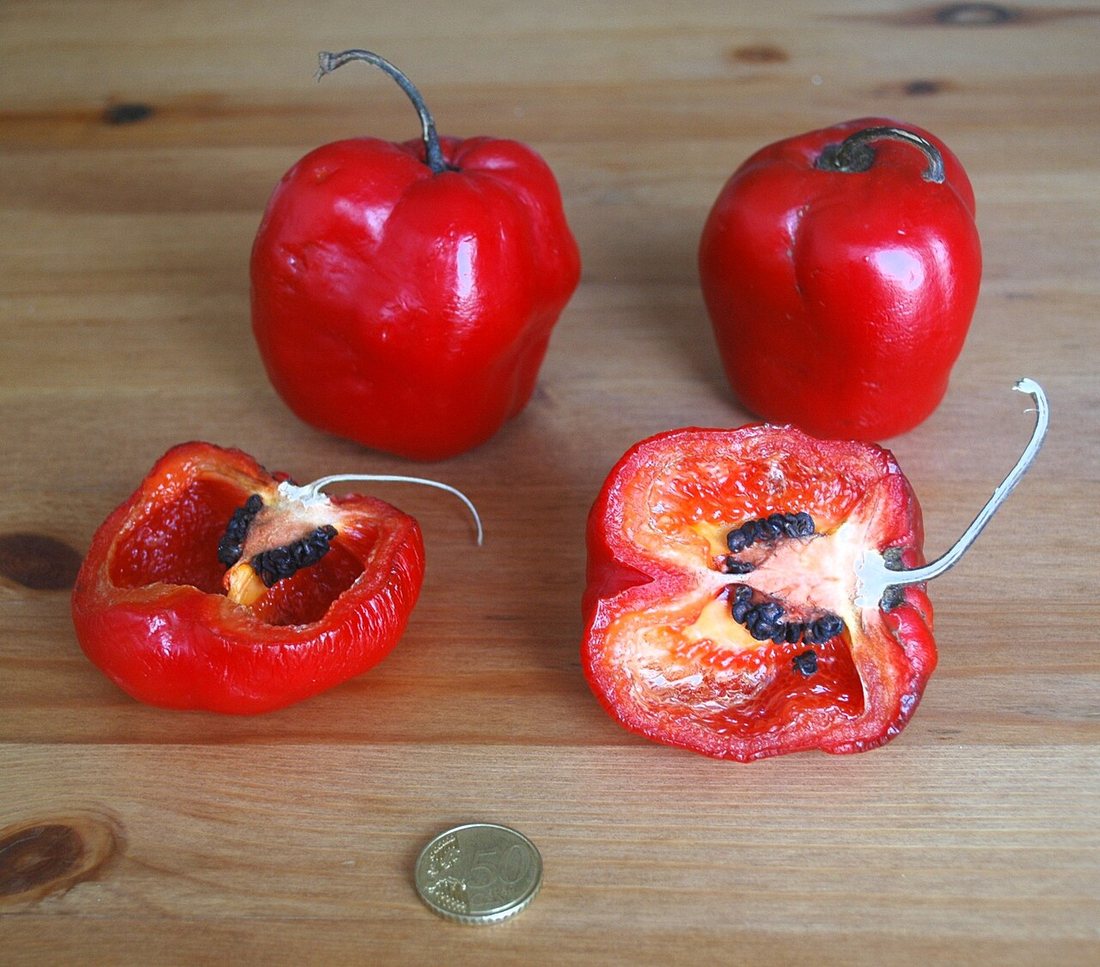
Every chile in a hot sauce, a jar of pickles or a bag of flakes belongs to one genus, Capsicum, and to one of five species that people domesticated. The genus is American: it is “native to temperate, subtropical and tropical regions of the Americas … with the primary centre of diversity in the Andes” (Barboza et al., PhytoKeys 2022, the current monograph of the genus). Nothing in it is native to Asia, Africa or Europe, whatever the names on the seed packets suggest.
The species matter in a kitchen for a practical reason. They differ in how long they take to ripen, in flavor, and in where the heat sits. And one fact about the fruit’s anatomy, that the heat is made in the placenta and not in the seeds, changes how a pepper should be cut.
The five domesticated species
Barboza’s monograph names them in one sentence: “five main domesticated species: C. annuum L., C. chinense Jacq. and C. frutescens L., now widely cultivated throughout the world and C. baccatum L. and C. pubescens Ruiz & Pav., cultivated predominantly in South America.”
| Species | Named by | Peppers that belong here | Notes |
|---|---|---|---|
| C. annuum | Linnaeus, 1753 (“herbaceous annual”) | Most commercial chiles and all bell peppers; jalapeño, serrano, cayenne, poblano and banana are usually filed here | ”The vast majority of the modern landraces, varietals and hybrids of chili peppers belong to this variety” (Barboza) |
| C. frutescens | Linnaeus, 1753 (“shrubby perennial”) | Tabasco | ”The famous hot Tabasco sauce is made from tabasco peppers, a varietal of C. frutescens” (Barboza) |
| C. baccatum | Linnaeus, 1767 | Ají amarillo, as reported | Cultivated mainly in South America |
| C. chinense | Jacquin, 1776 | Habanero, Scotch bonnet, Carolina Reaper, Bhut Jolokia, Red Savina | The superhots belong here |
| C. pubescens | Ruiz and Pavón, 1799 | Rocoto, locoto, ají rocoto | Its fruits are “one of the most appreciated in the Andean cuisine” (Barboza) |
All five had been formally described “by the beginning of the 19th century.”
What the table can and cannot claim. The assignments for habanero, Scotch bonnet, the superhots, tabasco and rocoto come straight from the monograph. The assignments for individual annuum chiles (jalapeño, serrano, cayenne, poblano, banana, pepperoncini) are the conventional ones, but no first-hand botanical source naming each cultivar by species was reached. The strongest support is Barboza’s statement that “the vast majority” of modern cultivars are annuum. Ají amarillo as C. baccatum rests on a secondary source.
Three species, one gene pool
C. annuum, C. chinense and C. frutescens together form what the monograph calls the “Annuum clade”, sharing one primary gene pool. The boundaries inside it are soft: “an unequivocal morphological delimitation for C. chinense is difficult.” That is why some peppers resist a clean label:
- The Thai or bird’s eye chile. It is usually called C. annuum, but a similar-looking chile from C. frutescens (the Philippine siling labuyo) is easily mistaken for it. The species of a “Thai chili” in a shop is genuinely ambiguous, and it is better not to assert one.
- The ghost pepper (Bhut Jolokia). Barboza files it under C. chinense. A 2007 paper in HortScience (Bosland and Baral) is titled “‘Bhut Jolokia’ – The world’s hottest known chile pepper is a putative naturally occurring interspecific hybrid.” That paper could not be read, so the hybrid idea rests on its title alone.
- The peri-peri pepper is reported to be a C. frutescens cultivar, the “African bird’s eye”. Like every other chile, it is American by origin. More on the sauce is on Africa, the Middle East and the Americas.
One species, not one ancestor
Seed Savers Exchange tells gardeners that “all pepper varieties originate from just one wild species native to Central and South America.” The monograph describes five species domesticated separately, from different wild relatives. On this point the seed-saving advice is wrong. (Its practical growing advice is good, and is used on Growing Hot Peppers.)
The “Chinese” pepper from Martinique
The name Capsicum chinense is a mistake, and the monograph says so directly. “Jacquin (1776) described C. chinense, based on cultivated material. In the protologue, he stated that he saw this species cultivated on the Island of Martinique (Lesser Antilles) … but he called it C. chinense, alluding to the region to which he thought the plant was native.” His original herbarium sheet is labelled “Capsicum sinense”.
The habanero and the Scotch bonnet carry a Latin name meaning “Chinese” because an 18th-century botanist guessed wrong about a plant he saw growing in the Caribbean. The species is American.
Jacquin’s was not the first geographic error. In 1542 Leonhart Fuchs published the first three scientific illustrations of chiles and named them as Indian peppers (“Calechutischer Pfeffer”, pepper of Calicut) “because he did not know the geographic origin of the plants” (Barboza). The word “pepper” itself is a borrowing from black pepper, which is unrelated; the story of how it attached is on the history page.
A shrub grown as an annual
Linnaeus’s two original names describe two habits: annuum, an “herbaceous annual”, and frutescens, a “shrubby perennial”. The plants are tropical perennials. Northern gardeners grow them as annuals because frost kills them, not because they die naturally at the end of a season. No extension guidance on overwintering hot peppers was found, so the growing page leaves the question open.
Anatomy: where the heat is
A chile fruit is hollow. Working from the outside in, it has:
- The pericarp. This is the wall: the skin and flesh that change color as the fruit ripens. Seed Savers describes the sequence “from green, to yellow, orange, and finally red, brown, or purple”, depending on the variety.
- The placenta. This is the pale tissue inside the cavity that holds the seeds. It is the “whitish membrane” of many cooking guides.
- The seeds, attached to the placenta.
Capsaicin is made in the placenta, not the seeds
A 2024 review in Plants on capsaicinoid metabolism puts it plainly: “capsaicinoids are synthesized by glandular cells within the placenta and pericarp tissue of pepper fruit.” Older work assumed synthesis “was limited to the placenta”. However, “substantial quantities” of the biosynthesis genes have been found in the pericarp of some superhot C. chinense lines.
Guinness World Records said the same when certifying Pepper X in 2023: “A commonly held belief is that the seeds of a pepper are what makes it hot. However, this is not true, as the capsaicin is contained in the placenta, the tissue which holds the seeds.”
The popular version: the heat is in the seeds. The evidence: the seeds sit against the placenta and pick up capsaicin from it, but the placenta is where it is made. Even an extension service repeats the older idea. The University of Minnesota’s pepper guide says capsaicin “is in the seeds and the whitish membrane inside the fruits.” That sentence gets the cook to the right result for the wrong reason.
What that means at the cutting board
- Removing the seeds and the placenta together does reduce heat. The UMN advice works because it takes out the placenta, not because it takes out the seeds.
- Scraping out only the seeds misses the point. It leaves behind the tissue that makes the heat.
- In the superhots, the wall carries heat too. Because some C. chinense lines make capsaicinoids in the pericarp, removing the placenta from a superhot does not make it mild.
- Wear gloves either way. NCHFP’s standing caution is on almost every pepper recipe it publishes: “Wear plastic or rubber gloves and do not touch your face while handling or cutting hot peppers.” Handling, and what to do when it goes wrong, is covered on Heat.
Why a plant would fill its fruit with an irritant, and why birds eat it anyway, is also on Heat.
Fresh and dried names
Many chiles change name when they are dried, which makes a spice aisle look more varied than it is.
- Chipotle means a smoked chile. Pati Jinich explains it as “the Jalapeño chile, that has been ripened, dried and smoked. Its name comes from the náhuatl Chilli or Chile, and Poctli or smoke.” The Nahuatl spelling differs between sources.
- Ancho is reported to be the dried poblano.
- Ají mirasol is reported to be the dried ají amarillo.
Sources disagree on how chipotles are made and on the difference between meco and morita. That dispute is set out on Dried and Smoked Chiles.
Why species matters for a sauce
Species mostly shows up in the kitchen as season length and flavor family:
- Season length. The C. chinense peppers (habanero, Scotch bonnet) are the ones a short northern season makes difficult; see Growing.
- Flavor family. The annuum chiles carry most of the American shelf. Cayenne carries Crystal and Frank’s, and red jalapeño carries Huy Fong’s sriracha. C. frutescens gives Tabasco its pepper. The chinense peppers carry the Caribbean pepper sauces.
The shelf itself is covered on The American Shelf.
Recipes in the collection
- Pickled Hot Peppers (NCHFP, Canned): a tested process for long hot peppers such as Hungarian, banana, chile and jalapeño.
- Pickled Jalapeño Rings (NCHFP, Canned) and Pickled Banana Pepper Rings (NCHFP, Canned): two annuum standards, both tested.
- Fermented Habanero Hot Sauce (Tim Chin): a C. chinense ferment finished to pH 3.4.
- Caribbean Scotch Bonnet Pepper Sauce: the Scotch bonnet in its home style.
- Ají Verde (Peruvian Green Chile Sauce): from the Andean side of the genus.
- Cayenne Pepper Sauce (NCHFP, Canned): a tested cooked sauce.
- Roasted Chile Powder: dried Thai, de árbol or japones chiles, toasted and ground.
Comments (0)