Peppers and Hot Sauce · 2 of 14
From Tehuacán to the Hot-Sauce Shelf
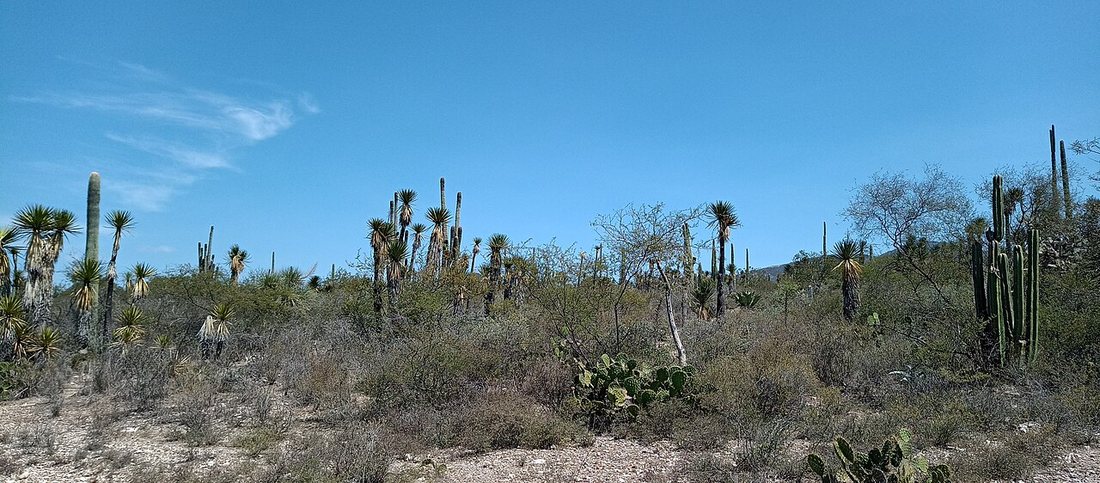
People were eating chiles for thousands of years before Europeans arrived in the Americas. Within about a century of Columbus, chiles were growing in Africa, India, the Philippines and Hungary. Several of the countries now most associated with chile heat (Korea, Sichuan, Thailand, Hungary) did not have the plant until the 16th century or later.
The evidence for that spread is uneven. The ancient end is well studied. The 16th-century movement is mostly undocumented. Several national stories about the chile are older than the chile’s arrival in that nation.
Six thousand years in the Americas
Two papers anchor the deep history.
Perry et al., Science 2007. Starch microfossils from chiles “have been found at seven sites dating from 6000 years before present to European contact and ranging from the Bahamas to southern Peru.” The authors found chile and maize together and concluded that the two “occurred together as an ancient and widespread Neotropical plant food complex that predates pottery in some regions.” In some regions, chiles were a staple before there were pots to cook them in.
Kraft et al., PNAS 2014. This study combined genetics, archaeology, ecology and historical linguistics to locate where C. annuum was domesticated. Its conclusion is cautious: domestication “could have occurred in one or both of two areas of Mexico: northeastern Mexico and central-east Mexico. Genetic evidence shows more support for the more northern location, but jointly all four lines of evidence support central-east Mexico, where preceramic macroremains of chili pepper have been recovered in the Valley of Tehuacán.” Proto-Otomanguean is “the oldest protolanguage for which a word for chili pepper reconstructs.”
Two cautions belong with those findings:
- Kraft is about C. annuum only. The other four domesticated species were domesticated in South America, which is the genus’s centre of diversity. See The Pepper.
- Watch the date conversion. The PhytoKeys monograph (Barboza et al. 2022) says chiles were “used as spices since 6000–6500 BCE”, and cites Perry and Kraft for it. Perry’s own abstract says 6,000 years before present, which is about 4000 BCE. The secondary figure does not match the source it cites. Perry’s wording is the one to use.
”Their pepper”: Columbus and the misnaming
On 15 January 1493, Columbus wrote in the journal of his first voyage: “There is also plenty of aji, which is their pepper, which is more valuable than pepper, and all the people eat nothing else, it being very wholesome. Fifty caravels might be annually loaded with it from Española.” (Markham translation.)
Earlier entries show that he had carried samples of black pepper from Castile to show the islanders. He was looking for the spice trade and he filed what he found under the spice he was looking for. That is how a New World fruit came to be called “pepper”, a name it still carries in English even though it is unrelated to Piper nigrum.
The first written description followed a year later. Diego Álvarez Chanca, the physician on the second voyage, described “‘agi’ … a spice that the native Indians of Hispaniola employed to season their foods” in a 1494 letter to the town council of Seville (per Barboza). By 1542, Leonhart Fuchs was publishing the first scientific illustrations, labelled as peppers of Calicut in India, because he did not know where the plant came from.
Around the world in a century
The broad outline is agreed. Chiles were “first introduced into Europe and subsequently into Africa and Asia” (Barboza), and C. chinense reached Asia “mainly by Portuguese explorers”. The detail is where the evidence thins out. The fullest narrative found is from YaleGlobal Online, which is journalism, not peer-reviewed scholarship:
- Portugal reached India in 1498.
- “By the 1500s they were regularly exporting chili peppers from Brazil.”
- A 16th-century botanist referred to chiles from Goa as “Pernambuco Peppers”, naming them after a Brazilian province.
- Portuguese slave traders “dispersed chili peppers” in Africa.
- Chiles reached the Philippines in 1564.
The routes are plausible, but the details of the spread are generally described as unrecorded. The sections below take the countries one at a time, each with the strength of its evidence stated.
Hungary: paprika arrived hot
According to a 2018 IntechOpen chapter on paprika quality (Klátyik et al.), paprika “arrived to Hungary as early as the sixteenth century.” The chapter gives two theories and does not choose between them:
- It was “imported from Iberia as a substitute to spice pepper, when the Eastern trade paths were closed to the country being under Ottoman rule.”
- It “reached the country by the Southern Slavonic-Turkish mediation from the Balkan.”
Neither route is established.
What is established is more surprising. Sweet Hungarian paprika is a 20th-century breeding result, not an ancient tradition. “Central European paprika had a typically hot taste until the 1920s, when a Szeged breeder found a variety that produced a sweet tasting fruit.” Government paprika research stations opened at Kalocsa in 1917 and Szeged in 1921. The mild red powder now thought of as the traditional Hungarian kind is about a century old.
China and Sichuan
A secondary source, not verified here, gives the earliest Chinese written mention of chiles as 1591 and their arrival as probably the 1570s. YaleGlobal suggests that Hunan and Sichuan, which were connected to the outside world by the Silk Road rather than by coastal ports, may have received chiles overland. That is speculation. The standard scholarly book, Brian Dott’s The Chile Pepper in China (Columbia, 2020), could not be consulted. When chiles entered Sichuan cooking could not be established from the sources reached.
Korea: two stories, one of them impossible
An open review, “Kimchi throughout millennia” (Journal of Ethnic Foods, 2023), sets out both versions:
- The conventional account. Red kimchi “was said to be invented only in 1592 at the time of Imjin wars (Japanese invasion of Korea), during which red chili pepper was first introduced in Korea.”
- The revisionist account. Gochu “has existed in the Korean peninsula since 2,000 years ago” and is “native to Korea.”
The second claim conflicts with the botany. Every Capsicum species is native to the Americas. A chile cannot have grown in Korea 2,000 years ago, and the claim is better read as a national story than as a finding.
The usual first Korean record is cited as Jibong yuseol, of 1614. That text was not consulted first-hand.
The gochujang legend problem
Gochujang raises the same issue. The ages commonly given for it rest on records of a “pepper paste” (苦椒醬) in a 9th-century Chinese text and in Korean medical books of 1433 and 1445. All of those predate the arrival of the chile in Korea. The character 椒 (jiao) named other pungent plants. The first gochujang recipes with chile powder appear in the 18th-century Jeungbo sallim gyeongje and in Gyuhap chongseo (1809), as reported in secondary sources.
The best-known origin story has the same flaw. In the Sunchang legend, Yi Seong-gye (later King Taejo) eats gochujang with bibimbap at a temple in the 14th century. That is about two centuries before chiles reached Korea, so whatever the future king ate, it was not chile gochujang. More on the paste is on Asia’s Chile Sauces and Pastes.
Southeast Asia
No first-hand source dates the chile’s arrival in Thailand. For the Malay world, secondary sources say sambals got their heat before chiles from long pepper (Piper retrofractum), ginger, galangal and andaliman, and that chili sambals are “recorded across the archipelago” by the 18th century. That is plausible, but no primary source was read. Here too, a sauce category now defined by chiles was probably older than the chile.
The bottle arrives
The early dates for bottled hot sauce in the United States are less certain than the brand histories suggest.
- 1807, Massachusetts. This is often cited as the first bottled hot sauce in the United States. The only trace is a popular book (Jennifer Trainer Thompson, Hot Sauce!, 2012). No advertisement or primary record was found, so the date should be treated as unconfirmed.
- 1868–1870, Avery Island. Edmund McIlhenny grew his first commercial crop of tabasco peppers in 1868. The first 658 bottles went out in 1869, and he took a patent in 1870, according to the company. An outside author argues that a New Orleans planter, Maunsel White, was growing the same pepper by 1849.
- 1920s. Frank’s RedHot reached shelves in 1920 and Crystal in 1923. Buffalo wings followed in 1964, and the role of Frank’s in them is disputed.
- 1980. David Tran founded Huy Fong Foods in Los Angeles. For almost three decades, a sauce named after a Thai seaside town was made from peppers grown in Ventura County, California.
Each of those stories is set out, with its disputes, on The American Shelf. What happened to the pepper inside the bottle (fermented, pickled in vinegar, or cooked) is the subject of Fermented Hot Sauce and Vinegar and Cooked Sauces. The existing Peppers, and the Hot-Sauce Shelf page shows how the two methods sit side by side on a supermarket shelf.
What the history adds up to
- The chile is very old in the Americas. It was eaten alongside maize for about 6,000 years before Europeans arrived.
- It is young almost everywhere else. In Asia, Africa and Europe it is generally a 16th-century arrival. Its spread is mostly undocumented.
- National stories often outrun the dates. The 2,000-year-old Korean gochu and the 14th-century gochujang are both older than the chile’s arrival in Korea. Hungary’s sweet paprika, often taken to be ancient, dates from the 1920s. More are collected on What the Popular Story Gets Wrong.
Recipes in the collection
- Gochujang: the ingredient page for the Korean paste, whose real history begins in the 18th century.
- Sambal Oelek (Serious Eats): the plain raw chile paste of the sambal family.
- Nasi Lemak (Malaysian Coconut Rice with Sambal).
- Ají Verde (Peruvian Green Chile Sauce): from the Andes, the genus’s centre of diversity.
- Cayenne Pepper Sauce (NCHFP, Canned): a tested American bottled sauce.
- Roasted Chile Powder.
Comments (0)