Peppers and Hot Sauce · 9 of 14
Giardiniera
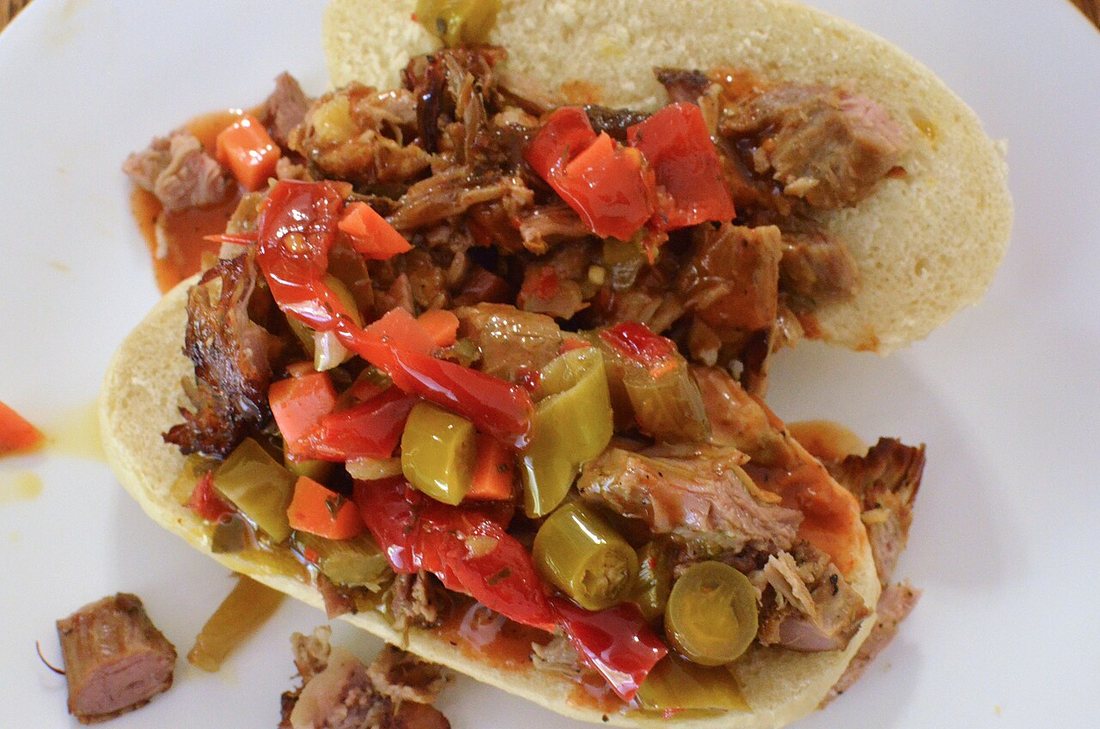
Two condiments share the name. Italian giardiniera is large pieces of vegetable in vinegar, eaten as antipasto. Chicago giardiniera is chopped vegetables and hot peppers cured in vinegar and then packed in oil, spooned onto an Italian beef. The first has a close relative among tested home-canning recipes. The second has none at all: no tested process exists anywhere for a vinegar- cured vegetable mix under oil, so a homemade Chicago giardiniera is a refrigerator food from the first day to the last.
The kitchen these pages are written for has made giardiniera.
How the jar changed medium on the way from Italy to Chicago, and why Italy sorts its preserves by what they sit in, is on Under Oil. This page is the Chicago history and the practical question of how to make either version safely.
The word
In Italian, giardiniera means “mixed pickles”; it is also the word for a woman gardener. Jim Graziano of J.P. Graziano Grocery in Chicago’s West Loop, in business since 1937, gave the Chicago Tribune the purpose in one line: “It was strictly to protect the vegetables for the winter.”
Chicago
The Tribune’s history of the condiment (Nick Kindelsperger, 2017) describes the Chicago mix as “pickled chiles, celery, cauliflower, carrots and olives submerged in oil,” and on its arrival says: “Though impossible to know the exact date, giardiniera undoubtedly appeared in Chicago along with the wave of Italian immigration … in the late 19th century.”
V. Formusa Co., maker of the Marconi brand, was founded in 1898 by Vincent Formusa of Termini Imerese, Sicily, and “got into the Sicilian method of preserving vegetables in oil.” The company does not claim to have been first — only “strong contention for at least popularizing it.” It also makes Portillo’s giardiniera. A 2026 Tribune piece on the company (Robert Channick) gives the shortest definition in print: “Chicago-style giardiniera is a veggie medley cured in vinegar and packed in oil.” Jeff Johnson of Formusa lists the contents: “Pickles, carrots, celery, cauliflower and peppers — that’s it.” Bob Johnson says the first restaurant he sold to directly was Johnnie’s Beef, which established the choice of “sweet or hot.” The company moved to Des Plaines in 2014. Its output is given as about a million pounds a year in 2017 and two million in 2026, probably growth rather than a contradiction.
Recipes vary by counter. Al’s #1 uses “a spare mix of celery and bell peppers, with only some red pepper flakes”; Johnnie’s adds carrots, cauliflower and sport peppers; Graziano’s version, with olives, dates “to at least the 1950s” and came from a woman named Deanna in Cicero. Potbelly’s “hot peppers” are giardiniera.
Sport peppers are often named as the Chicago chile. The one source found on them says they appeared on Vienna Beef hot dogs from 1957 and puts them at 10,000–23,000 Scoville units, while also calling them “much milder than hotter varieties”; the claim is uncited and internally inconsistent.
Italy, oil and vinegar
The Tribune’s sources disagree about what Italy does. In Italy, the 2017 article says, the vegetables are “cut in bigger chunks and typically canned with vinegar instead of oil,” and Domenica Marchetti (Preserving Italy) says: “I don’t see anything like the Chicago-style giardiniera in Italy.” Jeff Johnson of Formusa instead calls vinegar a “Northern Italian method” and says oil is used in Sicily. Both may be describing real practice in different regions; the sources do not settle it.
Italian beef
Giardiniera’s job in Chicago is the Italian beef sandwich, and the Tribune’s own archive revises that sandwich’s history. The popular origin stories, crediting Pasquale Scala or Tony Ferreri in the 1920s, have no Tribune mentions from that period. The first clear mention is 28 June 1953, at a Villa Scalabrini picnic. The Chicago Food Encyclopedia places the sandwich’s roots in “Italian American home cooking” and “peanut weddings.” The first Tribune recipe ran on 26 May 1962 under the pseudonym “Mary Meade,” with tomato paste and the first mention of dipping the bread. By 8 January 1979 the paper could assume Chicagoans knew “to demand hot pepper with Italian beef,” and on 15 September 1989 it called it “Chicago’s sandwich.”
Why there is no tested oil giardiniera
NCHFP’s pickle index has no recipe called giardiniera. The only tested NCHFP pepper product that contains oil is Marinated Peppers, and the reason it is safe is in its proportions: over 4 lb (1.8 kg) of peppers, 1 cup of oil travels with 1 cup of bottled lemon juice and 2 cups of 5% vinegar. The acid makes the oil irrelevant. A giardiniera whose vegetables are cured in vinegar, drained, and then covered in oil has no such tested proportion, and the drained vegetables are low-acid ones: cauliflower, carrot, celery and peppers.
The traditional Chicago method, as Jimmy Shay of Local Foods described it to the Tribune, is two steps: pickle the vegetables for two weeks, drain, then cover with oil and infuse another two weeks. That is a description, not a recipe; it gives no quantities, no acid strength and no temperature.
The one named home recipe for the Chicago style that could be found shows the hazard plainly. Curious Cuisiniere’s “Chicago Style Hot Giardiniera Relish” brines diced celery, carrot, red pepper, onion and olives overnight in the refrigerator in 2 cups water and ¼ cup salt, then rinses them and adds serranos, two cloves of minced raw garlic, oregano, red pepper flakes, ½ cup white vinegar and ½ cup vegetable oil, and tells the cook to “let marinate on the counter for up to 2 days.” That is raw garlic and fresh vegetables under oil at room temperature, with no measured acid. The garlic-in- oil botulism cases and the CDC’s guidance on homemade garlic oils are on Safety.
Making an oil giardiniera safely
The safe version is simple to state: keep it cold throughout. The vegetables are brined in the refrigerator, cured in the refrigerator, packed under oil in the refrigerator, and never left out to “marinate.” The collection’s recipe is written that way and labelled as having no tested process.
How long it keeps is a figure no source supplies. The nearest official number is CDC’s advice for homemade oils made with garlic or herbs — refrigerate, and throw them away after 4 days — and the University of Georgia gives the same 4-day limit for non-acidified infused oils. Those figures were written for oils, not for a vinegar-cured vegetable mix, and no tested figure exists for the mix. A small batch eaten quickly is the honest answer.
Michigan’s cottage food rules close the commercial door on both versions: pickled vegetables and oils flavored with fresh vegetables or garlic are both on MDARD’s not-allowed list.
The vinegar version, and the nearest tested formula
An Italian-style giardiniera in vinegar is much closer to a tested product, but only one NCHFP recipe comes near it, and only in its choice of vegetables.
NCHFP Pickled Mixed Vegetables (USDA, revised 2015) is a sweet mustard-and-turmeric pickle: 4 lb pickling cucumbers, 2 lb small onions, 4 cups celery, 2 cups carrots, 2 cups sweet red peppers and 2 cups cauliflower, iced 3 to 4 hours, then brought slowly to a boil in 5 cups white vinegar (5%), ¼ cup prepared mustard, ½ cup salt and 3½ cups sugar, with celery seed, mustard seed, cloves and turmeric. Hot pack: pints in sterile jars, 5 / 10 / 15 minutes; quarts in clean jars, 10 / 15 / 20 minutes, for 0–1,000, 1,001–6,000 and above 6,000 feet. It contains no hot pepper, so it tastes nothing like either giardiniera; its value here is as the only tested formula for cauliflower, carrot, celery and pepper in one jar. Following it exactly gives a shelf-stable mixed pickle; changing it gives a refrigerator one.
A widely published Italian-style recipe — Nick Evans’s “Homemade Giardiniera” for Simply Recipes — illustrates the gap between a canned recipe and a tested one. Its brine is 4 cups distilled vinegar, 2 cups water and 2 cups sugar, about 3.3% acetic acid before any vegetables go in, carrying cauliflower, carrots, celery, red bell pepper and jalapeños, with a 10-minute water bath. The formula has not been tested by NCHFP, its altitude advice does not match NCHFP’s bands, and its own storage figures disagree with each other (unprocessed jars “about 3 months” in the fridge, opened jars “up to 2 weeks”). It is a reasonable refrigerator pickle; the canning step should not be read as a tested process.
Recipes in the collection
- Chicago-Style Giardiniera (Refrigerator) — no tested process exists; kept cold throughout.
- Pickled Hot Peppers (NCHFP, Canned) — tested; a canned source of the hot peppers.
- Pickled Banana Pepper Rings (NCHFP, Canned) — tested.
- Jalapeños en Escabeche (Rick Bayless) — a Mexican pickled jalapeño-and-vegetable mix, refrigerator.
Comments (0)