Peppers and Hot Sauce · 12 of 14
Asia's Chile Sauces and Pastes
Every chile in Asia is an American plant, and every Asian chile sauce is therefore younger than the cuisine it now seems inseparable from. The genus is native to the Americas (Barboza et al., PhytoKeys 2022); chiles reached Asia in the sixteenth century, largely through Portuguese trade. That single fact explains most of what goes wrong in the popular histories below. Where a story dates a chile sauce earlier than chiles could have arrived, the story is describing something else, usually a different pungent ingredient that happened to share a word.
The four sauces here show four different problems with a sauce’s history: sriracha, named after a town and made famous by a company elsewhere; sambal, a family rather than a recipe; gochujang, whose earliest “records” predate the pepper; and chili crisp, whose founding date depends on whether the question is about a restaurant, a factory or a company.
How chiles reached Asia
The broad route is better established than the details. Barboza’s monograph says only that chiles were “first introduced into Europe and subsequently into Africa and Asia,” and that C. chinense reached Asia “mainly by Portuguese explorers.” A fuller account (YaleGlobal Online, journalism rather than peer review) has Portugal reaching India in 1498, exporting chiles from Brazil “by the 1500s,” a sixteenth-century botanist calling chiles from Goa “Pernambuco Peppers,” and chiles reaching the Philippines in 1564.
Country by country, the evidence thins out:
- China. Wikipedia gives the earliest Chinese written mention as 1591, with arrival thought to be in the 1570s; that sentence’s source was not verified. When chiles entered Sichuan cooking could not be established from a primary source. The suggestion that they reached Hunan and Sichuan overland rather than through the ports is speculation.
- Korea. Sources disagree. The conventional account dates red kimchi to the Imjin wars of 1592, when the chile “was first introduced”; a revisionist claim, reported in a 2023 review in the Journal of Ethnic Foods, holds that the Korean chile is native and 2,000 years old. The revisionist claim contradicts the botany, since every Capsicum is American.
- Southeast Asia. For Thailand, no first-hand source was found. For the Indonesian archipelago, the account (Wikipedia, not checked against a primary) is that chiles arrived through Portuguese and Spanish trade from the sixteenth century, Malacca having been taken in 1511, and that chili sambals are “recorded across the archipelago” by the eighteenth.
Sriracha: a Thai town, a Thai sauce, an American bottle
The name is a place. Sriracha (ศรีราชา) is named for the district of Si Racha in Chonburi province, Thailand. In Thailand the sauce is sot Siracha or nam phrik Siracha, and the pronunciation given by its distributor is “See-rah-jah,” the first “r” unvoiced.
The Thai original. The best-documented brand is Sriraja Panich. Its sole US distributor, Eastland Food, told Bon Appétit (Andrea Nguyen, 2013) that the sauce was “created over 80 years ago by Ms. Thanom Chakkapak in the sleepy seaside district of Si Racha,” and that “in 1984, Ms. Chakkapak sold the company to Thai Theparos Food Products.” That is the brand owner’s side of the history, not an independent one. Another account, on Wikipedia and tagged “citation needed,” credits La-Orr Suwanprasop with selling a Si Racha sauce under the brand “Gold Medals” in 1932. Dates of 1932 and 1935 both circulate and neither could be verified; “the 1930s” is the defensible date.
The distributor describes the Thai sauce as “aged for at least three months,” with vinegar “slowly added on a weekly basis,” and first eaten with seafood, “almost like a shrimp cocktail sauce.” Nguyen found the Thai versions “more liquid and pourable than Huy Fong’s,” with “bright chile heat, delicate sweetness, vinegary tang, and garlicky backnote.” Serious Eats (Joshua Bousel) agrees that Thai sriracha “tends to be thinner, less spicy, and sweeter.”
The American bottle. David Tran, a former major in the South Vietnamese army, founded Huy Fong Foods in Los Angeles’s Chinatown in 1980, naming it after “the Taiwanese freighter that carried him out of Vietnam” (Los Angeles Times, 2013). Because the sauce is named for a Thai city, the company “cannot trademark the name,” which is why the shelf holds many srirachas. The rooster on the bottle is Tran’s Chinese zodiac sign. The company’s later pepper shortage, and the dispute with its long-time grower behind it, are covered on The American Shelf.
Is the American one fermented? That remains unsettled. Huy Fong publishes no fermentation step. Its label lists an added acid: two bottle labels photographed on Open Food Facts read “Chili, Sugar, Salt, Garlic, Acetic Acid,” then potassium sorbate and a sulfite as preservatives and xanthan gum, while US retailer listings print the same list with “distilled vinegar” in place of acetic acid (checked 1 October 2026; the company’s own site could not be read). An added acid does not show whether the mash ferments first. A figure of “a minimum of one year, up to five,” attributed to a fermentation expert quoted in a Serious Eats article, has no supporting source and conflicts with what the makers of Tabasco say about their own aging. The question was already left open on Peppers, and the Hot-Sauce Shelf, and nothing found since closes it.
Two corrections follow. Sriracha is not a Vietnamese sauce, and the rooster bottle is not the original; the green-cap bottle is an American sauce, made in Los Angeles by a South Vietnamese army veteran, and named after a Thai town. In Vietnam, by Wikipedia’s account, sriracha is uncommon and tương ớt is the usual chili sauce.
A homemade version (Bousel, Serious Eats, 2012) ferments red jalapeños, garlic, brown sugar and salt in a sealed jar for 5–8 days, opened daily, then blends in vinegar and boils the sauce. The boil means the finished sauce is no longer live, and the short, sealed ferment is a homage to the Thai process, not a copy of it.
Sambal: a family, not a sauce
Sambal is a category. It names chile sauces and pastes across maritime Southeast Asia (Indonesia, Malaysia, Brunei, Singapore, southern Thailand and the southern Philippines), with a Sri Lankan cousin, sambol. The broad division, per Wikipedia, is sambal masak (cooked, more typical of the western archipelago) and sambal mentah (raw, more typical of the east). Indonesia is reported to have between 212 and 300 varieties. Before chiles, the heat came from long pepper (Piper retrofractum, Javanese cabai), ginger, galangal and andaliman.
The name on the jar is two things at once.
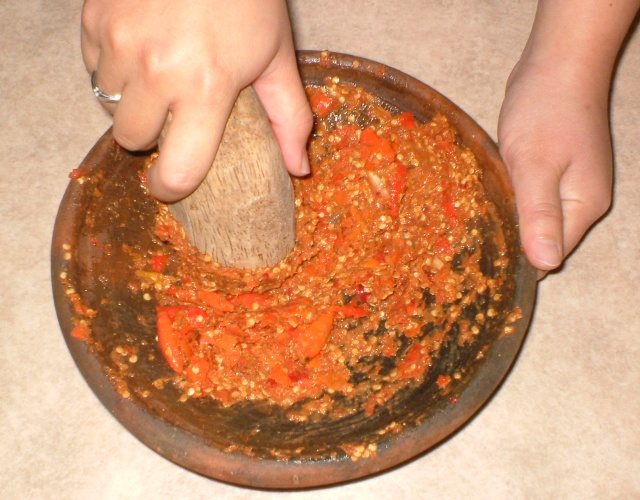
- Ulek is the tool. In Indonesian, the stone mortar is the cobek and the pestle the ulekan (from mengulek, to grind). Sambal ulek is, in the plainest sense, sambal made with the pestle: “a plain raw chilli paste that can serve as a base for other preparations.” Serious Eats calls the mortar and pestle together “an ‘ulek’”; strictly, the ulekan is only the pestle.
- Oe is Dutch spelling. Under the Van Ophuijsen system (1901–1947), the digraph ⟨oe⟩ wrote the sound [u]. It was dropped in 1947 and again in the 1972 reform. Oelek is ulek in colonial orthography, which is why Dutch and American jars still say oelek. Sambal oelek is reported to remain the most popular supermarket sambal in the Netherlands.
What the jar contains. Bousel’s observation: “In America… the versions we get off the shelf are heavily salted and mixed with vinegar for preservation.” The traditional form is chiles crushed to a paste. His own recipe (2013) is a pound of hot red chiles, 2 tablespoons of rice vinegar and a tablespoon of salt, pulsed in a food processor and kept refrigerated up to two weeks. He places it “in between the one-ingredient version” and the commercial jar, and his headnote says half the chiles were seeded, which the ingredient list does not mention.
The family is wide: sambal belacan adds shrimp paste; sambal tumis is a cooked, fried paste. The collection’s nasi lemak carries one.
Gochujang: the paste that predates its pepper
Gochujang is a fermented paste of gochugaru (chile powder), glutinous rice, meju (fermented soybean) powder, barley malt and salt; its sweetness comes from rice starch broken down during fermentation. It was traditionally made in earthenware jangdok on a jangdokdae platform, and home-making declined after commercial production reached the mass market in the early 1970s (Wikipedia, not checked against primary texts). There is more on the ingredient at Gochujang.
The chronology contains a trap. Wikipedia cites early records of a “pepper paste” (苦椒醬): the ninth-century Shiyi xinjian and Korean medical texts of 1433 and 1445. It then notes that all of these predate the arrival of chiles in Korea; the character jiao (椒) named other peppers. The dated chile record, as reported, begins later:
| Date | Source (as cited by Wikipedia) | What it records |
|---|---|---|
| 1614 | Jibong yuseol | A chile is mentioned |
| c. 1700 | Sallim gyeongje | Chile cultivation |
| 18th c. | Jeungbo sallim gyeongje | A gochujang recipe: 18 L meju powder, 540 mL chile powder, 1.8 L glutinous rice flour |
| 1809 | Gyuhap chongseo | Another recipe |
A pre-chile “pepper paste” date is not the age of gochujang. The same goes for the Sunchang legend, in which the fourteenth-century founder of the Joseon dynasty eats gochujang with bibimbap at a temple: it is told as “is said to,” and it is set about two centuries before chiles reached Korea. Whatever that king ate, it was not chile gochujang.
Chili crisp and Lao Gan Ma: three dates, one jar
Chili crisp, in Sohla El-Waylly’s definition (Serious Eats, 2018), is málà chile oil with crunch: “roasted soy nuts, fried onion, and fried garlic.” The jar that made the category famous is Lao Gan Ma, from Guizhou.
The founding date depends on what is being founded. Chinese Wikipedia, citing a 2016 biography, gives this sequence for Tao Huabi, born 1947 in Meitan County:
- 1989: a roadside eatery in Guiyang.
- November 1994: renamed and specialized in chili sauce.
- July 1996: two borrowed buildings and 40 workers for a chili-sauce factory.
- August 1997: the company is founded.
English Wikipedia puts the factory in 1994 and says she is “said to have invented the sauce in 1984”; El-Waylly says the line “was started in 1996,” after a 1989 noodle shop. 1997 is the company, not the sauce. The defensible summary is a 1989 eatery, a factory in the mid-1990s, and a company in 1997.
Safety. Chili crisp is a dried-chile-and-oil product. El-Waylly’s recipe fries the shallots and garlic dry before they join the jar, pours 375 °F (190 °C) oil over the chile mixture, and says to refrigerate for about three months. That refrigeration limit is the only storage guidance the source gives. Oil does not preserve anything; why that matters for chile oils is on Safety and Under Oil.
Vinegar cousins
Two Asian table sauces belong with the American South’s pepper vinegar rather than with the pastes above: Thai prik nam som, chiles in vinegar, and Filipino sugarcane vinegar with chiles (Octavio Peña, Serious Eats, 2026). The Southern version is on Africa, the Middle East and the Americas.
Recipes in the collection
- Fermented Sriracha (Serious Eats) — Joshua Bousel’s homage; untested
- Sambal Oelek (Serious Eats) — processor-made, refrigerated two weeks; untested
- Chili Crisp (Sohla El-Waylly) — refrigerated about three months; untested
- Roasted Chile Powder — a toasted Thai-style chile
- Gochujang — the ingredient page
- Nasi Lemak (Malaysian Coconut Rice with Sambal)
- Sriracha Wing Sauce
- Sriracha Pickled Eggs
Comments (0)