Peppers and Hot Sauce · 4 of 14
Growing Hot Peppers in a Short Season
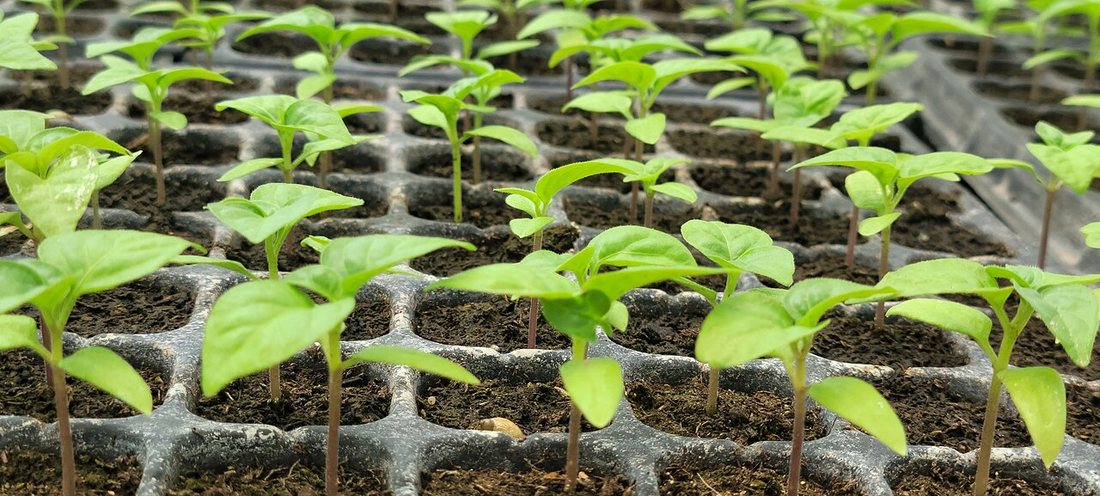
Peppers are tropical perennials. A northern garden has to grow them as fast annuals. The season is long enough for most jalapeños and serranos, but it is tight for the C. chinense peppers (habaneros and Scotch bonnets), which are likely to be among the slowest to ripen. The difference between a full harvest and a frost-killed plant of green fruit mostly comes down to three things: when the seeds go in, how warm the soil is, and how cold the nights get after transplanting.
The kitchen these pages are written for grows jalapeños, serranos, habaneros and Scotch bonnets. The guidance here is aimed at a Michigan garden. Michigan State University Extension’s pepper guidance could not be read for this page. The guidance below comes from the University of Minnesota Extension, which serves a similar or colder climate, and from Seed Savers Exchange.
Start early, and start warm
Peppers need a longer indoor start than tomatoes, and they need heat to germinate.
- Timing. UMN: “Start pepper seeds about eight weeks before planting outside. This is earlier than you would normally start tomato seeds.” Seed Savers says 6–8 weeks.
- Germination heat. UMN: “Use a heating mat to keep the flat at 80°F to 90°F [27–32 °C] until seedlings emerge … A soil temperature of 70°F [21 °C] is ideal.” Seed Savers puts the floor higher: “Peppers need soil temperatures of at least 75 degrees F [24 °C] in order to germinate and grow.”
The two sources agree on the main point. Cold soil is the usual reason pepper seeds fail to come up. A seed tray on a windowsill in March rarely reaches the needed temperature without a heat mat.
For C. chinense in particular, it makes sense to start at the early end of the window. No extension source gives day counts for habanero or Scotch bonnet. The general figures below show why the extra weeks matter.
Days to maturity
Seed Savers: “Most sweet peppers mature in 60–90 days; most hot peppers take from 85–100 days, but some varieties take up to 150 days to mature.” At 100 days or more, a pepper needs most of a northern summer, which is why the indoor start matters.
UMN gives two pieces of advice for choosing varieties:
- Read the “Days to Maturity” on the packet, and favor varieties described as “widely adapted” and “cold tolerant”.
- “Smaller-fruited peppers are more tolerant of both cool and hot temperatures.”
Where the habanero sits (this is inference, not a sourced figure): the C. chinense peppers sit at the long end of that 85–150-day range. In a short Michigan season they are the plants most likely to meet frost with fruit still green. Jalapeños and serranos are more forgiving.
Transplanting: nights matter more than days
UMN sets the threshold by nighttime lows, not by the calendar:
- “Transplant outdoors after nighttime low temperatures are above 50°F [10 °C].”
- While hardening seedlings off, bring them in “if night temperatures drop below 55°F [13 °C].”
- “Night temperatures below 60°F [16 °C] or above 70°F [21 °C] can weaken plant growth.”
Seed Savers sets the threshold by the soil: transplant “as soon as soil temperatures have warmed above 75 degrees F [24 °C] and the danger of frost has passed.”
The two thresholds are not the same, and the soil standard is the stricter of the two. UMN’s practical way to close the gap is black plastic: “Use black plastic mulch to warm the soil.”
UMN’s warning that cool nights “weaken plant growth” is the cost of setting out too early: time lost in June in a season that has little to spare.
Water, stress and heat
A common idea among gardeners is that stressing a pepper plant makes the fruit hotter. NMSU (Guide H-237) gives the careful version. Stress makes a mild cultivar hotter, but “a chile pepper plant that genetically produces low-heat fruit will not produce hot chile peppers even when grown in a stressed environment.” A 2024 review in Plants adds that moderate drought can raise capsaicinoids, that severe drought may lower them, and that hot varieties often show “no significant change.” Deficit irrigation can raise heat while cutting yield.
Holding back water from habaneros is not a reliable way to make them hotter, and it costs fruit. The full explanation is on Heat.
Harvest by color, or not at all
Color shows ripeness, but a pepper does not have to be fully ripe to be worth picking.
- Green is usable. UMN: “You do not need to wait for peppers to turn red before harvesting. Many varieties have good quality when green.” Green jalapeños and serranos are the standard kitchen form.
- The color sequence. Seed Savers: “Maturity in peppers is indicated by a color change … from green, to yellow, orange, and finally red, brown, or purple,” depending on the variety.
- Gloves. UMN: “Wear gloves when picking hot peppers.” This matters more with habaneros and Scotch bonnets than with jalapeños.
- When frost threatens. Seed Savers: “If frost threatens before the peppers mature, pull entire plant and hold at 65 to 75 degrees F [18–24 °C] in a protected location.”
Color also matters for the kitchen. Chipotles are made from jalapeños left to ripen red. In 2024 Huy Fong halted sriracha production because its chiles were “too green”, a commercial example of the same color problem. See The American Shelf.
Saving seed
Isolation
Peppers cross-pollinate more than many gardeners expect. Seed Savers: “Different species occasionally cross-pollinate, so be sure to isolate varieties … separate varieties by 300–1,600 feet [about 90–490 m]. Peppers are also commonly pollinated by insects.” Some varieties “have flowers with exserted stigmas, making them more prone to outcrossing.” Seed Savers recommends blossom bags or isolation tents where that distance is not possible, which is the case in most home gardens.
Choosing what to save
Only open-pollinated varieties come true from seed. UMN gives examples: “‘Habanero’, ‘California Wonder’ and ‘Corno di Toro’ peppers … will come true from seed.” Seed from a hybrid will not reproduce its parent.
Ripeness and curing
- Seed Savers: “Fruits are mature when they reach their final color and begin to soften.”
- UMN: let fruit ripen “until they become fully ripe and start to wrinkle.”
- Organic Seed Alliance: cut ripe peppers open to check for mould in the core, and “store peppers that have reached complete color development at about 65–75°F [18–24 °C] … for 7–10 days before extracting the seed.”
Does crossing change this year’s peppers?
A common worry is that a habanero planted next to a sweet pepper will make the sweet pepper hot this season. No pepper-specific source was found that answers this. A search of the scientific literature for the effect, known as xenia, in Capsicum turned up nothing relevant.
The closest extension statement is UMN’s, written about squash and melons rather than peppers: “cross-pollination will not affect the quality of the current crop, seeds from such a cross will grow into vines with fruit unlike that of the parent plant.”
The reasoning (not a sourced finding) runs like this. The fruit wall and the placenta, the tissues that make capsaicin, belong to the mother plant. Pollen supplies half the genes of the seeds. On that reasoning, a cross should show up in next year’s plants grown from saved seed, not in the heat of this year’s fruit. The practical consequence is the same either way. Isolation matters for seed saving and does not matter for eating.
Overwintering
No extension guidance on overwintering peppers was found. Botanically, the plants are perennial. Linnaeus named C. frutescens for its “shrubby perennial” habit. Northern gardens grow peppers as annuals because frost kills them, not because they reach the end of their natural life. Whether bringing a habanero indoors over winter is worth the trouble is left open here, because no source settled it.
Where the harvest goes
- Fresh, in a ferment. See Fermented Hot Sauce.
- Into vinegar. See Vinegar and Cooked Sauces and Pickled Peppers.
- Dried. See Dried and Smoked Chiles. Michigan’s cottage-food rules allow dried chilies to be sold and exclude hot sauce; see Safety.
Recipes in the collection
- Pickled Jalapeño Rings (NCHFP, Canned) and Pickled Hot Peppers (NCHFP, Canned): tested processes for a jalapeño or mixed-pepper harvest.
- Jalapeños en Escabeche (Rick Bayless): kept in the refrigerator.
- Fermented Habanero Hot Sauce (Tim Chin) and Caribbean Scotch Bonnet Pepper Sauce: for the C. chinense harvest.
- Master Hot Sauce (Bon Appétit): takes “jalapeño, serrano, Fresno, or habanero”, one variety or mixed.
- Golden Pepper Jelly (NCHFP, Canned).
- Cayenne Pepper Sauce (NCHFP, Canned).
Comments (0)