Peppers and Hot Sauce · 8 of 14
Pickled Peppers
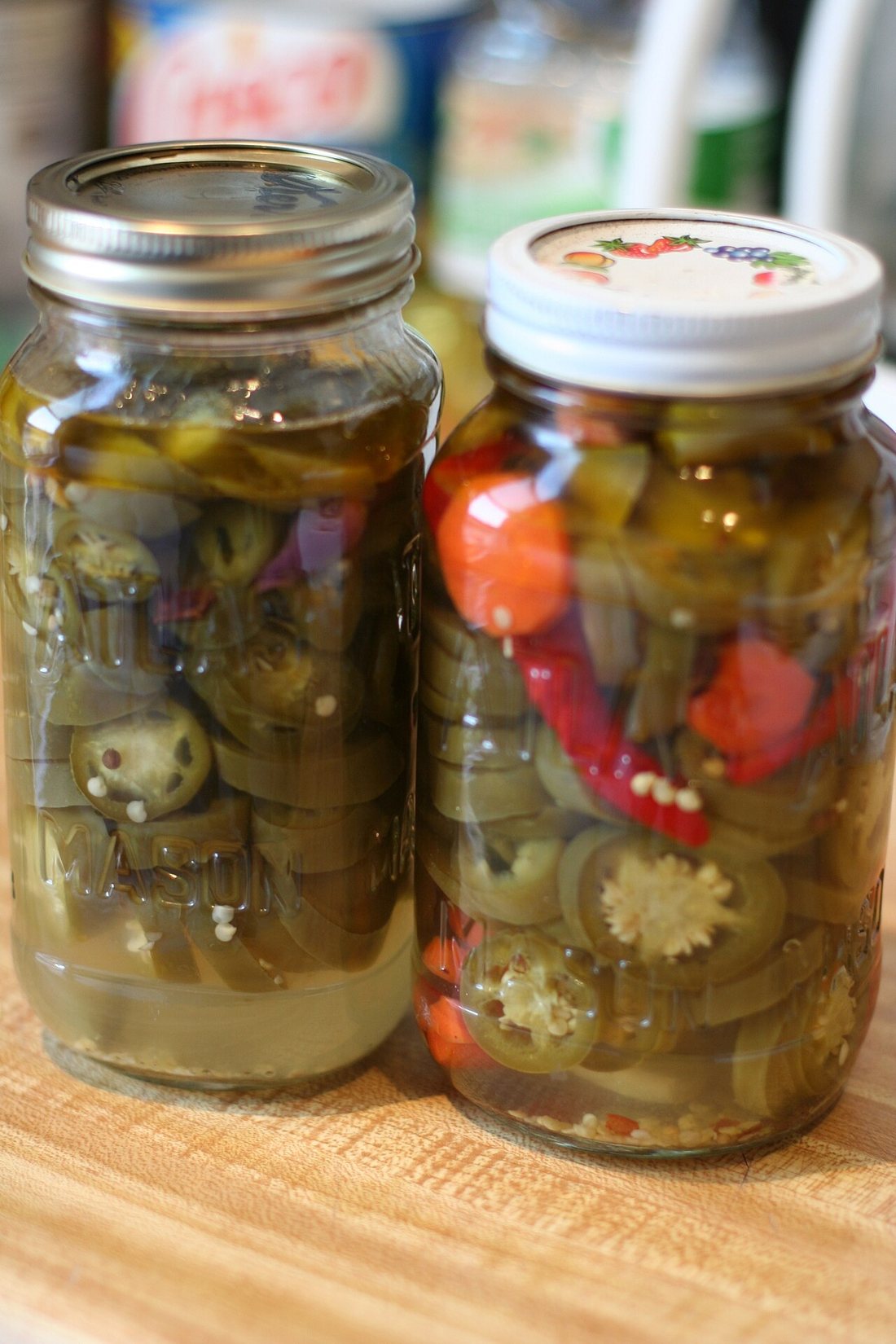
A pepper is a low-acid vegetable, and a pickled pepper is safe because of the vinegar and nothing else. That makes pickled peppers one of the better-documented corners of home preserving: the National Center for Home Food Preservation publishes tested processes for hot peppers, jalapeño rings, banana pepper rings, bell peppers and peppers marinated in oil, each with an exact brine and an altitude table. Outside those recipes, the jar belongs in the refrigerator.
The kitchen these pages are written for has pickled jalapeños, banana peppers, pepperoncini and other hot peppers.
The general case for peppers in a jar — why capsaicin stays in the brine and makes the whole jar hotter as it sits, and why clear brine means the acid was poured in — is on Peppers and the Hot-Sauce Shelf. This page is the tested processes and what each one is for.
The tested processes at a glance
All of these use a boiling-water canner, 5% vinegar, and canning or pickling salt.
| NCHFP recipe | Peppers | Brine per batch | Pack and jar | 0–1,000 ft |
|---|---|---|---|---|
| Pickled Hot Peppers | 4 lb hot long peppers + 3 lb sweet | 5 c vinegar, 1 c water, 4 tsp salt, 2 Tbsp sugar | Raw pack, half-pints or pints | 10 min |
| Pickled Jalapeño Rings | 3 lb jalapeños, lime-soaked | 7½ c cider vinegar, 1¾ c water, 2½ Tbsp salt | Raw pack, pints | 10 min |
| Pickled Yellow Pepper Rings | 2½–3 lb banana peppers | 5 c cider vinegar, 1¼ c water, 5 tsp salt | Raw pack, pints | 10 min |
| Pickled Bell Peppers | 7 lb bell peppers | 3 c vinegar, 3 c water, 3½ c sugar | Hot pack, sterile half-pints or pints | 5 min |
| Marinated Peppers | 4 lb bell, Hungarian, banana or jalapeño | 2 c vinegar, 1 c bottled lemon juice, 1 c oil | Raw pack, half-pints or pints | 15 min |
The ratio of vinegar to water is the safety number in each of these, and it is not the same across them. The jalapeño and banana rings run about four parts vinegar to one of water; the bell peppers run one to one, with a heavy dose of sugar that is part of the tested formula. None of them may be diluted further, and NCHFP’s general rule applies to all: “Do not alter vinegar, food, or water proportions in a recipe or use a vinegar with unknown acidity.”
Pickled Hot Peppers
The USDA’s general-purpose recipe, subtitled “Hungarian, Banana, Chile, Jalapeno,” adapted from the Complete Guide to Home Canning (revised 2015). About 9 pints.
- Cut. “If small peppers are left whole, slash 2 to 4 slits in each. Quarter large peppers.” The slits are NCHFP’s version of pricking each pepper so the brine reaches the inside.
- Peel. The peppers are blanched or blistered so the skins come off: in a 400 °F (204 °C) oven or broiler for 6 to 8 minutes, or on heavy wire mesh over a burner. Small peppers are then flattened.
- Brine. The vinegar, water, salt, sugar and two garlic cloves simmer 10 minutes. The garlic is removed before the brine goes over the peppers, so it never reaches the jar.
- Headspace ½ inch; 10, 15 or 20 minutes by altitude.
Two oddities in the published text are worth knowing about. The pack is labelled “raw” although the peppers have been blanched or blistered, and the recipe gives a total yield but no per-jar amounts.
Pickled Jalapeño Rings: the crisp one
The UGA recipe (September 2003) is the one tested process that sets out to make a crisp pepper, and it does it with pickling lime. 3 lb jalapeños are sliced ¼ inch thick and soaked in 1½ cups pickling lime in 1½ gallons of water, in the refrigerator, for 18 hours (12 to 24 are allowed).
Then comes the step that cannot be shortened. The rings are drained, rinsed, covered with fresh cold water and soaked an hour in the refrigerator — and that rinse-soak-drain is done three times. NCHFP: “Excess lime absorbed by the pepper rings must be removed to make safe pickles.” Lime is alkaline; lime left in the pepper raises the pH of the finished jar. The federal acidified-foods rule makes the same point in general terms: “Special care should be taken when food ingredients have been subjected to lye, lime, or similar high pH materials.” NCHFP also warns to “avoid inhaling the lime dust.”
Each hot pint jar gets 1 tablespoon mustard seed and 1½ teaspoons celery seed; the rings go in, and the boiling brine goes over with ½-inch headspace. 10, 15 or 20 minutes by altitude. About 6 pints.
Banana peppers and pepperoncini
Pickled Yellow Pepper Rings (UGA, March 2003) is the tested recipe for banana peppers: 2½ to 3 lb sliced into ¼-inch rings, ½ tablespoon celery seed and 1 tablespoon mustard seed in each hot pint, boiling brine to ½ inch, and NCHFP’s last instruction, “Shake jar to disperse spices before using contents.” About 4 pints. Banana peppers are also named in the subtitle of Pickled Hot Peppers.
No named-source recipe for pickled pepperoncini could be found, and NCHFP has none under that name. The yellow pepper rings are the closest tested process. What Americans call pepperoncini is reported to be the mild Italian friggitello, a different pepper from the hot Italian peperoncini; that identification rests on a single secondary source.
A related case shows how a published recipe can fall short of a tested one. Martha Stewart’s Pickled Hot Cherry Peppers (2 lb cherry peppers, white-wine vinegar of at least 5% acidity, a 15-minute water bath) leaves the peppers whole without slitting them, uses ¼-inch headspace where NCHFP specifies ½ inch, and gives no altitude adjustment. It is a good refrigerator recipe; it is not a tested canning process.
Bell peppers, sweet and sterile
Pickled Bell Peppers is the sweet one: 7 lb peppers in strips, brought to a boil in a syrup of 3½ cups sugar, 3 cups vinegar and 3 cups water, then packed into sterile half-pint jars with ½ clove garlic and ¼ teaspoon salt in each (double for pints). The processing time at low altitude is only 5 minutes, and that short time is the evident reason the recipe specifies sterilized jars: NCHFP’s jar guidance is generally summarized as requiring sterile jars for processes under 10 minutes.
Marinated Peppers: the tested pepper in oil
This is the only tested NCHFP pepper product that contains oil, and it is the reference point for anything else that puts peppers under oil. 4 lb peppers are slashed, blistered, peeled and flattened, then covered with a hot, well-mixed solution of 1 cup bottled lemon juice, 2 cups white vinegar (5%) and 1 cup olive or salad oil, with oregano, onion, and optional garlic and horseradish. Salt goes into each jar: ¼ teaspoon per half-pint, ½ per pint.
Heat is set by the mix of peppers. Hot uses 4 lb jalapeños; medium 2 lb jalapeños and 2 lb sweet and mild peppers; mild 1 lb jalapeños and 3 lb sweet and mild.
The oil is safe here because the acid is there. Without the lemon juice and vinegar in those proportions, the same jar is a low-acid vegetable under oil, which is the case set out on Under Oil and Safety.
Altitude
| Elevation | 0–1,000 ft | 1,001–3,000 ft | 3,001–6,000 ft | Above 6,000 ft |
|---|---|---|---|---|
| Hot peppers, jalapeño rings, yellow rings | 10 min | 15 | 15 | 20 |
| Bell peppers (sterile jars) | 5 min | 10 | 10 | 15 |
| Marinated peppers | 15 min | 20 | 20 | 25 |
Most of the pepper pickles use three altitude bands (0–1,000, 1,001–6,000 and above 6,000 feet), adding 5 minutes at each step; they are spread across four columns here only to sit beside Marinated Peppers, which is the one recipe with four bands. Plain peppers, with no acid, go in a pressure canner instead, where altitude changes the pressure rather than the time.
Refrigerator pickles
Most of the pickled peppers people actually eat are made this way, and the recipes say so.
Rick Bayless, Jalapeños en Escabeche. One quart. Garlic and onion are softened in 3 tablespoons oil; then carrot, 6 to 8 large or 12 medium jalapeños, 1 cup vinegar, 1 cup water, bay, black pepper, dried hierbas de olor and salt simmer together, partly covered, until the carrots are crisp-tender and the jalapeños have turned olive-green, 8 to 10 minutes. Cooled, covered, refrigerated a day before use; “They will keep for months refrigerated in a sealed container.” Bayless explains the water: the recipe is written for 5% vinegar, “which is too strong for this kind of pickling. That’s why we cut it with water. In Mexico, a lot of commercial vinegar and all the homemade vinegar you buy in market stalls is weaker and can be used straight.” His headnote recalls the pickled chiles from the glass barrels of Querétaro, Aguascalientes and San Luis Potosí as “so much more lively than the canned pickled jalapeños.” The recipe does not say whether the jalapeños go in whole, slit or sliced. It is a refrigerator recipe, and “months” means months in the refrigerator.
Others in the same family:
- Martha Stewart, Pickled Peppers — mixed hot peppers in rings, toasted cumin and coriander, 2 cups distilled vinegar to 1 cup water; refrigerated at least 3 days and up to a month.
- Bon Appétit, Pickled Jalapeños (Alfia Muzio) — white wine vinegar with a little oil, herbs and cumin, boiled and cooled; keep chilled, up to a month ahead.
- Bon Appétit, Pickled Green Chile Peppers — sliced serranos or jalapeños in a salt brine with only ¼ cup vinegar, left 48 hours at room temperature, then chilled for up to two weeks. That is mostly a salt brine and effectively a short ferment, which puts it under the rules on Fermented Hot Sauce rather than this page’s.
Keeping them crisp
The sources offer three levers, and none of them is a secret ingredient. Start firm: NCHFP calls for “firm” peppers in its bell and marinated recipes. Use lime, and rinse it out, the one tested crisping method for peppers, set out above. Do not overcook a refrigerator pickle: Bayless stops at crisp-tender, and the color change from bright to olive-green is his signal.
Recipes in the collection
- Pickled Hot Peppers (NCHFP, Canned) — tested.
- Pickled Jalapeño Rings (NCHFP, Canned) — tested.
- Pickled Banana Pepper Rings (NCHFP, Canned) — tested.
- Jalapeños en Escabeche (Rick Bayless) — refrigerator.
- Golden Pepper Jelly (NCHFP, Canned) — tested.
- Southern Pepper Vinegar (Virginia Willis) — refrigerator.
- Sriracha Pickled Eggs
Comments (0)