Peppers and Hot Sauce · 11 of 14
The American Shelf
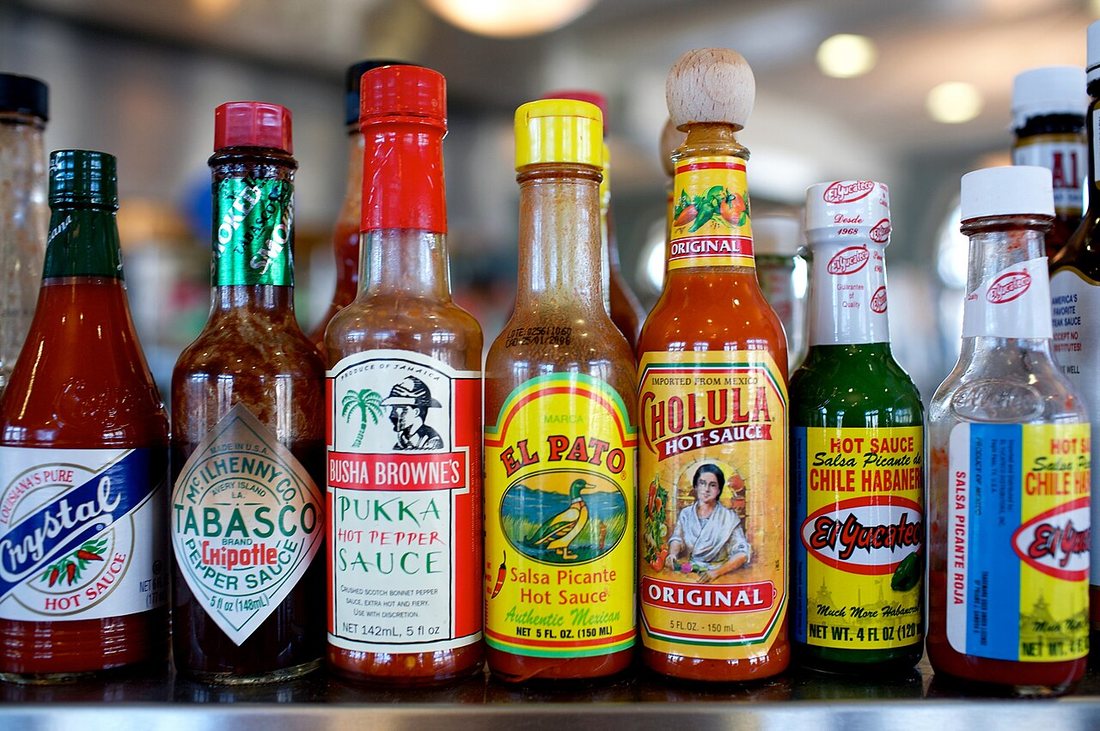
The best-known American hot sauces each come with an origin story on the brand’s website. Several of those stories are disputed. In most cases the only detailed source is the company itself, and some well-known claims have been contested by outside writers, in court, or by the companies’ own former partners.
The companion page Peppers, and the Hot-Sauce Shelf covers what is done to the pepper inside each style of bottle. This page covers the histories behind the labels, and how much of each history can be confirmed.
Before Tabasco: 1807?
One of the first bottled hot sauces sold in the United States is often said to have appeared in Massachusetts in 1807. The only source traced is a popular book, Jennifer Trainer Thompson’s Hot Sauce! (2012). No advertisement or other primary record was found. The 1807 date is unconfirmed, and the claim that Tabasco was the first American hot sauce is also uncertain. See What the Popular Story Gets Wrong.
Tabasco: 1868, 1869 or 1870
The company’s account
According to the McIlhenny Company’s history page:
- Edmund McIlhenny “grew his first commercial pepper crop in 1868.”
- “The next year, he sent out 658 bottles of sauce at one dollar apiece wholesale to grocers around the Gulf Coast.”
- He “secured a patent in 1870.”
- The first bottles were “small cologne-type bottles with sprinkler fitments … sealed in green wax.”
The three dates measure different things. 1868 is the first crop. 1869 is the first bottles. 1870 is the patent.
The pepper is the tabasco, a cultivar of Capsicum frutescens, and it is grown commercially in Louisiana (Barboza et al. 2022). McIlhenny planted “Capsicum frutescens pepper seeds”, according to the 64 Parishes encyclopedia. The same entry gives the origin of the seed with a hedge: “Although family stories differ, one account maintains it was there he received a handful of red pepper pods from an ex-Confederate returning from self-imposed exile in Mexico.”
The original process
64 Parishes describes the first method as 30 days in “crockery jars and barrels” with salt from Avery Island, followed by “French white wine vinegar” for at least another 30 days. The company says that today the mash ages “up to three years in white oak barrels” and is finished with “high-quality distilled vinegar.” The existing pickled page sets out the modern sequence: salt, oak, then 28 days in vinegar.
One caution about the source. The 64 Parishes entry was written by Shane K. Bernard, the McIlhenny Company’s historian. It is not an independent account.
How long the mash ages
Sources disagree:
| Claim | Source |
|---|---|
| ”Up to three years in white oak barrels” | McIlhenny Company |
| ”Up to eight years”, plus a 15-year Diamond Reserve | Tim Chin, Serious Eats |
| ”A minimum of one year, up to five” (for both Tabasco and sriracha) | Mara Jane King, quoted by Chin |
The only first-party figure is the company’s own: up to three years. The others are secondary. How barrel aging works as a fermentation is covered on Fermented Hot Sauce.
The Maunsel White dispute
Jeffrey Rothfeder’s McIlhenny’s Gold (2007) argues that Tabasco has an earlier origin. As quoted in Mark Robichaux’s Wall Street Journal review: “it seems clear now that in 1849, a full two decades before Edmund McIlhenny professed to discover the Tabasco pepper, White was already growing Tabasco chilies on his plantation.”
The evidence offered:
- A newspaper letter. A letter to the New Orleans Daily Delta describes the “Tobasco” as “a new species of red pepper, which Colonel White has introduced into this country.” A secondary source dates it to 26 January 1850.
- Court testimony. Jean Andrews’s Peppers: The Domesticated Capsicums is reported to quote 1922 testimony in a US Circuit Court that White gave pods and his recipe to McIlhenny. This was not seen first-hand.
- An advertisement. White’s heirs are reported to have advertised “Maunsel White’s Concentrated Essence of Tobasco Pepper” from 1864. This was not seen first-hand either.
Rothfeder concludes that McIlhenny’s sauce “was inspired by White’s recipe.” The company denies this.
This is a live dispute between a company historian and an outside author. The strongest evidence on White’s side, the 1922 testimony and the 1864 advertisement, has been reported but was not examined here.
Crystal, 1923
Baumer Foods’ history page: “Since 1923, when the first cayenne peppers were ground, aged and bottled as Crystal Hot Sauce … Baumer Foods was founded by Alvin and Mildred Baumer on Tchoupitoulas Street in New Orleans.”
Crystal is made from aged red cayenne, not tabasco peppers, with distilled vinegar and salt. A secondary source adds that the company’s landmark sign was damaged by Hurricane Katrina and that production moved to Reserve, Louisiana.
Frank’s RedHot, 1920, and the Buffalo wing
Cincinnati, not Louisiana
According to the Cincinnati Enquirer (Suess, 2021):
- Frank’s RedHot was “produced by the Frank Tea and Spice Co., and first put on shelves in 1920.”
- Jacob Frank had started the business in 1896.
- “In 1918, Jacob Frank traveled to Louisiana to learn about making hot sauce based on cayenne peppers … Frank found a partner in Adam Estilette … a pickling plant in New Iberia.”
Other accounts give 1917 for the Louisiana trip. The pepper and the method were Louisiana’s, but the company was based in Cincinnati.
1964: did Frank’s go on the first wings?
McCormick, which now owns Frank’s, gives a timeline that includes this entry for 1964: at the Anchor Bar in Buffalo, “they used Frank’s to invent Buffalo Wings.” This is a company claim, and the record does not support it well:
- The Anchor Bar did not name the sauce. Its own 2008 web page says that on “a Friday night in 1964,” Teressa Bellissimo fried the wings and “flavored them with a secret sauce”, and it calls the recipe “closely guarded.”
- No contemporary source was found showing that Frank’s was used in 1964. The connection appears to be later marketing, and at least one secondary source says Frank’s was probably not the original sauce.
- The Anchor Bar’s claim to have invented the dish is itself contested. The Buffalo History Museum gives a rival to the familiar Bellissimo story. John Young (1935–1988) opened “Wings & Things” in 1966 and served wings “uncut, breaded, deep-fried, and served with his secret, tomato-based Mambo Sauce.” His telephone-book listing is the first appearance of chicken wings in the Buffalo directory.
- Wings were on Buffalo menus much earlier. The museum also records “Chicken Wings, fried” on a Clarendon Hotel bill of fare dated 1 July 1857.
Published home versions of the sauce use melted butter and Frank’s in roughly equal volumes. J. Kenji López-Alt’s oven-fried wings at Serious Eats use 2 tablespoons of each per pound of wings. McCormick’s timeline dates its pre-made Buffalo wing sauce to 1996.
Texas Pete, from North Carolina
Texas Pete’s own homepage tells the story of the name: “A marketer suggested callin’ it ‘Mexican Joe,’ Sam insisted ‘It’s gotta be an American name!’ Sam figured Texas was known for spice and looked at his son Harold whose nickname was Pete.”
Texas Pete is made in Winston-Salem, North Carolina, not Texas. The 1929 founding date and the details of the founding family’s company come from secondary sources and were not confirmed.
Cholula
The company says Cholula Original is “crafted from a generations-old family recipe that features arbol and piquin peppers.” McCormick announced its purchase of the brand from L Catterton on 24 November 2020 and completed it shortly afterwards.
The rest of the brand’s history comes from secondary sources only and was not confirmed. That history says Cholula is named after the city of Cholula, Puebla, is made in Chapala, Jalisco, was made by one family for three generations, and reached the US market in Austin in 1989. Cholula is one of several Mexican brands (with Valentina, Tapatío and Búfalo) that Tim Chin of Serious Eats says do not ferment their peppers. Valentina’s own story, including a sauce named after a teenage soldier of the Mexican Revolution, is told on Africa, the Middle East and the Americas.
What “Louisiana-style” means
Tim Chin of Serious Eats defines the category by its brands: sauces “named after the birthplace of some of the country’s first commercial hot sauce brands such as Tabasco, Crystal, Frank’s Red Hot, Texas Pete, and of course, Louisiana Hot Sauce.” Chin describes them as smooth, “thin and watery to slightly viscous.” The formula is reported as red tabasco or cayenne peppers, vinegar and salt, sometimes with xanthan gum.
Louisiana-style describes a type of sauce, not where it is made. Frank’s was a Cincinnati company and Texas Pete is from North Carolina. How the style is made at home is covered on Fermented Hot Sauce and Vinegar and Cooked Sauces.
Huy Fong, 1980
The founder
From the Los Angeles Times (2013):
- “David Tran, 68, founded hot sauce company Huy Fong Foods Inc. in Chinatown in 1980 and a few years later introduced Sriracha sauce to the U.S.”
- Tran had been “a major in the South Vietnamese army.”
- “He named his company Huy Fong Foods after the Taiwanese freighter that carried him out of Vietnam.”
- “Huy Fong Foods has never spent a dollar on advertising.”
- Because the sauce is named after a Thai city, “the company cannot trademark the name.”
The rooster on the bottle is reported to be Tran’s sign in the Chinese zodiac. The Thai sauce from Si Racha, which is older and made in a different tradition, is covered on Asia’s Chile Sauces and Pastes. Huy Fong publishes no fermentation step, so whether its mash ferments remains unsettled.
The shortage: the weather and the supplier
From 1988, Underwood Ranches in Ventura County, California, grew Huy Fong’s red jalapeños. The partnership ended in 2016–17 (sources give both years) and led to lawsuits. Craig Underwood “won a $23 million judgment” (CNBC). USA Today puts the figure at $23.3 million and reports a jury finding that Huy Fong “breached its contract … and committed fraud.”
In 2022 Huy Fong announced “an unprecedented shortage of our products … caused by several spiraling events, including unexpected crop failure from the spring chili harvest.” This followed an April warning about “severe weather conditions affecting the quality of the peppers” (CNN).
The popular explanation is a drought in Mexico. That appears in some secondary sources and in a Bloomberg headline about weather ruining the chili crop. The CNN text that was read mentions neither Mexico nor drought, and Bloomberg could not be read. The drought explanation is weakly sourced.
The supplier split points to another cause. Underwood told CNBC that “he could have kept up with demand.” In May 2024 Huy Fong halted production again, because its chili was “too green to proceed with production as it is affecting the color of the product.” Stephanie Walker of New Mexico State University said that other sriracha makers “are flush with red jalapeños.” She suggested that Huy Fong, “which has been sourcing its chile peppers in Mexico, has not yet established solid relationships with dependable jalapeño growers” (USA Today, 2024).
A fair summary: the company blamed the weather, and the reporting points to the loss of its long-standing grower as the underlying weakness.
Recipes in the collection
- Fermented Habanero Hot Sauce (Tim Chin): a fermented mash its author describes as “roughly inspired by a Louisiana-style hot sauce like Tabasco”, finished to pH 3.4.
- Master Hot Sauce (Bon Appétit): a short salt ferment followed by vinegar.
- Cayenne Pepper Sauce (NCHFP, Canned): a tested cooked sauce for the canner.
- Southern Pepper Vinegar (Virginia Willis).
- Fermented Sriracha (Serious Eats).
- Classic Buffalo Wing Sauce and Sriracha Wing Sauce.
- Sriracha Pickled Eggs.
- Fermented Hot Sauce and Canned Hot Sauce.
Comments (0)