Peppers and Hot Sauce · 3 of 14
Heat: Capsaicin and Scoville
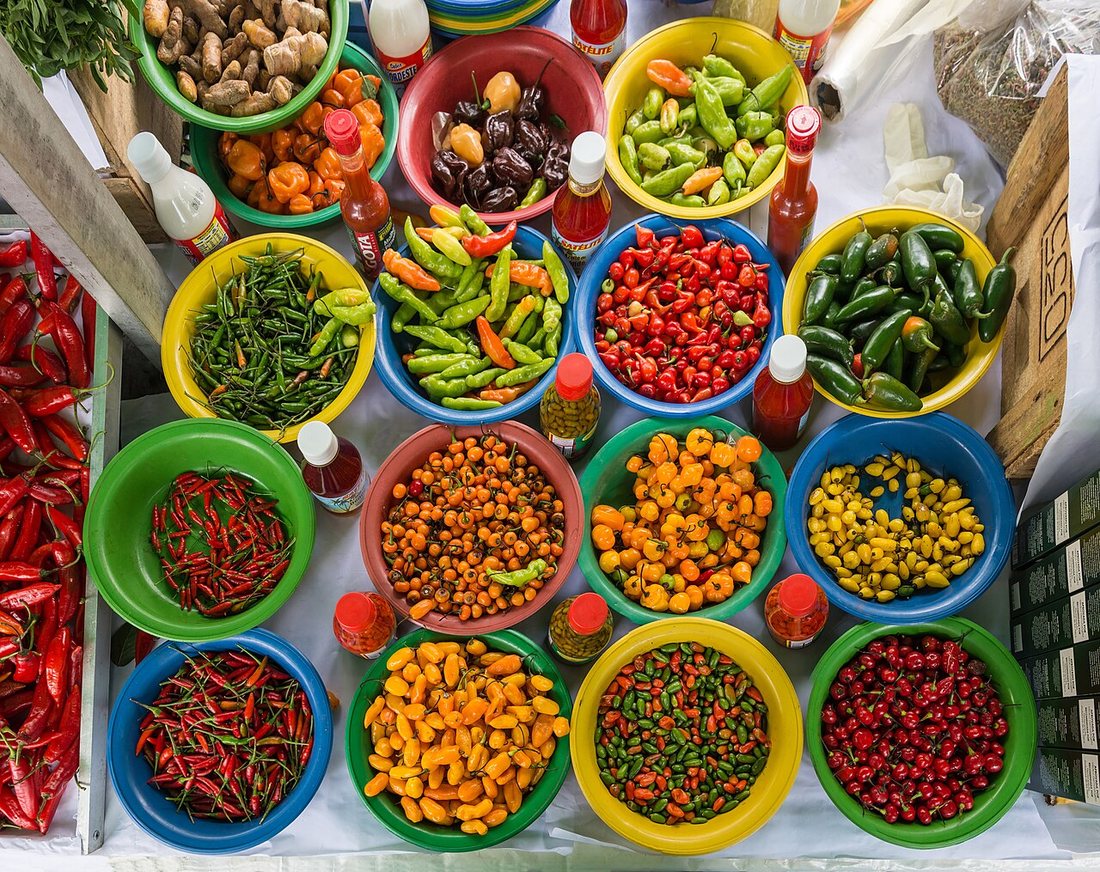
Chile heat is not a taste. It is a pain signal. Capsaicin binds a receptor whose normal job is to warn of dangerous heat, and the brain reports a burn even though nothing is burning. Most of what people believe about chile heat follows from that one fact, and so do several corrections: where the heat is, why birds ignore it, why milk works, and why milk does not help on skin.
The companion page Peppers, and the Hot-Sauce Shelf explains why capsaicin does not dissolve in water and therefore stays in a jar. This page covers the receptor, how heat is measured, how growing conditions change it, and how to deal with it in the mouth, on the hands and in the eyes.
Capsaicinoids, and where they are made
“Capsaicin” is shorthand for a family of related compounds, the capsaicinoids. A 2024 review in Plants says they “are synthesized by glandular cells within the placenta and pericarp tissue of pepper fruit.” The placenta is the pale tissue that holds the seeds. In some superhot C. chinense lines, the fruit wall carries “substantial quantities” of the genes that make them as well.
The seeds are not the source of the heat. They pick up capsaicin from the placenta they are attached to. Guinness made the same point when it certified the current record-holder: “the capsaicin is contained in the placenta, the tissue which holds the seeds.” The fruit itself is described on The Pepper.
TRPV1: a heat sensor fooled by a molecule
In 1997, David Julius’s laboratory cloned the receptor that capsaicin acts on (Caterina et al., Nature 1997). It is “a non-selective cation channel … also activated by increases in temperature in the noxious range.” In other words, the receptor that answers to capsaicin is the same one that answers to scalding heat.
The receptor was later named TRPV1. Julius shared the 2021 Nobel Prize in Physiology or Medicine with Ardem Patapoutian, who worked on touch. The Nobel committee’s press release describes how Julius “utilized capsaicin, a pungent compound from chili peppers that induces a burning sensation, to identify a sensor in the nerve endings of the skin that responds to heat … a heat-sensing receptor that is activated at temperatures perceived as painful.”
That explains why “hot” is the right word for a chile. The nerve sends the same signal it would send for a burn.
Why birds eat chiles
Birds do not feel the burn. Jordt and Julius (Cell 2002) put it directly: “Birds are indifferent to the pain-producing effects of capsaicin and therefore serve as vectors for seed dispersal.” The chicken version of the receptor is “normally insensitive” to capsaicin, but it is still “activated by heat or protons.” Sensitivity to capsaicin “is a recent acquisition of mammalian vanilloid receptors.”
The ecological explanation comes from Tewksbury and Nabhan (Nature 2001), who called it directed deterrence. Capsaicin “selectively discourages vertebrate predators without deterring more effective seed dispersers.” A mammal chewing a chile damages its seeds. A bird swallows them whole and carries them away. The chemistry deters the animals that would destroy the seeds and does not deter the ones that spread them.
Measuring heat: from tasters to chromatography
The Scoville test, 1912
Wilbur Scoville was an American pharmacist. His 1912 method, as summarized by New Mexico State University (NMSU Guide H-237, Bosland and Walker), worked like this: “The samples are diluted in the laboratory until heat can no longer be detected by the tasters. A single unit of dilution is called a Scoville Heat Unit.” A 2015 paper in Sensors adds that the extract “is diluted with sugar water until the pungency cannot be detected by five taste panels.”
The method relied on human tasters, and NMSU notes that it is “still subjective and depends on the taster’s palate.”
HPLC
NMSU’s verdict is direct: “The most accurate method for measuring heat in chile peppers is high-performance liquid chromatography (HPLC).” HPLC measures the capsaicinoids chemically, and the American Spice Trade Association (ASTA) “publishes the procedure accepted by the spice industry.” Results are reported in ASTA pungency units and are commonly converted to Scoville units so that the familiar scale survives. A conversion factor is widely quoted, but its source could not be confirmed, so it is not given here.
The numbers that are sourced
| Pepper | Figure | Source |
|---|---|---|
| Ají amarillo | 30,000–50,000 SHU | Reported in a secondary source |
| Carolina Reaper | 1,641,183 SHU (often rounded to 1.64 million) | Guinness, as cited in Barboza et al. 2022 |
| Pepper X | 2,693,000 SHU average | Guinness, 16 October 2023 |
Guinness certified Pepper X on 16 October 2023 as “officially the world’s hottest chilli pepper, rating at an average of 2,693,000 Scoville Heat Units.” It was bred by Ed Currie of the Puckerbutt Pepper Company, who also bred the Carolina Reaper. The testing was done by Winthrop University in South Carolina, “using specimens from the past four years.” Guinness says the record is measured both in Scoville units and in ASTA pungency units.
Two caveats apply:
- Independence. Winthrop is in South Carolina, near Currie’s farm, and the figure has reportedly been criticized because no independent testing has been done.
- Currency. The live Guinness record page did not show a current holder when it was checked, so it could not be confirmed that Pepper X still holds the title as of October 2026.
Scoville figures for everyday chiles such as jalapeño and cayenne are printed in many places. No primary source for them was reached, so they are left out.
Genetics sets the ceiling; stress moves heat within it
Gardeners often say that a stressed plant gives hotter peppers. NMSU’s version is more careful: “A mild chile pepper cultivar bred for low levels of heat will become hotter when exposed to any type of stress in the field. A chile pepper plant that genetically produces low-heat fruit will not produce hot chile peppers even when grown in a stressed environment.”
The 2024 Plants review makes the picture less tidy:
- “Moderate drought conditions can elevate capsaicinoid levels, whereas severe drought may decrease them.”
- Low-pungency varieties rose under drought, “while high-spicy varieties displayed no significant change.”
- Deficit irrigation can raise capsaicinoids while lowering yield.
- “The response varies among different varieties and genotypes.”
Summary: genetics sets the upper limit, and stress moves heat around inside it, in a direction that is not the same for every variety. Holding back water from a habanero is not a reliable way to make it hotter. How this plays out in a northern garden is covered on Growing.
Cooling a burn in the mouth
The usual explanation is that milk works because fat dissolves capsaicin. The data point to protein.
- Physiology & Behavior, 2019 (72 participants, several common drinks). “All beverages significantly reduced the burn … the largest reductions in burn were observed for whole milk, skim milk, and Kool-Aid.” The authors concluded that “milk is the best choice to mitigate burn, regardless of fat context, suggesting the presence of protein may be more relevant than lipid content.”
- Journal of Food Science, 2023 (89 participants). Free capsaicin “decreased linearly with protein concentration and the decrease was greater for casein than for whey.” As a rinse, “only the 5% (w/w) micellar casein solution was significantly more effective than the water rinse.”
- Food Quality and Preference, 2023. “Full-fat milk is not more efficacious than fat-free milk.”
Skim milk works as well as whole milk. Casein, the main protein in milk, does most of the work. The existing Peppers, and the Hot-Sauce Shelf page describes casein’s emulsifying role and flags the fat explanation as doubtful. The three studies above settle that doubt in casein’s favour. For the full list of popular claims this section corrects, see What the Popular Story Gets Wrong.
Hands, skin and eyes
Gloves
NCHFP’s standing caution appears on almost every pepper recipe it publishes: “Wear plastic or rubber gloves and do not touch your face while handling or cutting hot peppers. If you do not wear gloves, wash hands thoroughly with soap and water before touching your face or eyes.” For the small hot peppers (serrano, cayenne, habanero and tabasco), it adds that “they cause extreme irritation to the skin.”
Whether capsaicin gets through latex more easily than nitrile could not be established. NCHFP says only “plastic or rubber.”
Hunan hand
Heavy handling has a medical name. “‘Hunan hand’ is a contact dermatitis resulting from the direct handling of chili peppers containing capsaicin” (Williams, Clark and Dunford, Annals of Emergency Medicine 1995). It is “usually seen in people with continuous and prolonged exposure to chili peppers” (Saxena and Mandhyan, Pain Practice 2013). That paper describes a severe case that needed a nerve block. A 2025 case report calls the condition “rarely appearing” and describes a case that resolved without treatment. The risk grows with the amount of bare-handed contact.
Milk on skin: no better than water
Milk helps in the mouth, but not on skin. In a randomized trial, 49 law-enforcement trainees were sprayed in the face with oleoresin capsicum (pepper spray). They were treated with Maalox, 2% lidocaine gel, baby shampoo, milk or water. “There was no significant difference in pain between treatment groups … Time after exposure appeared to be the best predictor for decrease in pain” (Barry, Hennessy and McManus, Prehospital Emergency Care 2008).
On skin, the most reliable treatment is time. NCHFP’s advice is to wash with soap and water before touching the face or eyes. Milk is no better than water.
Eyes and air
There are no kitchen studies on eye exposure, but pepper-spray data show the eyes are the vulnerable point. In 3,671 exposures reported to a poison-control system, 6.8% had more severe symptoms. Of those, 53.8% involved the eyes and 31.7% the airways. There were no deaths (Kearney et al. 2014). That was spray, not cooking.
Pure capsaicin carries hazard warnings that include “May cause allergy or asthma symptoms or breathing difficulties if inhaled” and “May cause respiratory irritation” (PubChem). Those apply to the purified chemical, not to a pepper.
No extension, NIOSH or toxicology guidance on fumes from cooking superhot peppers was found. It is still sensible to run the hood fan when toasting or frying chiles, as the collection’s roasted chile powder recipe advises.
Recipes in the collection
- Roasted Chile Powder: toasting dried chiles at 350 °F (175 °C), with the hood fan on.
- Fermented Habanero Hot Sauce (Tim Chin): about 25 habaneros. Wear gloves.
- Caribbean Scotch Bonnet Pepper Sauce.
- Zhug (Yemeni Green Chile Sauce).
- Classic Buffalo Wing Sauce.
- Pickled Jalapeño Rings (NCHFP, Canned): NCHFP’s glove warning applies.
Comments (0)