Peppers and Hot Sauce · 10 of 14
Dried and Smoked Chiles
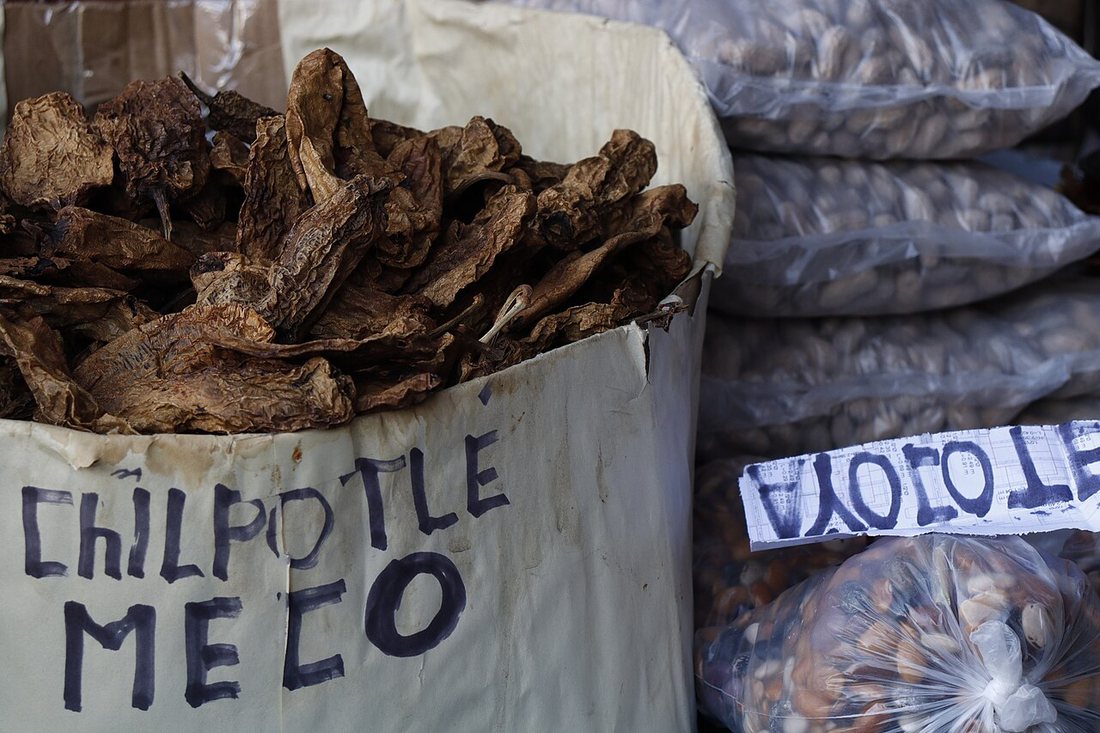
Drying is the oldest way to keep a chile, and of all the ways in this section it is the one that does not depend on acid. A pepper in vinegar is safe because of the vinegar, and a pepper ferment is safe only if the bacteria reach a low enough pH (see Safety). A dried pepper is safe because almost all of its water is gone. Take the water away and the pH question mostly goes away with it.
The practical guidance, however, is thinner than the tradition. Extension services publish clear drying temperatures and times. For smoking chiles at home, the sources reached for this section publish no tested method at all, and the two best-known commercial descriptions of chipotle production disagree on wood, temperature and duration. The kitchen these pages are written for has a dehydrator and a smoker, so both halves are covered here: what is established, and where the record runs out.
Drying temperatures: 140 °F is the working number
The figure that recurs across the extension material is 140 °F (60 °C).
- NCHFP, “Food Dehydrators”: “Dehydrators are efficiently designed to dry foods fast at 140ºF.” The recommended feature to look for is “an enclosed thermostat from 85ºF to 160ºF” (about 29–71 °C).
- Colorado State University Extension, “Drying Vegetables” (Kendall, DiPersio and Sofos; reviewed 2012) gives the oven method: preheat at the lowest setting (140–150 °F, 60–66 °C), then prop the door open and adjust until the oven holds a consistent 140 °F, checked with an oven thermometer every two hours, with trays shifted every half hour.
CSU’s vegetable table gives no separate dehydrator temperature; only its oven section names 140 °F. Its chile rows are worth having in full, because they treat green and red pods differently:
| Pepper (CSU row) | Preparation | Blanch | Drying time | Done when |
|---|---|---|---|---|
| Chili peppers, green | Slit the skin, rotate over a flame 6–8 min or scald in boiling water; peel, split, remove seeds and stem | None | 12–24 h | ”Crisp, brittle, medium green” |
| Chili peppers, red | Wash thoroughly; slice, or leave whole if small | 4 min | 12–24 h | ”Shrunken, dark red pods, flexible” |
| Peppers; pimentos | Stem, core, seed; cut into ¼–½ in (6–13 mm) strips or rings | 4 min | 8–12 h | ”Tough to brittle” |
Two points in that table are easy to misread. Dried red pods are finished while still flexible, not brittle; brittle is the test for green chiles and pepper strips. And CSU blanches red chiles and pepper strips before drying. Its reason is microbial, not cosmetic: blanching “enhances the destruction of potentially harmful bacteria during drying, including E. coli O157:H7, Salmonella … Listeria” (citing DiPersio et al. 2005, 2007). CSU’s blanching times are written for 3,000–5,000 ft and run slightly shorter at lower altitude.
Outdoors, and the ristra problem
NCHFP, “Sun Drying”: “Vegetables (with the exception of vine dried beans) and meats are not recommended for out-of-doors drying. Vegetables are low in sugar and acid … It is best to dry meats and vegetables indoors.” The same page says “a humidity below 60 percent is best.”
That sits awkwardly beside one of the best-known images of dried chiles, the New Mexico ristra, a string of red pods hung outdoors to air-dry. No New Mexico State University publication on ristra drying was located for this section, so the tension cannot be resolved here. What can be said is that the national guidance is indoor drying with controlled heat, and that the outdoor tradition is not what it describes. Tunisian harissa raises the same question: UNESCO’s description of the practice has the peppers sun-dried before grinding (see Africa, the Middle East and the Americas).
A third, informal method circulates: leaving small Thai bird chiles uncovered in the refrigerator for “two to three weeks, or until deep wrinkles form and the chiles are hard and dry” (Max Falkowitz, Serious Eats, 2011). By the same author’s account, thick-walled jalapeños and poblanos “won’t dry this way” and fruits “tend to rot before they dry out.” It is a personal method, not extension guidance.
Conditioning and storage
Drying is not finished when the trays come out. CSU’s conditioning step: fill containers two-thirds full and hold them 4–10 days, shaking daily. If moisture beads form inside, the batch goes back for more drying. Properly stored, CSU says, dried vegetables “keep well for six to 12 months,” with the best nutrient retention inside a year.
Powder and flakes
The only named-source chile powder recipe found is Pepper Teigen’s Roasted Chile Powder (Bon Appétit, 2021): 2 cups of dried red chiles (Thai, de árbol or japones) roasted on a sheet pan at 350 °F (177 °C) for about 6 minutes, checked halfway, until they turn “from red to a very dark reddish brown.” Cool completely, then grind in a mortar to the size of red pepper flakes, or 10–15 seconds in a spice grinder. It keeps airtight “about 3 months or longer if kept in the freezer.” Despite the title, it is ground to flake size, and it is a toasted Thai-style chile rather than a raw cayenne-type powder. The recipe itself says to turn on the hood fan if there is one.
A homemade cayenne powder or red-pepper-flake recipe from a named source was not found. Kirsten Shockey (FermentWorks, 2020) mentions dehydrating leftover ferment mash “to make into various pepper seasonings,” but publishes no method.
A note on paprika. Hungarian spice paprika is a dried, ground pepper, and its sweetness is newer than its reputation. Klátyik et al. (IntechOpen, 2018): “Central European paprika had a typically hot taste until the 1920s, when a Szeged breeder found a variety that produced a sweet tasting fruit.” Government research stations opened at Kalocsa in 1917 and Szeged in 1921. Sweet paprika is a twentieth-century breeding result, not an ancient one.
Chipotle: a smoked, dried, ripe jalapeño
On the meaning, the sources agree. Pati Jinich: “the Jalapeño chile, that has been ripened, dried and smoked. Its name comes from the náhuatl Chilli or Chile, and Poctli or smoke.” The Nahuatl spelling varies by source (chipoctli in Mely Martínez’s Mexico in My Kitchen; chīlpoctli in Wikipedia).
On how it is made, they do not.
- Martínez (2025): the first two jalapeño harvests are sold green and the last is left to ripen red for chipotle. “Workers remove the seeds by hand.” The chiles are smoked in brick-and-wood “cookers” up to “60 feet in length, 20 feet wide by 8 feet high” (about 18 × 6 × 2.4 m) for 2 to 3 days, mesquite being “the favorite wood to use in Mexico.” Camargo, Chihuahua, has been “a hub for chipotle production since 1973.” This is a single, if well-known, writer.
- Wikipedia, citing a 2015 Food Research International paper that was not read for this section: six days in an open smoker at 65–75 °C (149–167 °F), “using mainly pecan wood,” with moisture falling from 88% to 81% in the first three days and ending at 6%. “Typically, ten pounds of jalapeños make one pound of chipotles” (about 4.5 kg to 0.45 kg). Some commercial producers use gas dryers and artificial smoke flavoring.
Mesquite or pecan, two to three days or six: both accounts are in circulation and neither can be confirmed here.
Meco and morita: unsettled
The two chipotles most often named are the meco and the morita, and the sources describe the difference in three incompatible ways.
| Source | Meco | Morita | Explanation offered |
|---|---|---|---|
| Wikipedia | ”Grayish tan … smokier” | Darker, reddish-purple; “smoked for less time … considered inferior to the meco” | Smoking time and quality |
| Max Falkowitz, Serious Eats (2011) | “A dusty tan, with a milder, less smoky flavor" | "The color of dark raisins”; “the smoke, heat, and earth powerhouses” | Flavor, opposite to the row above |
| Pati Jinich | From “a larger variety of Jalapeños” | From “smaller varieties of Jalapeños” | Cultivar |
| Mely Martínez | ”Smoked for a longer time" | "The first stage of dehydration” | Smoking time |
Two sources say the meco is the smokier; one says the morita is. One says the difference is the plant; two say it is the process. The only points all four agree on are that both are smoke-dried red jalapeños, and that the morita is the one commonly sold in the United States.
Canned chipotles en adobo are, in Falkowitz’s description, “smoked and dried jalapeños rehydrated and canned in a sweet and tangy purée of tomato, vinegar, garlic, and some other spices.” No named-source recipe for making them at home was found. The nearest is Rick Bayless’s moritas en escabeche: dried moritas simmered briefly in piloncillo, vinegar and water with garlic and salt, weighted to rehydrate, ready in a couple of hours and kept refrigerated. That is a sugar-and-vinegar pickle, not an adobo.
Smoking chiles at home: what the sources do and do not say
No extension service or chef reached for this section publishes a home method for smoking chiles with times and temperatures. Pati Jinich’s whole answer to a reader is: “It’s a process of drying them and smoking them slowly over a fire or grill.” Michigan State’s smoking material did not load, and the Bayless book page cited for chipotle was not accessible.
What can be assembled from the record is limited:
- The commercial figures above (65–75 °C over days, to 6% moisture) describe drying with smoke, not hot-smoking. By the logic of the rest of this section, a pepper that comes out of a smoker soft and moist has not been dried; it is still a fresh, low-acid vegetable, to be refrigerated or finished in a dehydrator.
- Charring peppers before fermenting gives “a smoky element … reminiscent of the smokiness of chipotle peppers” (Tim Chin, Serious Eats). That is a flavor technique for a sauce, not a way to make chipotles.
- A smoked pepper that goes into a sauce, a jar or oil is governed by the same rules as any other pepper. Smoke is not acid, and it does not change what Safety says about pH 4.6 or about peppers under oil.
Dried chiles in other sauces
Dried chiles carry several sauces elsewhere in this section. Chili crisp and salsa macha are both dried chiles in hot oil (see Asia and Africa, the Middle East and the Americas); harissa begins, in its Tunisian form, with sun-dried peppers; and a Thai roasted chile powder is a condiment in its own right.
For anyone thinking of selling: Michigan’s cottage-food list excludes hot sauce by name, but allows dehydrated vegetables and dry herb and spice mixtures, so dried chiles and flakes appear to fall on the permitted side. That is a reading of MDARD’s list rather than a ruling; Safety has the detail.
Recipes in the collection
- Roasted Chile Powder (Pepper Teigen) — untested
- Chili Crisp (Sohla El-Waylly) — dried árbol, japones and Kashmiri chiles; untested
- Salsa Macha (Rick Martínez) — dried ancho and árbol in oil; untested
- Harissa (Diana Henry) — dried guajillo with optional chipotle paste; untested
Comments (0)