Peppers and Hot Sauce · 7 of 14
Safety: pH, Botulism and Oil
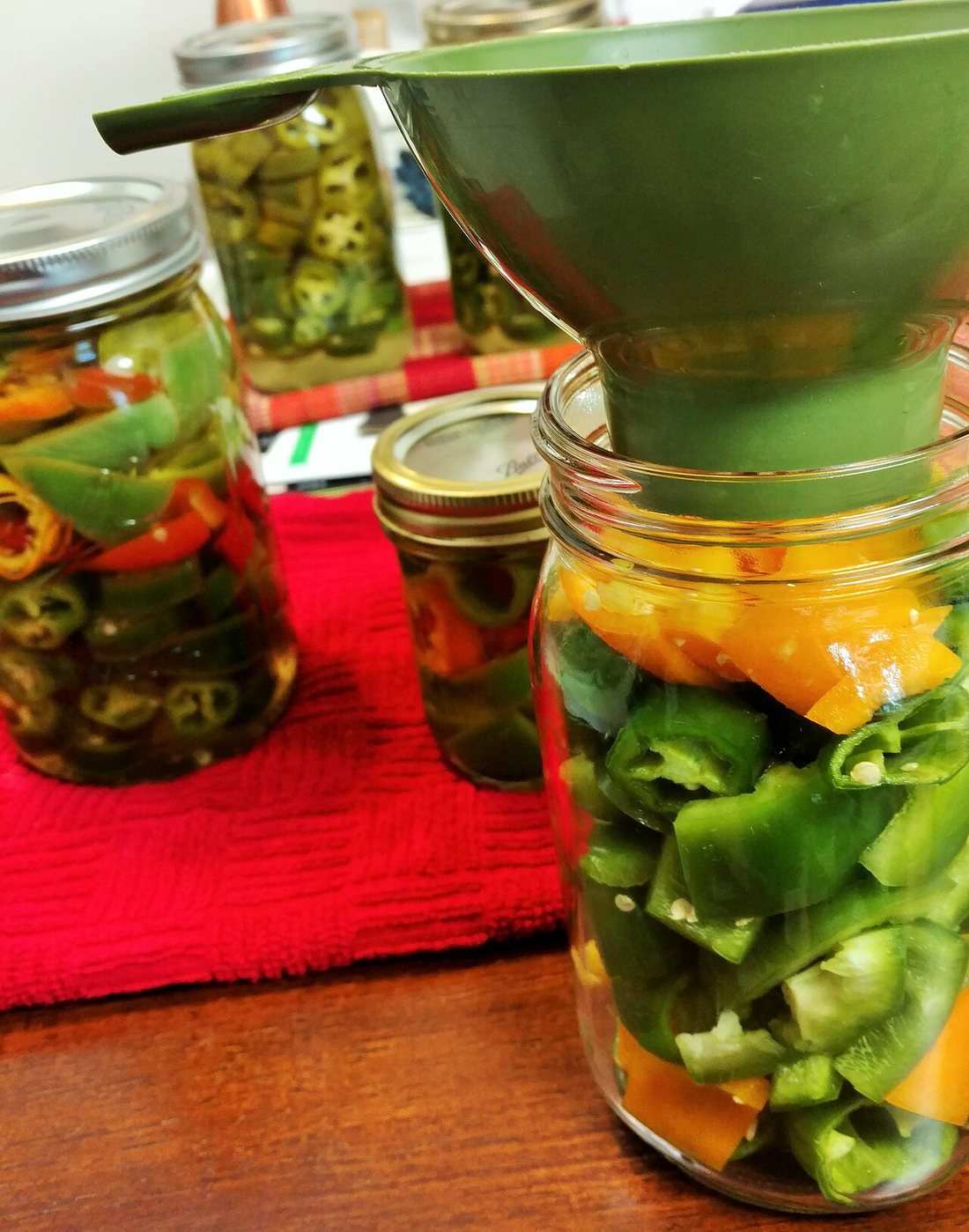
Every safety question about a hot sauce comes down to one number and one organism. Clostridium botulinum cannot grow below pH 4.6. Fresh peppers sit above it. So a pepper preserved in a sealed container at room temperature is safe only if something has carried it below 4.6 and something has dealt with what was living on it. There are three ways to get the acid there — vinegar or lemon juice poured in, acid grown by fermentation, or both — and only one of them is predictable.
Oil is not on that list. It is a lid, not a preservative, and the cases below show what happens when it is treated as one.
Peppers are a low-acid food
The FDA’s table of approximate food pH gives fresh peppers at 4.65–5.45 and green peppers at 5.20–5.93. Garlic is 5.80. The products made from them that are safe on a shelf are the acidified ones: acidified chili sauce at 2.77–3.70, red pepper relish at 3.10–3.62.
Federal regulation names peppers by name. 21 CFR 114.3(b) defines acidified foods as “low-acid foods to which acid(s) or acid food(s) are added; these foods include, but are not limited to, beans, cucumbers, cabbage, artichokes, cauliflower, puddings, peppers, tropical fruits, and fish.”
NCHFP treats plain peppers exactly as it treats any low-acid vegetable: in a pressure canner, hot pack, half-pints or pints only, 35 minutes — 11 to 14 lb on a dial gauge, 10 or 15 lb on a weighted gauge, by altitude. No quart size is offered. Every NCHFP pepper recipe that uses a boiling-water canner instead carries vinegar or bottled lemon juice. NCHFP’s salsa notes put the reason in one sentence: “You must add acid to canned salsas because the natural acidity may not be high enough.”
Michigan, 1977
The anchor case for any hot-sauce safety discussion happened in Michigan. From the published report (Terranova, Breman, Locey and Speck, Am J Epidemiol 1978):
“Between March 31 and April 6, 1977, 59 individuals developed type B botulism. All ill persons had eaten at the same Mexican restaurant and all had consumed a hot sauce made with improperly home-canned jalapeno peppers, either by adding it to their food, or by eating a nacho that had had hot sauce used in its preparation.”
About two-thirds of those exposed to the sauce became ill. Secondary accounts name the city and the restaurant, say the peppers had been canned at home by a former employee, and call it the largest botulism outbreak in the United States up to that time; none of that is in the published abstract, and it should be read as reported rather than established.
The failure was in the jar of peppers, not the sauce. Jalapeños are a low-acid food, and canned without a tested acidified or pressure process they became the vehicle. Every home rule on this page exists to prevent that jar.
One case is sometimes cited alongside it and should not be: the 2007 Texas and Indiana botulism outbreak traced to commercial hot-dog chili sauce, which is a meat sauce, not a pepper sauce.
Fermentation does not settle it
A ferment does grow acid, but it does not reliably grow enough. In three independent studies, pepper ferments without a starter culture finished at about pH 4.8 to 4.9, above the line, while inoculated ferments reached about 3.7. The data are on Fermented Hot Sauce. Utah State University Extension: “In most cases, fermentation alone cannot produce a shelf-stable (room temperature) food product.” NCHFP has no tested fermented hot sauce or pepper mash.
No documented botulism case from a fermented home pepper sauce was found in this research. That is a failed search, not evidence of safety, and it should not be repeated as “fermented hot sauce has never caused botulism.”
Oil
Oil keeps air out. C. botulinum is an anaerobe, so that is help to the organism, not a defense against it. The documented cases are mostly garlic, which sits at about pH 5.8 and, in the words of the University of Georgia, may already carry C. botulinum spores.
| Case | Vehicle | What happened |
|---|---|---|
| Vancouver, reported as 1985 | Commercial chopped garlic in soybean oil | 36 previously unrecognized type B cases from one restaurant, spread “over at least eight provinces and states in three countries,” first misdiagnosed as myasthenia gravis, psychiatric illness and stroke (St Louis et al., Ann Intern Med 1988) |
| New York State, 1989 | Garlic-in-oil product, made into garlic bread | Three cases; the leftover garlic-in-oil measured pH 5.7. FDA responded “by requiring that microbial inhibitors or acidifying agents be added to such products” (Morse et al., Am J Public Health 1990) |
| Denmark, 2003 | ”Garlic in chilli-oil” | One case, type B confirmed in leftovers (Lohse et al., Ugeskr Laeger 2003) |
CDC now lists chopped garlic in oil among the “new sources” of botulism and advises: “Refrigerate homemade oils made with garlic or herbs. Throw the oils away after 4 days.” The University of Georgia’s infused-oils publication for NCHFP (C1334, 2024) says the same — non-acidified infused oils “must be kept in the refrigerator and discarded 4 days after being made” — and gives the only tested home acidification for garlic and herbs: 1 tablespoon citric acid per 2 cups water, a 24-hour soak to pH 4.2 or below. “Do not replace the citric acid solution with vinegar or lemon juice, as they have not been tested.” That publication does not cover peppers.
Acid is what makes oil irrelevant. NCHFP’s tested Marinated Peppers carry a full cup of oil over 4 lb (1.8 kg) of peppers, safely, because the same jar holds 1 cup of bottled lemon juice and 2 cups of 5% vinegar. Italy’s experience with vegetables under oil, and the national health institute’s finding that the usual error is insufficient acidification, are on Under Oil.
Chili crisp, salsa macha, harissa
These are oil condiments, and the published recipes keep them cold:
- Chili crisp (Sohla El-Waylly): dried chiles, with the shallots and garlic fried and strained before they go in, under oil heated to 375 °F (190 °C) — refrigerated, about 3 months.
- Salsa macha: Rick Martínez’s headnote says it lasts “for months in the refrigerator”; Tejal Rao’s version says up to 1 month refrigerated.
- Harissa (Diana Henry’s version): jarred under extra oil, chilled, up to 2 weeks.
- Zhug (Kenji López-Alt): the recipe card says several weeks, the text says up to a week. For a raw fresh-garlic, fresh-herb sauce in oil, use the shorter figure.
The working rule follows from the cases: an oil condiment with fresh garlic, fresh herbs or fresh peppers in it is a refrigerator food, and a homemade one without a tested acidification step gets the 4-day limit CDC and UGA give for garlic and herb oils.
The second line: 4.0
The 4.6 line decides safety. A second line at 4.0 decides how the pH may be measured, and the federal rule states it twice. 21 CFR 114.90(b) allows colorimetric methods “if the pH is 4.0 or lower,” and 114.80(a)(2) repeats it: “If the finished equilibrium pH of the food is above 4.0, the measurement … shall be by a potentiometric method.” Between 4.0 and 4.6, that means a calibrated meter, not strips. Meter choice, calibration and sample preparation are on Measuring pH.
The same paragraph carries a warning that matters for one tested pickle: “Special care should be taken when food ingredients have been subjected to lye, lime, or similar high pH materials.” NCHFP’s crisp jalapeño rings are soaked in pickling lime and must be rinsed three times, because “Excess lime absorbed by the pepper rings must be removed to make safe pickles.” Details are on Pickled Peppers.
Two numbers that circulate in hobby writing are not regulatory: Tim Chin’s Serious Eats guide says commercial producers “aim for” 4.2 or lower and calls 3.4 “the popular standard” for home sauces. Both are uncited. The regulation is a finished equilibrium pH of 4.6 or below.
What “shelf-stable” requires
Acid alone is not the whole process even for a factory. 21 CFR 114.80(a)(1) requires acidified foods to be “thermally processed to an extent that is sufficient to destroy the vegetative cells of microorganisms of public health significance,” or to carry a permitted preservative instead. At home, only an NCHFP-tested process, followed exactly, makes a pepper product shelf-stable. That list is short:
- Sauces: Cayenne Pepper Sauce, Easy Hot Sauce, Chile Salsa.
- Pickles: Pickled Hot Peppers, Pickled Jalapeño Rings, Pickled Yellow Pepper Rings, Pickled Bell Peppers, Marinated Peppers, Pickled Mixed Vegetables.
- Relishes and jellies: Hot Pepper Relish, Sweet Pepper Relish, Pickled Pepper-Onion Relish, Golden Pepper Jelly.
- Plain peppers: pressure canner only.
NCHFP’s rule for all of them: “Do not alter vinegar, food, or water proportions in a recipe or use a vinegar with unknown acidity … There must be a minimum, uniform level of acid throughout the mixed product to prevent the growth of botulinum bacteria.” Anything else — every ferment, every oil condiment, every giardiniera, every invented sauce — is a refrigerator or freezer food. That is not a lesser outcome; it is simply the honest storage for an untested recipe.
Selling it in Michigan
Michigan’s cottage food law does not allow hot sauce at any volume. MDARD’s list of what may be made names it: “No sauces and condiments, including barbeque sauce, hot sauce, ketchup, or mustard.” The same list excludes fermented foods, “pickled fruits or vegetables, such as beets, cocktail onions, or cherry peppers,” salsas, “vegetable jams/jellies (e.g., hot pepper jelly),” and oils flavored with fresh vegetables or garlic, adding that “Pickled and acidified foods pose a risk of botulism.”
Michigan does not apply the pH rule to cottage food at all. Acid foods are excluded by list, even those well below 4.6.
What a pepper grower can sell is dried. The list allows “Dehydrated or freeze-dried vegetables or fruits … except melon, tomato, or leafy greens,” dry herb mixtures, and “Oils flavored with dried herbs or spices only (no garlic).” On a plain reading, dried chiles, chili powder and dried-chili oil are on the allowed side; MDARD (800-292-3939) is the authority to confirm it.
The sales caps are $50,000 a year, or $75,000 for products priced at $250 or more per unit, under MCL 289.4102(5) — figures the statute fixes “until October 1, 2026.” From that date MDARD may adjust them each year for inflation; the statute does not make the adjustment automatic, and on 1 October 2026 MDARD’s cottage food pages still gave $50,000 and $75,000. The caps are beside the point for hot sauce, which is excluded outright. Selling an acidified sauce means a licensed food business, and the details of that route should come from MDARD.
Recipes in the collection
- Cayenne Pepper Sauce (NCHFP, Canned) — tested.
- Pickled Hot Peppers (NCHFP, Canned) — tested.
- Pickled Jalapeño Rings (NCHFP, Canned) — tested.
- Golden Pepper Jelly (NCHFP, Canned) — tested.
- Chili Crisp (Sohla El-Waylly) — refrigerated.
- Chicago-Style Giardiniera (Refrigerator) — no tested process exists; kept cold throughout.
Comments (0)