Peppers and Hot Sauce · 6 of 14
Vinegar and Cooked Sauces
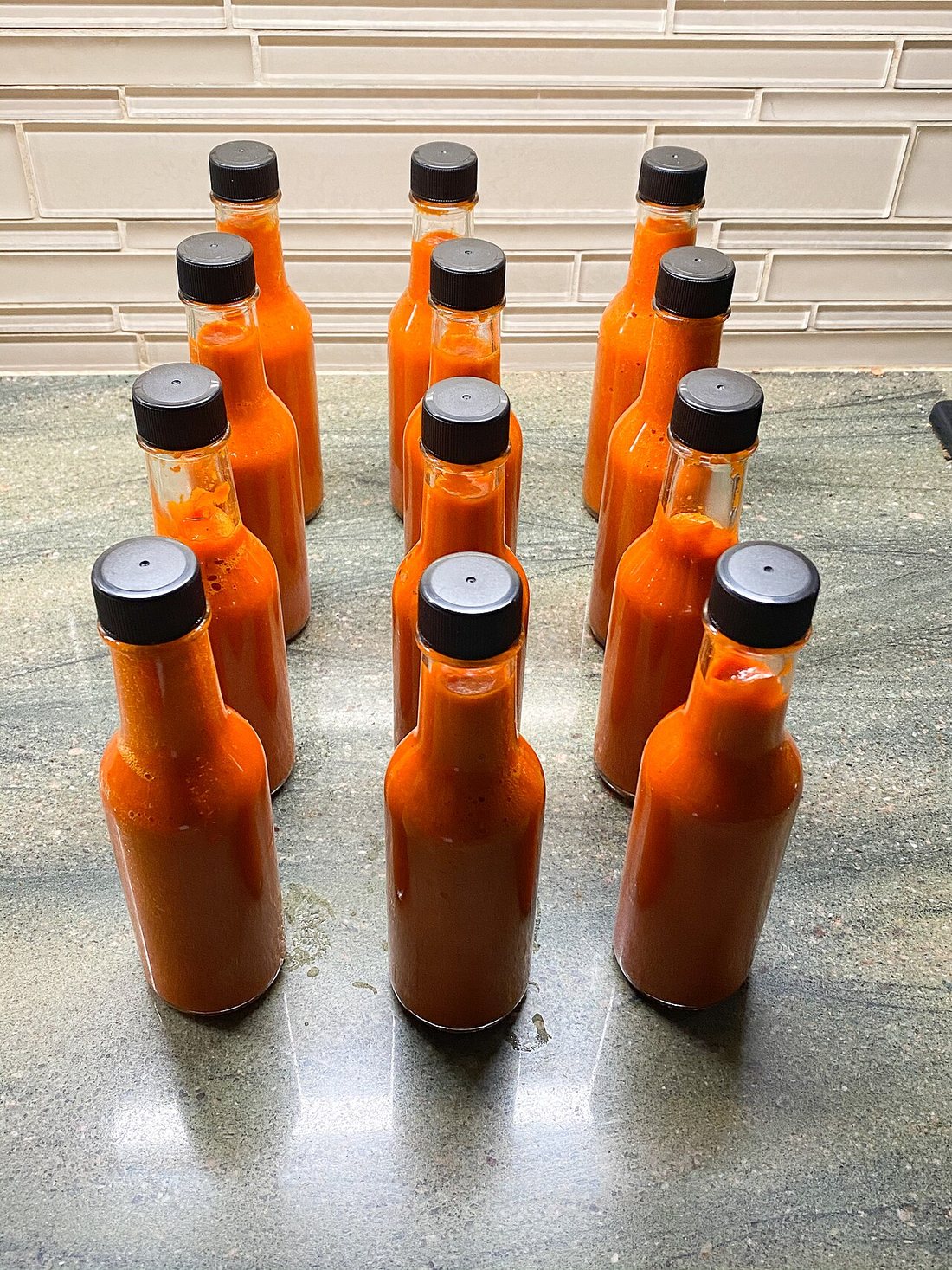
A fermented sauce grows its acid and lands wherever the bacteria take it. A vinegar sauce has its acid poured in, in a measured amount, so it arrives where the recipe says it will. That difference is why nearly every hot sauce on a store shelf ends in vinegar, including the ones that spent years fermenting first, and why both of the hot sauces that the National Center for Home Food Preservation has tested for home canning are vinegar sauces cooked with tomatoes.
The kitchen these pages are written for has made vinegar and cooked hot sauces.
Three families sit under this heading: pepper vinegar, where whole peppers steep in vinegar and the vinegar is the sauce; quick blended sauces, where chiles, salt and vinegar are puréed and briefly heated; and cooked sauces, simmered long enough to soften and thicken. Only two recipes in the last group are tested for the shelf.
What “Louisiana style” means
The term is used loosely. Tim Chin’s Serious Eats guide defines it by brand — Tabasco, Crystal, Frank’s RedHot, Texas Pete and Louisiana Hot Sauce — and by texture: smooth, “thin and watery to slightly viscous.” The usual ingredient pattern is red chiles (tabasco or cayenne), vinegar and salt, sometimes with xanthan gum; that description rests on Wikipedia and is best read as a sketch. Baumer Foods’ own history dates Crystal to 1923, “when the first cayenne peppers were ground, aged and bottled.”
Chin draws the useful line: the Mexican table sauces — Cholula, Valentina, Tapatío and Búfalo — do not ferment the peppers at all. Valentina’s yellow label, as listed in Spanish Wikipedia, reads water, dried puya chiles, acetic acid, iodized salt, spices and 0.1% sodium benzoate. That last item matters more than it looks, for reasons covered under the commercial rules below. The brands themselves are on the American shelf.
Pepper vinegar
Virginia Willis: “Almost every diner and ‘meat and three’ establishment across the South has a jar of hot pepper vinegar on each and every table. A dash or so … on greens is a revelation.” Octavio Peña, writing for Serious Eats in 2026, names the cousins: Thai prik nam som, and Filipino sugarcane vinegar with chiles. No documented origin or date for the Southern jar could be found.
Willis’s recipe is as plain as the condiment: 6 to 8 hot chiles (jalapeño, cayenne or banana), each slit two or three times, packed tightly into sterilized jars, and covered with 4 cups (about 950 ml) of apple cider vinegar heated to a simmer. The jar is sealed and refrigerated three weeks before opening, and keeps up to a year refrigerated. Her headnote: “The longer the mixture sits, the more potent it becomes.” The slits do the same job as the 2 to 4 slits NCHFP specifies for whole peppers in its tested pickles: they let the liquid into the fruit.
The custom of topping the bottle back up with fresh vinegar as it empties is widespread, but it is not part of Willis’s recipe and should not be credited to her.
Quick blended sauces
These are refrigerator sauces. None has been tested for room-temperature storage, and the sources give storage times that vary widely.
| Sauce | Core of the recipe | Heat | Storage the source gives |
|---|---|---|---|
| Jalapeño-Serrano (Joshua Bousel, Serious Eats) | 15 jalapeños, 5 serranos, 3 garlic cloves, 2 Tbsp kosher salt, 2 cups distilled vinegar | Boiled 1 min, then 3 days in a cool dark place, strained | Refrigerated up to 6 months |
| Master Hot Sauce (Bon Appétit) | 1 lb (450 g) chiles, 2 Tbsp kosher salt, 1½ cups distilled vinegar | None; 12 h with salt, then 1–7 days in vinegar, lid loose | Refrigerated up to 4 months |
| Jamaican Hot Sauce (Ian Knauer, Food & Wine) | 12 oz (340 g) Scotch bonnets, scallion whites, 2¼ cups vinegar, brown sugar, allspice | Simmered 1 min | ”Keeps in jars, chilled”; no limit given |
| Pepper Sauce (Lesley Enston, NYT) | 15 Scotch bonnets, garlic, culantro, ½ cup cider vinegar, lime, mustard | None | ”To infinity” — not a usable figure |
| Papaya-Habanero (Joshua Bousel, Serious Eats) | Papaya, habanero, shallot, vinegar, lime, spices | Simmered 10 min | Refrigerated up to a week |
Two of these deserve a caution. The Enston sauce is raw garlic, herbs and scotch bonnets with no measured acidity; refrigerate it and give it a limit rather than taking the “to infinity” at its word. And the Bon Appétit sauce’s 12-hour rest “to ferment slightly” is nominal — a sauce of chile, salt and vinegar on the Louisiana pattern, not a ferment in any meaningful sense.
NCHFP’s two tested hot sauces
NCHFP does have tested hot sauces — two of them. Both are tomato-based, both are acidified with 5% vinegar, and both are processed in a boiling-water canner. They are the only home hot sauces that can be put on a shelf on the authority of a tested process.
Cayenne Pepper Sauce (UGA, September 2003). Despite the name, it is filed among tomato products.
- 3 lb (1.4 kg) hot peppers (“for example, Anaheim, Hungarian, Jalapeños”), ⅓ cup minced garlic, 4 cups sliced onion, ⅓ cup chopped cilantro, three 28-oz cans diced tomatoes, 3 cups cider vinegar (5%), 2½ cups water. About 5 pints.
- Boil all ingredients 1 hour, simmer another hour, cool slightly, purée about 2 minutes per blender batch, and return just to a boil — “The mixture will start to spatter as it gets close to boiling.” Fill hot with ½-inch headspace.
- NCHFP’s note: “This is a very hot sauce.”
Easy Hot Sauce (UGA, March 2003, revised February 2009).
- 8 cups (64 oz) canned diced tomatoes, undrained; 1½ cups seeded, chopped serranos; 4 cups distilled white vinegar (5%); 2 tsp canning salt; 2 Tbsp whole mixed pickling spices in a bag. 7 to 8 half-pints.
- Boil, simmer 20 minutes, press through a food mill, return the liquid and boil 15 minutes more. Fill hot with ¼-inch headspace.
| Elevation | 0–1,000 ft | 1,001–6,000 ft | Above 6,000 ft |
|---|---|---|---|
| Cayenne Pepper Sauce, pints, hot pack | 10 min | 15 min | 20 min |
| Easy Hot Sauce, half-pints, hot pack | 10 min | 15 min | 20 min |
| Chile Salsa (Hot Tomato-Pepper Sauce), pints | 15 min | 20 min | 25 min |
The USDA Chile Salsa is the third relative: 5 lb tomatoes, 2 lb chiles, 1 lb onions, 1 cup 5% vinegar, 3 tsp salt, ½ tsp pepper, simmered 10 minutes.
The rules that come with these are short and not negotiable. NCHFP: “Do not alter vinegar, food, or water proportions in a recipe or use a vinegar with unknown acidity.” From the NCHFP salsa notes: “Do not increase the total amount of peppers in any recipe. However, you may substitute one type of pepper for another,” and “you may safely substitute an equal amount of lemon juice for vinegar … Do not substitute vinegar for lemon juice.” A sauce that departs from a tested recipe “may be frozen or stored in the refrigerator” — it may not be canned.
The same logic runs through NCHFP’s sweet pepper products. Golden Pepper Jelly (UGA, May 2018) says it outright: “The addition of vinegar to the low-acid sweet and hot peppers makes this recipe safe for boiling water canning. Do not reduce the amount of vinegar.” Hot Pepper Relish allows any mix of sweet and hot peppers “provided that the total amount of measured ground pepper is not altered … there should be no more than 10 cups of ground peppers.”
Heat on top of acid: the commercial frame
A commercial sauce is held to a different rule, and it is stricter than acid alone. Under 21 CFR 114.80(a)(1), “Acidified foods shall be thermally processed to an extent that is sufficient to destroy the vegetative cells of microorganisms of public health significance.” The same paragraph allows “permitted preservatives … (in lieu of thermal processing).” That is the reason for the sodium benzoate on a Valentina label: it is one of the two routes the regulation offers. The regulation lists acidification methods including direct batch acidification, which is the hot sauce case — acid added to the whole batch before it is filled.
Industry practice is the heat route. Cornell co-authors note that “Shelf-stable acidified sauces are commonly hot-filled to ensure commercial sterility.” Their own work tested the alternative, cold-fill-hold, and found it worked when sauces were brought to pH 3.2 with acetic acid: “Greater than 5-log reductions of pathogenic bacteria were achieved 0.5 h after inoculation.” With citric acid at the same pH, “at least 48 h was required” (Lobo et al., J Food Prot 2019). Vinegar is not just an acid; it is the faster-killing one.
One regulatory nuance stays a nuance. The definition of an acidified food in 21 CFR 114.3 excludes condiment sauces whose final pH does not differ much from that of their predominant acid ingredient, so a sauce that is mostly vinegar may count legally as an acid food rather than an acidified one. That affects how a manufacturer files; it changes nothing about safety at home.
No NCHFP process bottles a hot sauce by hot-filling alone. Both tested sauces go into canning jars and through a boiling-water canner. A home “hot-fill” into a shaker bottle borrows the commercial vocabulary without the commercial controls, and belongs in the refrigerator. The full reasoning is on Safety.
Bottling
Bottling is mostly a matter of texture. Bon Appétit purées its sauce about a minute and strains it through a fine sieve into the bottle, with the instruction to shake before use; Bousel presses the solids to get the most through. Tim Chin suggests xanthan gum at as little as 0.2% by weight to stop a strained sauce from separating, and notes that Cholula uses it. The original Tabasco bottles, by the company’s account, were “small cologne-type bottles with sprinkler fitments,” corked and sealed in green wax.
Recipes in the collection
- Cayenne Pepper Sauce (NCHFP, Canned) — tested.
- Golden Pepper Jelly (NCHFP, Canned) — tested.
- Southern Pepper Vinegar (Virginia Willis) — refrigerated.
- Master Hot Sauce (Bon Appétit) — refrigerated.
- Caribbean Scotch Bonnet Pepper Sauce — refrigerated.
- Canned Hot Sauce
- Classic Buffalo Wing Sauce
- Pineapple-Mango-Hot Pepper Jam
Comments (0)