Thermometers & Scales
Everything else on my bench is about turning meat into sausage — grinding it, mixing it, stuffing it, hanging it. This page is about the two tools that tell you the truth. A thermometer and a scale don’t shape the sausage; they judge it, and their judgment is the whole safety case. I’ve made sausage for forty years, and the single hardest thing to get another maker to accept is this: at the two points where sausage is dangerous — the finish temperature of a cooked link and the cure weight in a raw one — you do not get to guess. Not “you shouldn’t.” You don’t get to. The tools that remove the guess are cheap, and the failures they prevent range from a ruined batch to a hospital.
So this is the measurement page. It’s less romantic than the grinder and less satisfying than a rack of finished links, but it’s the page I’d hand a beginner first, because every recipe in my collection quietly assumes you own these two things and know how to trust them.
The internal temperature is the whole game
For any sausage you cook or smoke, doneness is defined by exactly one number: the internal temperature at the coolest point in the coolest link. Not the time on the smoker. Not the color of the bark. Not how it feels when you press it. Those are all things that correlate with done, on a good day, and betray you on a bad one.
The safe finished target for a comminuted pork or beef sausage is 160°F (71°C); a poultry sausage goes higher, to 165°F (74°C). That’s a USDA number, and it isn’t a suggestion I’ve decided to respect — it’s the temperature at which the pathogens you care about are reduced to a safe level in the time it takes to get there. Miss it low and you’ve served an undercooked ground-meat product, which is precisely the risk profile you were trying to avoid. And here’s the part people forget in the other direction: overshoot it and you break the fat. The emulsion you worked to keep cold and tight on the bench renders out, and you get a dry, shrunken, greasy link. The window between safe and ruined is real, and the only way to live inside it is to read the number. A thermometer isn’t a safety accessory bolted onto the cook — it is the definition of done.
Three kinds of thermometer
There are really three tools here, and I own and use all three depending on the job.
| Type | What it is | Where it earns its place |
|---|---|---|
| Instant-read | A fast probe on a handle; jab, read in a couple of seconds, pull it out | The single best first tool. Spot-check any link, any time. A good one reads in 2–3 seconds and is accurate to a degree. |
| Leave-in probe | A wired probe that stays buried in the meat, cable running out to a readout | The old smoker standard — you watch the climb without opening the door, but you’re tethered by a cable that runs through the seal |
| Wireless / smart | A sealed probe with no cable at all; it radios both internal and ambient temperature to your phone | What I actually run. Meater and ThermoWorks are the named leaders, and both give you two readings from one probe: the meat’s core and the air around it |
For a beginner, buy the instant-read first and don’t apologize for it — a fast, accurate instant-read will carry you through years of cooked sausage. But for smoking, where the cook runs for hours and every door-open costs you heat and time, the wireless probe is the upgrade that changed how I work.
A word on accuracy versus resolution, because they get confused. A thermometer that displays tenths of a degree is showing you resolution — how finely it can print a number. What you actually need is accuracy — how close that number is to the real temperature. A cheap probe can print “159.4°F” with false precision while sitting two or three degrees off the truth, which at the 160°F line is the whole ballgame. So buy on stated accuracy (a good instant-read is rated to within a degree), and check any probe you doubt against a reference: an ice-water slurry should read 32°F and hard-boiling water at sea level 212°F. If a probe misses those known points, it will miss the finish temperature too, and you’ll never know which side of safe you landed on. A thermometer, like a scale, is only worth what its calibration is worth.
My rig — a Meater and four wireless probes
Whatever I’m smoking, I watch it with a Meater and its four wireless probes. Each probe reads both the internal meat temperature and the ambient temperature of the air around it, and — this is the point — there are no wires running out of the smoker. Nothing crosses the door seal. I set the links, close the door, and watch all four on my phone.
Four channels matters more for sausage than for a single roast, and here’s why. Sausages are not uniform. The links on the top rack run hotter than the ones near the door; a fat link finishes later than a thin one; the piece nearest the firebox is a different cook from the piece in the far corner. If I probe one link and pull the whole batch when it hits 160°F, I’ve guaranteed nothing about the other forty. So I probe the links I suspect are the laggards — the thickest, the coolest-positioned — and I pull the batch when the slowest one crosses the line. The coolest link governs the batch. Four probes let me watch four candidates for “coolest” at once and stop trusting luck.
And because each probe also reads ambient, I’m watching my pit temperature at the meat’s height at the same time — which is a truer number than the dome thermometer three inches away from where the sausage actually hangs. When I stage a smoke the way I do my grandfather’s kielbasa — a slow climb through 130, 150, 170, 190°F — the ambient read is how I know the chamber is where I set it while the internal read tells me where the meat is. Two numbers, one probe, no open door. The full bench context is on my bench page, and the smoke staging itself lives with the smokers.
Why a 0.01-gram scale stops being optional the moment cure is involved
Now the scale, and this is the section I most want to land, because it’s the one where “eyeballing it” isn’t sloppy — it’s dangerous.
Every raw cured sausage uses a curing salt — Cure #1 (sodium nitrite) for short cures, Cure #2 (nitrite plus a nitrate reservoir) for long dry-cured work. The cure is what suppresses botulism in a low-oxygen environment, and it is dosed at a specific, non-negotiable rate: 0.25% of the meat weight, which is 2.5 grams per kilogram of meat. That rate is chosen to land the ingoing sodium nitrite right inside the legal and safe ceiling. Dose too little and you’ve kicked out your antibotulinal barrier. Dose too much and you’re eating an excess of a compound that is genuinely toxic in quantity. This is a safety-critical, mildly-toxic-in-excess additive that you are measuring in single grams. That sentence is the whole reason the scale matters.
Watch what happens when you try to weigh it on an ordinary kitchen scale.
The math
Take a modest 5-pound batch — a normal home run.
- 5 lb = 2.27 kg of meat.
- Cure at 2.5 g/kg → 2.27 × 2.5 = ≈ 5.7 grams of cure for the whole batch.
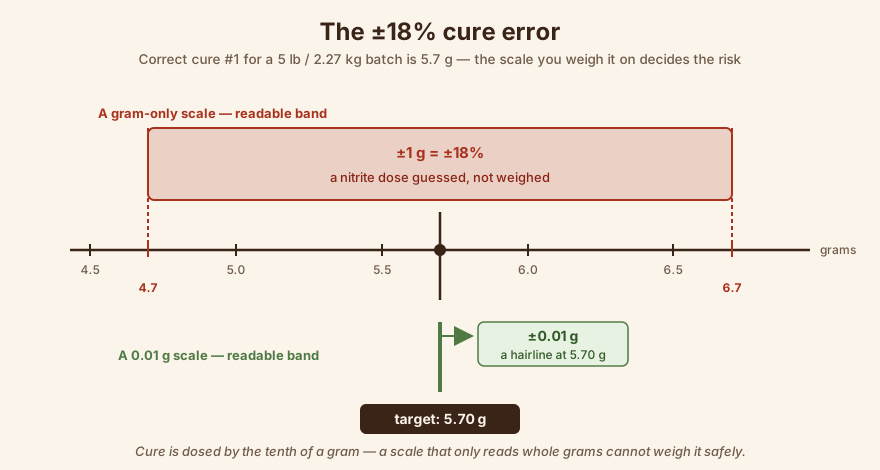
Now weigh that 5.7 g on a gram-only kitchen scale. Two problems stack up. First, it can only resolve to the nearest whole gram — it literally cannot display 5.7, only 5 or 6. Second, a cheap one carries a real-world tolerance of about ±1 gram on top of that. So on a 5.7 g target:
| Scale | What it can tell you | Error on a 5.7 g dose |
|---|---|---|
| Gram-only kitchen scale (±1 g real tolerance) | “5 grams” or “6 grams” — and it might be off by a gram either way | ±1 g on 5.7 g ≈ ±18% |
| 0.01 g jeweler’s / reloading scale | ”5.70 grams” | a fraction of one percent |
±18% error, on a nitrite ingredient, dosed for safety. That’s a swing from roughly 4.7 g to 6.7 g of cure — the difference between underdosed and overdosed, invisible, on a scale that told you a confident round number. And that’s the good case: even if the scale rounded perfectly to the nearest gram with zero tolerance error, “6 grams” is already about 5% high on a 5.7 g target, with no headroom left for the machine’s own drift.
A 0.01-gram scale reads 5.70 g and puts the whole error down into the fractions-of-a-percent range where it belongs. That is the entire argument. The scale doesn’t make the sausage taste better; it makes the safety math true instead of hopeful. The same cure arithmetic runs underneath every dry-cured recipe I have — it’s worked in full on reading a recipe and again on the Landjäger craft page, and both of those calculations are only honest if the scale under them can actually resolve the number they produce.
It isn’t only the cure
The fine scale earns its keep past the cure, too. A starter culture for fermented sausage is dosed at fractions of a gram per kilo — a quantity a 1-gram scale can’t weigh at all, only pretend to. Dextrose feeds that culture in single-digit grams. Potent spices — a cure accelerator, a concentrated seasoning — live at the same small weights. Once you’re making anything past a fresh breakfast link, the recipe is full of ingredients whose correct dose is smaller than a gram-only scale can see. The 0.01 g resolution you bought for the cure turns out to be the resolution the whole craft runs on.
Which is why my bench actually carries two scales, and I recommend the same to anyone serious. A larger-capacity gram scale — a few kilos of range — weighs the meat block, the fat, the salt at percentage rates: the bulk numbers where a hundredth of a gram is meaningless and the capacity is what matters. Then the 0.01 g scale handles the small, dangerous weights: the cure, the culture, the dextrose, the potent spice. Trying to weigh a 2-kilo meat block on a jeweler’s scale that tops out at 200 grams is as useless as trying to weigh 5.7 grams of cure on a scale built for the meat block. They’re different jobs, and one instrument can’t do both well. The bulk scale keeps your ratios honest; the fine scale keeps your cure safe.
Calibration — a scale you don’t trust is worse than none
Here’s the trap that undoes everything above: a fine scale that has quietly drifted a few percent out of true will read 5.70 g with total confidence while actually weighing something else. It reintroduces the exact dosing error you bought it to eliminate — except now it’s hidden behind a precise-looking display, which is worse than an honest gram-only scale, because you’ve stopped watching for it.
So you check it. A milligram or centigram scale should be verified against a known calibration weight — a certified 50 g or 100 g check weight, a few dollars for a set — before every curing session, not once when it comes out of the box. Set the weight on, confirm the reading, and only then trust the number. The rule is blunt: a scale you haven’t checked is not a measurement, it’s a decoration. The check takes ten seconds and it’s the difference between “the scale says 5.70” and “the scale is right that it’s 5.70.”
Buy the check weight in the range you actually work in, and buy it certified. A weight that claims 100 g but is really 100.8 g calibrates your scale to be wrong by the same amount — the error moves from the scale into the reference and you’ve gained nothing. This is also why the coin-in-a-pocket trick people suggest (“a nickel is 5 grams”) is worthless for our purposes: a circulated coin’s mass has drifted with wear, and you’d be trusting a nitrite dose to the wear pattern on your pocket change. Spend the few dollars on a real weight set, keep it in its case away from grease and fingerprints (skin oils add mass over time), and handle it with the tweezers it comes with. It is the cheapest insurance in the whole craft.
A pH meter for fermented sausage — and why strips won’t do
Fermented sausage adds a third measurement, and it’s the one most home makers skip and shouldn’t. In a fermented dry-cured sausage the primary safety barrier isn’t the cook — there is no cook — it’s acid. The starter culture has to drive the pH down to ≤ 5.3 within the fermentation window, fast enough to shut down pathogen growth before it can get established. Miss that drop, or hit it too slowly, and the sausage isn’t safe, no matter how good the chamber that dries it afterward.
That number — 5.3 — is a hard line, and it’s the reason pH paper strips are not good enough. The whole decision hinges on tenths: is this batch at 5.1 or at 5.3? Cheap pH paper simply cannot resolve that. You’re matching a smear of meat juice against a printed color chart, in tenths, and the meat’s own color and oils bias the read on top of it. You will not reliably tell 5.1 from 5.3 that way — and that specific gap is the safety margin. A strip that reads “about 5-ish, looks fine” gives you false confidence at exactly the resolution where the answer lives.
A digital pH meter, ideally one with a spear-tip probe made to pierce meat, gives you the tenths you actually need. The method is simple: mince a representative sample, slurry it with about twice its weight of distilled water, let the probe stabilize, read it, then clean the protein and oil off the tip before it goes away. It’s one more instrument to own and calibrate, but for fermented product it’s not optional — it’s the tool that confirms the barrier the chamber is counting on before it ever starts drying.
Weigh, don’t measure by volume
One last principle that ties all of this together, and it’s the simplest and the most violated: salt and cure are weighed, always. Never measured by volume.
A teaspoon is a lie for salt. Kosher salt and table salt occupy wildly different volumes for the same mass — a tablespoon of Diamond Crystal kosher and a tablespoon of table salt aren’t remotely the same amount of salt, because grain size and how it packs into the spoon change the mass per spoon by large margins. For seasoning salt, that volume lie means an inconsistent, sometimes over-salted batch. For cure, where the “salt” is carrying nitrite dosed to a legal ceiling, the same volume lie is a safety failure — you cannot measure a nitrite dose in teaspoons and have any idea what you actually put in.
The scale is the honest tool. It doesn’t care what brand of salt you bought, what grain it is, or how it packed into the spoon — it reports the mass, which is the thing that actually matters to both flavor and safety. Every recipe I write gives salt and cure by weight for exactly this reason, and the scale is what makes those numbers mean the same thing on your bench that they meant on mine.
That’s the case, then. The thermometer defines done for anything you cook, and the coolest link governs the batch. The 0.01-gram scale is what makes the cure math safe instead of a hope, calibrated before every session so its confidence is earned. The pH meter confirms the acid barrier that dried sausage lives or dies on. And weight, not volume, is the language all three speak. None of it shapes the sausage — but all of it tells you the truth, and in this craft the truth is the safety.
Part of Sausage Equipment. Next: casings and the tools for them — the skins, the horn, the pricker, and the twist. Back to the sausage program.
Comments (0)