Smokers
I have a whole separate write-up of my five smokers — the two PID-modified SmokinTex electrics, the offset, the stainless grill with a pellet tube, and the cold smoker I built myself — and I’m not going to repeat all of that here. This page is narrower and more useful: what a smoker actually does for a sausage, specifically. Because smoking a sausage is not the same job as smoking a brisket, and the differences are exactly where people get it wrong.
A brisket goes in the smoker to be cooked and flavored, low and slow, and you pull it when the bark and the probe say so. A sausage is fussier. Depending on which sausage you’re making, the smoker is doing one of two completely different jobs — and confusing them is a safety problem, not just a texture one.
Two jobs, and you have to know which one you’re doing
Hot smoke — to flavor and cook. Most of the smoked sausage I make is a cooked product: a fresh or cured farce that I smoke while stepping the temperature up until the links reach a safe internal temperature. Here the smoker is a flavored oven. My grandfather’s kielbasa is the pattern — it goes in low and climbs, hour by hour, until the inside hits a verified safe temperature, and then I finish it (often in a hot-water bath). The smoke is doing the flavor; the heat is doing the safety. This is the path for the cooked semi-dry method and for nearly every smoked link most Americans have eaten.
Cold smoke — to flavor without cooking. The other job is smoke below about 68°F (20°C) — cool enough that it never cooks the meat at all. This is the smoke on a traditional raw dry-cured sausage: a Landjäger, a salami. The cold smoke adds flavor and a little surface antimicrobial protection, but it does nothing to make the sausage safe. On a raw dry-cured stick, safety comes from the other hurdles — the cure, the fermentation’s pH drop, and above all the drying to a low water activity (and ⚠ even that stack has a documented gap where Salmonella is concerned) — and the smoke is just flavor riding on top of a sausage that was already made safe by the cure, the ferment, and the chamber.
Here’s where I get careful, because this is the dangerous confusion. Cold smoking a raw sausage is only safe when the whole hurdle stack is done correctly. I’ll tell you straight what I tell everyone: I’m wary of cold-smoking meat at home casually. I cold-smoke cheese and lox all the time, but a cold-smoked raw meat product is only as safe as its cure, its ferment, and its dry — and if any of those is off, the cold smoke won’t save you, because there’s no cook step anywhere. So cold smoke belongs to the dry-cured craft, executed fully, or it doesn’t belong on your meat at all. When in doubt, hot-smoke to a verified temperature. The full safety argument lives on the Landjäger craft page and, when it ships, the food-safety chapter of the curing section.
The drying stage — the step almost everyone skips
Whichever job you’re doing, there’s a first step that makes or breaks the result, and it took me years to learn it: you dry the surface of the sausage before you really smoke it.
Here’s the logic, straight out of how I run a cook. When you first put sausage in the smoker, start low — for a hog product I start around 120°F, roughly twenty degrees above the animal’s living temperature, which keeps the proteins from seizing and the fat from breaking. And for that first hour or so, I open the top and bottom dampers and let air move through the chamber to dry the outside of the sausage. If you’re going to use a water pan, do not add it during this first hour — you want the surface to dry, not stay wet.
Why? Smoke will not stick to a wet casing. Smoke adheres to a tacky, dry surface (a “pellicle”); on a wet one it beads and runs, and you end up with a streaky, blotchy link and poor smoke flavor. Skip the drying stage and you get exactly that — a sausage that looks and tastes like it fought the smoke. Do the drying stage and the smoke lays down even and deep.
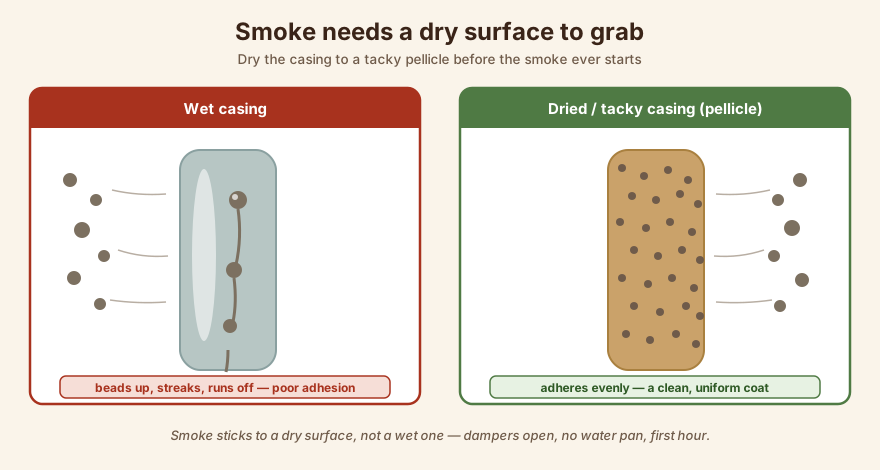
After that first hour, you close things down, add your smoke and (if you want it) your humidity, and step the temperature up on whatever schedule the sausage calls for.
Dampers, airflow, and humidity
A smoker for sausage lives or dies on airflow control. The dampers — an intake low, an exhaust up top — are how you govern both temperature and how much air (and moisture) moves through. Open for the drying stage; throttled once you’re building smoke and holding a temperature. Too little airflow and the smoke goes stale and creosote-bitter; too much and you can’t hold heat or humidity.
Humidity matters more than people think. Meat cooks and takes smoke better in a humid chamber — it’s the same water-holding logic that runs through all of sausage-making. A commercial smokehouse controls relative humidity precisely with a psychrometer reading wet-bulb and dry-bulb temperatures. Most of us at home just add a water pan once the drying stage is done, which is a blunt instrument — better than nothing, but a shot in the dark compared to real control. I don’t have a psychrometer either; it’s on the honest list of gaps in my bench.
The landscape — from a masonry smokehouse to a pellet grill
Every smoker is a variation on a few designs, and any of them can smoke sausage if you can control its temperature and airflow:
| Type | How it works | For sausage |
|---|---|---|
| Masonry / brick smokehouse | The old way — a chamber over a controllable fire, sometimes with the firebox remote | Traditional, big capacity, hard to hold precise low temps |
| Barrel / drum | A steel drum over coals or an offset fire | Cheap, effective, hands-on |
| Cabinet (electric or propane) | An insulated box with a heat source and a wood pan | My backbone — the easiest to hold at a precise temperature, which is what a cooked sausage needs |
| Pellet grill | An auger feeds wood pellets, computer-controlled | Convenient and consistent; watch that it can hold a low enough temp |
| Offset | A firebox off to one side, indirect heat | Great flavor, hands-on fire management |
| Cold smoker | An external generator feeds cool smoke to an unheated chamber | For the raw dry-cured path, cheese, and lox |
For a cooked sausage, the single most valuable trait is the ability to hold a low, steady temperature for hours, because you’re walking the internal temperature up gently to a safe finish without blowing the fat. That’s exactly why the heart of my hot smoking is a pair of insulated electric cabinets I fitted with PID controllers — the full story is on my Smokers & gear page. For the raw dry-cured path, you want a chamber that stays genuinely cool, which is a cold smoker or a cool-day cold-smoke setup, feeding smoke to a sausage that the drying chamber — not the smoke — is keeping safe.
Wood, briefly
Wood choice is more personal than technical, and I get into it on the Smoking dive. For sausage the short version: hickory is the traditional backbone (it’s what I use on the kielbasa), and I’m also partial to cherry, apple, and pecan for a milder, sweeter smoke. Match the wood’s strength to the sausage — a delicate weisswurst wants a light hand where a robust andouille can take a heavy hickory.
The smoker is only half a sausage’s environment, though. The other half — for anything you’re going to dry rather than cook — is the chamber, and that’s the piece almost no recipe tells you about.
Part of Sausage Equipment. For my actual smoker lineup, see Smokers & gear. Next: curing and drying chambers.
Comments (0)