Bowl Choppers & Emulsion
There’s a whole family of sausage a grinder cannot make. A hot dog, a bologna, a slice of mortadella, a plump weisswurst — cut into any of them and you don’t see grains of meat and specks of fat. You see a smooth, uniform, pink paste, tight and springy, with maybe a few deliberate fat cubes or pistachios suspended in it like fruit in a gelatin mold. That texture doesn’t come off a plate. No matter how fine you grind, a grinder gives you particles. These sausages are not ground fine — they’re emulsified, worked into a batter where the fat and water are held inside a film of dissolved meat protein.
I don’t make a lot of emulsified sausage at home, and I’ll be honest about why up front: the machine that does it right is expensive and it’s big. But I want to walk through how it actually works, because the science is genuinely beautiful, it’s the same science that governs the fat smear I fight on the grinder, and there’s a way to fake a small batch on the counter with a machine you probably already own. Get the mechanism in your head and you can make a decent home frankfurter. Miss it and you’ll make grease.
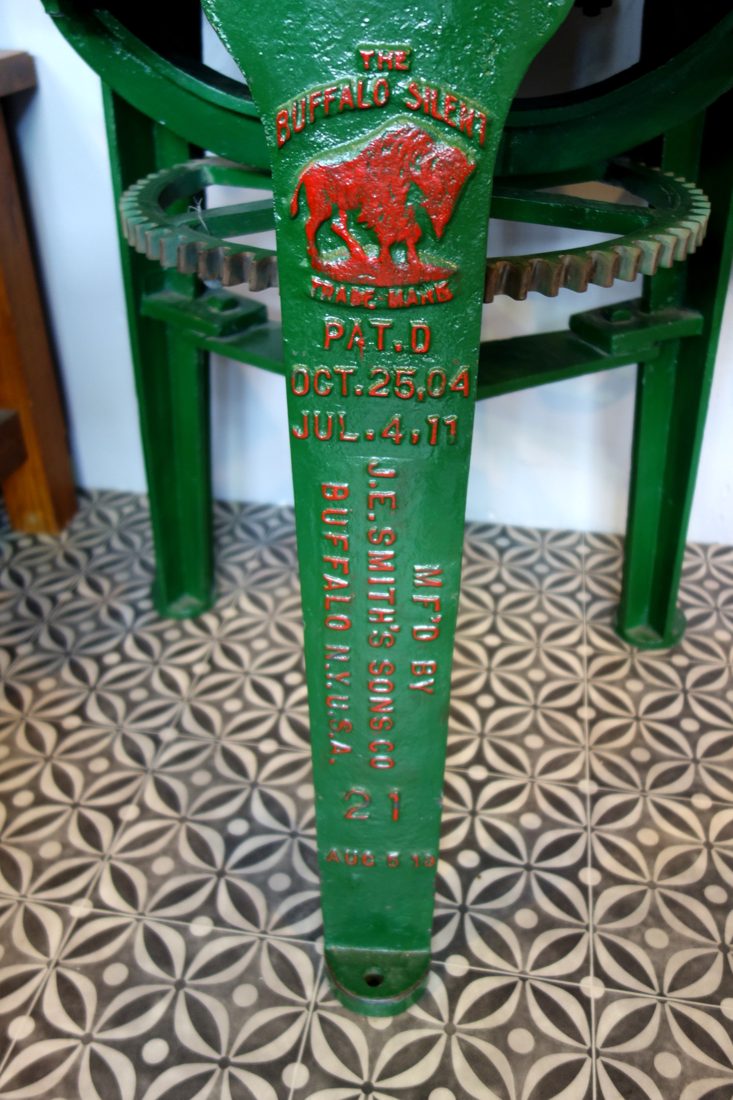
The machine — buffalo chopper, bowl cutter, silent cutter
The tool the trade uses for this is a bowl cutter. You’ll also hear it called a bowl chopper, a silent cutter (the older name), and — usually for the smaller countertop versions — a buffalo chopper. They’re close enough to synonyms that I’ll use them interchangeably; the nuance is that “silent cutter” is the vintage trade term and “buffalo chopper” sometimes gets reserved for a particular countertop style, but they’re all the same idea.
And the idea is elegant. Picture a shallow, horizontal steel bowl shaped like a doughnut, lying flat and turning slowly on its axis. Off to one side, mostly hidden under a hood, sits a shaft carrying a stack of curved knives that spin fast — thousands of RPM against the bowl’s lazy few. You charge the bowl with meat. The slow bowl carries that meat around and drives it through the arc of the spinning knives, over and over. Each pass shaves the particle size down a little further. The bowl might take the whole batch through the knives dozens of times in a couple of minutes, and the meat goes from coarse chunks to a fine, tacky paste that a grinder simply cannot reach.
That combination — a slow bowl feeding a fast knife — is the whole trick. The grinder shears once and extrudes; the bowl cutter shears again and again with no plate in the way to set a floor on fineness. That’s why commercial kitchens and processors own one: it’s the only machine that takes muscle all the way to emulsion, and the good ones will chop, mix, and even fold in ice and seasonings in the same bowl. A big floor model can turn out a couple hundred pounds of frankfurter batter in one run.
There’s a practical reason the professional machine is built the way it is, too, and it points straight at the temperature problem that governs everything downstream. The bowl and the knife assembly are heavy stainless, which means they hold cold — you can chill the machine and it stays chilled through a run — and the hooded design lets an operator watch the batter and pull it the instant it’s done. Better cutters run a thermometer right in the bowl, or the operator jams a probe into the batter between passes, because the one number that matters on this machine is the temperature of the paste, not the time on a clock. A grinder you can walk away from for a second; a bowl cutter you watch, because the knives that give you the fineness are also generating the heat that can destroy the batch. That’s the whole tension of the machine in one sentence: the same speed that builds the emulsion is what threatens to break it.
⭐ What an emulsified sausage actually is
Here’s the part worth slowing down for, because once it clicks, every rule that follows stops being a rule you memorize and becomes something you understand.
A frankfurter, a wiener, a bologna, a mortadella, a weisswurst — these are meat emulsions. An emulsion is a system where one thing that doesn’t want to mix with another is suspended inside it anyway, held apart by something that coats the droplets and keeps them from joining back up. Mayonnaise is the classic: tiny droplets of oil suspended in a little water and lemon juice, held apart by egg yolk. A meat emulsion is the same idea with different players. It’s a protein–fat–water system: tiny droplets of fat suspended in a water phase, each droplet wrapped in a film of dissolved muscle protein that keeps it from coalescing.
The protein doing the wrapping is chiefly myosin — the main contractile protein of lean muscle. On its own, myosin is locked up inside the muscle fibers and does nothing for you. But myosin is salt-soluble, and that one fact is the hinge the whole process turns on. When you chop lean meat with salt (and the cure, and often a phosphate), the salt pulls myosin out of the fibers and into solution. Dissolved myosin is sticky — it’s why a well-salted, well-mixed sausage forcemeat gets tacky and clings to your hand. That tackiness is extracted myosin, and extracted myosin is the emulsifier. It films every fat droplet, so when the sausage cooks and the fat wants to melt and run together, the protein coat holds each droplet in place. The result is that smooth, bound, springy bite instead of a puddle of grease.
If the protein film is thin or weak — not enough myosin extracted, or the film destroyed by heat — the fat coalesces, pools, and separates. The emulsion “breaks.” Everything below is about extracting as much myosin as you can and then not wrecking it.
One thing that confuses people the first time they look closely at a mortadella: the batter is a smooth emulsion, and yet it’s studded with clean white cubes of fat and, in the classic version, whole pistachios. If the whole point is a fine, uniform paste, where do the cubes come from? They’re added deliberately, at the very end, after the emulsion is built — cubes of firm back fat (usually blanched or par-cooked so they hold their shape) folded gently into the finished batter so they don’t get chopped down. So a mortadella is really two textures at once: an emulsified matrix doing all the binding, carrying discrete fat inclusions that were never emulsified at all. The matrix is what holds the sausage together; the cubes are decoration and richness riding inside it. Understanding that split — emulsion for the bind, inclusions added last so they survive — is the difference between a mortadella and a bologna that happens to have fat streaks because its emulsion broke.
⭐ The addition order — and why it is not negotiable
The order you add the ingredients to the bowl is not a matter of convenience or tradition. It’s dictated by the chemistry, and if you get it wrong the emulsion won’t form. Here’s the sequence and the reason behind each step.
1. Lean meat + salt + cure FIRST. You start by chopping the lean meat with the salt and cure — nothing else. This is the myosin-extraction step, and it has to happen before there’s any fat in the bowl. Chopping salted lean builds that tacky, protein-rich matrix — you’re dissolving myosin and creating the emulsifier before there’s anything for it to emulsify. The longer and finer you work the salted lean at this stage, the more myosin comes out and the stronger the film around each fat droplet will be later. Skip it — dump everything in at once — and the fat gets in the way before the protein is ever extracted, so there’s no film to do the holding. You get a coarse, weak, greasy batter that breaks the moment it’s warmed.
2. Then the ice and water. Once the salted lean is tacky and the myosin is out, you add the water phase — as crushed ice, in portions. This is the water the emulsion is suspended in, and (see below) it’s also your temperature brake. Adding it after the protein is extracted lets the dissolved myosin thin into a proper batter without diluting the extraction step.
3. Fat LAST, and briefly. The fat goes in at the end, and you chop it only until it’s dispersed into fine droplets — no longer. Fat holds no water and does nothing for the bind; its only job is to be suspended. Over-chop it and two bad things happen at once: it smears (exactly the grinder failure, same soft-fat mechanism), and all that extra knife time heats the batter toward the break. So the fat comes in last and gets the least work.
The load-bearing rule, if you remember nothing else: lean + salt to build the matrix, then ice, then fat. Some formulas tuck spice blends and phosphate in at particular points, but that three-beat order is the spine. Reverse it and the physics won’t cooperate no matter how good your machine is.
⭐ The temperature ceiling — the “break,” or “fat-out”
This is the number that separates a real hot dog from a greasy, crumbly failure, and it’s the same enemy — warm fat — that I fight at the grinder, just with a hard line drawn under it.
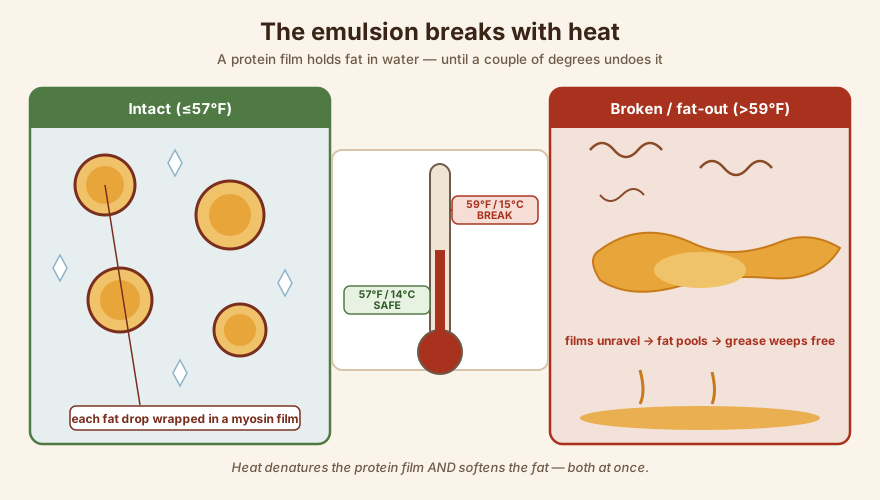
The batter has to stay cold. It’s safe up to about 57°F (14°C). Above roughly 59°F (15°C), the emulsion breaks. The trade calls the break a “fat-out,” and once it’s happened there’s no recovering the batch.
Here’s the mechanism, because knowing it is what makes you respect the number. The whole emulsion depends on that myosin film staying intact around each fat droplet. Warm the batter past the ceiling and two things go wrong simultaneously, and they compound:
- The protein film denatures. Heat unfolds and weakens the myosin coat that’s holding the fat droplets apart. The emulsifier stops emulsifying.
- The fat softens and renders. At the same time, the fat itself — which was a firm, choppable solid while cold — softens toward melting. Soft, rendering fat wants to coalesce and it will smear through any weakness in the film.
So above ~59°F the protein lets go exactly as the fat starts to run. The suspended droplets merge, the fat separates out, and you’ve got a broken batter. You often don’t see the full damage until it hits the smokehouse or the poaching bath: the sausage renders grease, weeps fat into the casing, and cooks up greasy, dry, and crumbly with visible fat pockets where the emulsion pooled and let go. It looks and eats like a mistake, because it is one.
That’s why the trade doesn’t chop to the ceiling — it finishes well below it. A lot of processors aim to bring the batter off the knives somewhere around 54–59°F (12–15°C) and treat anything approaching 64°F (18°C) as already gone. The ceiling is a wall you stay away from, not a target you flirt with.
And now the reason ice does double duty snaps into focus. The ice isn’t just the water phase — it’s the temperature brake. Those fast knives generate real heat; a bowl cutter working hard will warm a batch quickly, and speed is the enemy of the cold you need. So the crushed ice you add for the water phase is simultaneously absorbing that friction heat as it melts, holding the batter down under the ceiling while the knives do their work. That’s why emulsion formulas specify ice, not just “keep it cold” — the ice is both an ingredient and a coolant, and it’s doing both jobs at once. This is also why speed matters: you want to reach the fineness you need before the heat builds, so a fast machine and plenty of ice work together to get you to a bound batter before you hit the wall.
The home substitute — a food processor, and its real limits
You do not need a bowl cutter to make a small batch of emulsified sausage at home. A food processor — the ordinary countertop kind with the S-blade — will fake a coarse emulsion well enough for a batch of frankfurters or a little bologna. The fast blade chops salted lean into a tacky paste and, with ice added, will emulsify it. It won’t match a true silent cutter for fineness or consistency, but it’s genuinely good enough for home links if you respect what it can’t do.
And its limits are real, both of them:
Heat is the first limit, and it’s the one that ruins batches. The processor’s motor and the friction of that blade warm the batter fast — faster than you’d guess — and unlike a commercial cutter, there’s no thermometer built into the bowl telling you where you are. You can blow right past the 59°F / 15°C ceiling and break the emulsion without ever seeing it coming, then wonder why your hot dogs cooked up greasy. So you have to build the cold in and work in a way that never lets it climb:
- Freeze everything first. The bowl, the blade, and the meat itself — get them cold before you start. I put the processor bowl and blade in the freezer and bring the meat down to near-frozen, the same firm, crystals-just-starting state I want at the grinder.
- Add plenty of crushed ice as your water phase, and don’t be shy with it — it’s your only temperature brake.
- Work in short pulses, not a continuous grind. Pulse, check the temperature (an instant-read probe in the batter between pulses is worth the trouble), let it rest if it’s climbing, and stop before it breaks. The moment the batter looks like it’s going slick or greasy instead of tacky, you’re done — pushing further only fats it out.
Batch size is the second limit. A processor only handles a small charge. Overfill the bowl and the meat won’t circulate through the blade evenly — the stuff up top never reaches the cutting edge — and you get an inconsistent batter, part paste and part coarse. Small batches aren’t a suggestion; they’re the price of using the wrong-sized machine. Do a pound or two at a time and run it again rather than choking the bowl.
Follow the same addition order the pros use — salted lean first until it’s tacky, then ice, then fat — keep it cold and pulse-and-check, and a food processor will hand you a respectable home frankfurter or a small bologna. It’s the one place in sausage making where the countertop machine can honestly stand in for the commercial one, as long as you never forget that the commercial one has a temperature readout and yours doesn’t.
Putting it together
So the family of smooth sausages comes down to one machine and one idea. The bowl cutter — buffalo chopper, silent cutter, whatever you call it — is the only tool that takes meat past the particle floor a grinder is stuck at and all the way to a paste. And the paste only becomes a sausage because of the emulsion: salt pulls sticky myosin out of the lean, that myosin films the fat and holds the water, and the whole thing stays bound only as long as you keep it cold. Lean and salt first, then ice, then fat; finish under 57°F and never cross 59°F. Get those two things right and you’ve made a frankfurter. Get either wrong and you’ve made grease.
If you want to actually cook this way, the emulsion and forcemeat chapters of the sausage section go deeper on formulas and bind, and you can pull up the smooth-sausage recipes directly — weisswurst and bologna are the natural first batches. To see where the bowl cutter would sit next to the rest of my gear, there’s my bench, and the grinder page covers the same warm-fat enemy from the coarse end of the craft.
Next: Smokers — because once the batter is stuffed, an emulsified sausage lives or dies in the smokehouse, where the wrong temperature curve will render out the very fat you worked so hard to hold in.
Comments (0)