The Early Machines
I own old iron, and I love it. Some of the tools on my bench are new and motorized, but I keep a hand-crank chopper and a cast-iron cylinder stuffer around because they still work, they still teach, and holding one tells you something no spec sheet will: the machine we call a modern grinder was, in its bones, finished more than a century and a half ago. Everything since has been a better motor bolted to the same idea.
This page is the history of that idea — the hand-crank meat chopper that put a grinder in every 19th-century kitchen, the brands that made them, and the separate lineage of the stuffer. It’s also, in a couple of places, the history of what we don’t know. I’d rather hand you an honest question mark than a confident date that falls apart the moment you check it. There’s a lot of confident nonsense about early grinders on the internet, and untangling it is half the point of this page.
If you want the how it works rather than the where it came from, that’s the grinder page. If you want the pre-machine world of the knife and the block, start with by hand. This is the middle chapter: the machine age arrives.
The hand-crank meat chopper
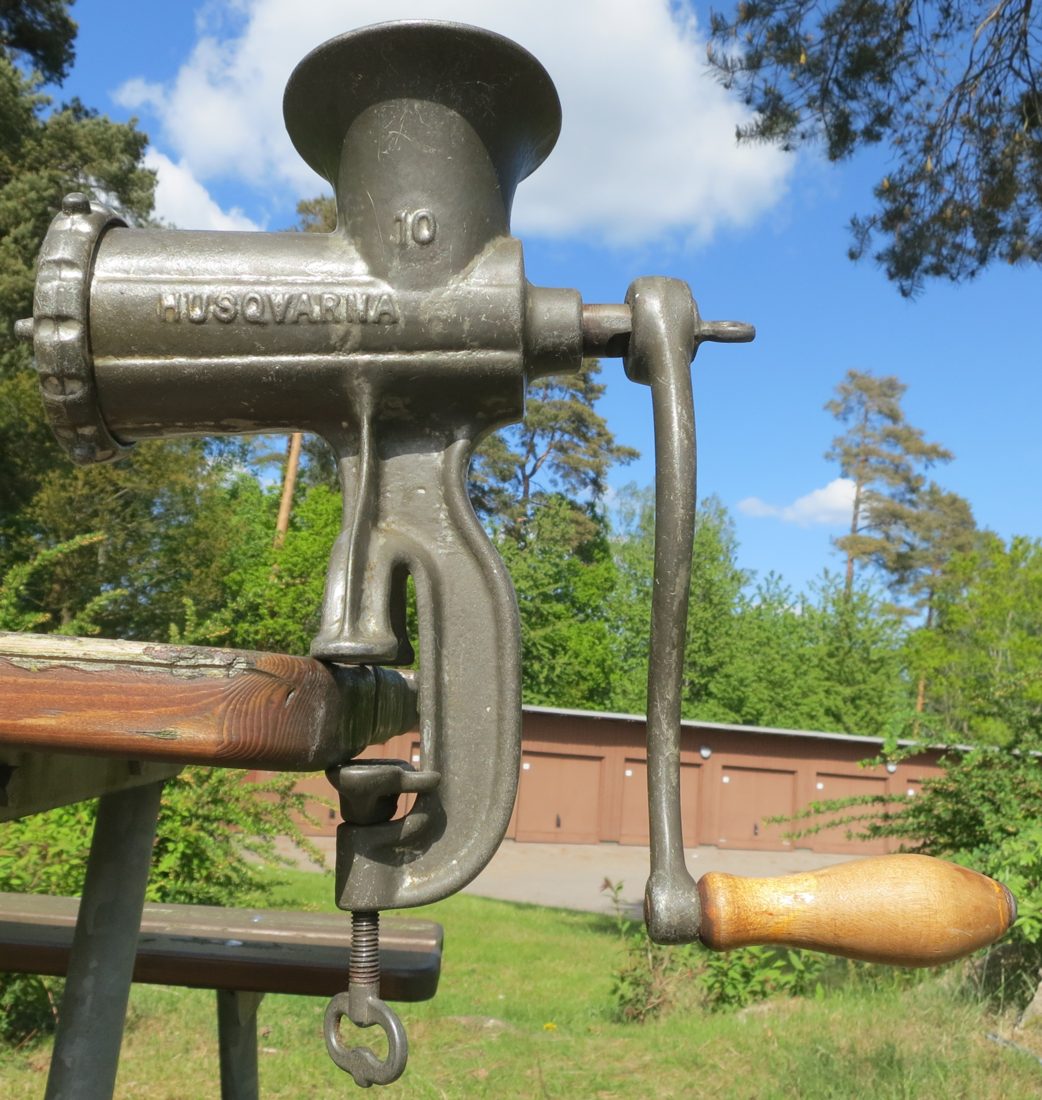
Picture the tool, because you’ve almost certainly seen one at a flea market or in a grandmother’s basement. A body of tinned cast iron, a clamp that grips the edge of a kitchen table and tightens with a wing screw, a hopper at the top to feed meat into, a crank handle on the side, and a stubby tube with a perforated face at the front where the ground meat comes worming out. That’s the household meat chopper, and from roughly the 1860s onward it was everywhere.
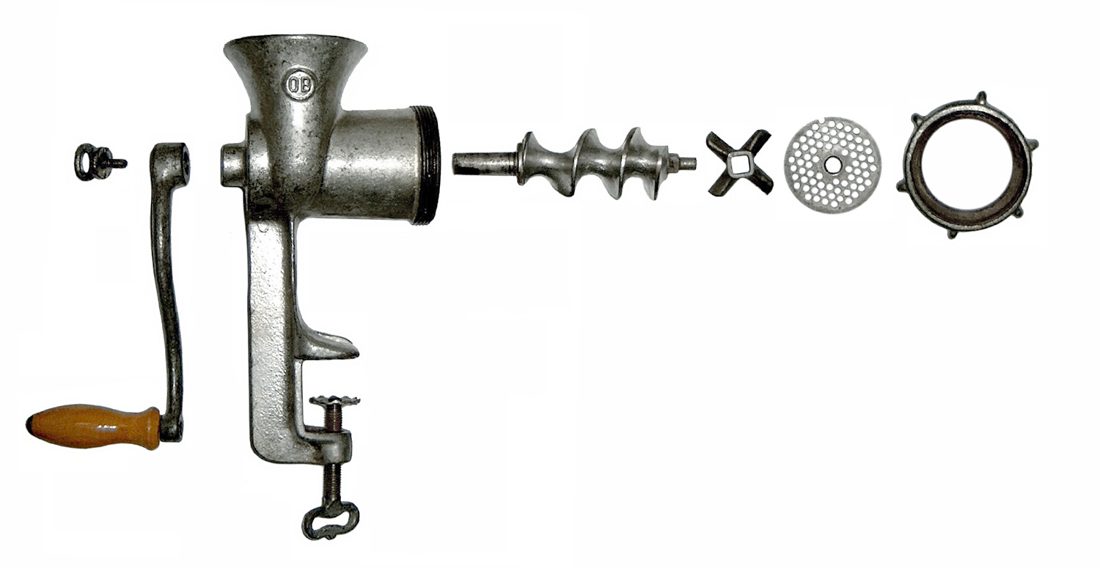
Inside is the whole trick, and it is a beautifully simple trick. Turn the crank and you turn a helical auger — a worm, a screw — running down the center of the barrel. The worm drives the meat forward against a rotating cross-shaped knife, and the knife shears the meat through the holes of a fixed perforated plate (the die) held at the mouth by a ring nut. Change the plate’s hole size and you change the grind, coarse to fine. Auger, knife, plate. Three parts.
Here’s what I want you to sit with: that is exactly the mechanism in the powered grinder on my bench today. My Weston #12 has a bigger motor and better steel, but the working parts are the same three, arranged the same way, doing the same job. The design was reinvented, not improved — we swapped muscle for electricity and left the mechanism alone because there was nothing to fix. When people ask me what changed in the grinder over 150 years, the honest answer is: the power source, the metallurgy, and almost nothing else.
The worm-and-plate isn’t even original to meat. It’s the Archimedes screw — the ancient device for moving water or grain uphill — pointed at a barrel of pork. So the meat grinder was an application of known mechanics, not a lightning-bolt invention. That matters for the next section, because it’s the reason I’m suspicious of any story that hangs the whole thing on one genius.
The invention story — and why I won’t hand you a clean one
You want to know who invented the meat grinder and in what year. So did I. I went looking, and what I found is that the tidy answer everybody repeats does not survive contact with the sources. So instead of a clean story, I’m going to give you the real one, which is messier and, I think, more interesting.
The name you’ll see over and over is Karl Freiherr von Drais (1785–1851), the German polymath famous for the 1817 Laufmaschine — the pedal-less “running machine” that’s the ancestor of the bicycle — and for the railway handcar that still carries his name, the draisine. The popular story credits him with the first meat grinder, somewhere in the early-to-mid 1800s.
The problem is that the record doesn’t actually agree with itself. English Wikipedia states it as fact — both its “Karl Drais” article and its “Meat grinder” article credit him, and put the date in the 1840s. But German-language sources, which are closest to the primary material on Drais, treat it as a disputed attribution, not an established fact. The German article on Drais files the meat-chopping machine among inventions merely ascribed to him — a footnote of the unconfirmed — rather than in the list of things he’s documented to have built (and that documented list is long: a musical-notation machine, an early typewriter, a wood-saving stove, a cooking machine, the Laufmaschine itself). And the German-language article on the Fleischwolf — the meat grinder — doesn’t mention Drais at all. Its earliest concrete anchor is an advertisement from the 1890s.
So the two encyclopedias flatly disagree, and the one that sits closer to the German primary sources is the one that withholds the credit.
The dates are no better. Trawl the appliance-marketing blogs that dominate the search results and you’ll be told the grinder was invented in 1820, or 1827, or the 1830s, or the 1840s, or 1845 — take your pick. They cite nothing, they contradict each other, and they clearly copy from one another. Even the “authoritative” 1840s figure is only as solid as English Wikipedia’s thin sourcing, which is to say not very.
Here is how I’ll put it, and it’s the most honest framing I can give you: Karl Drais is often credited with an early meat grinder, sometime in the 1830s or 1840s, but the attribution is genuinely disputed and the date is undocumented. German sources ascribe it to him without confirming it; the online dates cite nothing and don’t agree. I’m not going to assert an inventor or a year as fact, because the evidence doesn’t support one. The Drais name is real, and his Laufmaschine credit is rock-solid — which is very likely why the grinder got hung on him. A famous inventor is a convenient peg for an anonymous invention.
What is solid is the spread. Whoever built the first one, screw-driven hand-crank grinders were being made by numerous manufacturers across Europe and North America by the 1860s and 1870s, moving the technology out of the butcher’s shop and into the middle-class home. That’s not a single date or a single hero. It’s a wave of makers, all applying the same old screw principle at the same time. Which is exactly what you’d expect for an application of known mechanics, and exactly not what the lone-genius story wants.
The brands that are real and datable
When I can’t pin the inventor, I can at least pin the manufacturers — because factories leave records, catalogs, and advertisements that a folk attribution never does. These are the names you’ll find stamped into the cast iron of surviving machines, with dates I can actually stand behind.
| Maker | Base | Key dates | What they made |
|---|---|---|---|
| Enterprise Mfg. Co. | Philadelphia, PA | Founded 1864; bought by Silex in 1956; line continued as Chop-Rite | The archetypal American “meat chopper” and cylinder stuffers |
| Landers, Frary & Clark (“Universal”) | New Britain, CT | Reorganized under that name 1862; “Universal” Food Chopper introduced 1898 | Household food choppers; the “Universal” mark outlived the company (dissolved 1965) |
| Spong & Co. | London | Founded 1856; mincer market leaders by 1882 (~200,000 units) | Britain’s household mincer |
Enterprise Manufacturing Co. of Philadelphia is the big American name, founded in 1864. They marketed the household unit as the “meat chopper” — American makers favored “chopper,” while the British said “mincer” — and their castings were tinned, a thin tin coating over the cast iron to fight rust and stay food-safe on a tool that sat wet between uses. Their period ads sell the “Tinned Meat Chopper” in so many words, and in the 1890s one retailed for something like $1.75 to $2.25 (I’ve seen the surviving ads, one in The Puritan from early 1897). Enterprise was bought by the Silex company in 1956, and — this is the part I love — the same patterns were continued as Chop-Rite, which is why the successor company can still supply parts that fit a hundred-year-old Enterprise machine. The mechanism didn’t change, so the parts didn’t have to.
Landers, Frary & Clark of New Britain, Connecticut, reorganized under that name in 1862 and introduced their “Universal” Food Chopper in 1898. If you’ve got a hand-crank chopper stamped “Universal” or “L.F.&C.,” that’s them. The company dissolved in 1965, but the “Universal” trademark outlived it.
Across the Atlantic, Spong & Co. of London, founded in 1856, was the British household name — by 1882 they were the mincer market leaders, reportedly having sold around 200,000 units. A Spong mincer clamped to the kitchen table was a Victorian staple.
Two names you’ll also see on antiques — “Climax” and “Little Giant” — I’d treat with more caution. They read to me as model or product names rather than datable makers. Enterprise sold a “Climax” line, and “Little Giant” shows up on all sorts of small period grinders and stuffers, but I couldn’t pin either one to a single manufacturer with a founding year I’d trust. So I’ll name them as period model names and leave it there, rather than dress them up as companies I can’t verify.
The ”#” plate numbers — and the myth I want to kill
Every serious grinder, old or new, carries a size number: #5, #8, #10, #12, #20, #22, #32, #42, #52. My grinder is a #12. And there is a myth about these numbers so common that I have to address it head-on, because if you buy plates believing it you will buy the wrong plates.
The myth: “#12 means 12 millimeters.” It does not. Let me say that as plainly as I can: the # number is not a measurement of the hole size, and #12 does not mean 12 mm holes. A #12 grinder takes plates that come in a whole range of hole sizes — a coarse plate with big holes and a fine plate with tiny holes are both #12 plates, because they both fit the #12 head. The number can’t be the hole size, because one grinder uses many hole sizes.
What the number actually is: a hub, or head, size — effectively the diameter class of the plate, which is what determines whether a plate will fit your machine. Bigger number, bigger machine and bigger plate: a #12 plate is roughly 2¾ inches across, a #22 about 3¼ inches, a #32 close to 3.9 inches. It’s a compatibility code, not a measurement. And here’s the tell that proves it isn’t a clean measurement at all: #10 and #12 share the same plate diameter, as do #20 and #22. If the numbers were millimeters — or any real measurement — that couldn’t happen. They’re a sizing class that grew up around the trade, with a couple of quirks baked in.
And where did the numbering come from? I don’t know, and I’m not going to pretend I do — because it isn’t documented. No authoritative source I could find records who set the #-system or when. The best reading is that it’s an industry sizing convention that hardened around the dominant makers — Enterprise and later Hobart in the U.S., and the German manufacturers who stamped “#12 / #22 / #32” into their plates and knives — rather than a standard handed down by one inventor or one standards body. So: the number is a hub-diameter size class, not millimeters; the “#12 = 12 mm” line is wrong; and the origin of the system is genuinely undocumented. Three true things, and I’d rather give you all three than a satisfying invention no one can back up.
There’s a full plate chart, with the actual hole sizes and what each does, on the grinder page — that’s where the numbers you care about live.
The American debut — 1876, and what it does and doesn’t mean
In the United States, the hand-crank chopper had a clear moment of arrival: the 1876 Philadelphia Centennial Exposition. A museum account (the Mountain Gateway Museum in North Carolina) places the table-clamp meat grinder’s American public debut there, after which it spread as an affordable household tool — and, the museum argues, helped make ground beef, and eventually the hamburger, a mass American food.
I like that story and I’ll tell it, but I want to be precise about what it is. 1876 is a popularization date, not a first-invention date. The grinder wasn’t invented at the Centennial; it was shown off there to a huge American audience, and that’s when it caught on here. Those are different claims, and the distinction matters — especially given everything I just said about how tangled the actual invention story is. And the “the grinder made the hamburger possible” line is a reasonable museum synthesis, plausible on its face (cheap ground beef plus late-19th-century street food), but it’s causal storytelling, not a documented mechanism. I use it as color and I hedge the causation. It’s a nice thought. It isn’t proof.
The stuffer’s own history
Here’s a mistake I see constantly, and it’s worth stopping to fix: grinding and stuffing are two different jobs with two different histories. Grinding reduces meat; stuffing pushes the finished farce into a casing. They are not the same lineage, and conflating them muddles everything.
Yes, most home grinders — including old hand-crank choppers — come with a stuffing horn, a funnel tube you screw on where the plate goes, so the same auger extrudes the farce into a casing. It works, and generations of home cooks have stuffed that way. But it’s a compromise: the worm keeps working the meat and smearing the fat while it pushes. Dedicated stuffers exist precisely because a piston pushes the farce down a tube without re-grinding it. That’s the whole reason the separate machine was worth building. I lay out why that matters for texture on the stuffers page; here I just want to trace where the machine came from.
The stuffer’s arc runs roughly like this:
The horn and funnel (oldest). For centuries, before any machine, farce was pushed into casings by hand through a horn or funnel — literally thumbing the meat down a cow’s horn into a length of gut. Every stuffing tube on every machine today is a descendant of that horn. This is the pre-mechanical baseline, and it never fully went away.
The lever “sausage gun.” Small handheld or bench-mounted lever-actuated piston stuffers — squeeze a lever, a piston drives the farce out a nozzle — earned the nickname “sausage gun,” and it’s a good name for the shape and the action. The form is real and the nickname is real. But who first built one, and when, I could not find — so I’m not going to hand you “the sausage gun was invented by so-and-so in such-a-year.” That’s an unverified claim, and I’ll flag it as one rather than repeat it.
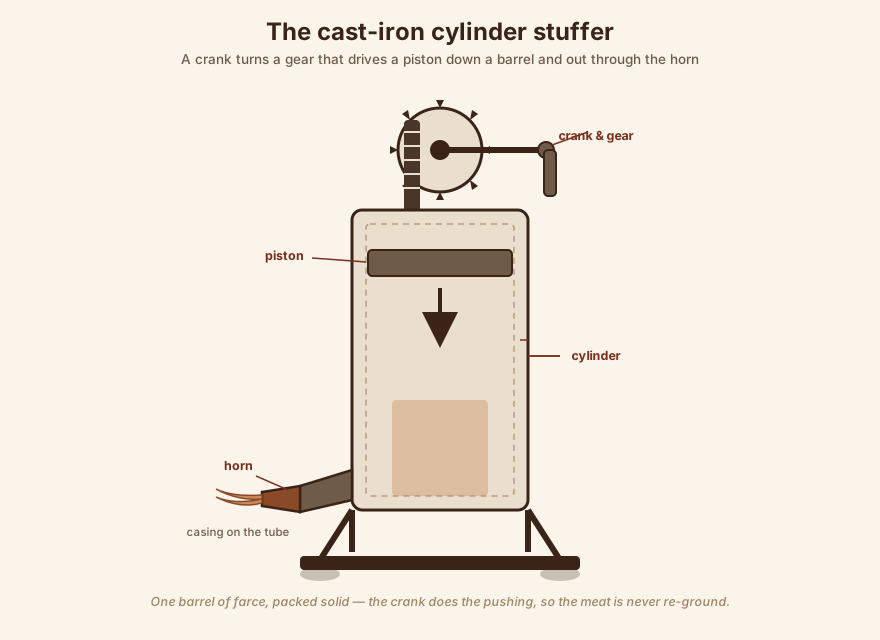
The cast-iron cylinder stuffer (19th century). This is the classic bench machine, and it’s the antique I actually keep: a cast-iron cylinder holds the farce, and a piston is driven down by a crank turning a gear against a toothed rack (some are lever-driven), forcing the farce out through a tube at the bottom. Enterprise made a well-known line — their No. 25 was a 4-quart stuffing press, cast iron, with a steel threaded center pin, a galvanized press plate, and a ¾-inch tube. And just like their choppers, the patterns were later continued by Chop-Rite, so parts largely interchange with the antiques. Pick one of these up and you understand instantly why it’s a different animal from a grinder: there’s no worm in it at all. It only pushes.
The water and hydraulic stuffer (20th century). Later came vertical piston stuffers driven by mains water pressure — a “water stuffer” — or by hydraulic rams, giving steady, gentle, gearless pressure for larger batches. I’ve seen a U.S. patent for a water-powered sausage stuffer dated to the early 1980s, and I’ll pass that along with a caution I’d want anyone to apply to any patent date: a patent date is when someone patented a particular design, not when the idea began. It does not mean water-driven stuffing “started” in the 1980s; it means one specific patent carries that date. Modern commercial stuffers are hydraulic or electric vertical pistons, and dedicated stuffers are still rated the honest way — by canister capacity (the Enterprise No. 25 held its 4 quarts; modern vertical stuffers run 3, 5, 7, 15, 20-plus pounds).
The motor arrives — and changes almost nothing
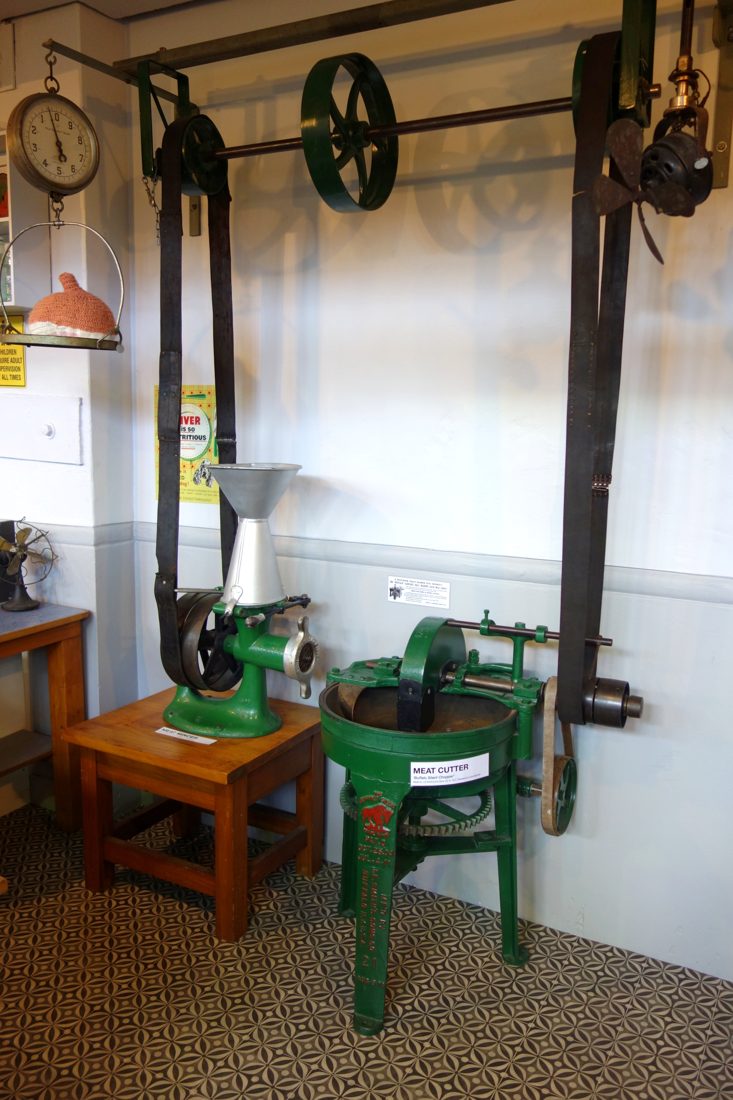
The last chapter is the one people expect to be a revolution and isn’t. As homes and shops electrified in the early-to-mid 20th century, the crank handle came off and a motor went on. Hobart became the archetypal American powered commercial grinder and mixer brand, the name in a lot of butcher shops and restaurant kitchens.
But look at what actually changed. The auger, the knife, and the plate were carried straight over, unchanged. The stuffer’s piston and cylinder were carried over too. The motor replaced the arm, and that’s genuinely most of the story. The mechanism a Victorian cook turned by hand in 1880 is the mechanism a motor turns in a modern shop — and it’s the mechanism turning on my own bench right now. I said it at the top and I’ll close on it, because it’s the truest single thing on this page: the sausage machine was reinvented, not improved. We got better power, better steel, and better tolerances. The idea was already done.
That’s why I keep the old iron around. Not for nostalgia, exactly — for the reminder. When my motorized F. Dick stuffer is humming and I’ve got both hands on the casing, I’m doing, faster, the exact job a cast-iron crank stuffer did a century ago, which was itself the exact job a cow’s horn did centuries before that. The machine age didn’t replace the craft. It just replaced the labor. The knife, the horn, and the screw are all still here.
If you want to see how those three parts behave under your hands today — how the plate size actually changes the grind, why a dull knife smears the fat, and which plate I reach for when — that’s next.
Onward to the grinder — the mechanism up close, and how I actually run it. Or back to the whole sausage collection.
Comments (0)