The Craft
Here is the thing nobody tells you when you first go looking for a Landjäger recipe: there are two different sausages hiding under that one name, they are made in two genuinely different ways, and the internet blurs them together constantly. Get them mixed up and you’ll either make a product that’s disappointing, or — if you mix them up in the wrong direction — one that’s dangerous. So before I touch a grinder, I want to draw the fork in the road clearly, because everything else on this page hangs off it.
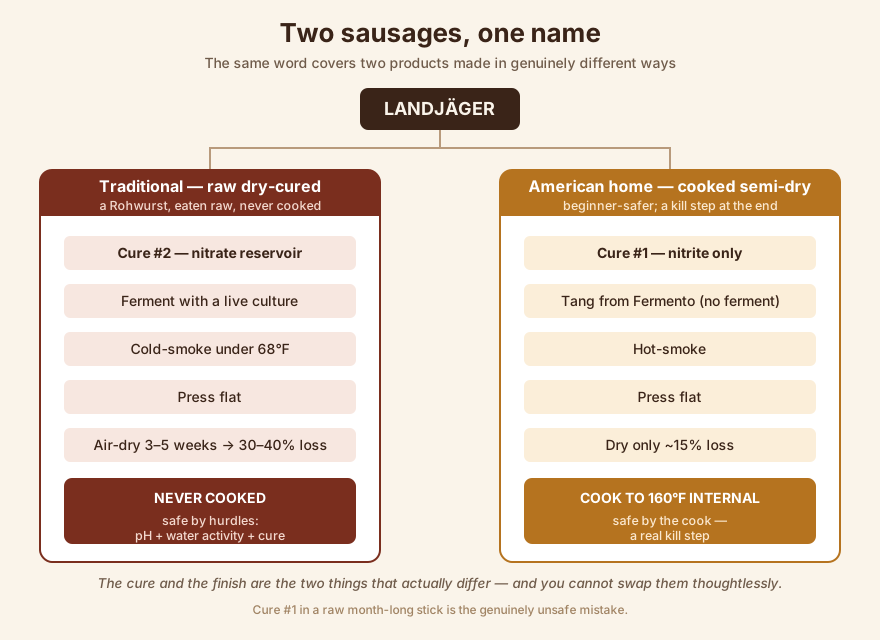
The two Landjägers
Product A — the traditional one — is a raw sausage. In German it’s a Rohwurst: cured, fermented, cold-smoked, pressed flat, and then air-dried for weeks until it has lost a big fraction of its starting weight. It is never cooked. You eat it raw, and it’s safe not because anything killed the bacteria with heat but because you built a place bacteria can’t live — acidic from the ferment, low in water from the dry, salted and cured. This is the real article, the one the German and Swiss shops make, and it’s the better sausage. It’s also the one that demands you get every hurdle right, because there is no cooking step at the end to bail you out.
Product B — the popular American home method — is a cooked sausage. It uses a different cure, it gets its tang from a shortcut instead of a real fermentation, and it’s finished by hot-smoking and cooking the links to 160°F internal — a genuine kill step — after which it’s dried only lightly. It’s a semi-dry snack stick built on the summer-sausage pattern, and it’s the version most American hobby recipes describe, including the one I keep in my collection. It is meaningfully easier and safer for a beginner, because the cook forgives mistakes that the raw method won’t.
Neither is wrong. But they are different foods, and — this is the part that actually matters — they use different curing salts for different reasons, and you cannot swap them thoughtlessly.
The cure: why #1 and #2 are not interchangeable here
This is the single most important thing on the page, so I’m going to be slow and show the arithmetic. If you want the general version of this argument, it’s on reading a sausage recipe; here’s how it plays out specifically for Landjäger.
There are two pink curing salts and they are not the same:
- Cure #1 (Prague Powder #1, Insta Cure #1): 6.25% sodium nitrite, the rest salt, dyed pink so you never confuse it with table salt.
- Cure #2 (Prague Powder #2): the same 6.25% sodium nitrite plus 4.0% sodium nitrate, also dyed pink.
That extra nitrate is the whole story. Nitrite gets used up relatively quickly — it does its job through the ferment and the cook and then it’s largely spent. Nitrate is a slow-release reservoir: over weeks, bacterial enzymes convert the nitrate into fresh nitrite a little at a time, which is exactly what you need when a raw sausage is going to hang and dry for a month with no cooking step to protect it. Nitrate keeps Clostridium botulinum suppressed the entire time the stick is drying.
So the logic falls out cleanly:
| Traditional raw (A) | Cooked semi-dry (B) | |
|---|---|---|
| Dries for | 3–5 weeks | days |
| Ever cooked? | No | Yes, to 160°F |
| Correct cure | Cure #2 (needs the nitrate reservoir for the long raw hang) | Cure #1 (nitrite only — the cook does the protecting; a nitrate reservoir is pointless) |
And here’s the tell that this is real and not theory: the popular home recipe (product B) notes that if you use Cure #2 instead of Cure #1, you get “a very hard link.” That’s the nitrate reservoir doing work it was never needed for in a cooked sausage. Use Cure #1 in the cooked version; use Cure #2 in the raw one. Getting this backwards — using Cure #1 in a raw stick that hangs for a month — is the genuinely unsafe mistake, because you’d leave the back half of the dry with nothing protecting it.
The ppm math, worked out
The universal home dose is 0.25% Cure #1 on the meat block — “1 level teaspoon per 5 lb.” Here’s why that number is exactly right:
0.25% Cure #1  = 2.5 g Cure #1 per 1 kg of meat
Sodium nitrite = 2.5 g × 6.25%
               = 0.15625 g per kg
               = 156 ppm     ← exactly the USDA comminuted-product ceiling
That 156 ppm is the legal maximum ingoing nitrite for a ground/comminuted product, and the 0.25% rule was built to land right on it. Cure #2 at the same 2.5 g/kg delivers the same 156 ppm nitrite plus a 100 ppm nitrate reservoir (2.5 g × 4.0% = 0.10 g/kg) — the reservoir that slow-feeds the raw dry. Weigh your cure on a scale that reads to a hundredth of a gram. This is the one place in sausage-making where “close enough” is not a phrase you get to use, and a cheap 0.01 g scale is not optional.
Semi-dry, dry, and a number you must not misapply
“Semi-dry” and “dry” aren’t vibes — they’re defined by how much water you pull out, usually as the moisture-to-protein ratio (MPR):
| Class | Water removed | MPR | Where Landjäger sits |
|---|---|---|---|
| Semi-dry | ~15% of weight | ≤ 3.1 : 1 | the cooked method (B); “summer sausage” territory |
| Dry (shelf-stable) | ~25–50% | ≤ 1.9 : 1 | salami — and the traditional raw Landjäger |
Now the nuance that can actually hurt someone. Landjäger is called “semi-dry” because it stays pliable, not rock-hard like a salami — that’s a texture description. But the traditional raw stick is dried to roughly 30–40% weight loss, which by the numbers is genuinely dry. The ~15% figure belongs to the cooked method, not the raw one. If you read “Landjäger is semi-dry, ~15% loss” and apply it to a raw, uncooked stick, you’ll pull it off the rack while it’s still dangerously wet. Watch the process, not just the label: the cooked stick loses ~15% because the cook already made it safe; the raw stick has to lose 30–40% because the drying is the safety.
For the record, the hurdles trade off against each other: a dry product leans on low water activity (aw under about 0.91), a semi-dry one leans on acidity — the higher the moisture, the lower the pH has to be to keep it safe. Which brings us to the tang.
Where the tang comes from — three roads, only one of them ferments
That characteristic Landjäger sourness is lactic acid, and there are three ways to get it into the sausage. They are not equivalent, and the difference is a safety difference, not just a flavor one.
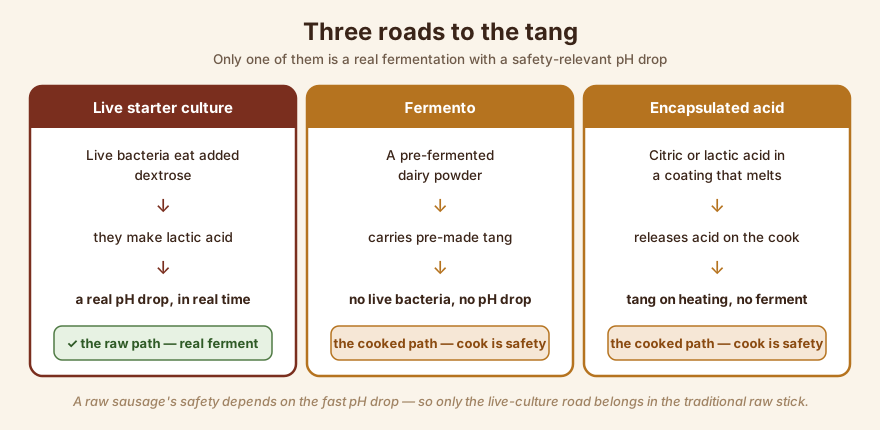
1. A live starter culture (Bactoferm T-SPX and the like) is real fermentation. You add live lactic-acid bacteria and a little sugar (dextrose), the bacteria eat the sugar and make lactic acid, and the pH drops in real time. This is the traditional raw road. A few rules that matter: roughly 1 g of dextrose per kilo drops the pH about 0.1 unit, so 0.5–0.7% sugar gets you near pH 5.0; the bacteria stall once the meat dries below about aw 0.93, so the acid has to be built early while the meat is still moist; and chlorinated tap water kills your culture — rehydrate it in distilled or non-chlorinated water, or you’ve just poured bleach on the organisms you’re paying for.
2. Fermento is the shortcut, and it’s what my collection’s home recipe uses, so let me be precise about what it actually is: a pre-fermented dairy powder — skim milk plus cultured whey. It carries pre-made lactic tang into the mix. It is not a live culture, it does not ferment anything, and it produces no pH drop. That’s not a knock — it’s exactly why it pairs with the cooked method. There’s no fermentation to time, no pH clock to watch, no culture to accidentally kill. The tang is milder than a real ferment, and the cook, not an acid drop, is doing the safety work.
3. Encapsulated acid (citric or lactic acid in a coating that melts when heated) releases its acid during the cook — another cooked-method shortcut. Citric tastes sharper; lactic is gentler on texture and color.
The one thing to hold onto: only the live-culture road produces the fast pH drop that a raw sausage’s safety depends on. Fermento and encapsulated acid are for the cooked version, where they add flavor to something the heat already made safe.
The meat block, the grind, the casing
The traditional block is beef and pork — Marianski runs it about 70% pork to 30% lean beef with the total fat around 25–30%, added as pork back fat. But the ratio genuinely varies: some Swabian and Swiss versions are beef-forward or close to half-and-half, and a game version might run 60% venison to 40% fatty pork. Beef gives the bite and the color; pork and back fat give the fat and the flavor. Don’t treat 70/30 as gospel — treat it as a traditional target.
Grind it with a little structure: pork through a 5 mm plate, beef finer through 3 mm, or a single 6 mm pass if you want it simpler. And keep everything cold — near-frozen meat, chilled bowl, chilled plate. Fat smear is a temperature failure before it’s an equipment failure; the day it goes wrong on you it’ll be because the meat warmed up, not because your knife was dull (though a dull knife will get you there faster).
Casing. The German food code is specific here: Landjäger goes in Schweinedünndarm — pork small intestine — and is pressed flat. In practice that means hog casing at 28/30 or 30/32 mm, and the classic thin Swabian version uses sheep casing at 22/24 mm. Anything much above 32 mm is drifting toward a small salami rather than a Landjäger.
The pairing geometry, which nobody explains clearly and which I had wrong for years: you don’t link a Landjäger like a chain of brats. You tie off a length of about 32 cm, cut it free, and then twist that single length at its middle. That gives you two sticks joined at one end — the pair — each landing at 80–125 g. The pair is what goes in the press, hangs, smokes, and gets sold. A single Landjäger is a loose end.
⚠ A correction to what I used to say here. I previously wrote that for thin casings under about 30 mm you should use Cure #1 rather than Cure #2, on the logic that a thin link dries fast and doesn’t need the nitrate reservoir. That was wrong, and it contradicted this page’s own warning four paragraphs up. The cure is chosen by the process, not the caliber: cooked → #1, raw-and-never-cooked → #2, exactly as the curing salts page puts it. A thin raw stick in 22/24 sheep still hangs three weeks or more, and three weeks is well past the useful life of nitrite alone. What caliber actually changes is drying time — 22/24 sheep gets to 30–40% loss in about three weeks, 28/30 hog in nearer five — and a longer dry is an argument for the nitrate reservoir, not against it. The Swabian formula uses sheep 22/24 with Cure #2, and that is the correct pairing.
The press — the step that makes a Landjäger a Landjäger
Everything so far, a salami shares. The press is what makes this sausage this sausage.
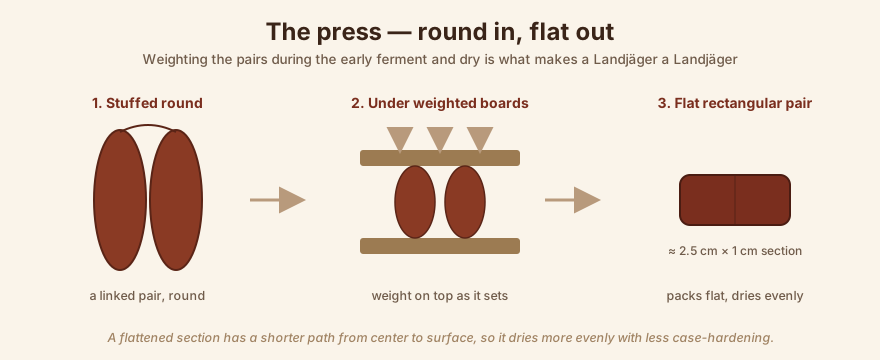
After you stuff and link, you lay the pairs between two boards or trays and put weight on top during the early fermentation and drying. As the sausage sets, it takes the signature flat, slightly concave, rectangular cross-section. Two things come out of this. The obvious one is form — the flat, dense brick that slides into a coat pocket, the whole identity of the sausage. The quieter one is drying: a flattened section has a shorter path from its center to its surface than a round one, so moisture leaves more evenly and you get less case-hardening — that maddening dried shell over a still-wet core. I’ll be honest that I couldn’t find a controlled study putting a number on the drying benefit, and nobody agrees on exactly how much weight for exactly how long — light weighting over the first day or two of the hang is the common practice. But the form is non-negotiable: no press, no Landjäger, just a skinny dried link.
Smoke — cold for the raw one, hot for the cooked one
The smoke splits the same way the cure does.
Traditional (raw): cold smoke, kept under about 68°F (20°C) for a few hours — enough for color, flavor, and a little surface protection, but not enough to cook anything. The Black Forest style smokes over fir and spruce; elsewhere it’s often beech, and apple, cherry, and pecan all show up in makers’ notes. The point of cold smoke is that the sausage stays raw and keeps drying; if the smoker creeps warm, you’re drifting toward accidentally cooking a stick you meant to dry.
American cooked: you step the smoker temperature up and finish the links to a 160°F internal kill step, summer-sausage style, then dry them lightly. Same wood choices; completely different intent — here the heat is the whole safety mechanism.
Safety — read this, because the raw method has no kill step
I put this last so it lands last. The Germany history page already says the true thing — traditional Landjäger is safe because its water activity dropped, not because it was heated — and I want to make that concrete.
The real hazard in a raw fermented sausage is not a bug you can cook away — it’s a toxin. Staphylococcus aureus, if you let it grow during a slow warm ferment, produces an enterotoxin that is heat-stable and survives cooking. Once that toxin is in the sausage, no later cook, no amount of drying, and no smoke will destroy it. That single fact drives the whole method:
- S. aureus grows above 60°F — which is why 60°F is the reference line for the entire safety calculation.
- It is brutally salt- and drying-tolerant (still active down to aw 0.86), so you cannot simply out-dry it.
- But it is shut down by fast acidification — get the pH to 5.3 or below quickly and it can’t grow or make toxin.
That’s the entire reason a live culture plus dextrose (or, in the cooked method, the cook itself) is non-negotiable. A raw sausage that just “sits out fermenting” without a real, fast acid drop is the classic path to a staph poisoning. The industry number for this is degree-hours — hours above 60°F times the degrees over 60, accumulated until the sausage hits pH 5.3:
| Fermentation temperature | Max degree-hours to reach pH 5.3 (US) |
|---|---|
| Below 90°F | 1200 |
| 90–100°F | 1000 |
| Above 100°F | 900 |
The hotter and faster you ferment, the fewer degree-hours you’re allowed — because heat helps the staph too. ⚠ (You’ll see it written that Canada is stricter at 665 / 555 / 500. It isn’t — those are Celsius degree-hours, and ×1.8 gives 1197 / 999 / 900, the same limits in a different unit. I had this wrong here for a while.) A slow T-SPX ferment around 70°F has a generous window; a hot fast ferment does not.
This is exactly why a beginner is genuinely safer starting with the cooked method (B). The cook to 160°F is a real kill step for Salmonella, E. coli O157:H7, and living staph cells — it forgives an imperfect acid drop in a way that raw drying never will. With Fermento there’s no live ferment to mistime and no degree-hour clock to blow. The one thing the cook still cannot fix is pre-formed staph toxin, so even the cooked method wants clean meat, cold handling, and a prompt process — but it takes away the tightrope. The raw method makes the better sausage; it just asks you to execute every hurdle correctly, and it punishes shortcuts.
Verify, don’t guess:
- Internal temperature (cooked method): confirm 160°F with a probe.
- Weight loss (both): weigh green, then to target — ~15% for the cooked semi-dry, ~30–40% for the raw dry stick. Weight loss is your practical stand-in for water activity at home.
- pH (raw method): confirm the drop to 5.3 or below early, and a finished tang around 4.9–5.3.
One more, for the raw pork path only: trichinae. It matters only if you’re eating pork raw and dry-cured with no cook (product A). Commercial US pork is very low-risk now, but the belt-and-suspenders move is to freeze the pork first — the long-standing 9 CFR 318.10 schedule for pieces under 6 inches thick is 5°F for 20 days, −10°F for 10 days, or −20°F for 6 days. The cook step in the American method makes this moot.
🔴 And here is a correction I need to make loudly, because I had it wrong on this page and it is the dangerous direction to be wrong in. I used to write that a venison Landjäger carries its own Trichinella risk and that “the same freezing logic applies.” It does not. The freezing schedule above was built for the strain that circulates in domestic pork. The Trichinella strains carried by wild game — bear above all, but wild boar and other game too — are freeze-resistant and survive freezing that kills the pork strain dead. Worse, curing, salting, smoking and drying do not reliably kill trichinae either, so a raw dry-cured game stick has no control acting on the parasite at all. The only reliable kill for at-risk game is heat, to a verified 160°F throughout. The full argument is on meat, and it is the reason the venison formula carries its own safety block rather than borrowing the pork one: with venison you are choosing to rely on the hurdle stack knowingly, and with bear you should not make a raw never-cooked stick at all.
⚠ And one thing this page used to leave implied, which the food-safety chapter now states outright: the hurdle stack above is a genuine, validated control for botulism, for Staph aureus, for trichinae in pork, and for shelf-stability. It is not a validated kill step for Salmonella or STEC — USDA says so plainly, and in 2021 two outbreaks sickened 70+ people at establishments that met every one of those hurdles. Read that section before you decide the stack is complete.
None of this is meant to scare you off — it’s meant to let you make the raw one someday with your eyes open. Start with the cooked method, learn the feel of the grind and the press and the dry, and graduate to the raw dry-cured stick when the numbers above are second nature. When you’re ready to actually stand at the bench, making your own walks through both, with a worked example. And if you want to know why I chase this particular sausage so hard, that’s why I make my own.
Part of the Landjäger deep dive. Next: making your own.
Comments (0)