Stuffers
Here’s the sentence that will save you the most grief in this whole program: the grinder makes the meat, the stuffer makes the sausage. They are two different jobs, and the single biggest mistake I see from people getting serious is trying to do the second job with the first machine. You can stuff with a grinder. I did it for years, because it’s what I had. But the day I finally put a real vertical piston stuffer on my bench, the quality of my links jumped in a way that nothing else — not a better recipe, not a better smoker — had ever moved it. This page is about why that is, how the good tool works, and the one on my bench that I’ve since made hands-free.
Why a grinder is a bad stuffer
Let me be specific, because “it’s just better” is the kind of thing the internet says without telling you why, and the why is the whole point.
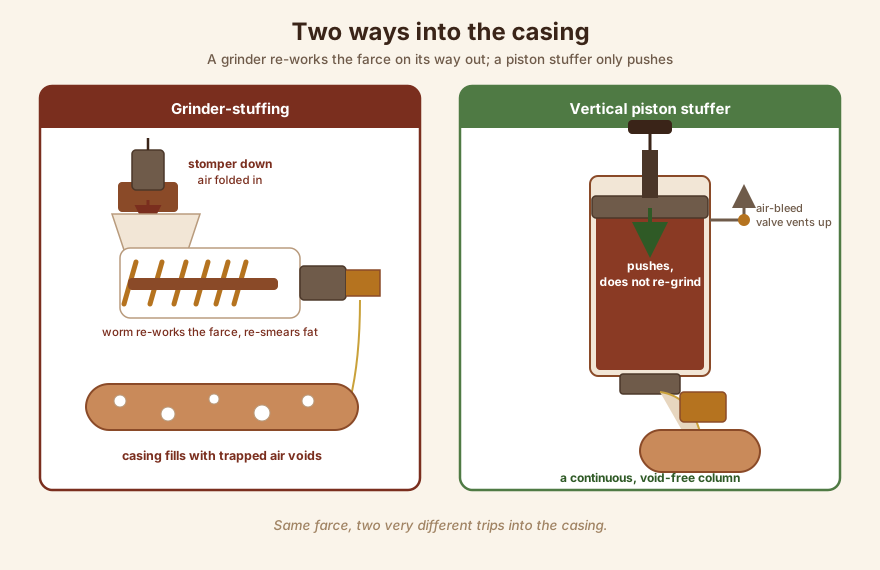
When you stuff with a grinder, you pull the knife and plate out (or you swap to a stuffing plate — a plate with one big hole and no cutting), thread a horn onto the front, and feed your already-ground, already-mixed farce back into the hopper. The worm grabs it and pushes it out through the horn into the casing. It works. Sausage comes out the end. But look at what you just did to the meat, because two bad things happen and they’re both mechanical, not a matter of skill.
You re-worked the farce through the worm. You spent all that care at the grinder keeping the meat cold and getting a clean, distinct grind — separate particles of lean and fat, not a paste. Now you’re dragging that carefully-ground meat back through the same auger, squeezing it under the same rising pressure, warming it with the same friction. The worm doesn’t know it’s not supposed to grind this time. It smears the soft fat all over again, exactly the way a dull knife smears it (that’s the fat-smear failure — a temperature problem first, a mechanical one second, and the grinder-as-stuffer hits it from both sides). The clean grind you built gets partly undone on its way into the casing.
You whip in air. To keep a grinder fed you’re pushing meat down the throat with the stomper, and every push folds air into the column. That air has nowhere to go but forward, into the casing, where it sits as pockets and voids under the skin. More on air below, because it’s the enemy no matter what you stuff with — but a grinder is an air-making machine, and you’re asking it to be an air-avoiding one.
So grinder-stuffing costs you texture and gives you air. It’s a compromise, and an honest one when it’s all you own — but it is not the same tool.
There’s a subtler cost, too, and it’s about time. A grinder stuffs slowly and unevenly because the worm’s output pulses with the flights and because you’re constantly stopping to feed the hopper. Every one of those stops is a chance for the meat to warm up on the bench, and warm fat is the fat that smears. A packed stuffer canister, by contrast, holds thirty pounds ready to go, so you fill your whole run in one continuous, cold, uninterrupted pass. Speed isn’t vanity here — it’s temperature control, which is the thing that governs everything else in sausage. The faster the farce gets from the grinder into the casing, the less of it turns to paste on the way.
What a real stuffer does instead
A vertical piston stuffer does exactly one thing, and does it without any of that damage: it pushes. It doesn’t grind, doesn’t shear, doesn’t re-work anything. It’s a positive-displacement pump for meat.
Picture a tall stainless can — the canister, or cylinder — that you pack full of farce. A solid piston sits on top of the meat, sealed to the cylinder wall with a rubber gasket. You drive that piston down, and it forces an intact, continuous column of farce out the bottom, through a horn, into the casing. The grind you made survives the trip. There’s no auger to smear the fat, no throat to stomp air into. The piston meets the top of a solid, packed column of meat and simply moves it, all of it, in one direction, at whatever steady pace you choose.
That’s the whole idea, and it’s why the result is better: you’re delivering the sausage you already made, instead of making it a second, worse time on the way out. Smoother fill, tighter texture, far less air, fewer blowouts. Once you’ve felt the difference you don’t go back.
Water-drive versus gear-drive
If you go shopping for a vertical stuffer, nearly everything you’ll see is gear-drive, and that’s the right default. But there’s an older cousin worth knowing about.
Gear-drive is the modern standard. A hand crank turns an enclosed steel gear train, which drives a toothed rack, which pushes the piston down the cylinder. All the force multiplication happens in that gearbox, so a modest turn of the crank becomes a lot of steady pressure on the meat. It’s precise, quiet, powerful, and there’s no plumbing to deal with. The one real drawback is that cranking is a two-handed job — you’re turning the handle with one hand and doing your best to manage the casing with the other, which is exactly the problem I solved on mine (below).
The good gear-drive units are two-speed, and this matters more than it sounds. There’s a fast/high gear for raising the piston and for refilling or purging quickly — you don’t want to crank forever just to reset between canisters. And there’s a slow/low gear, with much higher mechanical advantage, for the actual stuffing. That low gear is where you get smooth, controllable, gentle pressure — the fine control that fills a casing evenly without splitting it. You do the real work in low, and you use high to get set up. A stuffer without that gearbox is a stuffer you fight.
Water-drive is the older, rarer approach, and it’s a genuinely clever idea: instead of gears, you put household water-line pressure behind the piston. Hook the back of the cylinder to your tap, open the valve, and line pressure pushes the piston down onto the meat. There are real patents for water-pressure sausage stuffers, so it’s not folklore — it’s a legitimate mechanism. The appeal is that it’s smooth and geometrically simple, with no gear train to buy or maintain. The problems are why you almost never see one now: it depends entirely on your water pressure, it wastes water down the drain the whole time you’re stuffing, and gear-drive simply does the job better without a hose. Know that it exists and is real; don’t go looking for one as your daily tool.
The canister, the piston, and the air-bleed valve
Whatever drives it, a vertical stuffer is three parts that matter:
The canister is a stainless cylinder — good ones are 304 stainless — that holds the farce. It lifts out for packing and cleaning. Its capacity is how the machine is rated: mine is a 15-liter canister, which is roughly 30 pounds of meat in one load, and that number is the whole vocabulary of stuffer sizing (a “5-pound stuffer,” a “15-pound stuffer,” and so on).
The piston rides down inside it, sealed to the wall by a rubber gasket so the meat can’t escape up past it. The piston body is usually aluminum or a tough plastic. When it’s sealed and driven down, everything below it has to go out the horn — that’s the positive displacement.
The air-bleed valve is the part nobody photographs and everybody should understand, because it’s the single most important anti-air feature on the machine. It’s a small, spring-loaded valve set into the head of the piston. When you lower the piston onto the packed meat, there’s always a pocket of air trapped between the piston face and the top of the farce. If that valve is open, the trapped air escapes upward through the piston as it descends — it vents out the top instead of being driven down into your sausage. Then, the moment the piston face meets solid meat, the valve seats and seals, so the stuffer can build real pressure. Open on the way down to bleed the air, sealed once it’s on the meat to do the work. F. Dick even sells the cylinder air valve as its own service part, which tells you how central it is. Learn where yours is and use it every single fill.
Air pockets — where they come from and how to beat them
Air is the defect that makes a good sausage look amateur — voids under the casing, uneven links, weak spots that dry wrong or blow out. It comes from three places, and each has a fix:
- A loosely packed canister. If you drop meat into the cylinder in loose balls, you trap air in the gaps between them. Pack it in firm layers, pressing each one down to drive out the voids before you add the next. A solid, gap-free column is half the battle before you ever lower the piston.
- Not using the bleed valve. That trapped pocket between piston and meat has to go somewhere. Open the air-bleed valve on the down-stroke and let it vent up and out, then let it seal on the meat. Skip this and you drive that whole pocket into your first link.
- Air folded in earlier, during mixing or from grinder-stuffing upstream. You minimize this by mixing thoughtfully and — the big one — by using a real stuffer instead of an auger, so you’re not adding fresh air at the last step.
Then there’s the fourth move, at the finish line: stuff at a steady rate so the horn stays full and the casing fills evenly (start-stop stuffing pumps air in at every restart), and prick the finished links. A sausage pricker — a little block of pins, or a sterilized needle — vents any residual pockets that made it through. You slide it along the link, pop the visible air bubbles, and let them collapse before the sausage goes to dry or to smoke. It’s the last insurance, and it’s why you’ll see me run a pin down every link before they hit the rack.
One more thing on the “steady rate,” because it’s where hands and machine meet. The pockets you can’t prick out are the ones the casing sealed over during an uneven fill — a slug of meat too fast, then a pause, then another slug, and the casing balloons and slackens with each surge and traps air in the slack. What defeats that is a constant delivery rate matched to how fast you can feed the casing off the horn. On a hand-cranked stuffer that’s genuinely hard, because the hand setting the pace is also the hand that could be managing the casing. Get the rate right and even the pricking gets easier, because there’s less to prick. This is exactly the problem my foot pedal was built to solve, which I’ll get to below.
Horns sized by casing caliber
The horn (or tube, or funnel — same thing) is what the meat exits through, and it screws onto the bottom of the canister. It is not one-size-fits-all — you match the horn’s outer diameter to the casing you’re stuffing, because the casing slides onto the horn and the meat fills it as it comes off the end. Too small a horn chokes a coarse grind and heats it fighting through; too large a horn won’t hold the casing on at all.
The rough map, small to large:
| Horn (approx. OD) | Casing / product |
|---|---|
| ~1/2”–5/8” (13–16 mm) | Snack sticks, sheep casings — the thin stuff |
| ~7/8” (22 mm) | Hog casings — breakfast and dinner links |
| ~1 1/4”–1 1/2” (32–40 mm) | Bologna, summer sausage, beef middles, big casings |
Most stuffers ship with a set of four horns covering exactly this spread, and you’ll use all of them depending on what you’re making. Casing calibers, soaking, and which casing goes with which product are their own subject — that all lives on the casings & tools page, and it’s worth reading alongside this one, because the horn and the casing are a matched choice.
⭐ My stuffer — an F. Dick TWF-15, and the motor I built for it
Here’s the tool at the center of my bench. I run an F. Dick TWF-15 — a 15-liter vertical piston stuffer, which works out to about 30 pounds of farce in a single load. It’s all stainless: the rods, the crank, the base, the gearbox, the cylinder, with the cylinder air valve I described above. It’s a commercial tabletop machine and it will outlast me.
A word on the name, because it’s a good one. F. Dick is Friedr. Dick — the German tool house founded in 1778, out of Esslingen and today in Deizisau. They’ve been making butcher’s knives, chef’s knives, and sharpening steels for going on two and a half centuries; if you’ve used a good butcher’s steel, there’s a fair chance it said Dick on it. They also make high-grade stainless sausage fillers, which is how the TWF-15 came to be on my bench. When something has been made by the same house since before the American Revolution, it tends to be made right, and this thing is.
Now the part I’m actually proud of. A gear-drive stuffer’s one weakness is that cranking it takes a hand — and stuffing is a job that wants both of your hands on the casing. When you’re filling a link, you’re feeding the casing off the horn at just the right speed, controlling how tight it packs, pinching and twisting off links, watching for air, keeping the fill even. That’s genuinely a two-hand job. And for years I did it the way everyone does: one hand cranking, the other hand trying to do all of the above by itself, fighting the casing while the crank hand set the pace. It works, but it’s a compromise, and you can see the compromise in the links — a little uneven, a little bunched where the two jobs collided.
So I designed and built a motor drive for my TWF-15, run off a foot pedal. I press the pedal, the motor turns the piston, the farce comes out; I let off, it stops. My hands never touch the crank. Both of them stay on the casing the entire time — feeding, controlling the tension, twisting the links, pricking the air — and my foot does the one thing my hands used to have to steal from that work. The pedal even gives me finer pace control than a hand crank ever did, because I’m not modulating force, just tapping a pedal, and I can feather it while I watch the fill.
This isn’t some exotic idea — motorizing a manual crank stuffer for hands-free feed is a real, valued practice among people who stuff in any volume, and you can buy foot-pedal electric stuffers off the shelf now. But the shelf ones are their own machines; I already had a stuffer I trusted, built by a 250-year-old knife house, and I didn’t want to trade it away to get a foot pedal. So I put the pedal on it. That’s the teaching hook I want you to take from this whole page: the reason a real stuffer matters is that it lets you deliver the sausage you already made without wrecking it — and the reason hands-free feed matters is that it lets you actually control the delivery. A good stuffer frees the meat from re-grinding. A foot pedal frees your hands to do the craft. Put those two together and the links come off the horn even, tight, and air-free, batch after batch, in a way I could never quite hit when one hand was busy turning a handle.
If you’re handy and you own a gear-drive stuffer you like, this is a build worth doing. If you’re not, buy the foot-pedal machine. Either way, the goal is the same: both hands on the casing.
Keeping it clean
A stuffer is simpler to clean than a grinder — there’s no knife-and-plate stack, just a smooth cylinder, a piston, a gasket, and the horns — but the same rule applies: meat hides in every seam, and ground meat spoils fast. Break it down completely after every use. Pull the piston, take off the gasket, run hot water through the cylinder and every horn, and get into the piston’s air-valve seat, because farce packs up in there and that’s the one part whose function you can’t afford to gum up. Dry everything and reassemble. The stainless doesn’t rust the way carbon-steel plates do, so it’s a forgiving machine — but a clean valve and a clean gasket are what keep the next batch air-free, so give them the thirty seconds.
Part of Sausage Equipment, and the tool where a batch becomes actual links. See how it sits alongside everything else on my bench, and put it to work across the sausage program. Next: bowl choppers & emulsion — the machine that takes meat past a grind and all the way to a frankfurter batter, and the temperature ceiling that makes or breaks it.
Comments (0)