Packaging & Storage
You did all the work — cold meat, clean grind, a good bind, a careful stuff, the right cook or the right dry — and now it’s sitting on the counter. How you package and store it decides whether all that effort keeps for months or turns on you in a week. This is the least glamorous chapter in the section and one of the most important, because it’s where a beautiful batch quietly goes rancid, and because it’s the second place (after the cure) where a packaging decision can actually make someone sick.
My own routine is simple and it’s the backbone of this page: ice-bath the finished links, rest them, vacuum-seal, and freeze. Everything below is why that works, where it doesn’t, and the two safety lines you don’t get to guess at.
The vacuum sealer — edge vs. chamber
The single most useful storage tool on my bench is a vacuum sealer, because the enemy of stored sausage is oxygen (more on why in a second), and a vacuum sealer pulls it out. There are two kinds, and the difference is real:
Edge (external) sealers — the FoodSaver type. The bag sticks out of the machine, a pump sucks the air out through the open end, and a bar heat-seals it. They’re cheap, compact, and perfectly good for dry, firm things: cured sticks, snack sticks, finished links, cheese. Their weakness is anything wet — a marinated or juicy sausage, or a bag with liquid — because the pump will pull the liquid right up to the seal and ruin it, and they can’t pull a deep vacuum on a soft, moist product without crushing it.
Chamber sealers — the whole bag goes inside a rigid chamber, the machine evacuates the entire chamber (bag and all), then seals. Because the pressure is equalized inside and out, they handle liquids and marinades with no fuss, pull a deeper, more consistent vacuum, and use cheaper flat pouches. They cost more and take up counter space, but if you package a lot of wet or delicate product they’re worth it. For most home sausage-makers an edge sealer is plenty; step up to a chamber sealer when liquids and volume make you.
Why fat goes rancid — the real clock on stored sausage
Here’s the thing most people don’t realize: the limit on how long sausage keeps well in the freezer usually isn’t bacteria at all — it’s fat oxidation, which is a purely chemical process that keeps happening even at freezer temperatures, just slowly. Oxygen reacts with the fat and turns it rancid: stale, cardboard-y, faintly paint-like — not dangerous, exactly, but it ruins the flavor, and a fatty fresh sausage is especially prone to it. This is why the vacuum matters: pull the oxygen out and you slow the rancidity way down.
That chemistry sets the practical quality windows. Frozen sausage is safe essentially indefinitely — freezing stops microbial growth cold — but the quality fades on this rough schedule:
| Product | Good quality, frozen | Limited mainly by |
|---|---|---|
| Fresh sausage (uncured) | ~1–2 months | fat oxidation / rancidity |
| Cooked sausage | ~2–3 months | oxidation, texture |
| Smoked / cured sausage | ~1–2 months | fat oxidation |
I’ll be honest that the exact months vary by source and by how fatty and how well-sealed the sausage is — treat these as “eat it sooner than you think,” not gospel. Vacuum-sealing, squeezing out air, and a cold, steady freezer all push the window longer; loose freezer bags and a self-defrosting freezer that cycles warm push it shorter. Label and date every package — you will not remember, and a chest freezer is where undated sausage goes to become a mystery.
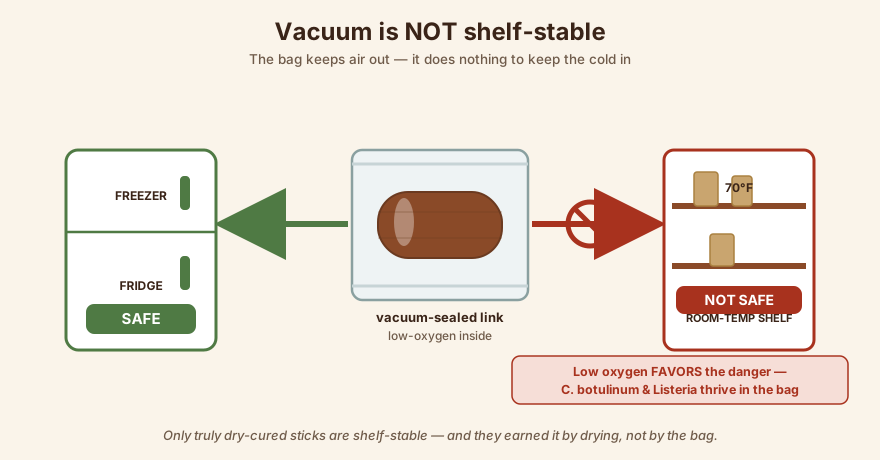
⚠ The safety line: vacuum is NOT shelf-stable
This is the point on the page I most need you to take seriously, because vacuum packaging looks like preservation and it fools people.
A vacuum-sealed package is reduced-oxygen packaging (ROP), and reduced oxygen is exactly the condition that favors the most dangerous organisms in meat. Clostridium botulinum and Listeria monocytogenes both do fine — better, even — without oxygen. So sealing a sausage in plastic and pulling the air out does not make it safe to sit at room temperature, and it does not make it safe to leave in the fridge indefinitely. If anything, ROP removes the oxygen-loving spoilage bacteria that would otherwise warn you (with slime and off-smells) that a product has gone bad, so a dangerous vacuum-packed product can look and smell fine.
The rule is simple and firm: a vacuum-sealed sausage must be refrigerated (at or below 41°F) or frozen — treat the vacuum as a quality tool, never as a substitute for the cold chain. Commercial ROP operations run under a “two-barrier” rule and tight time limits (a refrigerated retail cap around 30 days) precisely because vacuum alone isn’t a hurdle you can lean on. At home: vacuum-seal to protect flavor, then put it straight in the freezer or the fridge, and don’t kid yourself that the plastic bought you shelf life. The only sausages that are genuinely shelf-stable at room temperature are the fully dry-cured ones that got there through cure, acid, and water-activity — and they earned it in the chamber, not in the sealer.
⚠ The other safety line: pressure-can, never water-bath
Some people want to can sausage — meatballs in sauce, sausage for the pantry — and this is the second place a good intention can kill someone. Meat is a low-acid food, and low-acid foods must be pressure-canned, never water-bath canned. The reason is Clostridium botulinum spores: a boiling-water bath tops out at 212°F, which kills the bacteria but not their heat-resistant spores, and a sealed jar of low-acid meat at room temperature is a perfect incubator for those spores to wake up and produce botulinum toxin. A pressure canner reaches 240°F, hot enough to destroy the spores, and it is the only safe way to home-can meat for shelf storage.
I’m not going to write a canning course here — follow a tested source like the National Center for Home Food Preservation and your canner’s manual to the letter, because canning is one of the few kitchen activities where “close enough” is genuinely deadly. But the headline is non-negotiable: low-acid meat, pressure canner, 240°F, tested recipe — or don’t can it, freeze it instead. Freezing is the safe, easy, forgiving default, which is exactly why it’s my standard.
My routine, and why
So here’s what I actually do, and now you can see the reasoning under it. When a cook or a cure is finished, I ice-bath the links to stop the cooking and set the texture, let them rest at room temperature for a bit to firm and bloom, then vacuum-seal them in meal-sized portions — I’d rather thaw two small bags than one giant one — label and date each one, and freeze. Fresh sausage I’ll keep in the fridge only for the few days before I cook it, and I plan batches so I’m not sitting on raw sausage. Anything I want to keep, I freeze, because freezing is the one storage method that’s both safe and simple, and the vacuum is there to protect the flavor over those weeks, not to bend the safety rules.
The dry-cured sticks are the exception that proves it: a finished Landjäger or salami is genuinely shelf-stable and I can keep it cool and dry without freezing — but even those I often vacuum-seal and refrigerate or freeze once they’re cut, because a cut face is a fresh surface again, exposed to oxygen, and the rancidity clock restarts.
That’s the last of the bench. From the knife that came before every machine to the bag that outlasts the batch, the tools are all in service of one thing: making good sausage, safely, and keeping it good until you eat it. If you want to see how it all comes together on one actual working surface, that’s my bench.
Part of Sausage Equipment. Back to the sausage program, or on to my bench to see the whole kit in one place.
Comments (0)