By Hand
Before there was a grinder there was a knife and a block, and for almost the whole history of sausage that was the machine. Mechanical mincing is a nineteenth-century arrival — a newcomer, really — laid down over a craft that is thousands of years old. For all those centuries, “grinding” meant a person standing at a bench, reducing meat and fat to the right texture with an edge and their own two arms. I run a grinder. I’m not a purist and I’ll say so up front. But I’ve hand-chopped enough farce over forty years to know what the knife does that the machine doesn’t, and understanding the hand method is the fastest way I know to understand what the grinder is actually for — and where it quietly cheats you.
This is the chapter about doing it the old way: how forcemeat was made before the worm and the plate, why a well-executed hand chop still beats a grinder for certain products, where I still reach for the knife on a modern bench, and the handful of hand tools worth owning and keeping sharp.
The way it was done for a few thousand years
Farce — forcemeat, the seasoned meat-and-fat mixture that becomes the inside of a sausage or a pâté — was reduced by hand, with one of three tools, long before anyone thought to turn a screw against a plate.
The chopping knife. The workhorse was a heavy knife on a heavy block. In the simplest version it’s a single blade and a lot of patience: you cube the meat, then rock and chop, gathering and turning the pile, chopping again, working it down pass after pass until the grain is where you want it. A faster version is the two-knife rock-chop — a blade in each hand, worked in an alternating rhythm so the pile is being cut almost continuously. And then there’s the purpose-built tool for exactly this job: a curved, often two-handled blade you rock across the meat. The French call it a hachoir; the Italians call the half-moon version a mezzaluna (“half-moon”), and it’s the same idea — a curved edge whose geometry lets you rock through a pile of meat and herbs fast, keeping a cutting edge in contact with the board through the whole arc of the stroke. That tool has been in kitchen use since at least the early eighteenth century, it long predates the grinder, and — this is the part people forget — it never actually went away. A mezzaluna is still hanging in plenty of working kitchens right now.
The mortar. For the finest textures — the smooth, bound pastes at the pâté-and-quenelle end of the craft — the tool was the mortar and pestle. You pound rather than cut, breaking the meat and fat down and working them together into a paste. It’s slow and it’s real labor, but for a very fine forcemeat, pounding to a paste in a mortar is a technique that predates every machine and still gets used at the high end.
The block. The tool nobody credits is the surface. A heavy end-grain butcher’s block — wood stood on end so the blade goes into the grain rather than across it — is the “machine” of this era as much as any knife. End-grain wood self-heals under the edge: the fibers part and close instead of being sliced through, which is kind to the blade and gives you a stable, dense, replaceable cutting surface that can take years of chopping. The low chopping bench and the block are the unglamorous half of hand production, and the whole reason a butcher could stand there and chop all day without destroying his knives.
And it was labor. I want to be honest about that, because there’s a romance to hand work that skips right over the arms. Chopping enough farce for a real batch of sausage by hand is genuinely hard, repetitive work — it’s the reason the grinder swept the trade the moment it existed. The mechanical mincer didn’t replace the goal of hand-chopping; it replaced the labor of it, and it did so completely enough that within a few decades the knife had gone from the only option to a deliberate choice. The knife never left the shop, but for volume production it stopped being the default. If you want the story of the machine that displaced all this — and the shaky folklore around who “invented” it — that’s the early machines chapter. (Short version, flagged as folklore: the popular internet story credits a single German inventor with the meat grinder around the 1830s or ’40s, but that attribution is genuinely disputed — German-language sources file it among inventions merely ascribed to him, the dates repeated online contradict each other, and no source actually nails it down. What’s solid is that screw-driven hand-crank grinders spread across Europe and North America from the mid-nineteenth century onward. Nobody hero, no clean date.)
The cut versus the crush — why hand-chopped texture is still prized
Here’s the part that matters, and it’s not nostalgia. There is a real, mechanical reason a knife-chopped sausage can have a texture a grinder can’t quite match, and it comes down to two words: cut versus crush.
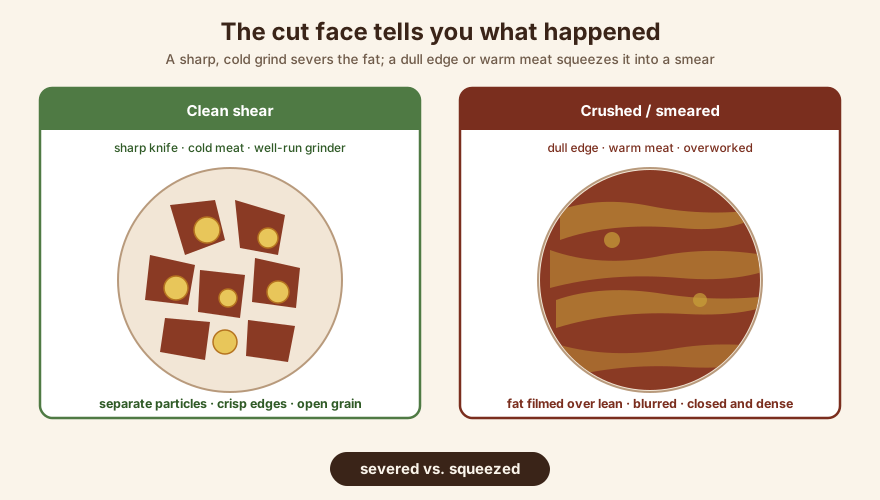
A sharp knife severs. It parts a muscle fiber and a piece of fat cleanly, in one stroke, leaving two clean faces. A grinder does something different and more violent than people realize. The worm — the auger inside the head — turns with a decreasing pitch, so it doesn’t just carry the meat forward, it compresses it, driving it under rising pressure against the back of the plate before the spinning knife shears it through the holes. When everything is right — cold meat, a sharp knife, a plate matched flat to that knife — that shear is clean and the grinder cuts beautifully. But the grinder is always working at the edge of crushing, because crushing is what the auger does by nature. Let anything slip — warm meat, a dull knife, a knife and plate that don’t mate flat — and the machine stops cutting and starts mashing. It drags the meat against the plate, and it squeezes the fat instead of severing it.
And squeezed fat is the enemy of the whole enterprise. This is the theme that runs through every chapter of this section, so I’ll state it plainly: fat smear is a temperature failure first and an equipment failure second, and the crush is how it happens. Fat is only a firm solid while it’s cold; as it warms toward body temperature it softens, then starts to render. Soft fat under pressure doesn’t get cut into clean particles — it smears, gets dragged out into a greasy film that coats the lean protein. Once the fat is smeared into the meat like that, you’ve lost the clean, distinct grain, and you’ve set yourself up for a greasy, dense, “broken” texture where the fat weeps out during cooking instead of sitting in the sausage as intact flecks. A dull knife or a mismatched plate doesn’t just crush mechanically; it adds friction, which is heat, which softens the fat further — so a bad edge and warm meat compound each other. Warm meat plus a dull knife is the worst case there is.
Now put the hand chop next to that. A sharp knife on cold fat, worked by someone paying attention, severs every particle. The fat comes off the knife in clean, discrete pieces with clean faces — not smeared into the lean but sitting in it, distinct. That’s what gives a well-chopped coarse sausage its look and its bite: a clean, open grain where you can see the lean and the fat as separate things, the fat in intact particles that stay intact through cooking. You are, in effect, doing by hand exactly what the grinder is trying to do on its best day — a clean scissor-shear of cold meat and fat — except your knife can’t accidentally turn into a crusher the way the auger can. There’s no worm building pressure behind the cut. There’s just the edge.
That’s why some of the world’s best coarse sausages and a lot of the best pâtés and terrines are still knife-cut, and it’s not affectation. Coarse country sausages, high-end salumi, the rustic pâté de campagne with its deliberate chunky grain, steak tartare — these are hand-cut precisely because the maker wants that clean, distinct particle structure and doesn’t want to risk the smear. When you cut fat with a knife instead of pushing it through a plate, you get texture control the machine can’t guarantee.
Let me keep it honest, though, because the brief for this whole program is that the corrections are the product. The mechanism — knife severs, auger crushes-and-shears — is solid; it follows directly from how each tool works and every charcuterie writer worth reading says the same. But the claim that hand-cut is sensorily superior is a craft judgment, not a lab measurement. A grinder run cold, with a sharp knife lapped flat to its plate and half-frozen meat moving fast, produces a clean grind that most people could not tell from a hand chop — and it does it in two minutes instead of forty. The honest statement is narrower and more useful: a well-executed hand chop is the most reliable way to get a clean, distinct, un-smeared coarse grain, because it removes the one failure mode the grinder can never fully escape — the crush. The knife’s advantage isn’t magic. It’s that it can’t slip into crushing the way the auger can. Cold plus sharp beats the crush, and the knife is cold-and-sharp with nothing in between.
Where hand work still belongs on a modern bench
So do I chop everything by hand? No. I grind. I run a Weston #12 and it does the overwhelming majority of my volume, because when I’m making ten pounds of kielbasa the labor argument the nineteenth century made is the same argument I make. The grinder isn’t a compromise for that job — run cold and sharp, it’s the right tool. I’m not going to pretend otherwise to sell you a knife.
But there’s a real place for hand work on a modern bench, and it’s worth knowing where.
Coarse, rustic textures where the grain is the point. When I want a really open, chunky texture — a coarse country sausage, a coarse pâté where you want to see distinct pieces of meat and fat — hand-cutting gives me a look and a bite that even my coarsest plate can’t. The coarsest plates still push everything through a round hole of one size; a knife lets me leave particles of genuinely varied size and shape, which reads as handmade because it is.
Small batches and test batches. If I’m working out a new recipe and I only want to make a pound to taste it, dragging out the grinder, chilling all its parts, breaking it down and washing it afterward is more setup than the job deserves. A knife and a board and ten minutes gets me a pound of farce with no cleanup worth mentioning. For a small test batch the hand method is genuinely faster, start to finish, than the machine.
Products where the tradition is the recipe. Some things are traditionally hand-cut and part of what they are is that texture — certain coarse salami, certain regional sausages and terrines. Making those by hand isn’t reenactment; it’s using the method the product was designed around.
Control, and learning. This is the real reason I keep the knife on the bench even though the grinder does the work. Chopping by hand puts you in direct contact with the meat and the fat in a way the machine hides from you. You feel the fat start to soften if you’ve let it get warm. You see the grain come together particle by particle and you stop exactly where you want it, instead of committing to whatever a plate hands you. And once you’ve felt fat smear under a knife because you let it warm up, you understand — in your hands, not just as a rule you read — exactly what’s going wrong inside the grinder head when a batch comes out greasy. The hand method teaches you what the machine is doing when you can’t see it. I’d tell anyone serious about this to hand-chop a batch or two early on, not because they’ll do it forever, but because it’s the best teacher of why cold and sharp matter that I know. Everything on the grinder page will make more sense afterward.
So my honest take: I’m a grinder guy who respects the knife and reaches for it deliberately. The ćevapi I love get ground because I make them by the dozen, but the little test batch of a new coarse sausage, or a rustic pâté where the grain is the whole point, might well get cut by hand. The two aren’t rivals. The knife is where the craft came from, and it’s still the tool that teaches you what the machine is for.
The hand tools worth owning
You don’t need much, and what you need you probably half-own already. But own good versions and keep them sharp, because a sharp edge is the entire point of this chapter — the moment the edge dulls, the knife starts crushing instead of cutting, and you’ve thrown away the one advantage the hand method has.
A good knife. For breaking down and cubing meat, a proper boning knife does the primary work — getting the meat off bone and into clean cubes — and a wide chef’s knife does the chopping and reducing. If I had to own one knife for this, it’d be a heavy chef’s knife with enough blade to rock-chop a real pile without my knuckles hitting the board. Carbon steel takes a keener edge than stainless and is the traditional choice; it also rusts if you leave it wet, so it’s a trade-off, not a free upgrade — the same trade-off that runs through the carbon-versus-stainless question on grinder plates. What matters more than the steel is that it’s sharp.
A heavy board. A dense, heavy cutting board that doesn’t slide, ideally end-grain wood for the reasons above — it’s kinder to your edge and it takes the abuse of chopping. A board that skates around the counter while you’re rocking a knife through cold meat is both slow and dangerous. Weight is a feature here. If it’s light enough to move while you chop, it’s too light.
Maybe a mezzaluna. For chopping — herbs, aromatics, and yes, meat — a mezzaluna (or a two-handled hachoir) does what a straight blade does but faster, because the curved edge rocks through a pile keeping contact with the board the whole way. It’s not essential; a chef’s knife will do everything it does. But if you find yourself chopping a lot, it’s a genuinely useful, genuinely old tool that earns its hook on the wall.
And the thing that makes all of them work: keep them sharp. This is not a footnote, it’s the whole game. A sharp edge severs; a dull edge crushes and smears — the exact failure the hand method exists to avoid. A dull knife turns a hand chop into the same greasy mess a warm grinder gives you, which defeats the entire purpose of picking up the knife in the first place. Learn to put a real edge on your knives and keep it there — a stone, a steel to true the edge between sharpenings, and the discipline to actually use them. It’s the same principle that governs the grinder, where the plates and knives have to be kept sharp and lapped flat for exactly the same reason: a keen edge cuts cold fat clean, a dull one drags it and smears it. Whether the edge is a chef’s knife in your hand or a four-wing knife spinning against a plate, the physics is identical. Sharp cuts. Dull crushes. Cold helps sharp win.
That’s the hand method: an edge, a heavy block, cold meat, and the patience the machine bought us out of. You don’t have to work this way, and most of the time I don’t. But every good thing the grinder does, it does by imitating the knife on its best day — a clean shear of cold meat and fat — and every bad thing it does, it does by slipping into the crush the knife can’t fall into. Know the knife, and you’ll understand the machine that replaced it.
Part of Sausage Equipment. Next: the machines that replaced the knife — see early machines. Back to the sausage program.
Comments (0)