The Curing Salts
This is the page I want you to read twice. Not because curing salt is complicated — the chemistry fits on a napkin — but because it is the one ingredient in sausage-making where a mistake is measured in hospital visits, not disappointing flavor. Get the fat ratio wrong and you make a greasy sausage. Get the cure wrong and you can make a dangerous one, or a wasted one, or occasionally a poisonous one. So I’m going to be slow and exact here, and I’d rather over-explain than have you guess.
Everything on this page connects to the cure logic on the Landjäger craft page and reading a recipe — those show the cure at work in a specific sausage. This page is the reference: what the curing salts are, what each one is for, and the arithmetic that keeps them safe.
First, what curing salt is even doing
Curing salt is not the salt that seasons your sausage — that’s the table’s worth of kosher salt you weigh separately. Curing salt is a tiny, precisely-dosed delivery of sodium nitrite (and, in some cures, sodium nitrate), and it does three things that ordinary salt cannot:
- It stops botulism. Clostridium botulinum — the bacterium that makes the deadliest toxin we know — thrives in exactly the conditions a sausage creates: low-oxygen, low-acid, sitting warm in a smoker for hours. Nitrite suppresses it. This is not optional chemistry for a smoked or cured sausage; it is the whole reason curing salt exists. The danger zone where botulism grows and a smokehouse both live is the same temperature range, which is the entire problem nitrite solves.
- It fixes the color and the flavor. Nitrite reacts with the meat’s myoglobin to make the stable pink of cured meat (the pink of ham, hot dogs, bacon, summer sausage) and produces the characteristic “cured” tang that a fresh sausage doesn’t have.
- It fights rancidity. Nitrite is an antioxidant; cured meat keeps better and its fat goes off more slowly.
Because it’s dosed in the low hundreds of parts per million and because too much nitrite is genuinely toxic, curing salts are dyed pink so you can never mistake them for table salt. That pink dye is a safety feature. Respect it.
The four things people call “cure” — and they are not the same
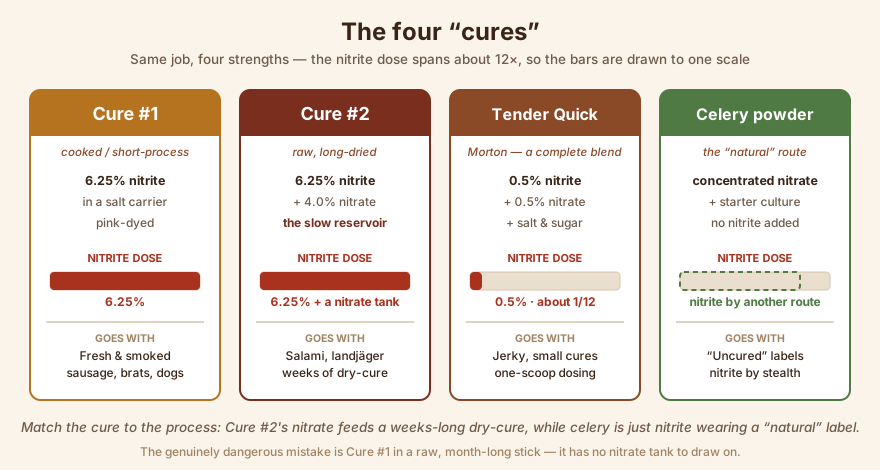
Here is where nearly every home mistake starts: there are several different products people call “cure,” they contain very different amounts of nitrite, and they are not interchangeable. Using one where a recipe calls for another is either useless or dangerous.
Cure #1 — for anything that gets cooked
Cure #1 (also sold as Prague Powder #1, Insta Cure #1, or pink curing salt #1) is 6.25% sodium nitrite and about 93.75% salt, dyed pink. It is the cure for any sausage that will be cooked or hot-smoked to a safe temperature and eaten within a reasonable time — fresh smoked sausage, summer sausage, snack sticks, hot dogs, bacon, and the cooked Landjäger method. Its nitrite does its protective work through the cure and the cook and is then largely spent. If your sausage is going to be cooked, Cure #1 is almost certainly what you want.
Cure #2 — for anything raw that dries for weeks
Cure #2 (Prague Powder #2, Insta Cure #2) is the same 6.25% sodium nitrite plus an additional 4.0% sodium nitrate, dyed pink. That extra nitrate is a slow-release reservoir: over the weeks a raw sausage hangs and dries, bacterial enzymes convert the nitrate into fresh nitrite a little at a time, keeping the sausage protected the entire time it’s drying with no cook step to fall back on. Cure #2 is for dry-cured, raw, never-cooked products — salami, saucisson, traditional Landjäger. Using Cure #1 in a weeks-long dry stick leaves the back half of the dry with nothing protecting it; using Cure #2 in a cooked sausage buys no safety and, as the sausage-forum recipes note, tends to give “a very hard link.” Match the cure to the process: cooked → #1, raw-and-dried → #2.
Morton Tender Quick — a complete blend, and much weaker
Morton Tender Quick confuses people constantly, so read this carefully. It is not a concentrated pink cure — it’s a complete curing mix: mostly salt and sugar, with only about 0.5% sodium nitrite and 0.5% sodium nitrate. That’s roughly one-twelfth the nitrite concentration of Cure #1. Because it carries nitrate as well as nitrite, it behaves a little like Cure #2 in that one respect, but it is a fundamentally different product used at a fundamentally different rate — you use it by the tablespoon per pound of meat, following Morton’s directions, and you cut back your other salt because Tender Quick is mostly salt. You cannot swap Tender Quick for Cure #1 gram-for-gram — a teaspoon of Cure #1 and a teaspoon of Tender Quick deliver wildly different amounts of nitrite, and confusing them is a real hazard in both directions (way too little, or, if you scaled up thinking it was weak, way too much salt). It’s a legitimate, old-fashioned home cure — my mother’s summer sausage recipe uses it — but it lives in its own system, not the Prague-powder system.
”Celery powder” and the “uncured” lie
Walk down the grocery aisle and you’ll see bacon and hot dogs labeled “uncured — no nitrates or nitrites added.” This is, to put it plainly, marketing that verges on dishonest, and you should understand it because it’s genuinely misleading. Those products are cured with celery powder or celery juice, which is naturally very high in nitrate; a starter culture converts that nitrate to nitrite in the meat — so the product is cured with nitrite by another route. It is chemically the same nitrite doing the same job. The only true statement on the label is “no synthetic nitrite added.” Worse, the natural route is often less precisely controlled, so “uncured” products can carry nitrite levels as high as or higher than conventionally cured ones. Say it plainly, the way I will: “uncured, celery-powder” bacon is cured bacon. There’s nothing wrong with using celery powder if you understand what it is — but don’t let anyone sell you the idea that it’s nitrite-free, because it isn’t.
The arithmetic — show your work, every time
Here’s the math that makes Cure #1 safe, and it’s worth doing by hand once so you trust it forever. The standard dose is 0.25% of the meat block, which is 2.5 grams of Cure #1 per kilogram of meat:
Sodium nitrite delivered = 2.5 g Cure #1 × 6.25% nitrite
                         = 2.5 × 0.0625
                         = 0.15625 g per kg
                         = 156 ppm      ← exactly the USDA comminuted-product ceiling
That 156 parts per million is the legal maximum ingoing nitrite for a ground/comminuted product, and the 0.25% rule is built to land right on it — enough to protect against botulism, not a milligram more than allowed. This is why the universal home ratio is “1 level teaspoon of Cure #1 per 5 pounds of meat.” Cure #2 at the same 2.5 g/kg delivers the same 156 ppm nitrite plus about 100 ppm of the slow-release nitrate reservoir.
And this is exactly why the scale matters so much: at 2.5 grams per kilogram, a 5-pound batch needs only about 5.7 grams of cure. Weigh that on a scale that only reads whole grams and you’re guessing within ±18% on a mildly-toxic, safety-critical ingredient. Weigh curing salt on a scale that reads to a hundredth of a gram. Never eyeball it, never measure it by volume, never round. Under-dose and you lose the botulism protection; wildly over-dose and nitrite is itself toxic. The window is generous enough to be perfectly safe if you weigh, and only dangerous if you guess.
The nitrite scare, honestly
You’ve heard that cured meat is a cancer risk and that nitrite is the villain, and I want to give you the honest, sourced version rather than either the panic or the dismissal.
The real chemistry: under high, dry heat (frying bacon hard), nitrite can react with amino acids to form small amounts of nitrosamines, some of which are carcinogenic. That’s the legitimate concern, and it’s why sodium erythorbate or ascorbate is added to most cured products — it substantially cuts nitrosamine formation, which is a genuine safety improvement. But two things keep it in proportion. First, the great majority of the nitrate and nitrite in the average diet comes from vegetables — leafy greens, celery, beets — not from cured meat; the “uncured” celery-powder route is a vivid demonstration of that. Second, the nitrite dose in properly cured sausage is tiny and capped by law at that 156 ppm. Cured meat is a food to eat with awareness, not terror; the botulism that nitrite prevents is a far more immediate danger than the nitrosamines it might contribute, especially once erythorbate is doing its job. I use cure, I use it correctly, and I don’t lose sleep over it — but I also don’t pretend it’s health food.
Which cure goes in which of my sausages
To make it concrete, here’s how the cures map onto what I actually make:
| Sausage | Cure | Why |
|---|---|---|
| Smoked kielbasa, fresh smoked sausage, snack sticks, summer sausage | Cure #1 | Cooked/hot-smoked to a safe internal temperature |
| The cooked Landjäger method | Cure #1 | It gets a real cook step |
| Dry-cured salami, traditional raw Landjäger, saucisson | Cure #2 | Weeks of raw drying need the nitrate reservoir |
| Mom’s summer sausage | Morton Tender Quick | An old-fashioned complete-blend cure, used her way |
| Fresh sausage cooked and eaten the same day (breakfast links, fresh brats) | No cure needed | No smoking, no aging, no low-and-slow danger zone — cook it and eat it |
That last row matters too: a fresh sausage you grind, stuff, and cook promptly doesn’t need curing salt at all. Cure is for the sausages that spend time in the danger zone — smoked low and slow, or aged for weeks. If you’re making fresh brats for tonight’s grill, skip the pink salt; you don’t need it and it would only give the meat a cured character you may not want.
The rules, in one place
Because this is the safety page, here is everything that matters, distilled:
- Cure #1 and Cure #2 are not interchangeable. Cooked → #1. Raw-and-dried-for-weeks → #2.
- Tender Quick is a different, much weaker complete blend — never swap it gram-for-gram for a Prague powder; use it by its own directions.
- “Uncured / celery powder” is cured with nitrite by another name — treat it as cured.
- Weigh curing salt to 0.01 g. Never by volume, never by eye, never rounded. 0.25% Cure #1 = 156 ppm = the legal max; that’s the target.
- Keep it dyed-pink and labeled so nobody in your kitchen ever mistakes it for salt.
- Fresh, promptly-cooked sausage needs no cure.
Do those six things and curing salt is the safe, boring, essential ingredient it’s supposed to be. Ignore them and it’s the one thing in this whole craft that can actually hurt someone. That’s why I asked you to read the page twice.
Part of Sausage Ingredients. Next: cultures and fermentation — the living ingredient that works alongside the cure. See also the cure at work on the Landjäger craft page and the 0.01 g scale that doses it.
Comments (0)