Pâté, Terrine and the Family
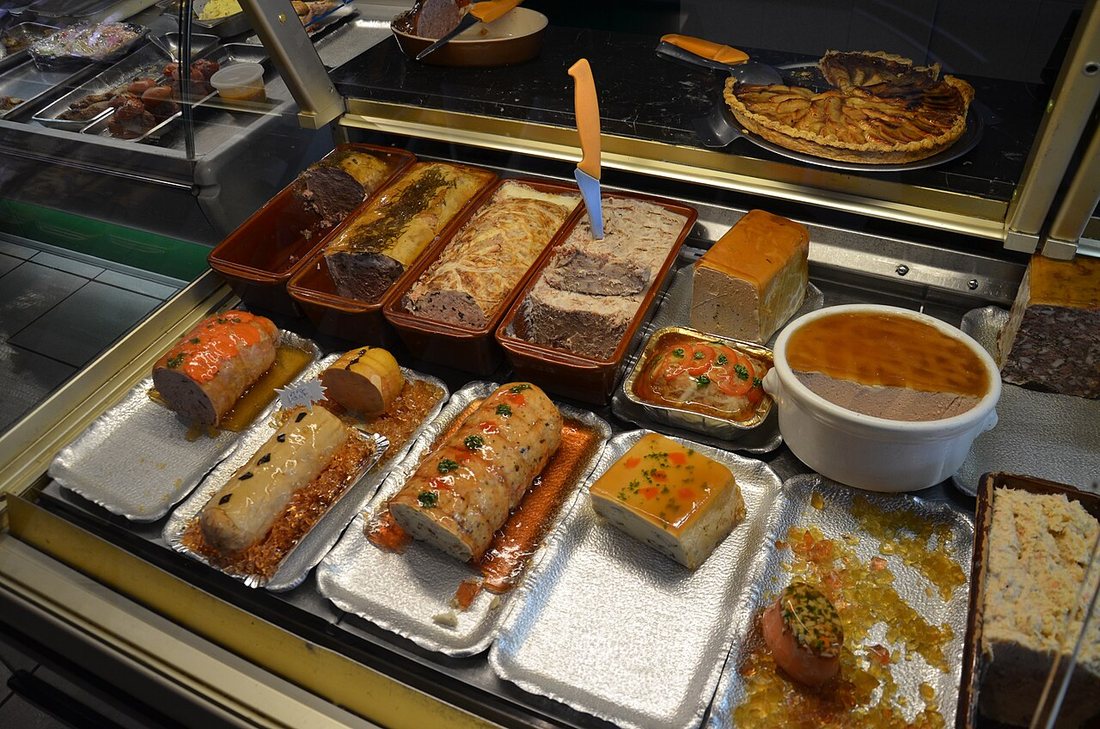
The question everyone asks — what is the difference between a pâté and a terrine? — has a short classical answer that the popular one contradicts. Escoffier (1907): “A ‘Terrine’ or Patty is only a pie without a crust.” His glossary calls the vessel a terrine à pâté, “a special utensil in which patties are cooked.” In the classical usage, a terrine is a pâté that has lost its crust, and the word for the pot became the word for what was cooked in it.
The popular rule — pâté is smooth, terrine is coarse and sliced — is not the classical distinction, and it does not survive a French menu. The French themselves say pâté de campagne and terrine de campagne interchangeably for the same coarse pork forcemeat. What the names really record is history: pâté meant a pastry (c. 1170), terrine meant an earthenware pot (1412), and the crust became optional over the following centuries (see History and Words). The more useful way to sort the family is by what holds the dish together: a forcemeat set by heat, a liver set by egg or butter, meat held in its own fat, or pieces held in jelly.
The kitchen these pages are written for has made liver pâté and a country terrine, and has a terrine mold, a meat grinder and a sous vide circulator.
Forcemeat terrines
A forcemeat is ground or puréed meat and fat, seasoned with salt, that sets into a sliceable gel when cooked. The four-way division taught in American culinary schools — the Culinary Institute of America’s taxonomy, as reproduced by The Culinary Pro — is:
- Country (campagne): rustic and coarse, usually pork and pork fat with liver and garnish.
- Straight: smooth, made by grinding progressively through finer plates and often sieving.
- Gratin: part of the protein, commonly pork or poultry liver, is browned before it goes into the raw mix. Escoffier had the same idea in 1907: a quarter to a fifth of browned “gratin stuffing” stirred through a raw game forcemeat.
- Mousseline: lean veal, poultry, fish or shellfish puréed and lightened with egg white and cream.
The fat ratio has changed. Escoffier’s forcemeats for pies and terrines run about one part fat to one part lean; the modern professional norm is two parts lean to one of fat. Both are sourced — they are different eras, not a contradiction. See Forcemeat Terrines and The Science of a Forcemeat.
Liver pâtés, parfaits and mousses
This is the branch most English speakers mean by “pâté.” A parfait, in the working definition, starts from raw livers puréed with eggs, wine and seasoning and baked gently in a water bath; a professional variant (Sally Abé) uses no oven at all, carrying the blend to 68 °C (154 °F) with boiling reduced liquor and setting it with gelatine. A mousse is usually described as cooked livers blended with butter or cream, but no firm professional definition was found, and Escoffier treated mousse and mousseline as “the same substance” differing only in how they are molded. A plain liver pâté can be either cooked or raw-set. The Danish leverpostej — pork liver and lard bound with flour and egg and baked in a loaf pan — is the everyday northern version. See Liver Pâtés, Parfaits and Mousses.
Pâté en croûte
The original pâté: a forcemeat and garnish baked in pastry, the gap left by shrinking meat filled afterwards with jelly. The English raised pie, with its hot-water crust, is its cousin; Mrs Beeton (1861) says of that crust that it “answers just as well for raised pies, for the crust is seldom eaten.” The French egg-and-butter crust was the edible one. At the modern world championship the jelly is scored out of 30 — the same as the pastry. See En Croûte, Galantine and Ballotine.
Galantine and ballotine
The two are usually confused, and Escoffier separates them by cut, method and temperature, not shape. A galantine is a whole boned bird rolled around forcemeat and garnish, poached in stock, and served cold with its own jelly. A ballotine, in his usage, is a boned leg — “useful for disposing of any odd legs of fowls” — stuffed and braised, served hot or cold. The modern menu habit of calling any rolled, stuffed breast a ballotine is a drift from that. See En Croûte, Galantine and Ballotine.
Rillettes and potted meats
Here the binder is fat. Rillettes are pork (or duck, rabbit, fish) cooked slowly in fat for hours, shredded, and packed under fat; rillons are the same cook with the cubes left whole. British potted meats and shrimp are pounded or gently heated in butter and sealed under clarified butter. Escoffier gave no rillettes recipe: they were “the province of the pork-butcher.” A fat seal excludes air, which is not the same as making a pot safe — see Food Safety and Rillettes and Potted Meats.
Aspics and head cheese
Here the binder is gelatin, usually drawn from the animal itself. Head cheese (fromage de tête) is the meat of a pig’s or calf’s head simmered until its stock sets on its own; it contains no dairy. Vinegared, it is souse. Jambon persillé is ham and parsley set in a wine-and-vinegar broth made gelatinous with feet. Oeufs en gelée and other molded aspics set whole pieces in clarified jelly. Escoffier wanted aspic as soft as it would stand: “the greater the viscosity of the jelly the less value will the same possess.” See Aspic and Head Cheese.
Foie gras preparations
Foie gras is the one member of the family with a legal vocabulary. French decree categories, as summarised in secondary sources, run from foie gras entier (whole lobes) through bloc (emulsified liver) to parfait (at least 75% foie gras). A home foie gras terrine is, by the French definition, mi-cuit — pasteurized below 100 °C. The traditional torchon is rolled in cloth and poached off the heat, in water that has stopped boiling. See Foie Gras.
Fish and vegetable terrines
A fish terrine is usually a mousseline — Escoffier calls that forcemeat “particularly suited to preparations with a shell-fish base.” Vegetables contain no gelatin, so a vegetable terrine needs a setting agent or pressure: jelly, gelatin, fresh cheese, or simply a weighted press overnight. Fish rillettes are a confit rather than a forcemeat. See Fish and Vegetable Terrines.
American and world cousins
The family is wider than France. In US federal law (9 CFR 319.182), braunschweiger and liverwurst must each contain at least 30% liver; braunschweiger is limited to pork, beef or veal liver and is the one allowed a smoked character. Scrapple, goetta and livermush are one German grain-and-offal family set in loaves and fried in slices — cornmeal and buckwheat in Pennsylvania, pinhead oats in Cincinnati, cornmeal in North Carolina, where a food writer calls livermush “a delicious paté that lacks a pedigree.” Elsewhere: Danish leverpostej, German Leberkäse (which, confusingly, need not contain liver when sold under the Bavarian name), the Vietnamese liver pâté in a bánh mì, Ashkenazi chopped liver — a coarse cooked-liver spread bound with egg and schmaltz — and Belgium’s protected pâté gaumais, which is a pâté en croûte, not a spread. See American Cousins and Around the World.
The family at a glance
| Form | What holds it together | Cooked how | Served | Page |
|---|---|---|---|---|
| Country / straight / gratin terrine | heat-set meat protein, egg, panade | baked in a water bath | cold, sliced | Forcemeat Terrines |
| Mousseline terrine | egg white and cream | gentle water bath | cold or warm | Forcemeat Terrines |
| Liver pâté / parfait / mousse | egg, butter, sometimes gelatine | water bath, or hot liquid in a blender | cold, spread or sliced | Liver |
| Pâté en croûte | forcemeat + pastry + jelly | baked | cold, sliced | En Croûte |
| Galantine | forcemeat inside the bird’s skin + jelly | poached | cold | En Croûte |
| Ballotine (classical) | stuffed boned leg | braised | hot or cold | En Croûte |
| Rillettes / potted | fat | slow-cooked in fat, or heated in butter | cold, spread | Rillettes |
| Head cheese / aspic / persillé | natural or added gelatin | simmered, then set | cold, sliced | Aspic |
| Foie gras terrine / torchon | the liver’s own fat | mi-cuit, gentle poach or bath | cold | Foie Gras |
| Vegetable terrine | jelly, cheese or pressure | assembled, pressed | room temperature | Fish and Vegetable |
| Scrapple / goetta / livermush | cooked grain | simmered, set, then fried | hot, sliced | American Cousins |
Recipes in the collection
- Country Terrine · Country Terrine with Black Pepper & Thyme · Pork Terrine
- Chicken Liver Pâté (Jacques Pépin) · Chicken Liver Parfait (Sally Abé) · Baked Chicken Liver Mousse (Terrine-Style)
- Leverpostej (Danish Liver Pâté) · Chopped Chicken Liver
- Duck Pâté en Croûte · Chicken Galantine with Duck and Foie Gras (Sous Vide)
- Pork Rillettes · Duck Rillettes · Potted Shrimp with Mace Butter
- Pressed Pig’s Head Terrine (Head Cheese) · Ham and Parsley Terrine (Jambon Persillé) · Eggs in Aspic (Oeufs en Gelée)
- Foie Gras Torchon · Salmon and Whiting Terrine · Roasted Vegetable Terrine
- Scrapple (Pennsylvania Dutch) · Goetta (Cincinnati Pork and Oats) · Livermush (North Carolina) · Braunschweiger Leberwurst
Comments (0)