American Cousins
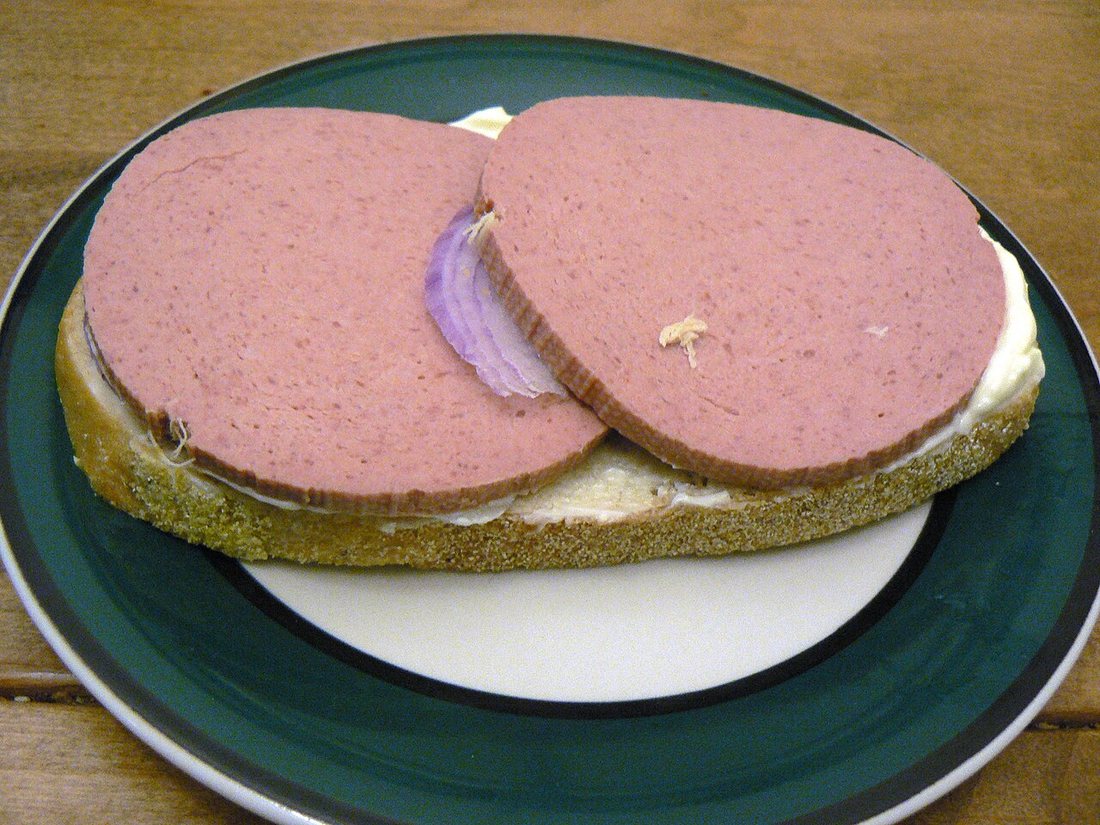
The United States has its own pâtés, and it rarely calls them that. Liverwurst is a liver pâté in a casing. Scrapple, goetta and livermush are country terrines of pork and offal, stretched with grain, set in a loaf pan, sliced and fried for breakfast. Souse and hog head cheese are head cheese under American names, and canned potted meat is the industrial heir of the English potted pot. Sheri Castle, writing in Southern Living in August 2026, calls livermush “a delicious paté that lacks a pedigree”, which is a fair description of the whole family.
Most of these foods came with German-speaking immigrants, and the regional differences are largely differences of grain.
Liverwurst and braunschweiger: what US law says
The federal standard is 9 CFR 319.182, “Braunschweiger and liver sausage or liverwurst”, effective 19 August 1982. (Section 319.281, sometimes cited for liver sausage, is the standard for Bockwurst.)
| Braunschweiger (319.182(a)) | Liver sausage / liverwurst (319.182(b)) | |
|---|---|---|
| Kind of product | cooked sausage | cooked sausage |
| Minimum liver | 30%, computed on the weight of the fresh livers | 30% |
| Whose liver | pork, beef and/or veal only | pork, beef, veal, sheep or goat |
| Other | ”may have a smoked taste characteristic” | may contain byproducts |
Both need at least 30% liver. The legal differences are the species allowed and the smoke. Braunschweiger may be labelled “Braunschweiger—A Liver Sausage” or “Braunschweiger—A Liverwurst”. Wikipedia states that in American usage braunschweiger is “almost always smoked” and liverwurst “is never smoked”; the “never” is a generalization, and the regulation does not forbid smoking liverwurst.
The name has also drifted. In Germany, “Braunschweiger” is not a liver sausage at all: under German food law it names a kind of Mettwurst (Wikipedia). The American meaning is a drift.
In structure, a liverwurst is a liver pâté forced into a casing and cooked: a fine forcemeat of liver, pork and fat, set by heat. The collection’s Braunschweiger Leberwurst belongs here.
Scrapple
Scrapple is the Mid-Atlantic member, a breakfast staple in Philadelphia and Baltimore. It descends from the Low German panhas, carried by German settlers around Philadelphia and Chester County in the seventeenth and eighteenth centuries; Pennsylvania Dutch Pannhaas is glossed as “pan tenderloin”, and “scrapple” is a diminutive of scrap (Wikipedia). Claims that it has pre-Roman roots have no source.
The method is a two-stage cook. Hog offal and trimmings — head, heart, liver — are boiled for broth; cornmeal is cooked in that broth into a mush; the minced meat goes back in; the whole is seasoned, commonly with sage, thyme and savory, and set in loaves. The grain is cornmeal and wheat flour, often buckwheat.
The collection’s Scrapple (Pennsylvania Dutch), from Chichi Wang, is typical in shape: pork butt and two trotters simmered about 3 hours; 4 oz (115 g) of pork liver seared and diced in; 2 cups of cornmeal whisked into 7 cups (1.66 L) of the stock and cooked “thick like polenta”; ½ cup of buckwheat flour whisked in during the last 10 minutes; set in a 9×5 in pan at least 3 hours; sliced ¾ in thick and fried crisp in cast iron. No US labelling standard for scrapple was found.
Goetta
Goetta is Cincinnati’s. It came with nineteenth-century German immigrants from Oldenburg, Hanover and Westphalia, and its name is Low German Götte, “groats” (Wikipedia). It is pork, sometimes with beef, cooked with steel-cut (pinhead) oats and bay, rosemary, pepper, clove, thyme and onion, set in loaf pans, then sliced and fried.
It is also the most commercial of the three. Sander Packing was the first commercial maker; Glier’s, founded in 1946, makes over a million pounds a year, 99% of it eaten locally, and has run Glier’s Goettafest in Newport, Kentucky, since 2002. Wikipedia states that “USDA standards mandate at least 50% meat content”; no CFR section was found to confirm it.
The collection’s Goetta (Cincinnati Pork and Oats), from Jed Portman, has no liver in it, which is correct: goetta is a grain-and-pork loaf. A 3 lb (1.36 kg) bone-in shoulder is oven-braised with onion, celery and bay, the meat is ground and returned to 8 cups of the liquid with 2½ cups (400 g) of pinhead oats, and the pot bakes uncovered about 2 hours, stirred often, until it becomes a thick paste. It chills at least 10 hours in three loaf pans and is fried in ½-inch slices, which the source warns are delicate.
Livermush
Livermush belongs to western North Carolina: pig liver, head parts, cornmeal, pepper and sage (Wikipedia). Sheri Castle describes it as “a puree of pig’s liver and spices bound with enough cooked cornmeal mush to make it moldable and sliceable”, and names the distinction from its neighbour: “The higher proportion of cornmeal is what distinguishes livermush from liver pudding.” It is cooked, not smoked, grew up in the mill and furniture-factory towns of the western foothills, and is traditionally eaten seared, with yellow mustard. According to Castle, all five remaining commercial producers are in North Carolina.
Two widely repeated facts do not hold up cleanly:
- “By North Carolina law, livermush must be at least 30% pig liver.” This is stated by Wikipedia; the statute or rule could not be located. It may be true, but it is unconfirmed.
- The Shelby festival. Wikipedia calls it the Livermush Exposition, held since 1987; Castle, writing in 2026, names it “Mush, Music & Mutts”, with about 10,000 attendees. Either the sources disagree or the festival was renamed; no date for a renaming was found. Drexel and Marion also hold livermush events, and the Shelby producers are Jenkins Foods and Mack’s Liver Mush.
A derivation from German settlers’ pon hoss, and a surge in popularity during the Depression, are proposed but unsourced.
The collection’s Livermush (North Carolina) follows Steven Goff’s version in Garden & Gun, which is a restaurant variant: 8 oz (225 g) of seared pork liver, 1 lb of cooked pulled pork, onion, garlic and sage are simmered in a quart of beef broth, stick-blended, then cooked about an hour with 1 cup of grits in place of a cornmeal mush, tightened with cornmeal a tablespoon at a time, molded overnight, sliced an inch thick, dredged in cornmeal and fried.
One family, three grains
Set side by side, scrapple, goetta and livermush are the same German idea: a grain-and-offal stretcher, in which a pig’s lesser parts and their broth are thickened with cheap grain until the pot sets into something that can be sliced. What changed was the local grain:
| Region | Grain | Liver | |
|---|---|---|---|
| Scrapple | Pennsylvania, Philadelphia, Baltimore | cornmeal, wheat or buckwheat flour | among the offal |
| Goetta | Cincinnati | pinhead oats | none |
| Livermush | western North Carolina | cornmeal (more than liver pudding) | defining |
All three are then treated identically: chilled in a loaf pan, sliced, fried hard.
Souse and hog head cheese
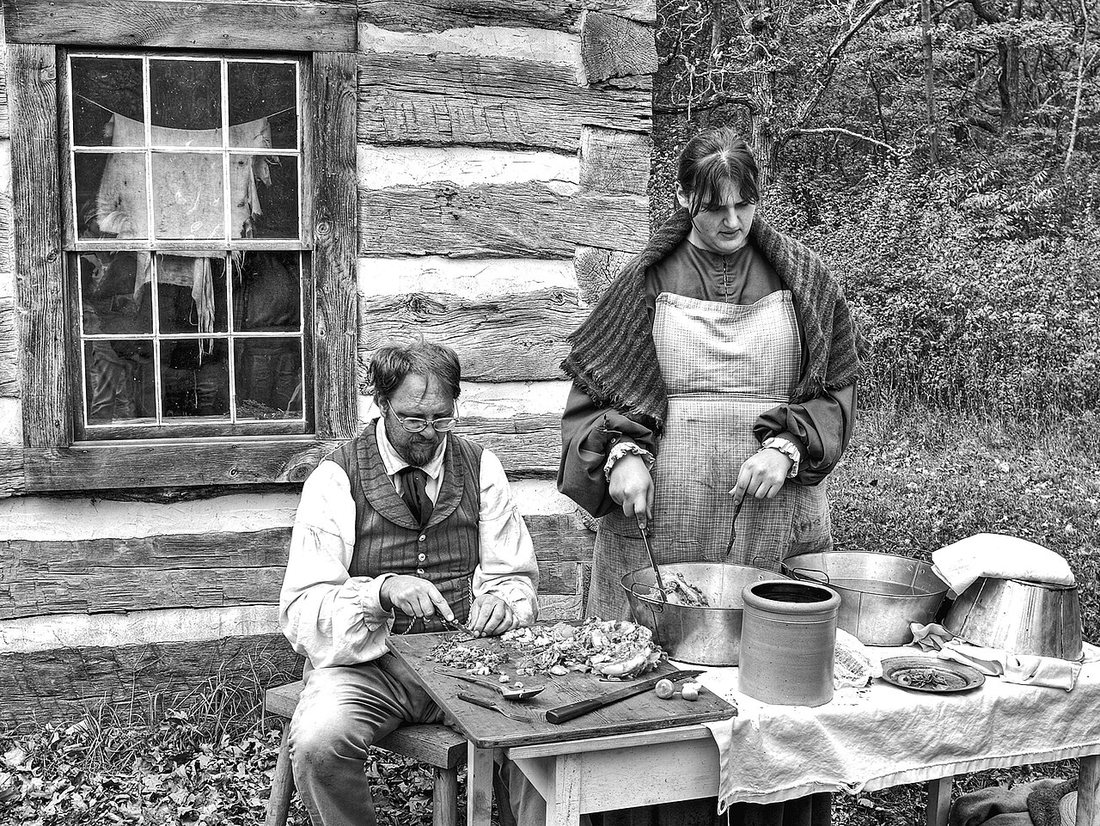
Head cheese is meat from the head set in its own jelly; it contains no dairy (see Aspic and Head Cheese). In North America the vinegar-sharpened version is called souse. Louisiana hog head cheese is a heavily seasoned cold cut sharpened with green onion and vinegar (Wikipedia).
Caribbean souse is a different dish with the same name. In Barbados and Trinidad it is pig’s feet, chicken feet or cow tongue served in a brine of water, lime, cucumber, hot pepper and salt, a cold pickled dish traditionally eaten on Saturday mornings. It is not set.
The collection has two souse sandwiches: the Hog Head Cheese (Souse) Sandwich and the Souse (Pickled Pork) and Onion Sandwich.
Potted meat and deviled ham
English cooks potted meat by packing it hot into a pot under a seal of butter or fat; Hannah Glasse (1748) pounds cold tongue, beef or venison with melted butter and anchovy and covers it with clarified butter. The canned “potted meat food product” is its industrial descendant.
The American landmark is the William Underwood Company of Boston, founded in 1822. It produced the first canned deviled ham in 1868 and trademarked its devil logo in 1870. The company describes it as “the oldest food trademark still in use in the United States”; that superlative is the company’s own claim and was not independently confirmed. Underwood’s canning also had a scientific side: in 1895–96 the firm worked with MIT (Prescott, and W. L. Underwood) to establish that spoilage spores die at 250 °F (121 °C) for 10 minutes in a retort.
That retort is what separates the can from the crock. The CDC advises pregnant women, adults over 65 and people with weakened immunity to avoid refrigerated pâtés and meat spreads and to choose ones “in sealed, airtight containers that don’t need to be kept refrigerated before opening.” A commercially retorted can is safe for that reason; a home-canned pâté is not, and no tested home process could be found (see Food Safety).
Comments (0)