History and Words
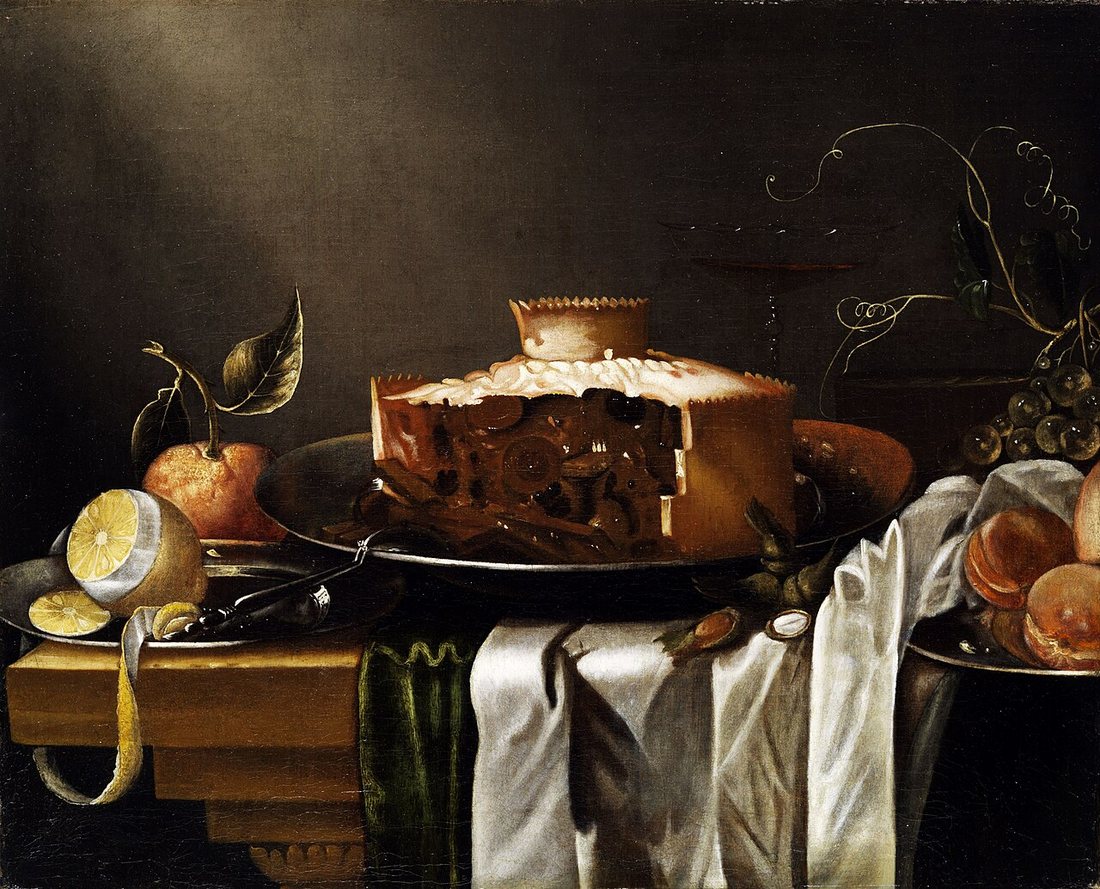
The vocabulary of this family is older than the dishes it now names, and almost every word in it has moved. “Pâté” meant a thing made of dough; “terrine” meant a pot; “galantine” meant a jelly for fish; “aspic” meant a sauce, served hot. Each word drifted from the container or the medium toward the food, and the modern menu inherits the drift without the history.
The history of who made these dishes is just as surprising. In medieval and early-modern Paris the pâté belonged to the pastry-cook, not the pork-butcher, and the pork-butcher was forbidden to sell raw meat at all. The crust was a container, a preservative and at times a shipping crate. The crustless terrine is the late arrival.
The words
Pâté. The French dictionary of record, the Trésor de la langue française (TLFi), gives the first sense c. 1170, in Chrétien de Troyes’ Érec et Énide: “a pastry that encloses meat and fish.” It is pâte (dough) plus the suffix -é — literally a dough-thing. English borrowed pâté in 1706 as “small pie or pastry” (Etymonline), but it already had its own crust-word, pasty, from c. 1300.
Croûte. Crouste in the sense “the pastry wrapping a pâté” is attested c. 1165 — earlier than the sense “outer part of bread.” So pâté en croûte is, etymologically, a dough-thing in dough. The phrase only became necessary once pâté stopped implying a crust; when it first appears could not be established.
Terrine. TLFi records therine, “earthenware vessel,” in 1412 (executors’ records at Tournai), from Old French terrin, “of earth.” The sense “what has been cooked in a terrine and is served cold” arrives only in 1684, in a letter of Mme de Sévigné dated 18 September. The pot is about 270 years older than the dish named after it. And the English side adds a twist: Etymonline calls terrine “the obsolete but original form of tureen.” Terrine and tureen are the same word.
Galantine. The earliest form, galentine c. 1223, is defined by TLFi as “a jelly in which fish or meat is served.” Its derivation, in TLFi’s words, is probably from the Dalmatian Romance of Ragusa (Dubrovnik), galatina, from Latin gelare, “to congeal” — Ragusa being known for exporting fish in jelly. A rival scholarly hypothesis proposes a Gallo-Roman *galare. The popular derivation from Old French géline, “hen,” is folk etymology: the earliest sense is a jelly, and it was used of fish. The fourteenth-century Viandier shows what the word meant in the kitchen: pike and eel cooked in wine and vinegar, the liquor thickened and spiced, then set aside in an earthen or wooden vessel “to cool,” the fish laid in it. Two other theories circulate. Galangal did appear in some medieval galantine sauces — the Viandier’s includes it — but the Ménagier de Paris’s galantines for carp and for skate contain none, so it was an occasional spice, not the defining one. The galant, “elegant,” theory has no dictionary support, since the word is attested long before galant meant elegant.
Aspic. TLFi’s first culinary citation (Marin, 1742) lists “ravigote or aspic” among little sauces. An earlier instance turns up in Le Cuisinier gascon (Amsterdam, 1740), where roast chickens are dished with “a sauce à l’aspic underneath” — a hot sauce poured under a roast. Etymonline notes that the oldest English recipes are “vinegar-based liquid sauces, not necessarily served cold.” The first aspic was a sauce; the jelly evolved later. Why “aspic” at all is contested three ways: molds shaped like a coiled snake (Dauzat), jelly with snake-like colors (Bloch-Wartburg), or aspic, spike lavender, as a seasoning (Etymonline, hedged). The popular “cold as an asp” explanation appears in no dictionary consulted.
Charcutier. The word comes from chair cuite, “cooked flesh” (TLFi) — not from chair and couper, “to cut meat,” as is often assumed. The old spelling chaircuttier (1464) invites the error.
Rillettes. First attested in 1836, in Balzac’s Le Lys dans la vallée, where the schoolboy narrator never gets to see “cette brune confiture” — this brown jam — spread for him on bread. It is a Touraine diminutive of Middle French rille, a long strip of pork fat, from Latin regula, “straight stick.” Rillettes and “ruler” share a root.
Farce and forcemeat. Culinary farce is early fourteenth century, from Late Latin farcire, “to stuff.” The theatrical farce is the same word: comic interludes stuffed into religious drama “like stuffing into a dish” (TLFi). English forcemeat dates from the 1680s. Potted, of meat, is from the 1640s.
The Paris guilds
René de Lespinasse’s edition of the Paris guild statutes (1886) prints the documents in full, and they overturn the modern picture of the charcutier’s pâté.
- The pâté was the pastry-cook’s trade. A royal ordinance of 1351 allowed pasticiers to keep their pâtés only one day. The pâtissiers’ statutes of 4 August 1440 banned pâtés of measly or stinking meat and the sale of reheated pâtés. A 1522 petition admitted the obvious: a pâté sold cheaply had to be filled with meat “kept and abandoned since Thursday or the week… stinking and corrupt,” and the guild set a price floor of five deniers, on pain of the goods being thrown in the Seine. A crust hides what is inside, and the regulation targeted exactly that.
- The charcutiers could not sell raw meat. Their first statutes are dated “1475” in the text and 17 January 1476 by Lespinasse — the same document, in Old Style and New Style reckoning. Article 15 forbids them to sell any raw flesh “except bacon fat”; the butchers held the privilege of slaughter and sale. Article 6 forbids them to sell herring, because the sausages made on herring days might “taste of herring.” Article 12 limits sausage-making to the cold months, from 15 September to Shrovetide.
- Their customers had no hearth. Letters patent of 1513 describe the trade’s buyers as the poor of Paris, “most of whom have neither fire nor place.” Cooked-meat shops existed because many Parisians could not cook.
- By 1745 the pâtissier had to buy his pork from the charcutier. The statutes of 28 July 1745 barred pâtissiers, traiteurs and rôtisseurs from the charcutier’s trade and required them to use only fresh pork and lard bought from master charcutiers.
When the charcutier took over the pâté and the terrine is not documented in the sources read. The 1791 abolition of the guilds is a plausible turning point, but no source consulted makes the link.
The crust as container and crate
The Viandier already names both options: a recipe “for paste en pot” chops the meat “as for a paste en pate” — pâté in a pot versus pâté in pastry. The crustless version existed in the fourteenth century, but it was a hot dish. The Ménagier de Paris (c. 1393) cooks its pasté en pot de mouton “in a well-covered pot” and dishes it out hot, closer to a hash than a sliced cold terrine. The Ménagier also shows the household sending its meat out “to the pâtissier” to be chopped and baked, and pouring sauce into the baked pie — the ancestor of filling a pâté en croûte’s gap with jelly.
La Varenne’s Le Cuisinier françois (1651) bakes a ham in pâte bise, coarse brown-flour pastry, for five hours if it is large, and serves it “cold, in slices.” He sorts his pâtés into those for eating hot and those “for eating cold,” and offers veal pâté in either pâte fine or pâte bise. The usual reading is that the fine crust was eaten and the coarse one was a case; La Varenne does not state that rule in the passages read.
Hannah Glasse (The Art of Cookery, 3rd ed., 1748) makes the crust’s job explicit. Her Yorkshire Christmas Pie nests a boned pigeon, partridge, fowl and goose inside a large turkey, adds hare and woodcock and four pounds of butter, and bakes four hours. “This Crust will take a Bushel of Flour… These Pies are often sent to London in a Box as Presents; therefore the Walls must be well built.” The crust was a structural, travelling container.
Victorian aspic and American gelatin
Mrs Beeton (1861) defines aspic as “a savoury jelly, used as an exterior moulding for cold game, poultry, fish, &c.,” transparent so the bird can be seen through it. Her ornamental aspic starts from a knuckle of veal and a cow-heel, simmered four hours and clarified with three eggs. She also quotes Liebig’s verdict that gelatine “possesses no nutritive value” — the scientific demotion of a jelly that earlier cookery had treated as nourishment. Beeton has no galantine entry at all. Escoffier’s Le Guide culinaire (1907) gave cold preparations — galantines, pâtés, terrines — their own chapter and asked of an aspic that it be “succulent, absolutely limpid, and set just right.”
Boxed gelatin arrived by the 1870s, and Knox sold the first commercial granulated gelatin in 1894, as reported in secondary sources. Perfection Salad — cabbage, celery and red pepper in a plain aspic — is credited to Mrs. John E. Cook of New Castle, Pennsylvania, in 1904. It is often said to have won third prize in a Better Homes and Gardens contest, but that magazine was founded in 1922, so the sponsor is wrong as usually told; the real sponsor, commonly said to be Knox, could not be confirmed. Gelatin salads became a 1950s suburban marker of owning a refrigerator and fell from fashion in the 1960s–70s as French cooking became the new standard. The widely repeated claim that a third of 1920s cookbook salads contained gelatin rests on a secondary source whose basis was not checked.
Myths corrected
| Popular claim | What the sources show |
|---|---|
| Terrine and pâté are ancient, distinct categories | ”Pâté” is the pastry (c. 1170); “terrine” the pot (1412) and the cold dish only from 1684. The modern distinction is recent. |
| ”Charcutier” means meat-cutter | From chair cuite, cooked flesh. |
| Galantine comes from géline, hen | Probably Ragusan galatina, from gelare; first sense a jelly, for fish. |
| Aspic is named for being “cold as an asp” | Not in any dictionary; the first aspics were sauces, one served hot. |
| The charcutiers’ guild dates from 1475 — or 1476 | Both: one statute, Old Style and New Style. |
| Medieval pâté crusts were never eaten | Not documented as a rule; La Varenne offers fine and coarse crusts. |
| Perfection Salad won a Better Homes and Gardens prize in 1904 | The magazine did not exist until 1922. |
Foie gras has its own set of corrected origin stories; see Foie Gras. For what the words mean now, see Pâté, Terrine and the Family.
Recipes in the collection
- Duck Pâté en Croûte — the crust as container, with jelly poured into the gap
- Chicken Galantine with Duck and Foie Gras (Sous Vide)
- Pork Rillettes — Balzac’s “brown jam”
- Potted Shrimp with Mace Butter
- Potted Meat and Crackers
- Eggs in Aspic (Oeufs en Gelée)
- Tomato Aspic — a 1944 Army aspic from the gelatin era
- Pressed Pig’s Head Terrine (Head Cheese) — the Viandier’s “cheeses of boar’s head” in modern form
- Country Terrine
Comments (0)