En Croûte, Galantine and Ballotine
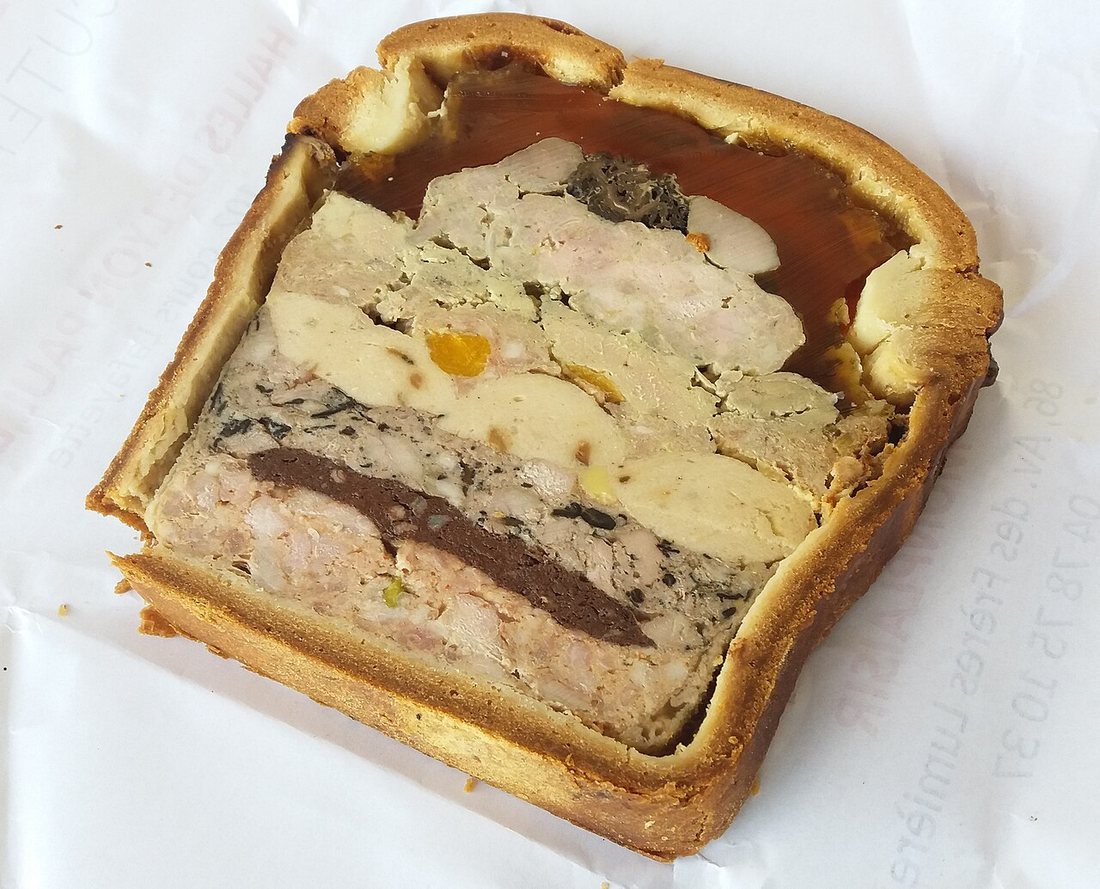
The oldest form of the family is the one with the crust. In French, pâté first meant “a pastry which encloses meat and fish” (Chrétien de Troyes, c. 1170, per the TLFi), and croûte in its early culinary sense meant “the pastry wrapping a pâté” (c. 1165). “Pâté en croûte” is therefore a redundancy: a dough-thing in dough. The phrase became necessary only once pâté stopped implying a crust. The medieval Viandier already sets paste en pot (in a pot) against paste en pate (in pastry). See History and Words.
This page covers the crusted pâté and its two crustless relatives that are built instead of packed: the galantine and the ballotine. The three share a problem. Each is a forcemeat and garnish that has to hold a shape, and each ends up with jelly in it.
Two crusts: one to carry, one to eat
By 1861 Mrs Beeton’s Book of Household Management already printed both crusts side by side, and said plainly what separated them.
- No. 1217, “Common crust for raised pies”, is a hot-water crust. Per pound of flour it takes ½ pint water, 1½ oz butter and 1½ oz lard, with the fat melted in boiling water and beaten into the flour until “quite stiff”. Beeton: “This paste does not taste so nicely as the preceding one, but is worked with greater facility, and answers just as well for raised pies, for the crust is seldom eaten.”
- No. 1216, “Pâte brisée, or French crust, for raised pies”, takes 6 oz butter, 2 eggs and ⅓ pint water per pound of flour, rubbed in cold and kept “very firm … that the sides of the pie may be easily raised”. Enriching it to equal weights of flour and butter makes it tastier, “but then it is not so easily raised.”
The trade-off is in the source: more fat makes a better eat and a weaker wall. The English hot-water crust was a structural shell. Hot and rather sticky, it can be raised by hand around a bowl or dish, and it holds heavy wet fillings (en.wikipedia). The egg-and-butter French crust (pâte à pâté) was the one meant to be eaten.
A century earlier Hannah Glasse (1748) wrote about crust as building material. Her “Standing Crust for Great Pies” is a peck of flour and six pounds of butter boiled in a gallon of water, “fit for the Walls of a Goose Pye”. Of the Yorkshire Christmas Pie, a boned turkey, goose, fowl, partridge and pigeon nested together, she says: “This Crust will take a Bushel of Flour … These Pies are often sent to London in a Box as Presents; therefore the Walls must be well built.” The crust was a shipping crate. French practice drew a similar line in the 17th century: La Varenne (1651) bakes pâtés in pâte fine or pâte bise (coarse brown-flour pastry) and serves the cold ones “par tranches”, in slices.
The mold
Beeton’s illustrations are captioned “RAISED-PIE MOULD” and “RAISED-PIE MOULD, OPEN”, so a mold that opened was a household item by 1861 (the drawing itself was not examined, so the hinge is unconfirmed). A pâté en croûte can be built in an ordinary terrine mold lined with pastry, but the sources give no way to unmold it cleanly without hinged or loose sides. A hand-raised hot-water crust needs no mold at all, which makes it the lowest-equipment way in.
Chimneys, the gap and the jelly
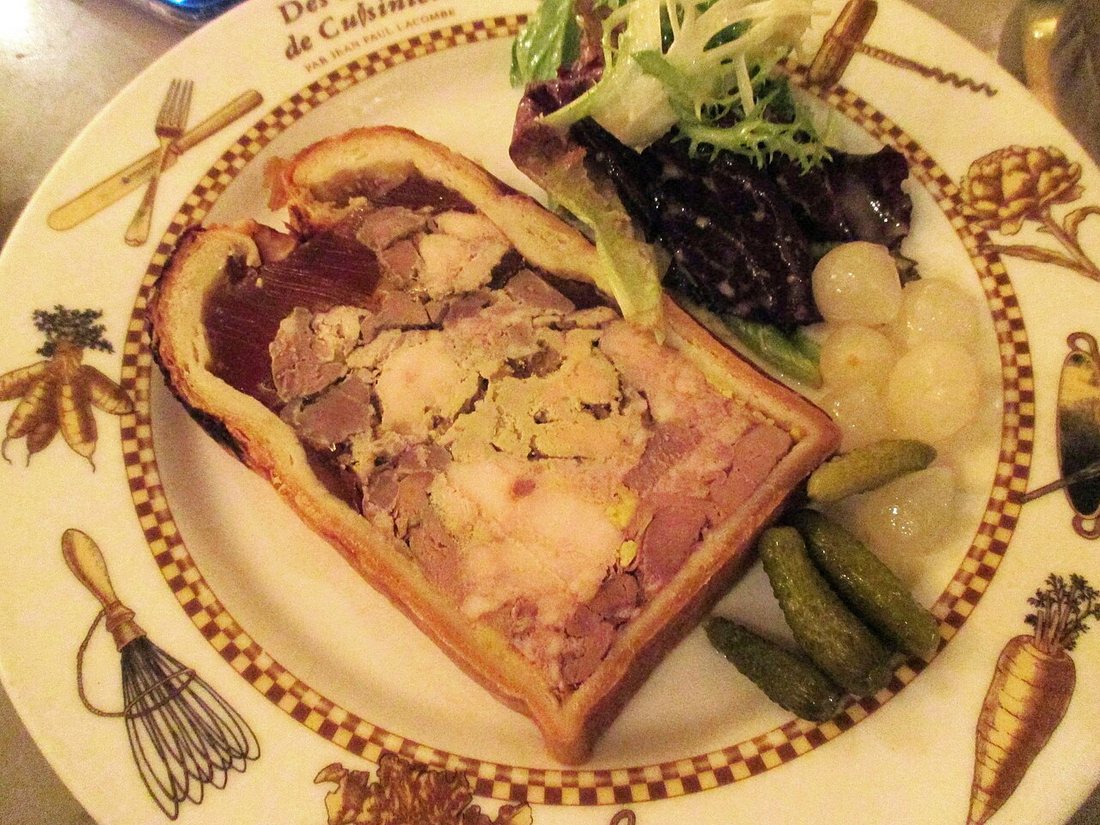
As the forcemeat cooks it shrinks away from the crust. The jelly poured in afterwards fills that gap, keeps air off the filling and, in modern competition, is scored as a component in its own right. Pouring a liquid into a baked pie is very old: the Ménagier de Paris (c. 1393) pours sauce into its beef pâtés once cooked, and the Viandier does the same for lamprey in pastry.
Chimneys. Matt Ryle (Maison François, London; Great British Chefs) makes “five holes at either end of the lid” and fits “little funnels out of tin foil” into them. Francis Derby’s duck pâté en croûte (Saveur) rings a ½-inch vent with dough and fits a foil chimney. Escoffier’s passages do not use the word; for whole hot foie gras in crust he says only to “make a slit in the top for the escape of the steam” (No. 1726). No 1907 description of a foil or card chimney was found.
When the jelly goes in is contested. The sources span the whole range from a hot pie to a cold one:
| Source | When |
|---|---|
| Beeton, 1861 (No. 1340) | Reduced gravy from the bones, poured through a funnel after baking; “when cold, it should form a firm jelly, and not be the least degree in a liquid state” |
| Escoffier, 1907 (No. 1834) | “When the pie is almost cold”, a jelly flavored with hare fumet |
| Ryle (modern London) | Once the pie is “chilled completely”, beef-stock jelly poured through the funnels to the top |
| Melton Mowbray industry | A 6% gelatin solution at 80–90 °C (176–194 °F) “immediately after baking” |
Whatever the timing, the liquid has to set firm when cold, as Beeton insists.
Core temperature: contested
Published targets disagree:
- 65 °C (149 °F): Ryle, baked at 200 °C for 20 minutes and then 180 °C until the core reaches it.
- 69 °C (157 °F): The Culinary Pro, baked at 350 °F (175 °C).
- 71 °C (160 °F): the USDA minimum for ground pork and sausage.
- 74 °C (165 °F): the USDA figure for all poultry. Derby’s duck, chicken-thigh and chicken-liver farce is baked to 165 °F.
The two chef figures sit below the USDA number for ground pork. The UK allows lower temperatures with a hold (65 °C for 10 minutes, for example). A probe reading of 65 °C with no hold, as Ryle gives it, is not the same thing. See Food Safety.
The crust as a blotter
Escoffier gives the crust a second job. The best way to cook a whole hot foie gras, he writes, “is to bake it in a crust of paste that can absorb the excess of grease produced by the melting of the liver” (No. 1726). In foie gras baked in brioche (No. 1727) the paste takes up the fat and “allows of obtaining a foie gras clear of all grease … and is therefore best suited to cold dishing.” The crust works as a blotter as well as a container. The modern championship keeps a prize for the combination: the Prix Richelieu, for “le meilleur pâté-croûte contenant du foie gras”. See Foie Gras.
The world championship
The Championnat du Monde de Pâté-Croûte was “créé en 2009 sur un pari audacieux entre amis”, founded on a bet between friends, by the Confrérie du Pâté-Croûte around the Lyon chef Christophe Marguin. The organizers’ own framing is that the dish “a souffert pendant longtemps de la charcuterie industrielle” even though it is among the most technical to make. That is their claim, not independent history.
The judging treats the jelly as seriously as the pastry. Each candidate presents two pâtés, one whole and one sliced, and the jury tastes blind. The score is out of 200: whole piece /20, plated slice /20, gelée (taste, cooking, seasoning) /30, pastry /30, and overall balance and taste of the farce /100.
- Japanese chefs have won six of the sixteen titles (2014, 2017, 2019, 2021, 2022, 2024), three of them in a row from 2019 to 2022. Belgium won in 2015. The rest went to France.
- No 2020 edition was held, because of the pandemic.
- “Held in Lyon since 2009” is too simple. The 2026 final is announced for Lyon on 30 November, but for years the final evening was held at Maison Chapoutier in Tain-l’Hermitage, in the Drôme. The venues of 2009–2012 could not be established.
At the ceremony the grand master invokes Saint Laurent for cooks, Saint Antoine for charcutiers and Saint Michel for pastry-cooks. The pâté-croûte still straddles the two old guilds.
Two protected pies
- Pâté gaumais (Belgium). A raised pie from the Gaume, in Belgian Lorraine, filled with pork cuts marinated in wine or vinegar. It must be round, at least 15 cm (6 in) across and 200 g (7 oz), and at least 30% meat. It gained a Belgian label on 12 July 1998 and EU PGI status on 9 October 2001, and had 12 producers in 2024. A contest is held at Virton every 26 December (fr.wikipedia). Belgium’s protected “pâté” is a pie, not a spread.
- Melton Mowbray pork pie (England). PGI granted 4 April 2008. It requires uncured pork, which is gray when cooked, and a hand-formed crust. Traditional recipes poured clarified butter or hot pork stock in after baking to fill the gap and keep air off the meat. Here the jelly is a seal first and a flavor second.
Galantine and ballotine: the real distinction
Menus now call almost any rolled, stuffed poultry breast a ballotine, and French Wikipedia describes the word as naming “the shaping technique itself”. Escoffier’s split is sharper. It is by cut, by cooking method and by serving temperature, not by shape.
Galantine de volaille (No. 1708). Bone the whole bird through “an incision down the skin of the back, from the head to the tail” until “the carcass is quite bare”. Spread the skin on linen. Cut the breast into ⅓-inch strips and marinate them in brandy with matching strips of truffle, salted fat pork, cooked ham and salted ox-tongue. Grind the leg meat with veal and “twice as much very fat, fresh pork” into a sieved forcemeat. Layer forcemeat and strips “alternately and regularly”, sew up the skin, and “roll the galantine in a napkin, either end of which should be tightly strung”. Poach about 1¼ hours in a white veal stock made with pork rind and the carcass. Re-roll in a fresh napkin and “cool under a weight not exceeding five or six lbs”. The cooking liquor is clarified into the jelly served with it.
Ballotines (No. 1654) are “useful for disposing of any odd legs of fowls”: boned legs, stuffed, the skin sewn shut. “Ballotines … are braised”, and may be served hot, or cold coated in jelly or chaud-froid.
| Galantine | Ballotine (Escoffier) | |
|---|---|---|
| Cut | Whole bird, boned | A boned leg |
| Cooking | Poached in stock | Braised |
| Served | Cold, in its jelly | Hot or cold |
English Wikipedia agrees that ballotines are single-serving entrées, served hot or cold, whereas a galantine is served cold. The words fit. The TLFi dates ballottines de volaille to 1739 (Marin) and derives the word from balle, a bale of merchandise, so a ballotine is a little parcel.
The galantine was a jelly before it was a bird. The TLFi’s earliest sense (c. 1223) is “the jelly in which fish or meat is served”, probably borrowed from the Dalmatian Romance of Ragusa (Dubrovnik), galatina, from Latin gelare. Ragusa was known for exporting fish in jelly. The popular derivation from géline, “hen”, is folk etymology as far as the research could find, and so is galant. Galangal was sometimes an ingredient in medieval galantine sauces but not a defining one. The etymology remains contested; the details are on History and Words.
The modern galantine
Simon Gueller’s version (Great British Chefs) swaps the napkin and stock for cling film and a circulator. A boned chicken, pounded to an even 1.5 cm (⅝ in), is rolled around strips of duck breast and foie gras and cooked in a water bath at 65 °C (149 °F) for 1½ hours, then chilled in iced water. That is the source’s time and temperature. Pasteurization time at a given temperature depends on thickness: Baldwin’s tables give poultry at 65 °C 3¾ hours at 70 mm. Measure the finished roll against them (see Equipment and Sous Vide). It is cooked and chilled, but not glazed in aspic like the classical dish. Boning is the barrier to a galantine at home, not equipment.
Recipes in the collection
- Duck Pâté en Croûte: Francis Derby’s butter-and-yolk crust, foil chimney, gelatin aspic poured at room temperature
- Chicken Galantine with Duck and Foie Gras (Sous Vide): 65 °C for 1½ hours
- Classic Terrine of Foie Gras
- Country Terrine: the same forcemeat without the crust
Comments (0)