Liver Pâtés, Parfaits and Mousses
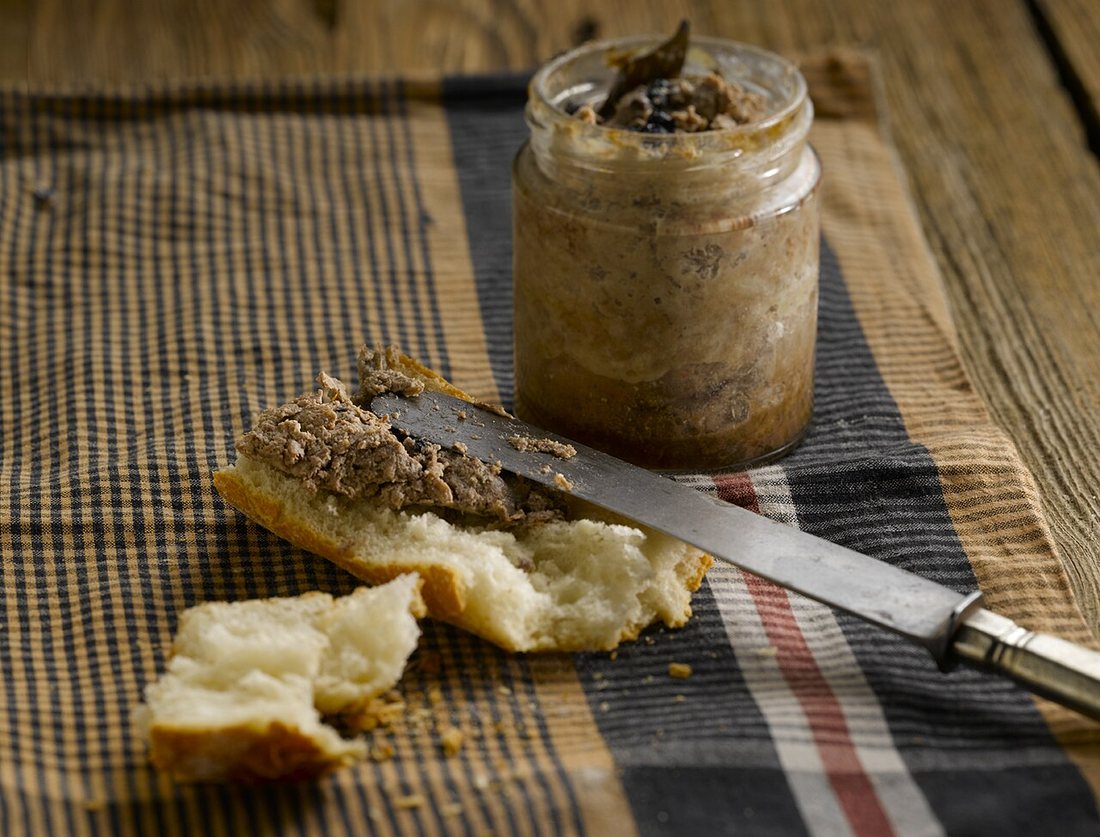
The smooth liver spread is the most familiar member of the pâté family and the one with the loosest vocabulary. Pâté, parfait and mousse are used almost interchangeably on menus, and the classical texts do not draw the modern lines at all. What does separate one liver spread from another is method — whether the livers are cooked before blending, blended to temperature, or baked raw as a custard — and that choice decides both the texture and the safety of the result.
The kitchen these pages are written for has made liver pâté and a country terrine, and has a terrine mold, a meat grinder and a sous vide circulator.
The words
- Parfait. Wikipedia’s definition is the useful one: raw livers are puréed before mixing with eggs, wine and seasonings, then cooked in a bain-marie for a smoother texture. The defining step is a raw purée set by egg (or gelatine) and gentle heat. In practice the word has drifted: some restaurant “parfaits” are seared livers blended with butter and cream. Under French law, a parfait de foie gras must contain at least 75% foie gras (Décret 93-999, as reported by French Wikipedia).
- Mousse. In current usage, cooked livers blended with butter or cream, sometimes lightened. No professional text defining it that way was reached, so the distinction is not a firm rule. The culinary mousse is attested from 1755 as a whipped sweet cream; a first date for a savory liver mousse was not found.
- Escoffier’s view. He did not draw today’s line at all: “the substance is the same from which mousses and mousselines are prepared,” differing only in how they are molded (No. 1740, 1907).
Pain de foie gras (Escoffier No. 1741) is the classical precedent for mounting a liver with butter: reduced Madeira braising liquor, four yolks and half a pound of butter worked “as for a Hollandaise sauce,” two gelatine leaves, then sieved foie gras folded in while lukewarm.
And a surprise from the same book. Fresh foie gras travels badly, so, Escoffier writes, “it is preferable to buy the Parfait of foie gras ready-made from a good firm rather than to try to make it oneself” (No. 1742). Some of the “classic” preparations were bought in even in his kitchen. See Foie Gras.
Three methods, side by side
The three chicken-liver recipes in the collection were chosen because each represents a different way of getting from raw liver to a smooth spread.
| Poach, then blend | Blend to temperature | Raw emulsion, baked | |
|---|---|---|---|
| Recipe | Pépin (Food & Wine) | Sally Abé (Great British Chefs) | Chichi Wang (Serious Eats) |
| Livers | ½ lb (225 g) | 400 g (14 oz) | 1 lb (450 g) |
| How the liver is cooked | Simmered covered in ½ cup water with onion, garlic, bay and thyme, about 3 min to “barely pink inside,” then 5 min standing | Blitzed raw while boiling reduced brandy and Madeira is poured on; the hot liquid carries the blend to 68 °C (154 °F) | Blended raw with 2 eggs, ½ cup cream, brandy and spices, then baked in a covered water bath at 250 °F (120 °C) |
| Fat | 12 tbsp (170 g) butter, added 2 tbsp at a time | 50 g butter, blended in | 6 oz (170 g) blanched salt-pork backfat, added slowly with the blender running |
| What sets it | Chilled butter | 4 gelatine leaves; set over ice at least 4 h | Egg and cream, as a custard |
| Sieved | No | Yes, fine sieve | Yes, strained |
| Doneness given | Color only | 68 °C | 160 °F (71 °C) in the center, about 1½ h |
| Oven | None | None | Yes |
Some points the table does not show:
- Pépin’s ratio is about 3:4 butter to liver by weight, so the butter is doing most of the setting. The source gives color, not temperature, as the doneness test.
- Abé’s is the only method that uses a thermometer mid-blend. At 68 °C the FSIS poultry table calls for about a minute’s hold, and a butter-rich purée sits above that table’s 12% fat ceiling; the WSU work puts the texture sweet spot at 70 °C. The recipe’s figures were checked against the source page on 30 September 2026.
- Wang’s is the terrine technique applied to liver alone — a raw farce baked in a bain-marie — and it works with duck liver too. Her warning is mechanical: add the fat too fast and the mixture breaks. Her 160 °F center is just below the 165 °F poultry line; at 160 °F the FSIS equivalent is about 26 seconds’ hold.
A fourth style is common in Britain: seared livers blended with nearly their own weight of butter and sealed under more (a James Martin version for BBC Good Food uses 375 g butter to 400 g livers). Recipes that sear livers “brown on the outside but still rosy in the middle” follow exactly the pattern the CDC identifies in chicken-liver outbreaks.
For why liver goes grainy — protein squeezing out water above about 70 °C — see The Science of a Forcemeat.
Butter caps: the potting tradition
The clarified-butter seal on a jar of chicken-liver pâté is the English potting tradition applied to a purée. Hannah Glasse (1748) wanted the butter “near an Inch thick above the Birds.” Mrs Beeton (1861) stated the keeping rule: more butter, longer keeping; more gravy, shorter.
Glasse also included a recipe “To save Potted Birds, that begin to be bad” — birds that had travelled far and smelled of “the Rankness of the Butter.” The seal failed often enough to need a fix. A butter cap keeps out air, which slows drying and mold. It is also anaerobic, which is the condition botulism needs, and it did not stop Listeria in the French rillettes outbreak of 1993. It is a finish, not a preservative. See Rillettes and Potted Meats.
Chopped liver
Chopped liver is Ashkenazi, made historically from goose liver and now mostly chicken: liver, onion, hard-boiled egg and schmaltz, on matzah or rye. Wikipedia files it as “a similar recipe” to pâté with schmaltz in place of butter. Structurally it is a coarse cooked-liver spread — chopped rather than sieved, bound by egg and chicken fat rather than a butter emulsion. The schmaltz follows from kashrut: lard is forbidden, and butter cannot be served with meat.
Daniel Gritzer’s version (Serious Eats) grills or broils the livers until “only the last traces of pink remain,” pulses them with the eggs 12–15 times to a rough paste — deliberately not smooth — and loosens it with schmaltz a tablespoon at a time. The collection’s Chopped Chicken Liver is Andrew Zimmern’s.
On the broiling: English Wikipedia, in its foie gras article, reports that under rabbinic law liver can be kashered only by broiling. That account was not checked against a halakhic source here, and the recipe sources consulted present broiling as a cooking choice rather than a religious rule.
The idiom “Now that ain’t chopped liver” is traced by the Random House Historical Dictionary to Jimmy Durante, 1954.
Leverpostej
Denmark’s liver pâté is the simplest form in the whole family: pork liver and fat, onion, flour, egg, salt, pepper and allspice (some versions add a little anchovy), processed smooth, poured into a pan and baked. It is eaten cold on rye, or warm with pickled beets or gherkins and fried bacon or mushrooms.
The history, resting on Danish Wikipedia, is that the Frenchman François Louis Beauvais was given permission in 1847 to sell French-style pork products from a shop on Østergade in Copenhagen, and sold liver pâté “with great success” to the city’s bourgeoisie. By 1900 production had moved to dedicated factories, and before the First World War it was a working-class staple. Danes voted it their favorite sandwich topping in two 1992 surveys. Stryhn’s, the large producer, was founded in 1945.
The collection’s Leverpostej is Arla’s: 300 g pork liver, ¼ liter milk, 150 g melted butter, a tablespoon of flour, onion, one egg, salt and pepper, started in a cold oven set to 175 °C (350 °F). It is butter-based rather than lard-based, and uses oregano; Arla gives the classic allspice (with cloves and thyme) only in its Christmas variation.
Vietnamese pâté for bánh mì
French rule brought the baguette and pâté chaud to Vietnam from the 1860s. Until the 1950s, sandwiches “hewed closely to French tastes, typically a jambon-beurre moistened with a mayonnaise or liver pâté spread.” In 1958 Hòa Mã in Saigon became one of the first shops to sell bánh mì thịt, and liver pâté is now a standard layer of bánh mì thịt nguội.
The traditional Vietnamese pa tê is a baked pork-liver loaf. The collection’s Vietnamese Chicken Liver Pâté and Chả Lụa, from Saveur, says openly that it is a quicker stand-in for “a time-consuming old-fashioned loaf of pork liver.” It simmers chicken livers in stock (the source allows “a little pink”), purées them with a bread panade, shallot, cognac, five-spice and fish sauce, and loosens the paste with the cooking liquid. A pork-liver source recipe could not be found.
Beef liver, and the sausage cousins
The collection holds six beef-liver pâtés and a keto-paleo liver pâté, listed below. The WSU temperature work was done on chicken livers and does not transfer directly; the foodsafety.gov chart has no liver row for beef, and the nearest row is ground beef at 160 °F (71 °C).
Liver also runs through the sausage side of the family. In US law, braunschweiger and liver sausage must both contain at least 30% liver (9 CFR 319.182), braunschweiger being limited to pork, beef or veal liver and allowed a smoked character. See Liver in the Offal section for the organ itself.
Safety, in brief
Chicken-liver pâté is the most documented pâté hazard: Campylobacter lives inside the liver, and outbreaks follow when livers are left pink to keep the texture. Cook poultry liver to 165 °F (74 °C), or hold 70–73.9 °C for the validated times; use a thermometer, because color is not reliable either way. In the UK, liver pâté remains on the NHS avoid list in pregnancy, for vitamin A. Full detail: Food Safety.
Recipes in the collection
- Chicken Liver Pâté (Jacques Pépin)
- Chicken Liver Parfait (Sally Abé)
- Baked Chicken Liver Mousse (Terrine-Style)
- Chopped Chicken Liver
- Leverpostej (Danish Liver Pâté)
- Vietnamese Chicken Liver Pâté and Chả Lụa for Bánh Mì
- Bánh Mì Thịt (Vietnamese Pork Sandwich)
- Bacon-Beef Liver Pâté with Rosemary and Thyme
- Classic Beef Liver Pate
- Easy Beef Liver Pate
- Beef Liver Pate - 1
- Beef Liver Pâté - 2
- Beef Liver Pâté with Red Wine and Herbs
- Keto-Paleo Liver Pâté
- Braunschweiger Leberwurst
Comments (0)