Equipment and Sous Vide
The equipment for this family is short and old: a mold, a weight, something to grind or purée with, a sieve, and a way to tell when the inside is cooked. Most of it is older than the thermometer, and the classical doneness tests still work. The newest tool, the sous vide circulator, is the one with the least published guidance: its safety envelope is well documented, but named-source times for terrines are not.
The kitchen these pages are written for has made liver pâté and a country terrine, and has a terrine mold, a meat grinder and a sous vide circulator.
The mold
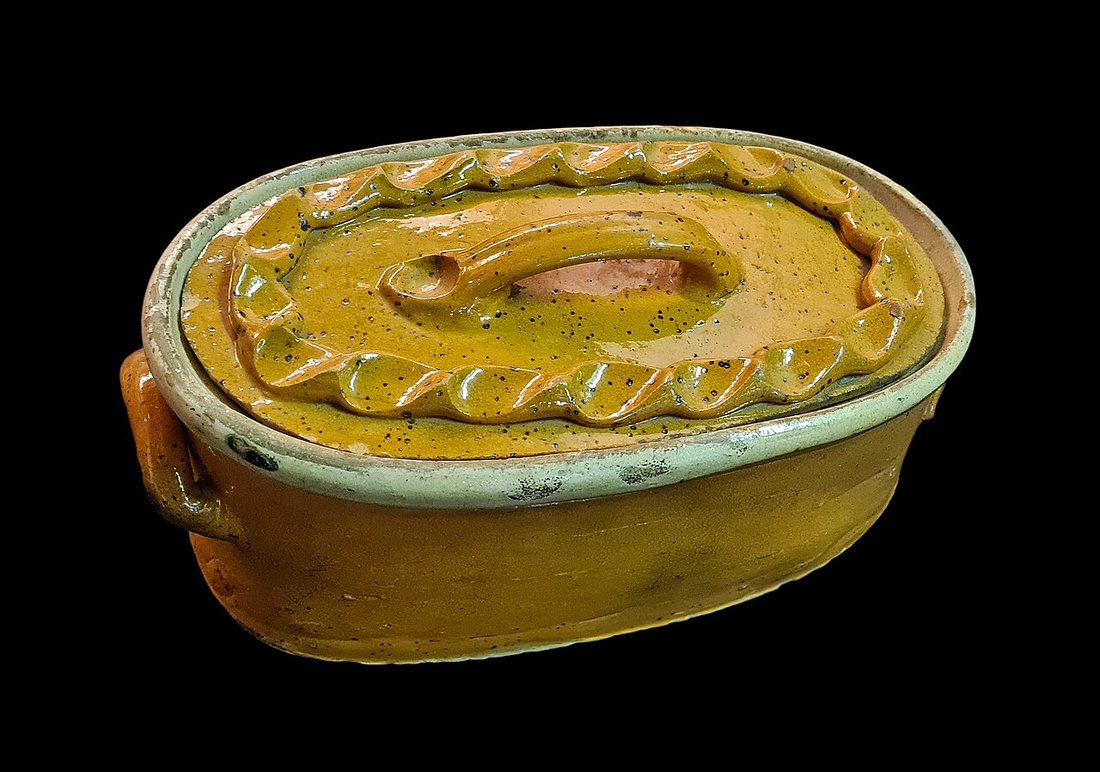
A terrine mold is, in the standard description, a glazed earthenware dish with vertical sides and a tightly fitting lid, usually rectangular or oval; modern versions are enamelled cast iron, and molds also come in stainless steel, aluminium and plastic. The name moved from the dish to the food. Escoffier’s glossary (1907) still lists “Terrine à pâté, a special utensil in which patties are cooked,” and defines the food as “only a pie without a crust” (see Pâté, Terrine and the Family). Standard dimensions for the common brands could not be established from the sources.
Escoffier lined the mold with slices of fat bacon before filling it — the 1907 English translation says “bacon,” which almost certainly renders unsmoked fatback, though the French original was not checked — and baked it “in a saucepan containing a little water” in the oven: the water bath. Caul fat, the lace-like membrane of the abdomen, is the other classical wrapper; Escoffier wraps foie gras in bacon or “a piece of pig’s caul.”
Raised-pie molds
A pâté en croûte can be hand-raised, or built in a mold. Mrs Beeton’s Book of Household Management (1861) carries illustrations captioned “RAISED-PIE MOULD” and “RAISED-PIE MOULD, OPEN,” so a mold that opens was a household item by then; the hinge or pin mechanism itself was not examined. Beeton notes that a pie made in a mold — her timbale — is “more easily made than one where the paste is raised by the hands.” A pâté en croûte built in an ordinary rigid terrine or loaf tin is hard to unmold cleanly, and the sources give no workaround. Beeton’s hot-water crust, raised by hand, needs no mold at all. A modern London recipe (Matt Ryle, Great British Chefs) uses a 30 cm mold and makes chimneys from “little funnels” of foil set into holes in the lid.
The press and the weight
Pressing packs the terrine as it cools, drives out air and excess fat, and gives a firm slice. Escoffier gives the rule, and it depends on how the terrine will be served:
- Served from its dish: “slight pressure.”
- Turned out and presented whole: “greater pressure,” because it has to stand on its own.
- A galantine: cooled “under a weight not exceeding five or six lbs” (about 2.3–2.7 kg).
No special press is needed. The improvised version in a modern vegetable-terrine recipe (Great British Chefs) is a second loaf tin, set on top and filled with “something heavy such as a jar or tin.” Head cheese and ham-hock terrines are pressed the same way.
Grinder, processor and sieve
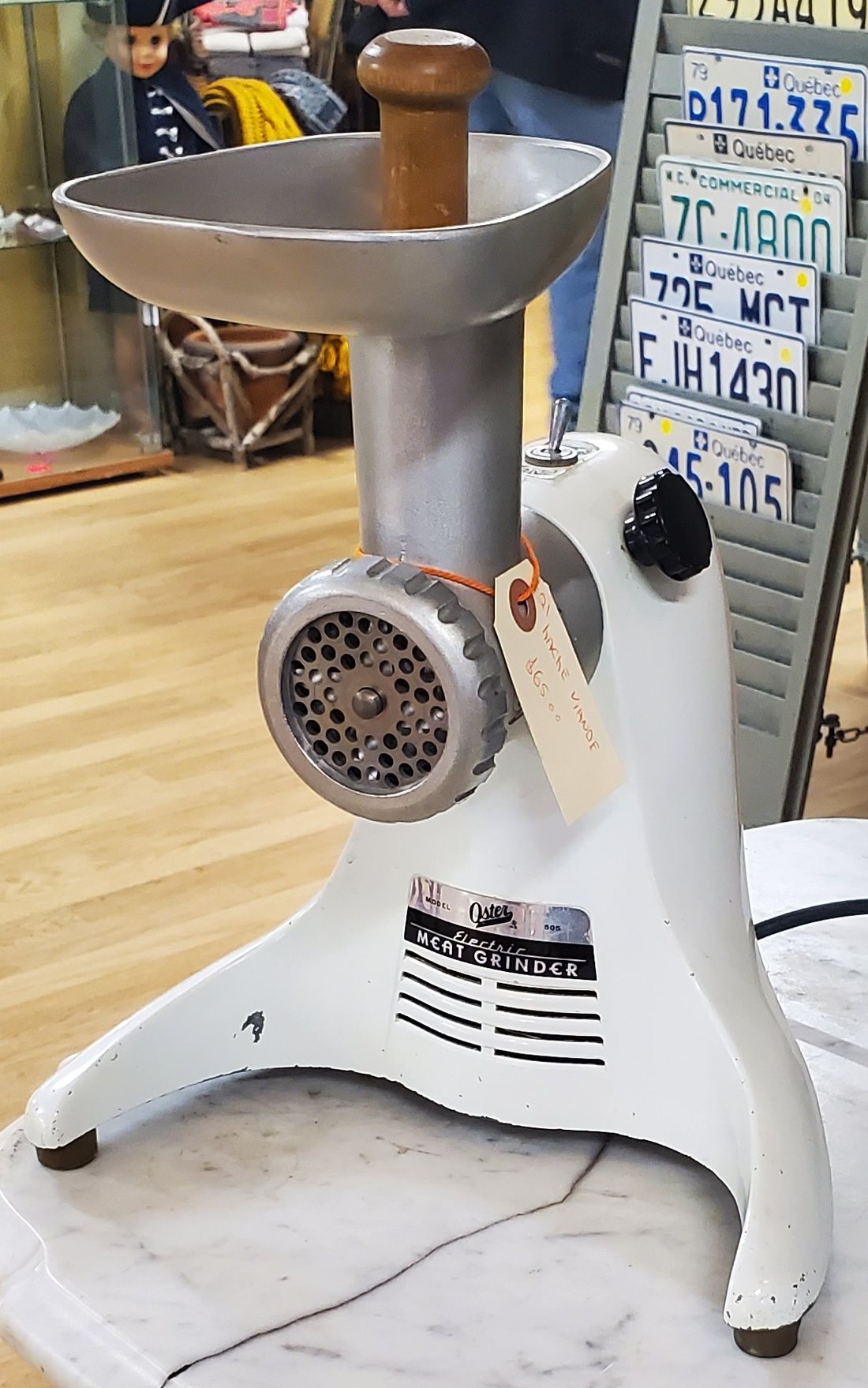
Temperature matters more than the machine. The Culinary Pro, a US culinary-education site, gives the ideal grinding temperature as 28–30 °F (−2 to −1 °C), with the grinder parts and bowls chilled and the work done over ice; a good grind shows meat and fat as distinct particles, not a smear. It also advises keeping a forcemeat below 40 °F (4 °C) — a figure that could not be traced to a primary study. The research that does exist comes from industrial bowl-choppers: in beef frankfurter batters, end-point chopping temperatures of 15 °C (59 °F) or less gave the most stable batters, and chopping above 15 °C lowered quality (J. Food Sci. 1995); in pork sausage, 12.8 °C (55 °F) gave the best yield (J. Food Sci. 1990); in bologna, lower chopping temperatures reduced purge in storage (Meat Sci. 1996). The mechanism carries over to a home grinder and processor: friction warms the mix, the fat softens and smears instead of cutting, and the cooked terrine weeps fat. A home rule of “grind near-frozen, finish under about 15 °C” is consistent with that data.
Plate sizes. A straight forcemeat is made by grinding progressively, large to medium to fine (Culinary Pro); a country forcemeat stays coarse. Specific plate sizes for each forcemeat could not be found in any reachable source and are not given here.
Processor versus grinder. The classical pair was the mortar and the sieve: Escoffier pounds and then sieves nearly every forcemeat (“As a rule, forcemeat should always be rubbed through a sieve”). In a modern kitchen the division of labour follows from what each forcemeat needs, though no source states it outright: the grinder produces the defined particle of a country or straight forcemeat, while the food processor replaces the mortar for a mousseline or a liver parfait, where the goal is a smooth emulsion worked cold — Escoffier’s mousseline is made “keeping the receptacle on ice.”
The tamis. A drum sieve is a cylindrical wood or metal frame with a flat mesh of metal, nylon or horsehair, 6–16 inches across; the purée is pushed across the mesh with a scraper. It is what turns a processed liver or mousseline into a restaurant-smooth one. Escoffier’s instruction is simply “rub through tammy.”
Thermometers and the old tests
A probe thermometer settles doneness by number. The US safe minimums (foodsafety.gov) are 160 °F (71 °C) for ground meat and sausage — pork, beef, veal, lamb, and also rabbit and venison — and 165 °F (74 °C) for all poultry, a row that explicitly includes giblets and so covers chicken livers. Lower temperatures held for longer can deliver the same safety; see Food Safety.
Escoffier’s two tests need no instrument, and they remain useful alongside one. A terrine is cooked “when the grease which rises to the surface is quite clear. As long as this grease is turbid, raw juices are still issuing from the forcemeat and the garnish inside.” And: “If [a needle] withdraws evenly heated throughout its length, the terrine is cooked.” Clear fat and a warm needle are the pre-thermometer readout of the same event the probe measures.
Sous vide: what is sourced and what is not
The safety envelope is sourced. Douglas Baldwin’s A Practical Guide to Sous Vide Cooking gives pasteurization times by thickness. As read from his tables, at 70 mm — a typical terrine cross-section:
| Food | Bath temperature | Time at 70 mm |
|---|---|---|
| Poultry | 60 °C (140 °F) | 5 h |
| Poultry | 65 °C (149 °F) | 3¾ h |
| Beef, pork, lamb | 60 °C (140 °F) | 4 h |
| Beef, pork, lamb | 63 °C (145 °F) | 3½ h |
Thinner pieces need far less (poultry at 60 °C: 45 minutes at 5 mm, 1¼ hours at 20 mm). Baldwin’s poultry figures derive from an FSIS table that stops at 12% fat and notes that fat adds time — so a liver parfait carrying its weight in butter sits outside what the table strictly covers.
Cooling and storage are sourced. Baldwin: cool the food “still sealed in its pouch” in ice water “that is at least half ice until it’s cold all the way through.” After rapid chilling, pasteurized food must be frozen or held below 2.5 °C (36.5 °F) for up to 90 days, below 3.3 °C (38 °F) for less than 31 days, below 5 °C (41 °F) for less than 10 days, or below 7 °C (44.5 °F) for less than 5 days. Those limits are set by non-proteolytic Clostridium botulinum and apply to a sealed bag that has never been opened — not to a terrine that has been cut and rewrapped.
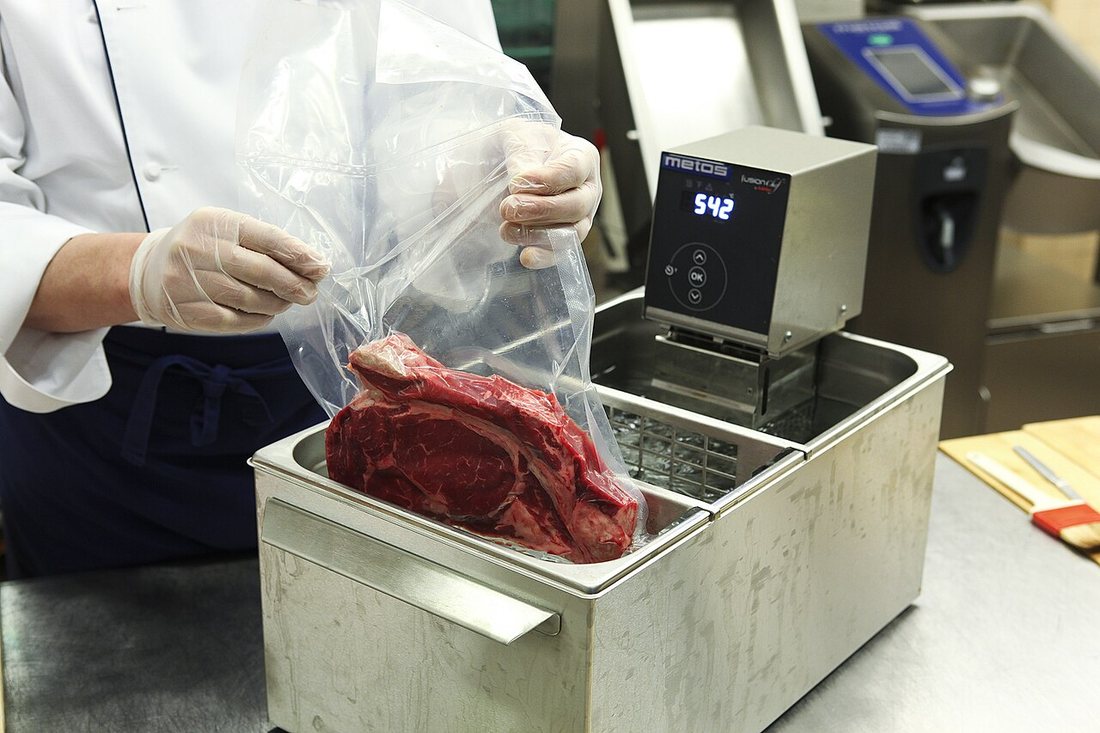
Terrine-specific times are not sourced. Baldwin’s guide does not cover terrines, pâtés or foie gras, and no named-source time and temperature was found for a sous vide terrine, parfait, rillettes or torchon. The one circulator number in the collection is a galantine: Simon Gueller’s chicken, duck and foie gras roll, cooked at 65 °C for 1½ hours and chilled in iced water. That is the source’s figure. It is shorter than Baldwin’s 3¾ hours for 70 mm of poultry at the same temperature, and the roll’s diameter is not given, so it cannot be checked against his table; the thickness of the roll is what decides it. A fish rillettes recipe (William Drabble) confits salmon in duck fat at 65 °C for 15–20 minutes, a sous-vide-style number used in a pan.
How to put a terrine in the bath — reasoning, not a sourced rule. A lidded enamelled cast-iron mold is not made to be submerged: the lid does not seal against water over hours, and cast iron is slow to heat through. The practical sous vide terrine is therefore a vacuum-bagged or film-rolled log, or a sealed jar for rillettes and parfait, with the mold used afterwards only for pressing and setting. No source tested this; it follows from how the equipment is built.
What a terrine mold, grinder and circulator can make
| Form | Feasible? | What is still needed |
|---|---|---|
| Straight or gratin forcemeat terrine | Yes | a fine plate and a sieve for a straight forcemeat |
| Mousseline terrine (fish or chicken) | Yes | a food processor and an ice bath |
| Liver parfait or mousse | Yes | a fine sieve (a tamis is ideal) |
| Leverpostej | Yes — the easiest | nothing |
| Pâté en croûte | Possible in a terrine or loaf tin, hard to unmold | a hinged mold, or a hand-raised hot-water crust |
| Galantine or ballotine | Yes; boning skill is the barrier | cheesecloth or film; the circulator helps |
| Rillettes, rillons, potted meats | Yes, no mold needed | jars; the circulator suits it |
| Ham hock, jambon persillé, head cheese | Yes | a stockpot and a weight |
| Foie gras terrine or torchon | Technically yes | the liver itself, and sourced sous vide numbers |
| Vegetable terrine | Yes | gelatin or jelly, unless it is simply pressed |
Recipes in the collection
- Chicken Galantine with Duck and Foie Gras (Sous Vide) — the circulator recipe, 65 °C for 1½ hours
- Country Terrine · Pork Terrine — grinder and mold
- Chicken Liver Parfait (Sally Abé) — blender and fine sieve, no oven
- Baked Chicken Liver Mousse (Terrine-Style) — baked to 160 °F in the mold
- Leverpostej (Danish Liver Pâté) — loaf pan and oven
- Salmon and Whiting Terrine — processor mousseline
- Duck Pâté en Croûte — the mold question in practice
- Pressed Pig’s Head Terrine (Head Cheese) · Ham and Parsley Terrine (Jambon Persillé) — pot and weight
- Roasted Vegetable Terrine — pressed, no binder
- Pork Rillettes · Salmon Rillettes — jars, no mold
Comments (0)