Fish and Vegetable Terrines
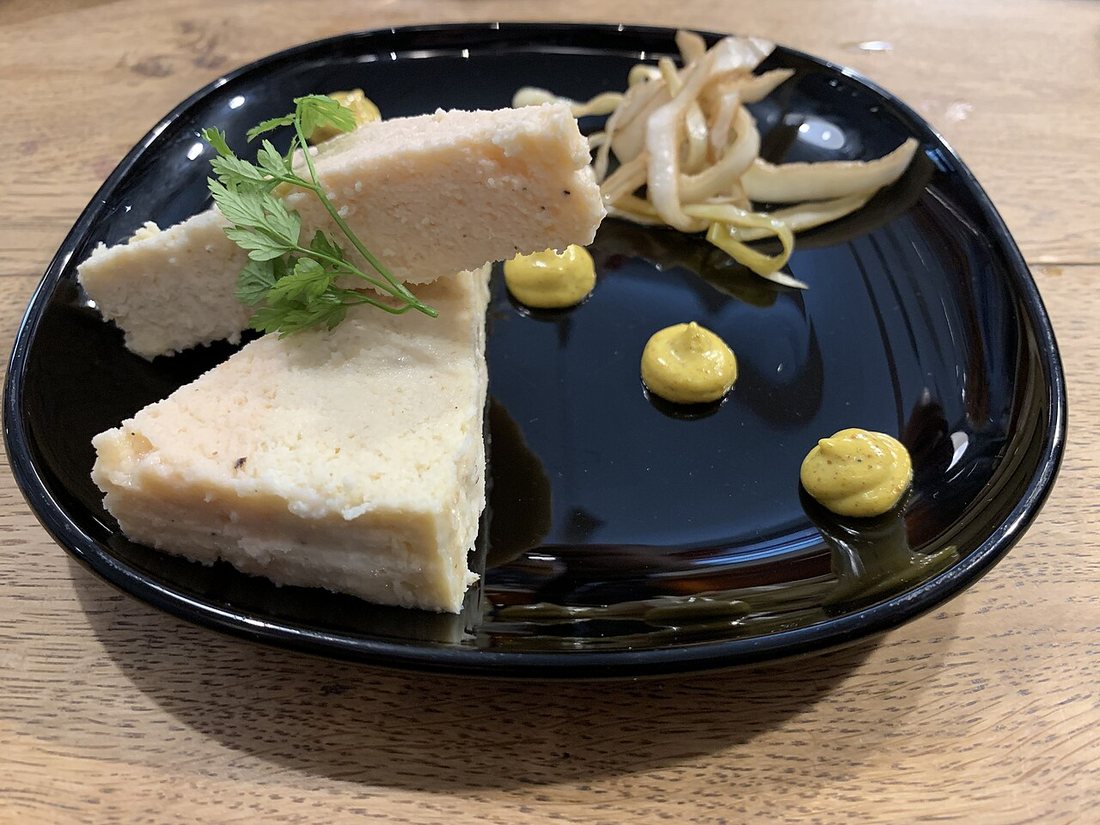
A meat terrine holds together because the meat does the work: salt draws out sticky protein, pork fat carries the flavor, and the trimmings and bones supply their own jelly. Fish and vegetables each lack one of those supports. Fish is lean, fragile and sets at low temperatures; vegetables have no binding protein and no gelatin at all. Every fish or vegetable terrine is therefore an answer to the question of what will hold it together instead — cream and egg white, fat, gelatin, or simple pressure.
The fish half of the family is also older than its reputation. The word galantine first meant a jelly for fish, not a stuffed bird (see History and Words). The fourteenth-century Viandier cooks pike and eel in wine and vinegar, thickens and spices the broth, and pours it into an earthenware or wooden vessel “to cool” before the fish goes in: a cold fish set in a spiced liquor. The TLFi links the word to Ragusa (Dubrovnik), a town known for exporting fish in jelly. The Ménagier de Paris (c. 1393) keeps a galentine de poisson froit and sells pastés norrois, “Norse pies”, made of cod liver.
The fish mousseline
The classical fish terrine is built on a mousseline, a forcemeat lightened with cream. Escoffier’s recipe (No. 195, A Guide to Modern Cookery, 1907) is written for chicken, but he states that “mousseline forcemeats of all kinds, with meat, poultry, game, fish, or shell-fish, may be made according to the principles and quantities given above”, and that the method is “particularly suited to preparations with a shell-fish base.”
The formula:
- 1 lb (about 454 g) of meat or fish, pounded to a paste with 1 oz salt, pepper and nutmeg
- the whites of 2 eggs, added gradually
- the paste rubbed through a fine sieve
- 1 pint of thick fresh cream, worked in gradually, “working with great caution and keeping the receptacle on ice”
The egg white is there to raise the cream, not merely to bind. Escoffier: “The addition of the white of egg is not essential if the meats used already possess a certain quantity of albumen; but without the white of egg the forcemeat absorbs much less cream.” More cream is what makes a mousseline light, so the white is the ingredient that makes the lightness possible.
He also ranked it above every other forcemeat: “whereas it can replace all other kinds, none of these can replace it.”
A caveat on the pint. This is a 1907 English translation, so the pint is most likely the imperial pint of 20 fl oz, about 568 ml, which puts the cream above the weight of the fish. A US pint is 16 fl oz, about 473 ml. Whether Escoffier’s French original specifies half a liter or something else could not be confirmed; a cook following the English text with a US pint is making a slightly firmer forcemeat than the translation intends.
Keeping it cold, and testing it
The ice bath is original to the recipe. Modern industrial studies of meat batters (not fish, but the same mechanism) found the most stable batters were chopped at or below 15 °C (59 °F), and that higher temperatures lowered quality. A culinary-education source (The Culinary Pro) gives the failure modes: a warm mousseline breaks and turns grainy or greasy.
The test is a poached sample. Poach a small quenelle in salted water and taste it before filling the mold. Escoffier’s correction: “add a little white of egg if it be too light, and a little cream if it be too stiff.” The Culinary Pro gives the modern equivalent: rubbery means more cream or fat; loose means more egg white or a panade.
The classical tools for a mousseline were the mortar and the sieve; in a modern kitchen the food processor does the pounding, though no source reached says so in those words. No sourced time and temperature for cooking a mousseline terrine sous vide was found.
The salmon and whiting terrine
The collection’s Salmon and Whiting Terrine (Saveur) is the layered mousseline in its familiar form. The forcemeat is 1½ lb (680 g) of whiting ground in a processor with 1½ cups of crème fraîche and two egg whites. Whole salmon fillets, ½ in (1.3 cm) thick and 1¼ lb (570 g) in all, are laid between layers of it, four layers in total, in a parchment-lined 5×9×3 in loaf pan. It bakes covered in a water bath at 350 °F (175 °C) for 35–40 minutes, is pressed gently with a can to drain about ½ cup of liquid, and chills overnight.
The source’s end point is 120 °F (49 °C) in the center. The FDA and USDA minimum for fish is 145 °F (63 °C). The published recipe is therefore 25 °F below the government figure; a cook who wants the official margin must bake it further than the source directs. The sauce served with it is a mayonnaise made with a raw yolk and folded with a raw beaten white.
The egg arithmetic in the source is consistent: two whites go into the forcemeat; the third white and the one yolk go into the sauce.
Salmon in fat: rillettes
Fish can also be set the way pork rillettes are: cooked in fat, flaked and bound with it. The clearest professional example is William Drabble’s salmon rillettes (Great British Chefs). The salmon is lightly cured for 3–4 hours with salt, sugar and lemon zest, then poached in duck fat at 65 °C (149 °F) for 15–20 minutes, “until cooked but still pink in the middle”, flaked, and bound with some of the poaching fat, mayonnaise and capers. That is a confit, and 65 °C is a sous vide number; a circulator suits it.
The collection’s Salmon Rillettes (Anna Zepaltas, Food & Wine) is different. The fresh salmon is seasoned with Pernod, poached in a court-bouillon taken off the heat for 10 minutes, chilled and flaked, then folded with butter, sour cream, shallot and flaked hot-smoked salmon. Nothing is cooked in fat and nothing is sealed; it is a rillettes by texture only. A butter-bound flaked spread is the usual modern idiom for fish rillettes. The British potted shrimp belongs to the same logic, shrimp held in spiced butter (see Rillettes and Potted Meats).
Smoked salmon and gelatin-set molds
The collection’s two smoked-salmon terrines are not cooked at all. The larger Smoked Salmon Terrine lines a loaf pan with smoked salmon and fills it with cream cheese, crème fraîche and chopped salmon set with four leaves of gelatine; the Individual Smoked Salmon Terrine uses no setting agent, only soft cheese, cream and a night in the fridge. The Salmon Mousse is cooked salmon puréed, set with gelatin and lightened with whipped cream. None relies on egg and heat.
Where gelatin does the setting, fish behaves differently from meat. Wikipedia’s aspic article notes that “fish aspic is more delicate since fish gelatin melts at lower temperatures.” Gelatin in general melts below body temperature, which is why it dissolves pleasantly in the mouth, and its strength declines if it is held above 100 °C (212 °F), so an aspic stock boiled hard for a long time sets more weakly (Wikipedia, Gelatin). Escoffier’s standard for any aspic was that it be as soft as it would stand: “the greater the viscosity of the jelly the less value will the same possess.”
Vegetable terrines: pressure or jelly
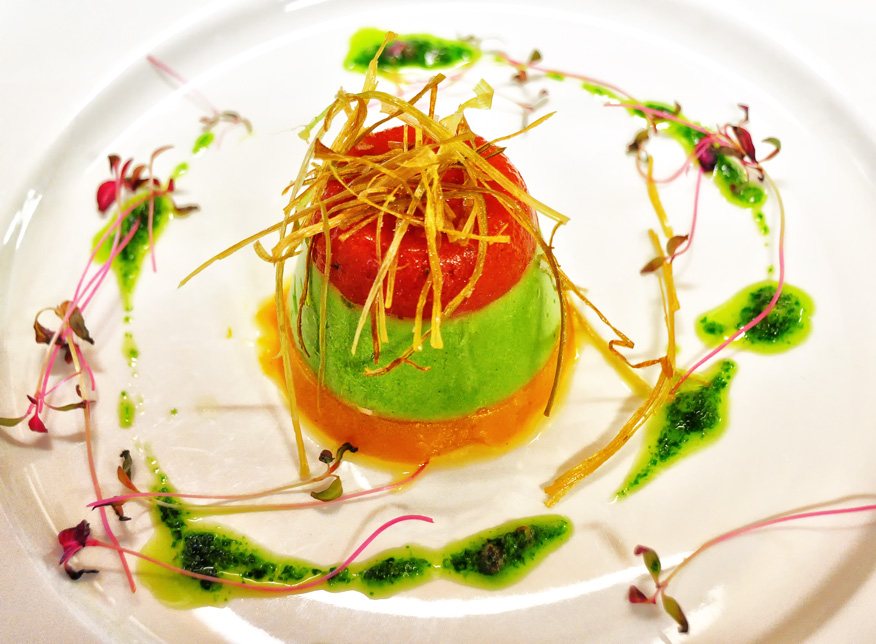
Vegetables contain no natural gelatin, and they contain no salt-soluble protein to bind like meat. A vegetable terrine must be held together some other way. The sources describe two.
Pressed and layered
The collection’s Roasted Vegetable Terrine (Saveur, November 2012) has no binder at all. Eggplant, zucchini and yellow squash are sliced lengthwise ¼ in (6 mm) thick and roasted at 450 °F (230 °C); peppers are charred and peeled; spinach is blanched and squeezed dry. They are layered in a plastic-lined 9×5 in loaf pan wrapped in spinach, with a sun-dried-tomato and walnut pesto and a herbed goat cheese between the strata. The pan is covered, weighted with three 15-oz cans on cardboard, and chilled at least 8 hours. The cheese, the pesto and the pressure do the holding. It is a terrine by mold and slice, not by forcemeat.
Great British Chefs’ potato, parsnip, chestnut and sage terrine uses the same device: the mixture is pressed overnight with a second loaf tin filled with jars or tins. Its instruction is the whole technique in one sentence: “squeeze the mixture together just enough to ensure there are no gaps, but retain the structure of the vegetables.” It sits on a cranberry-jelly base and is served at room temperature. The Culinary Pro describes layered vegetable terrines generally as “bound with aspic or fresh cheese.”
Jelly-set
The alternative is to suspend the vegetables in aspic or gelatin, as a jambon persillé suspends parsley. The collection’s Tomato Aspic, from the 1944 Army cookbook, is the American descendant of this line. Packaged gelatin arrived commercially in the US in the 1890s (Knox, 1894), and savory gelatin salads followed; one well-known example, Perfection Salad, is often said to have won third prize in a 1904 Better Homes and Gardens contest, but that magazine was founded in 1922, so the sponsor as usually stated cannot be right.
One practical rule applies to fruit in any gelatin set. Actinidain, the enzyme in kiwifruit, was identified in 1959 when a researcher investigated why kiwi jellies would not solidify; it digests gelatin, and it is inactivated at about 60 °C (140 °F). Pineapple (bromelain) and papaya (papain) carry similar enzymes. Cooked or canned fruit sets; fresh does not.
The egg-custard vegetable terrine
A third type is often described: vegetables set in an egg custard, baked like a quiche without a crust. No reachable professional source for this method was found, so it is not described here.
Safety
The fish-specific numbers are the ones above: FDA and USDA put fish at 145 °F (63 °C), and the salmon and whiting terrine’s published 120 °F sits well below it.
For vegetable pâtés, the UK’s NHS revised its pregnancy advice on 15 June 2026: “vegetable pâté or vegetarian pâté” moved to the foods to be careful with — keep chilled and eat before the use-by date. The US CDC still advises higher-risk groups to avoid refrigerated pâtés and meat spreads. The two agencies now disagree.
Vegetarian pâté is not safer in a jar. Botulism has followed tinned vegetarian pâté in southern Vietnam (12 cases in 2020, C. botulinum type B found in household samples) and home-canned vegetarian pâté in Hanoi. No tested home-canning process for pâté of any kind was found. Keep vegetable terrines refrigerated and eat them within days. See Food Safety.
Comments (0)